
The modern workplace has developed its own dictionary. Quiet quitting. Boreout. Coffee badging. Hustle culture. The four-day week. Resenteeism. New terms arrive almost monthly, each with a flurry of headlines declaring it the trend that will define work.
It is easy to dismiss them as buzzwords. But look closely and something interesting emerges: they are not random. Most of them are describing pieces of the same big story, a shifting, often strained relationship between people and their jobs. Understanding them together tells you more than any one of them does alone.
This is a plain-English field guide to the terms everyone is using, grouped into families, with a link to a deeper dive on each. Consider it a map of the modern workplace, and a way of seeing the pattern underneath.
The disengagement family
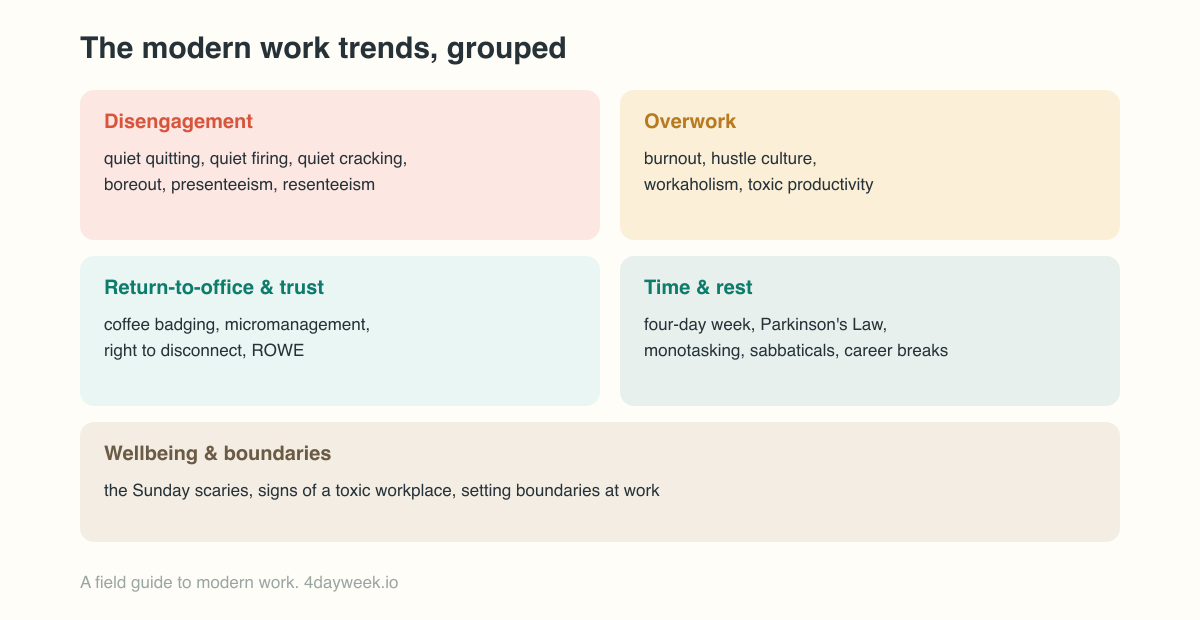
These describe the different ways people quietly withdraw when work stops working for them.
- Quiet quitting is doing your job and no more, refusing the unpaid extra effort that many workplaces quietly assume they are owed. It is a boundary, not laziness.
- Quiet firing is the mirror image: when an employer makes a role so unrewarding, with no growth, support or recognition, that the employee gives up and leaves on their own.
- Quiet cracking is a newer term for a persistent, low-level unhappiness that slowly erodes engagement and confidence over time, often unnoticed.
- Resenteeism is staying in a job you resent, usually because leaving feels too risky, while quietly seething about it.
- Boreout is burnout's opposite: chronic under-stimulation and boredom from work that is too unchallenging or meaningless, which turns out to be just as damaging as overwork.
- Presenteeism is being at work but not functioning, showing up while ill, exhausted or checked out, and getting far less done than usual.
The common thread: all six are what happens when the deal between people and work goes bad. The names differ, but the story is the same, disengagement in one form or another.
The overwork family
These describe the flip side: work taking too much.
- Burnout is the exhaustion, cynicism and reduced capacity that come from chronic, unrelenting work stress. It is the most established term of the lot, and the most serious.
- Hustle culture is the belief that constant work and self-sacrifice are the price of success, and that rest is something to feel guilty about. It is the ideology that produces a lot of the rest.
- Workaholism is the individual version: a genuine, compulsive inability to stop working, treated by researchers as a behavioural addiction.
- Toxic productivity is the internalised guilt that makes any rest feel like laziness, so that even weekends and hobbies have to be "productive".
The common thread: these are all about work claiming more than its fair share, of your hours, your health, and your sense of self-worth.
The return-to-office and trust family
These describe the tug-of-war over where, when and how we work, and who gets to decide.
- Coffee badging is showing up at the office just long enough to be seen, then leaving, a quiet protest against return-to-office mandates that offer no real reason to be there.
- Micromanagement is the controlling management style that scrutinises every detail and trusts no one, and quietly destroys the motivation and quality it thinks it is protecting.
- The right to disconnect is the idea, now law in some countries, that you should be able to switch off from work outside your hours without penalty.
- Results-only work environment (ROWE) is the radical alternative: judge people purely on results, not hours or presence, and give them total autonomy over their time.
The common thread: a struggle over control and trust. On one side, presence, monitoring and mandates. On the other, autonomy, flexibility and outcomes.
The time and rest family
These are less about dysfunction and more about the solutions people are reaching for, ways of putting time and life back into the equation.
- The four-day week is the headline act: the same pay and output in fewer days, on the basis that long hours were never a reliable measure of value.
- Parkinson's Law is the principle underneath it: work expands to fill the time available, so cutting the time squeezes out the padding, not the important work.
- Monotasking is doing one thing at a time, fully, the antidote to the scattered, always-switching way most of us are pushed to work.
- Sabbaticals and career breaks are ways of buying back longer stretches of time, without necessarily ending a career.
- Flexible working is the legal and practical route many people use to reshape when, where and how much they work.
The common thread: all of these are about reclaiming time, and about measuring work by what it produces rather than how long it takes.
The wellbeing and boundaries family
Finally, the terms about protecting yourself in the middle of all this.
- The Sunday scaries are the dread that builds before the work week, an everyday early-warning sign that the week ahead feels heavier than the rest you got.
- Signs of a toxic workplace is the checklist for spotting when the environment itself, not just a bad week, is the problem.
- Setting boundaries at work is the practical skill of protecting your time and energy so the job does not quietly take over your life.
The common thread: these are about noticing the warning signs, and defending the line between work and the rest of your life.
The newer arrivals
Work-Life Balance Jobs with Genuinely Reduced Hours
Save one to come back to it — it's free.



The vocabulary keeps growing, and new terms surface almost as fast as anyone can define them. A few you may hear next:
- The great detachment describes workers who feel stuck and disengaged but are staying put, neither thriving nor quitting, in a cooler job market. It is the successor to the "great resignation".
- Productivity paranoia is the manager's version of distrust: the anxious belief, common since remote work took off, that people are not really working unless they can be seen or tracked doing it.
- Loud quitting is the noisy opposite of quiet quitting: actively, openly disengaged employees who make their discontent known rather than withdrawing silently.
- Revenge quitting is leaving a job dramatically and deliberately, often to make a point, after resentment finally boils over.
- Bare minimum Mondays and quiet vacationing are smaller acts of reclaiming time: easing gently into the week, or quietly taking a lighter day without making a formal thing of it.
You do not need to memorise every new coinage. What matters is that they keep describing the same underlying tension, and keep pointing in the same direction, which brings us to the real point.
The one thing they all have in common
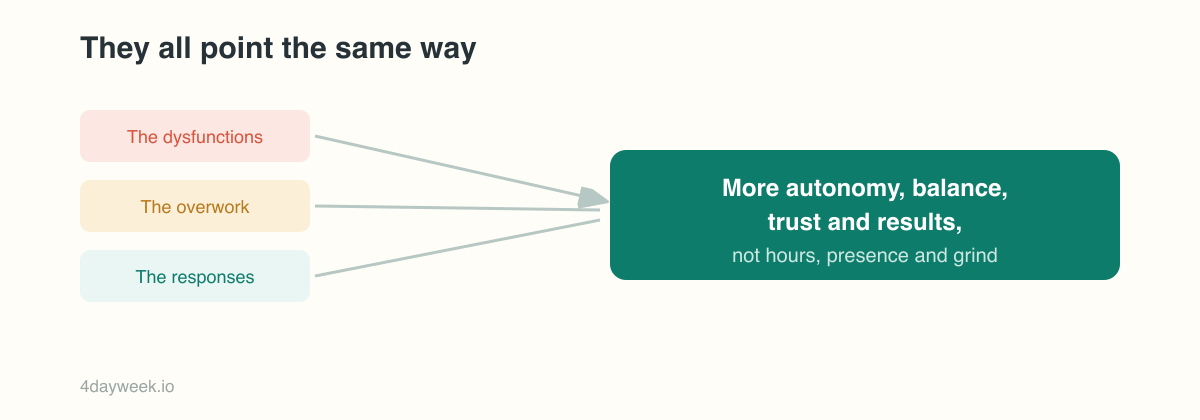
Step back from the whole map, and a single pattern comes into focus. Nearly every one of these terms, the dysfunctions and the responses alike, is pointing in the same direction.
People want more autonomy over how they work. More balance between the job and the life. More trust, and less surveillance. And a way of measuring work that values what actually gets done over how many hours were visibly spent doing it.
The dysfunctions (quiet quitting, boreout, resenteeism, burnout, coffee badging) are what happens when work ignores those wants. The responses (the four-day week, flexible work, ROWE, boundaries, the right to disconnect) are what happens when it finally starts to listen.
That is the story hiding under all the buzzwords. It is not really about any single trend. It is about a working world slowly, unevenly, renegotiating the deal, away from hours, presence and grind, and toward time, trust and results. The companies furthest along that road are the ones already offering four-day weeks and genuinely flexible work. The rest, sooner or later, will follow, because the direction of travel could hardly be clearer.
Frequently asked questions
What are these modern workplace trends really about? Most of them describe pieces of the same story: a strained relationship between people and their jobs. The "dysfunction" terms name what goes wrong when work takes too much or gives too little, and the "solution" terms name the ways people are pushing back toward balance and autonomy.
Are terms like quiet quitting and boreout just buzzwords? The labels are catchy, but the things they describe are real and measurable. Quiet quitting, boreout, burnout and the rest all point at genuine, well-documented experiences. The value in naming them is that it makes a shared problem easier to see and act on.
What connects all these workplace trends? Almost all of them reflect the same underlying shift: people wanting more autonomy, more balance, more trust, and a way of judging work by results rather than hours. The healthy responses, from flexible work to the four-day week, all share that logic.
What is the alternative to all this workplace dysfunction? Broadly, work built around trust and outcomes rather than hours and presence: reasonable working time, genuine flexibility, and respect for a life outside the job. The four-day week is one of the clearest expressions of that alternative.
Curious what work looks like on the other side of all these trends? Browse four-day-week and reduced-hours jobs on 4dayweek.io.




Get 4-day week jobs in your inbox
Create a free account to receive curated opportunities weekly.
Sign up for freeFree forever. No spam, unsubscribe anytime.