We use the word "workaholic" lightly, often as a humblebrag. "Oh, I'm such a workaholic." It sounds like a flattering flaw, the kind of thing you admit in a job interview.
But real workaholism is not a badge. It is a genuine compulsion, closer to an addiction than to dedication, and like any addiction it quietly damages the person caught in it. The tell is not how many hours someone works. It is whether they can stop.
Here is what workaholism actually is, how to tell it apart from healthy hard work, what drives it, and how people recover.
What is workaholism?
Workaholism is a compulsive, uncontrollable need to work, where the drive to work overrides your health, relationships and wellbeing, and you cannot switch it off even when you want to.
The crucial word is compulsive. A workaholic is not simply someone who works a lot. It is someone who has lost the ability to choose. Work becomes the thing they reach for constantly, feel anxious and guilty without, and keep doing at the expense of everything else, not because they decided to, but because they cannot help it.
Researchers who study it, most notably the psychologist Bryan Robinson, treat workaholism as a behavioural addiction. It shows the classic addiction pattern: a compulsion that is hard to control, relief while doing it and guilt or anxiety when not, and a creeping "tolerance" where more and more work is needed to feel okay. Seen that way, "workaholic" stops being a cute label and becomes something worth taking seriously.
Workaholism vs working hard
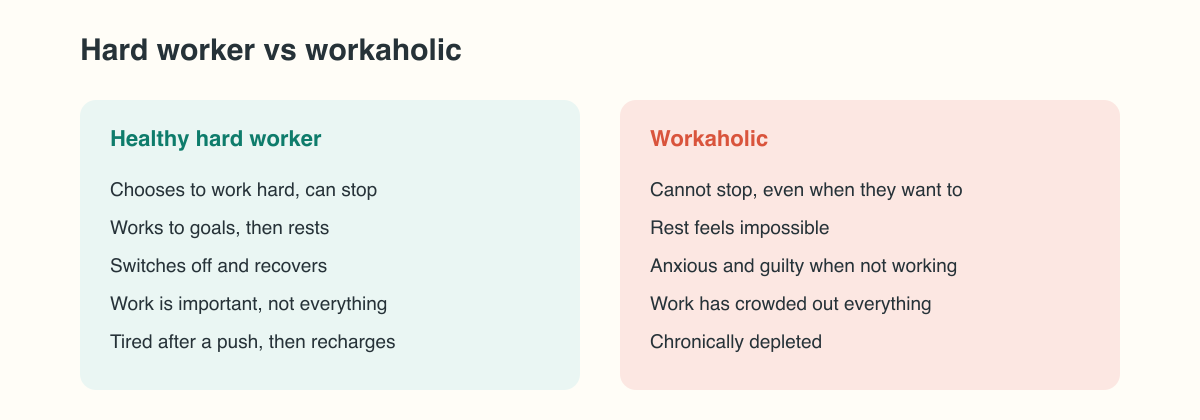
This is the distinction that matters most, because plenty of people work long hours and are perfectly healthy. The difference is not the hours. It is the relationship with the work.
| Healthy hard worker | Workaholic |
|---|---|
| Chooses to work hard, and can stop | Cannot stop, even when they want to |
| Works toward goals, then rests | Works compulsively, rest feels impossible |
| Switches off and recovers | Anxious and guilty when not working |
| Work is important, not everything | Work has crowded out almost everything else |
| Tired after a big push, then recharges | Chronically depleted, running on compulsion |
A passionate, dedicated worker can be fully engaged and then close the laptop, go home, and be genuinely present with their life. A workaholic takes the work with them everywhere, mentally if not physically, because they cannot put it down. One is driven by choice and passion. The other is driven by compulsion and anxiety.
The signs of workaholism
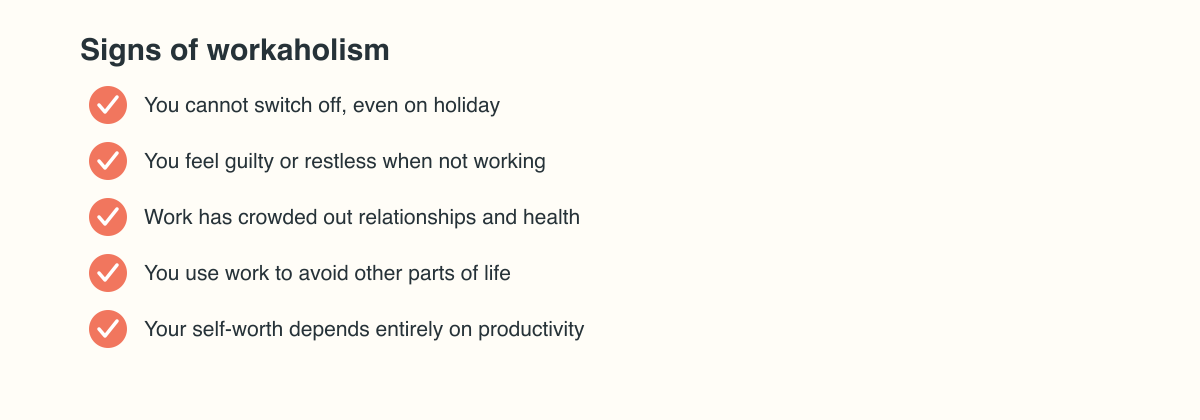
Workaholism hides well, partly because our culture rewards it. Some honest signs:
- You cannot switch off. Even on holiday or at dinner, your mind is on work, and being unable to check it makes you anxious.
- You feel guilty or restless when you are not working, as if rest is something you have not earned.
- Work has crowded out your relationships, hobbies and health, and you barely notice it happening.
- You keep working despite the cost: poor sleep, strained relationships, declining health.
- You use work to avoid other feelings or parts of life. Being busy is a way of not sitting with something else.
- You hide or downplay how much you work, or feel a jolt of anxiety at the thought of doing less.
- Your self-worth is almost entirely tied to productivity. A day without output feels like a day you failed as a person.
One or two of these on a busy week is normal. The signature of workaholism is the compulsion underneath: the sense that you could not stop even if you tried.
What causes workaholism?
Workaholism is rarely really about loving the work. It is usually about what the work is doing for you, or protecting you from.
- Anxiety and control. Work can be a way to manage anxiety. Staying busy keeps difficult feelings at bay and creates a sense of control.
- Perfectionism. If nothing is ever good enough, the work is never done, so you never stop.
- Low self-worth. When your value feels conditional on achievement, you have to keep achieving to feel okay, endlessly.
- Avoidance. Overwork can be a socially acceptable way to escape a difficult relationship, loneliness, or feelings you would rather not face.
- A culture that rewards it. Hustle culture pours fuel on all of this, praising the exact behaviour that is quietly harming people and making it feel like virtue rather than a problem.
That last factor is important. Workaholism is an individual pattern, but it grows best in environments that celebrate overwork. A person prone to it, dropped into an always-on culture, can spiral without anyone raising an eyebrow, because everyone around them is applauding.
The health toll of workaholism
Because our culture treats it as a virtue, the genuine cost of workaholism is easy to overlook. It is real, and it accumulates.
- Physical health. Chronic overwork and the stress that comes with it are linked to poor sleep, high blood pressure, weakened immunity and, in serious cases, elevated cardiovascular risk. The compulsion keeps the body in a prolonged stress state it was never designed for.
- Mental health. Workaholism travels closely with anxiety and depression. It is often driven by them in the first place, and then makes them worse, in a loop that tightens over time.
- Relationships. The people around a workaholic tend to feel the absence keenly. Work that never switches off leaves partners, children and friends competing with a laptop, and usually losing.
- The eventual crash. Left unchecked, workaholism frequently ends in full burnout, the point at which the compulsion finally collides with a body and mind that cannot keep going. The irony is bleak: the drive to never stop working can end in being unable to work at all.
None of this is a moral failing. It is what happens when a genuine compulsion meets a culture that rewards it. Which is exactly why recovery usually needs both an inner shift and, ideally, a change in the environment around it.
Work-Life Balance Jobs with Genuinely Reduced Hours
Save one to come back to it — it's free.



Workaholism in an always-on world
Remote work and smartphones have made workaholism easier to feed than ever. When the office is in your pocket and the work is always one tap away, the compulsion never has to stop. There is no commute to mark the end of the day, no building to leave, no natural boundary at all.
For someone prone to workaholism, this is quietly dangerous. The always-on setup removes the last few external limits that used to force a stop. That makes deliberate, structural boundaries, a hard shut-down time, work apps off the personal phone, a genuinely protected weekend, more important, not less. And it makes a workplace culture that actively discourages after-hours work a real protective factor rather than a nice-to-have.
How to recover from workaholism
The good news is that workaholism responds well to the same things that treat other compulsions: structure, support, and addressing the root. Some steps that genuinely help:
- Name it honestly. Dropping the "lovable flaw" framing and recognising it as a compulsion that is costing you is the real starting point.
- Rebuild boundaries, deliberately. Set firm limits on hours and stick to them, even when it feels wrong. Protect a hard stop, protect your weekends, protect meals. See our guide to setting boundaries at work.
- Treat rest as non-negotiable, not a reward. Schedule genuinely non-work things you value, and give them the same weight you give work.
- Sit with the discomfort. The anxiety and guilt when you first slow down are the withdrawal, not a sign you should go back. It passes.
- Address what is underneath. Because workaholism is so often driven by anxiety, perfectionism or avoidance, therapy can be genuinely transformative. This is not a weakness. It is treating the actual cause.
- Change the environment if you can. Recovering inside a culture that glorifies overwork is like getting sober in a bar. A workplace that respects reasonable hours makes it far easier to build a healthier relationship with work.
The bigger picture
Workaholism is what happens when work stops being something you do and becomes something you cannot stop doing. And while the pattern lives in the individual, the culture around it decides whether it gets challenged or celebrated.
The most helpful environment for anyone prone to overwork is one where reasonable hours are simply the norm, where stopping at the end of the day is expected, and where you are valued for your results rather than your visible exhaustion. That is precisely the shape of work that reduced-hours and four-day-week employers are built around. It will not, on its own, cure a deep-seated compulsion. But a job that expects you to have a life, rather than rewarding you for not having one, is a far better place to build a healthier relationship with work.
Frequently asked questions
What is workaholism? A compulsive, uncontrollable need to work that overrides your health, relationships and wellbeing. The defining feature is an inability to switch off, even when you want to, which sets it apart from simply working hard.
Is workaholism a real addiction? Researchers treat it as a behavioural addiction. It follows a similar pattern: a compulsion that is hard to control, guilt or anxiety when not working, and a need for ever more work to feel okay.
What is the difference between a workaholic and a hard worker? Control. A hard worker chooses to work and can stop and recover. A workaholic cannot stop, feels anxious and guilty when not working, and keeps going even as it damages the rest of their life.
What causes workaholism? Often anxiety, perfectionism, low self-worth or using work to avoid other parts of life, frequently amplified by a hustle culture that rewards overwork and makes it feel virtuous.
How do you recover from workaholism? Name it honestly, rebuild firm boundaries around your hours, treat rest as non-negotiable, sit through the initial discomfort of slowing down, and address the underlying anxiety, often with professional help. A workplace that respects reasonable hours makes recovery much easier.
Building a healthier relationship with work? Browse four-day-week and reduced-hours roles on 4dayweek.io.




Get 4-day week jobs in your inbox
Create a free account to receive curated opportunities weekly.
Sign up for freeFree forever. No spam, unsubscribe anytime.