
Some managers hand you a goal and get out of your way. Others hand you a goal, then hover over every step of how you reach it, rewrite your emails, sit in on your calls, and ask for an update on the update.
The second kind believe they are protecting quality. What they are usually doing is slowly draining the life out of their team.
Micromanagement is one of the most common complaints in working life, and one of the most corrosive. It looks like diligence and feels like distrust. Here is how to recognise it, why managers fall into it, the damage it does, and how to handle it, whether you are on the receiving end or worried you might be the culprit.
What is micromanagement?
Micromanagement is a management style in which a manager closely observes, controls and involves themselves in the small details of their team's work, rather than trusting people to do their jobs.
The defining feature is a lack of autonomy. A micromanager is not just interested in what gets done, they need to control how, when and exactly the way every part of it happens. Nothing is too small to check, correct or approve.
It is worth being fair here. Close guidance is not always micromanagement. A new hire, a high-stakes project or a genuine performance issue can all justify a closer eye for a while. Micromanagement is when that control becomes the default for everyone, all the time, regardless of whether people need it. That is when it stops being support and starts being a cage.
The signs you are being micromanaged
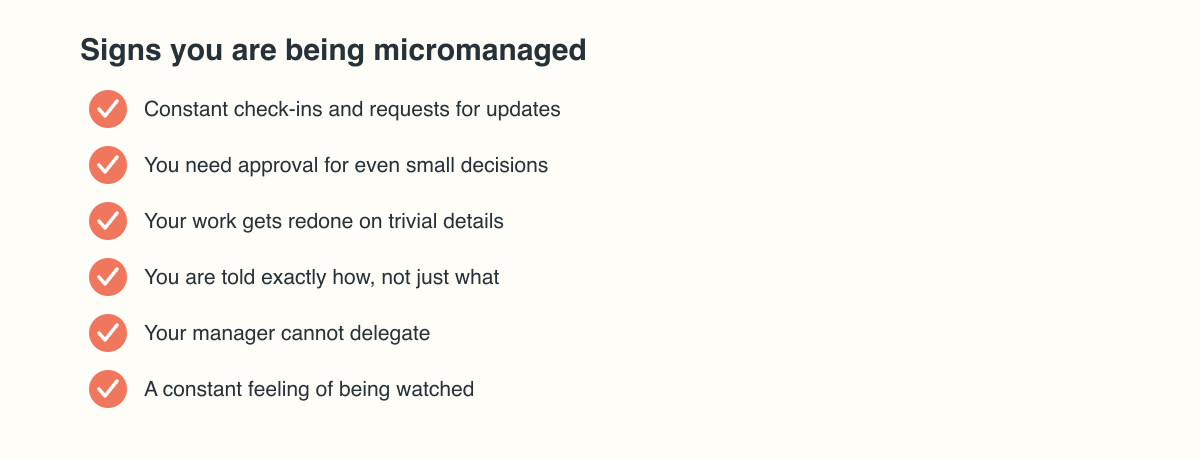
Micromanagement can be hard to name when you are inside it, because it disguises itself as thoroughness. The common signs:
- Constant check-ins. You are asked for updates so often that reporting on the work eats into doing it.
- Everything needs approval. You cannot make even small decisions without a sign-off.
- Your work gets redone. Your manager rewrites, tweaks or overrules your output on details that do not matter.
- You are told how, not just what. Instead of an outcome, you are handed a rigid, step-by-step method with no room to use your judgement.
- They struggle to delegate. Tasks get pulled back, or handed over with so many conditions they might as well not have been.
- You feel watched. There is a background sense that someone is always monitoring, checking, ready to pounce on a mistake.
If several of these are constant, and aimed at capable people who do not need that much oversight, that is micromanagement, not diligence.
Why do managers micromanage?
Almost nobody sets out to be a micromanager. It usually grows from something the manager is feeling, not something the team is doing wrong.
- Anxiety and insecurity. A manager who is worried about their own standing may cling to control because the team's output reflects on them. If it has to be perfect, and they do not fully trust it will be, they hover.
- Fear of failure. If mistakes feel catastrophic, controlling every detail feels safer than trusting others to get it right.
- They were promoted for doing, not leading. Great individual performers often become managers with no training in how to let go. So they keep doing the work, through other people.
- A lack of trust. Sometimes it is a genuine belief that people will not deliver unless watched, an assumption that says more about the manager than the team.
- Pressure from above. A manager being micromanaged themselves often passes it straight down the line.
Understanding the cause matters, because it points at the truth: micromanagement is usually the manager's problem to solve, not a reasonable response to the team.
The damage micromanagement does
Micromanagement is not a harmless quirk. It quietly wrecks the things it claims to protect.
- It kills motivation. Being controlled and distrusted is profoundly de-motivating. People stop caring about work they are not trusted to own.
- It stunts growth. You cannot develop judgement you are never allowed to use. Micromanaged people stop learning, because every decision is made for them.
- It lowers quality. This is the great irony. Anxious, hovered-over people do worse work, not better. They stop taking initiative, stop flagging problems, and simply wait to be told what to do.
- It burns out the manager, too. Trying to control everything is exhausting and unsustainable. The micromanager becomes a bottleneck, drowning in detail they should have delegated.
- It drives good people out. Capable, self-motivated people (the ones you most want to keep) are the least willing to be micromanaged. They leave for somewhere they will be trusted.
Put simply, micromanagement takes talented adults and treats them like people who cannot be relied on, and then gets exactly the disengaged, dependent behaviour it feared.
How to deal with a micromanager
If you are being micromanaged, you are not powerless. A few approaches that genuinely help:
- Get ahead of the check-ins. Proactively share updates before they are asked for. Micromanagement is often fuelled by anxiety, and reliable, unprompted communication can slowly starve that anxiety of oxygen.
- Build trust deliberately. Deliver consistently on the small things, and gently point to the track record. Trust is often the currency that buys you more autonomy over time.
- Ask for outcomes, not instructions. Try reframing: "If you can tell me what a great result looks like, I will figure out the how and check in at these points." It offers control over the destination in exchange for freedom on the route.
- Have the honest conversation. Calmly: "I do my best work with a bit more room to run. Can we try me owning this end to end and see how it goes?" Sometimes managers genuinely do not realise how their style lands.
- Know your limits. If nothing shifts, and the constant control is grinding you down, that is real information. Some managers will not change, and the healthiest move can be a role, or an employer, that trusts you.
How to stop micromanaging (if it might be you)
Recognising it in yourself is a good sign, not a bad one. To loosen the grip:
- Delegate outcomes, not tasks. Hand over a clear goal and the authority to reach it, then step back.
- Agree check-in points in advance, so you are not hovering, and let people come to you between them.
- Let small mistakes happen. They are how people learn. Not every error is a crisis.
- Ask why you feel the need to control. Usually it is your own anxiety, and it is worth addressing directly rather than exporting it onto your team.
- Measure results, not activity. Judge people on what they deliver, not on how visibly busy or closely watched they are.
Work-Life Balance Jobs with Genuinely Reduced Hours
Save one to come back to it — it's free.


Micromanagement in a remote world
Remote and hybrid work gave micromanagers a new and worrying toolkit. Unable to physically hover, some managers reached for technology instead: monitoring software, screenshot tools, activity trackers, mouse-movement loggers, and a general expectation of instant replies to prove you are "at your desk".
This is micromanagement wearing a digital disguise, and it is sometimes called productivity paranoia: the manager's anxious conviction that people cannot be working unless they can be watched working. It is the same distrust as always, just automated.
And it fails in the same way, only worse. Surveillance does not produce good work. It produces the appearance of activity: people wiggling their mouse, padding their online hours, performing busyness for the tracker instead of focusing on results. It corrodes trust, spikes stress, and pushes exactly the capable people you want to keep toward the door. You cannot surveil your way to a motivated, high-performing team. The remote era did not create a need for more monitoring. It created a clearer test of whether a manager can trust and measure outcomes, or only control and observe.
The alternative: trust and outcomes
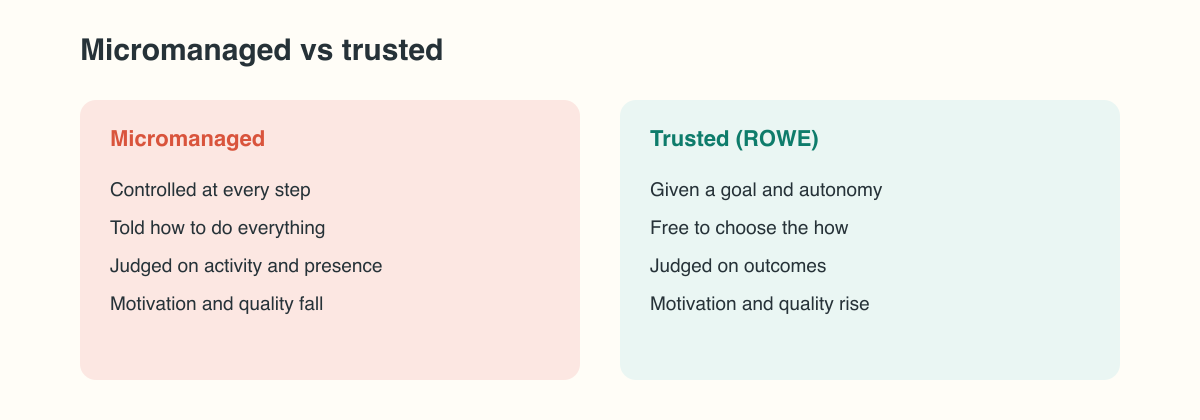
The opposite of micromanagement is not neglect. It is trust: giving people a clear goal and the autonomy to reach it, then judging them on results.
This is not a soft idea, it is a more effective one. Autonomy is one of the strongest drivers of motivation and good work that exists. It is the principle behind a results-only work environment, where people are measured on outcomes rather than hours or visibility. And it is the same trust that makes flexible and reduced-hours working possible in the first place.
You cannot offer someone a four-day week or genuine flexibility while also needing to watch their every move. Trusting people with their time and trusting them with their work are the same muscle. The employers that have built cultures of autonomy tend to be the ones who never had much time for micromanagement, because they understood the trade the whole time: treat people like capable adults, and they will act like them.
Frequently asked questions
What is micromanagement? A management style where a manager controls and scrutinises every small detail of their team's work, leaving little room for autonomy. The defining feature is a lack of trust in people to do their jobs.
What are the signs of being micromanaged? Constant requests for updates, needing approval for even small decisions, having your work redone on trivial details, being told exactly how to do everything, a manager who cannot delegate, and a persistent feeling of being watched.
Why do managers micromanage? Usually because of their own anxiety, insecurity or fear of failure, a lack of training in how to lead rather than do, or pressure from their own boss, rather than because the team genuinely needs that much oversight.
How do I deal with a micromanager? Share updates proactively to ease their anxiety, build a track record of reliability, ask to be measured on outcomes rather than steps, and have a calm, direct conversation about needing more room. If nothing changes, consider whether the role is right.
Does micromanagement actually improve quality? No. It usually lowers it. Hovered-over people stop taking initiative and simply wait to be told what to do, which produces more dependent, lower-quality work, not better.
Want to be trusted to do great work? Browse four-day-week and flexible roles at outcome-focused employers on 4dayweek.io.




Get 4-day week jobs in your inbox
Create a free account to receive curated opportunities weekly.
Sign up for freeFree forever. No spam, unsubscribe anytime.