Badge in. Grab a coffee. Nod at a few faces. Badge out.
Total time in the office: forty minutes. Box ticked. Back home to actually get some work done.
That's coffee badging, and it's one of the clearest signs that return-to-office mandates aren't working the way companies hoped.
What is coffee badging?
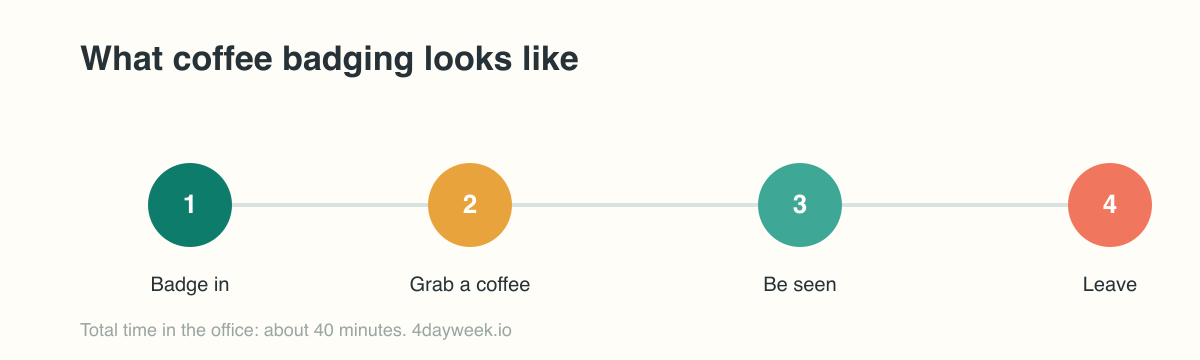
Coffee badging is showing up at the office just long enough to be seen, swiping your access badge, grabbing a coffee, making an appearance, before leaving to do your real work somewhere else.
The name captures it perfectly: you came in for the badge swipe, not the day. You've technically satisfied the attendance requirement while quietly opting out of the point of it.
It's the physical-world cousin of other quiet workplace rebellions like quiet quitting, meeting the letter of a rule while ignoring its spirit. And it's become common enough to earn its own name.
Why do people coffee badge?
Because they've done the maths on a mandate that doesn't add up for them.
When a company says "be in the office three days a week" without changing why the office is worth the trip, employees are left with a rule that costs them a commute and gives them little back. Coffee badging is the rational response: satisfy the requirement at minimum cost.
The drivers are consistent:
- Mandates without meaning. If there's no real reason to be in, no collaboration, no team, just solo work you could do anywhere, the office is pure overhead.
- The commute tax. Hours and money spent travelling to do exactly what you'd do at home.
- Focus. Open-plan offices are often worse for deep work than a quiet room at home.
- A trust gap. Being told to be visible reads as "we don't trust you to work unless we can see you", and people push back.
What the data says
This isn't a fringe habit. In Owl Labs' widely cited State of Hybrid Work research, coffee badging peaked at around three in five hybrid workers in 2023. It has since fallen to closer to two in five (about 44% in 2024) as employers caught on and cracked down, with a large majority of coffee badgers reporting they've been spotted by their boss.
The decline is the tell. When employers have to actively police attendance to stop people leaving early, and a big chunk keep doing it anyway, that's not an employee problem. That's a signal that the policy has lost the room.
Where the term came from
"Coffee badging" entered the workplace vocabulary around 2023, popularised by research from the video-conferencing company Owl Labs, whose widely cited survey found that a striking share of hybrid workers admitted to it. The phrase stuck because it named something people were already quietly doing the moment return-to-office mandates arrived.
It joined a whole lexicon of quiet workplace pushback that emerged around the same time, quiet quitting, coffee badging, and the rest, all describing the same underlying thing: employees complying with the letter of a rule while opting out of its spirit.
Is coffee badging a bad thing?
It depends who you ask, and it's worth seeing both sides honestly.
From the employee's view, it's pragmatic, even reasonable. If you're required to be somewhere for no real benefit, minimising the cost while meeting the rule is just sensible. The mandate created the game; coffee badging is playing it.
From the employer's view, it's a red flag, but not the one they usually think. The instinct is to see it as employees cheating. The sharper read is that coffee badging is feedback: proof that the office, as currently offered, isn't worth people's time. Punishing it treats the symptom; fixing the office treats the cause.
The healthiest view: coffee badging isn't really about coffee or badges. It's a negotiation nobody's having out loud, about whether being in the building actually helps anyone do better work.
The bigger return-to-office picture
Coffee badging is one symptom of a broader tension. Many companies mandated returns on a hunch, that offices drive collaboration and culture, without a clear plan for what people should do there. Employees, having proved for years they can deliver from home, pushed back.
The result is a stand-off: mandates on one side, coffee badging (and quiet quitting, and attrition) on the other. And the data keeps suggesting the mandates aren't winning hearts, they're winning car-park photos.
What coffee badging really signals
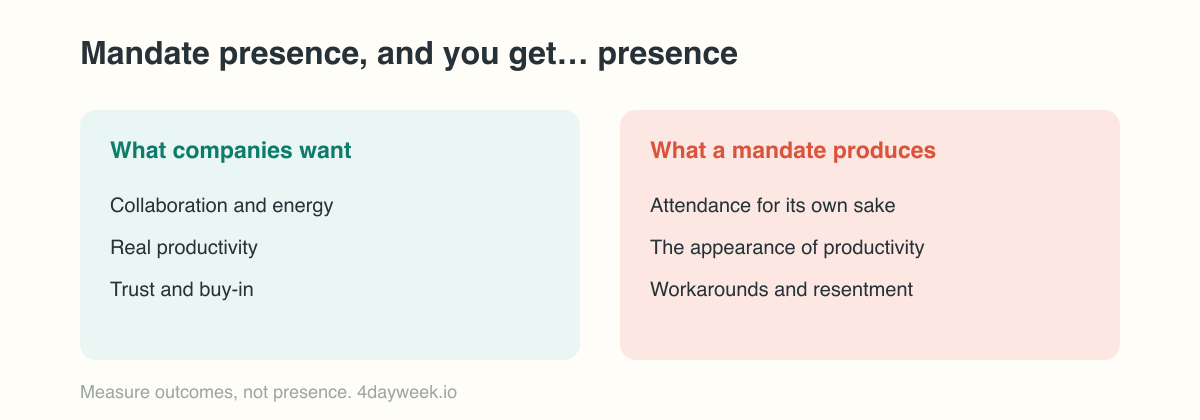
Coffee badging is a symptom, and the underlying condition is worth naming: companies measuring presence instead of output.
Here's the trap. Mandate physical attendance and you make being seen the goal. So employees optimise for being seen, the badge swipe, the coffee, the cameo, rather than for doing great work. You get the appearance of compliance and none of the collaboration you actually wanted.
| What the company wants | What a mandate actually produces |
|---|---|
| Collaboration and energy | Attendance for its own sake |
| Productivity | The appearance of productivity |
| Trust and buy-in | Workarounds and resentment |
Work-Life Balance Jobs with Genuinely Reduced Hours
Save one to come back to it — it's free.



Stricter tracking only escalates the game. Watch the badge data more closely and people will simply badge for longer while doing the same amount of nothing. You can't surveil your way to engagement.
The fix: earn the commute, measure the output
The companies that don't have a coffee-badging problem aren't the ones with the strictest mandates. They're the ones who made two shifts:
- Give people a real reason to come in. Reserve the office for what it's genuinely good at, collaboration, onboarding, connection, the occasional in-person day that's worth the trip, and stop demanding attendance for solo work.
- Measure outcomes, not presence. Judge people on what they deliver, not where they sit. Once output is the metric, the badge swipe stops mattering, and so does coffee badging.
That's the same principle behind the four-day week: trust people, measure results, and stop confusing time-and-place with productivity. Employers who build flexibility and reduced hours into how they work don't need to police attendance, because they never mistook a full car park for a productive company.
Coffee badging and the future of the office
Coffee badging is really a data point in a bigger question every company is now answering, whether they mean to or not: what is the office actually for?
For decades, the answer was "it's where work happens", because it had to be. That's no longer true for knowledge work, and everyone knows it. So the office has to earn its place, not assume it. The winners will be the organisations that turn the office into something worth the trip, a place for the connection, collaboration and culture that genuinely are better in person, and let the focused, heads-down work happen wherever it's done best.
In that world, coffee badging disappears, not because it's banned, but because there's nothing to rebel against. When being in the office is genuinely valuable, people come in. When it isn't, no mandate, and no badge-swipe audit, will make it so.
The companies still fighting this with stricter rules are treating a symptom. The ones pulling ahead are asking the better question: not "how do we make people come in?" but "how do we make work worth showing up for, wherever it happens?"
Frequently asked questions
What is coffee badging? Showing up at the office just long enough to be seen, badging in, getting a coffee, making an appearance, then leaving to work elsewhere, so you meet an attendance rule without really participating in it.
Why do employees coffee badge? Because return-to-office mandates often add a commute without adding value. If there's no real reason to be in, coffee badging satisfies the rule at minimum cost.
Is coffee badging common? Yes, surveys of hybrid workers have found a majority admit to coffee badging or say they'd like to, which suggests many attendance mandates aren't achieving their goal.
How do companies stop coffee badging? Not with stricter tracking. By giving people genuine reasons to come in (collaboration, connection) and measuring outcomes instead of presence, so where someone works stops being the point.
Want a job that trusts you to do great work anywhere? Browse four-day-week and flexible roles on 4dayweek.io →




Get 4-day week jobs in your inbox
Create a free account to receive curated opportunities weekly.
Sign up for freeFree forever. No spam, unsubscribe anytime.