
No one calls you into a room. No one hands you a letter.
Instead, the interesting projects quietly stop coming. The pay review passes you by, again. Your manager's calendar is never quite free. Little by little, the job you liked becomes a job you can't wait to leave.
That's quiet firing. And once you can name it, you can stop taking it personally and start doing something about it.
What is quiet firing?
Quiet firing is when an employer deliberately or negligently makes a role so unrewarding that the employee gives up and resigns, avoiding the cost, paperwork and awkwardness of an actual dismissal.
Rather than manage someone out openly, the employer simply stops investing: no growth, no feedback, no raises, no interesting work. The message is never said out loud, but it's unmistakable, we'd rather you left.
It's the exact mirror of quiet quitting. In quiet quitting, the employee withdraws discretionary effort. In quiet firing, the employer withdraws investment. Both are quiet failures of the same relationship, and quiet firing often comes first, with quiet quitting the natural response to it.
Quiet quitting vs quiet firing
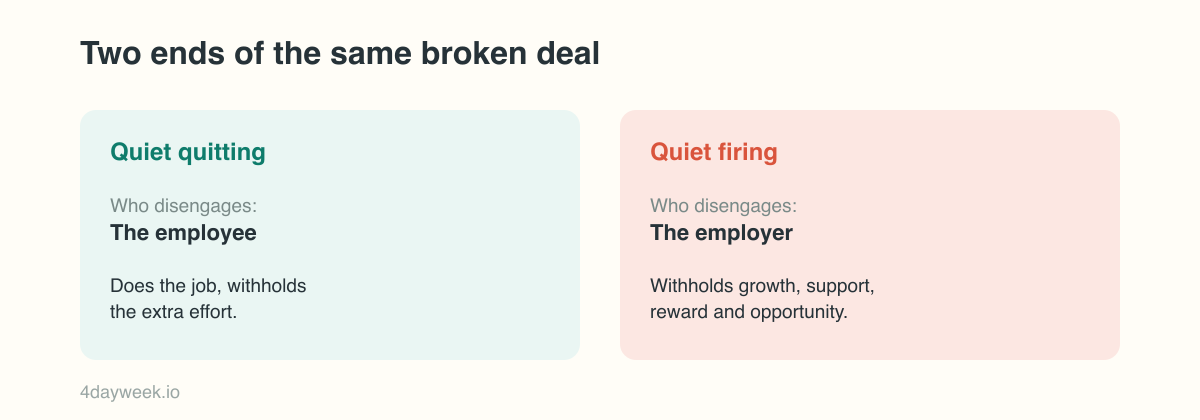
The two get talked about together for good reason, they're two ends of the same broken deal.
| Who disengages | What it looks like | |
|---|---|---|
| Quiet quitting | The employee | Doing the job, withholding the extra effort |
| Quiet firing | The employer | Withholding growth, support, reward and opportunity |
The uncomfortable truth: a lot of "quiet quitting" is really a reasonable response to being quietly fired. When effort stops being rewarded, people stop volunteering it. Naming both halves is the only way to fix either.
The signs of quiet firing
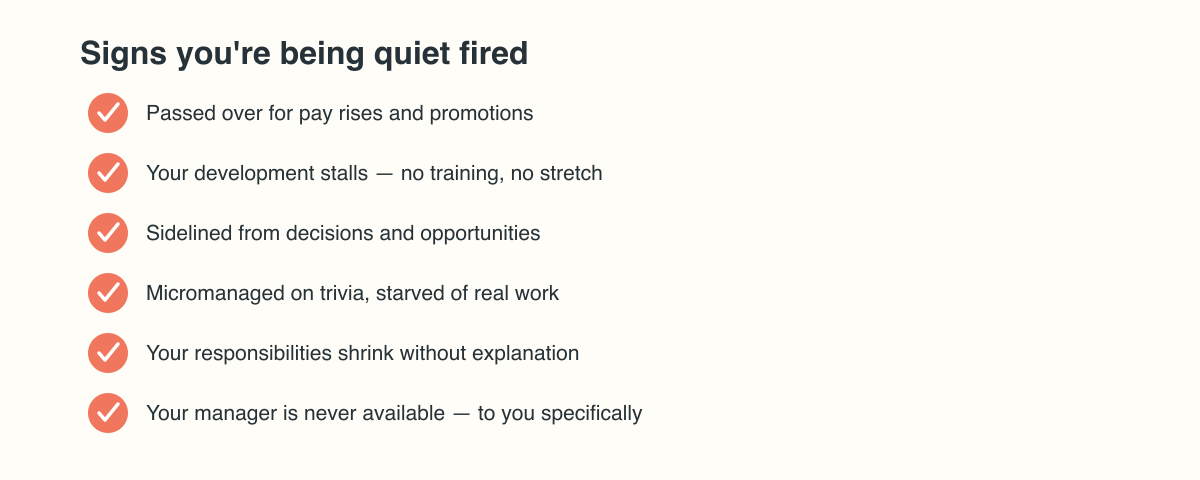
Quiet firing is death by a thousand cuts, so it's easy to miss until you're worn down. The pattern is consistent:
- You're passed over for pay rises while others move up.
- Your development stalls, no training, no stretch projects, no path forward.
- You're sidelined, left off invitations, decisions and key conversations.
- Feedback dries up, or turns vague and discouraging.
- You're micromanaged on trivia while starved of anything meaningful.
- Your responsibilities shrink without explanation.
- Your manager is perpetually unavailable to you specifically.
Any one of these can have an innocent explanation. Several of them, persistently, aimed at you? That's a pattern worth taking seriously.
Is quiet firing legal?
Mostly, yes, being neglected or overlooked isn't, on its own, against the law. An employer generally isn't obliged to promote you, develop you, or make your job enjoyable.
But it can cross legal lines, and it's worth knowing where:
- Discrimination. If the neglect targets you because of a protected characteristic, age, sex, race, disability, and so on, it may be unlawful.
- Constructive dismissal. If an employer's conduct is serious enough to breach the trust at the heart of your contract, effectively forcing you out, you may, in some jurisdictions, be able to claim you were constructively dismissed. This is a high bar and jurisdiction-specific.
- Retaliation. Freezing someone out because they raised a complaint or exercised a right can be unlawful.
(This is general guidance, not legal advice, if you think your situation crosses these lines, get advice specific to where you work.)
Why do employers quiet fire?
It's rarely stated out loud, but the motives are consistent:
- Avoiding the cost and paperwork of firing. A formal dismissal can mean process, notice, payoffs and legal risk. Making someone leave voluntarily sidesteps all of it.
- Conflict avoidance. Many managers would rather do almost anything than have a direct, difficult conversation. Quiet firing lets them avoid it entirely, at the employee's expense.
- Sidestepping redundancy. Instead of a formal redundancy process (with its consultation and payments), an employer might quietly make roles unpleasant enough that people self-select out.
- A manager who's checked out. Sometimes it isn't strategy at all, just a disengaged manager who's stopped investing in anyone.
Is quiet firing deliberate or accidental?
Both, and the distinction matters for how you respond.
Sometimes it's a deliberate strategy: a calculated way to shed someone without the mess of a dismissal. Other times it's pure negligence, an overloaded or indifferent manager who simply isn't developing, recognising or supporting their people, with the same corrosive effect.
The result feels identical from the receiving end. But it's worth testing which one you're facing, because an accidental version can sometimes be fixed by naming it, while a deliberate one is usually your cue to leave. That test is a conversation.
How to raise it with your manager
You don't have to accuse anyone. A calm, specific, non-defensive conversation often reveals which version you're dealing with. Something like:
"I've noticed I haven't been included in [X] recently, and it's been a while since we talked about my development or a pay review. I want to make sure I'm contributing where I can, is there something I should be aware of?"
That framing does three things: it's specific (facts, not feelings), it's non-hostile (you're offering to help, not attacking), and it forces a response. Watch what happens next:
Work-Life Balance Jobs with Genuinely Reduced Hours
Save one to come back to it — it's free.



- A manager who engages, explains, and course-corrects? Possibly accidental, and possibly fixable.
- A manager who stonewalls, gets vague, or brushes you off? You have your answer.
Either way, you've replaced a vague, gnawing anxiety with useful information.
Why quiet firing backfires on companies
For employers tempted by it, quiet firing is a false economy, it usually costs more than it saves.
- It poisons the people who stay. Colleagues watch someone get frozen out and quietly conclude that loyalty and effort aren't safe here. Engagement drops across the team, not just for the target.
- It loses the wrong people. Quiet firing pushes out whoever is most able to leave, often your best people, who have options, while those who can't leave stay and disengage.
- It breeds quiet quitting. Withdraw investment and people withdraw effort. You get a demoralised team doing the minimum.
- Reputation travels. Glassdoor, LinkedIn and word-of-mouth mean a culture of managing people out quietly doesn't stay quiet for long, and it shows up in your ability to hire.
Managing someone out by starving them is management by avoidance. It's cheaper, in every sense, to either invest in people properly or have the honest conversation.
What to do if you're being quiet fired
Don't quietly absorb it. Respond deliberately.
- Name it to yourself. Recognising the pattern breaks the spell of "maybe it's just me." It usually isn't.
- Document it. Keep a dated record of missed reviews, sidelining, shrinking responsibilities. Facts beat feelings if it ever escalates.
- Raise it directly. Ask your manager plainly: "I've noticed X and Y. Is there a concern I should know about?" Sometimes it flushes out a fixable issue; sometimes it confirms what you suspected.
- Protect your wellbeing. Being frozen out is corrosive. Don't let it convince you you're the problem.
- Start looking. If the investment isn't coming back, the healthiest move is usually the door, on your terms, not theirs.
And when you look, look for the opposite of a quiet-firing culture: employers who actually invest in people, respect their time, and build work around a sustainable life. The kind of companies offering four-day weeks and reduced-hours roles tend to be exactly that, because starving people out is the last thing a company competing on how well it treats its staff would do.
Frequently asked questions
What is quiet firing? It's when an employer makes a job deliberately unrewarding, no raises, growth, support or interesting work, so the employee resigns on their own, sparing the employer a formal dismissal.
What's the difference between quiet quitting and quiet firing? Quiet quitting is the employee withdrawing extra effort; quiet firing is the employer withdrawing investment and support. Quiet firing often triggers quiet quitting in response.
Is quiet firing illegal? Usually not by itself. But it can be unlawful if it's driven by a protected characteristic (discrimination), amounts to constructive dismissal, or is retaliation for exercising a right.
What are the signs of quiet firing? Being repeatedly passed over for raises and promotions, no development, being sidelined or excluded, micromanaged on trivia, shrinking responsibilities, and a manager who's never available to you.
What should I do if I'm being quiet fired? Document the pattern, raise it directly with your manager, protect your wellbeing, and start looking for an employer that invests in its people.
Ready for a workplace that invests in you? Browse four-day-week and reduced-hours roles on 4dayweek.io →




Get 4-day week jobs in your inbox
Create a free account to receive curated opportunities weekly.
Sign up for freeFree forever. No spam, unsubscribe anytime.