
Imagine a job with no set hours. No mandatory meetings. No one tracking when you arrive or leave. As much time off as you like. And just one rule: get your work done.
Sound like a fantasy? For a few thousand employees at one of America's biggest retailers, it was real. In the early 2000s, Best Buy ran exactly this experiment, and gave it a name: the results-only work environment, or ROWE.
ROWE never took over the working world. But its central idea, that you should measure what people achieve rather than how long they sit at a desk, has quietly become one of the most important arguments in modern work. Here is the story, how it worked, and why it matters more now than ever.
What is a results-only work environment?
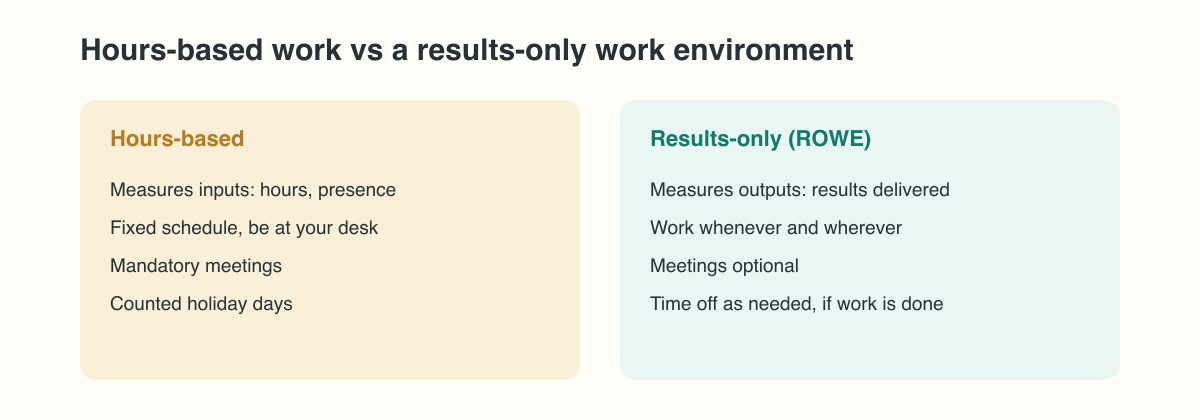
A results-only work environment (ROWE) is a workplace where employees are evaluated solely on the results they produce, not on the hours they work, where they work, or how they work.
In a true ROWE, autonomy is total. There are no fixed schedules and no expectation of being physically present. As its creators put it, leaving the office at 2pm is not "leaving early", and arriving at 2pm is not "coming in late", because time and place simply stop being the measure. The only thing that counts is whether the work gets done to the standard required.
It is a genuinely radical inversion of how most jobs operate. The traditional workplace measures inputs: hours logged, seats filled, presence displayed. A ROWE measures outputs: results delivered. Everything else, when, where and how, is left entirely to the employee.
Where ROWE came from
ROWE was created by two HR professionals, Cali Ressler and Jody Thompson, at Best Buy's corporate headquarters in the early 2000s.
The seed was planted around 2001, when Best Buy was trying to become a more attractive place for talented people to work. When they asked employees what they actually wanted, the answer came back overwhelmingly clear: "Trust me with my time, trust me to do my job, and I will deliver results, and be happier too."
Ressler and Thompson took that literally. They built a pilot programme that stripped away the traditional controls, no required hours, no mandatory meetings, complete freedom over time, and simply held people accountable for results. It grew from there, was rolled out across parts of Best Buy's corporate workforce, and the two went on to write a book about it, spreading the idea well beyond the company.
How a ROWE works
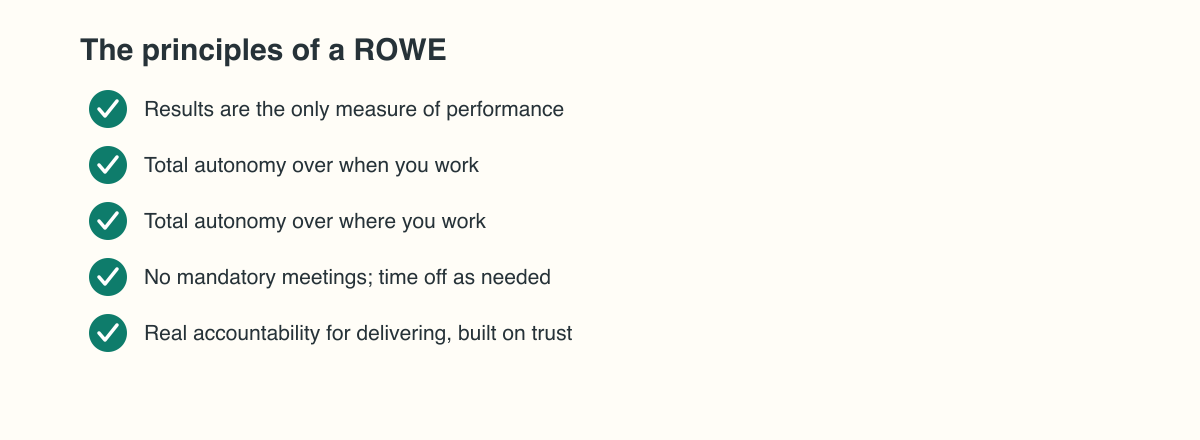
The principles of a true ROWE are simple to state and radical to live:
- Results are the only measure. Performance is judged entirely on outcomes and goals met, not on activity or attendance.
- Total autonomy over time. Employees decide when they work. There are no set hours and no expectation of a nine-to-five.
- Total autonomy over place. People work wherever they are most effective. The office becomes optional, a tool rather than a requirement.
- No mandatory meetings. Meetings are optional and exist only where they genuinely add value. Your attendance is never assumed.
- Effectively unlimited time off. As long as the work gets done, there is no need to count holiday days. Time is yours to manage.
- Accountability is real. The trade for all that freedom is genuine accountability for delivering. Autonomy without accountability is just chaos, and a ROWE is not chaos.
The whole system rests on one foundation: trust. It only works if managers genuinely trust their people to deliver, and let go of the need to see them doing it.
The pros and cons of ROWE
ROWE promised a lot, and the evidence from where it was tried suggests it delivered real benefits, alongside real challenges.
The upsides:
- Higher engagement and satisfaction. People given genuine autonomy tend to be more motivated and happier.
- Better retention. Employees are reluctant to leave a level of freedom they cannot get elsewhere.
- Improved productivity. Freed from performing presence, many people simply get more of the actual work done.
- Better work-life balance. Total control over your time makes fitting work around life dramatically easier.
The challenges:
- It demands a huge culture shift. Managers used to controlling and observing have to learn to trust and measure outcomes, which many find genuinely hard.
- Not every role fits. Jobs that require presence at set times (a shop floor, a hospital ward) do not map neatly onto pure ROWE.
- Results have to be measurable. It works best where "done well" can be clearly defined. Fuzzier roles are harder to run this way.
- It can blur boundaries. Total flexibility can tip into always-on if people are not careful, so it needs a healthy culture around it.
Why ROWE faded, and why it still matters
If ROWE was so good, why is not every company running one? Partly, timing and nerve. Best Buy itself scrapped its ROWE in 2013 under new leadership that wanted people back in the office, and the pure, formal version never became mainstream. It asked more trust of managers than most organisations were ready to give.
But here is the thing: ROWE won the argument even as it lost the brand. Look at how knowledge work actually operates now. Remote and hybrid work, flexible hours, unlimited-PTO policies, "async" cultures, the whole modern conversation about measuring output over presence, all of it is ROWE's logic, seeping into the mainstream a decade or two later. The pandemic did in a few months what Best Buy could not do in years: prove at scale that people can be trusted to deliver without being watched.
Work-Life Balance Jobs with Genuinely Reduced Hours
Save one to come back to it — it's free.



And ROWE is the direct intellectual cousin of the four-day week. Both start from the same insight: that hours are a lousy proxy for value, and results are what actually matter. A four-day week is, in a sense, a more structured, more achievable version of the same bet, keep the outcomes, cut the time-serving. It asks the same core question ROWE did: if the work gets done, why do we care so much about the hours?
The pure ROWE may have been ahead of its time. But its central claim, trust people, measure results, and free them from the tyranny of the clock, is more alive today than ever. It runs directly counter to micromanagement and everything it stands for, and it points at where good work is quietly heading.
Could a results-only approach work for your team?
You do not need to adopt the full, formal ROWE to borrow its best ideas. The useful question is not "should we become a pure ROWE?" but "how much closer to outcomes-over-hours could we move?"
It fits most naturally where:
- Work is project- or output-based, so "done well" can be clearly defined and measured.
- Roles are autonomous, without a hard requirement to be present at fixed times for others.
- Trust already runs reasonably high, or leadership is genuinely willing to build it.
- The work is knowledge work, where thinking, creating and problem-solving matter more than clocking hours.
It fits less naturally where physical presence at set times is the job itself, such as a shop floor, a hospital ward or a reception desk. Even there, though, the underlying principle, judge people on the quality of their work rather than on visible busyness, still applies.
For most teams, the realistic path is not a dramatic overnight switch but a gradual shift: define what good results actually look like, give people more control over how and when they hit them, drop the meetings and check-ins that exist only to monitor, and measure what gets delivered. Each step in that direction captures a little more of what made ROWE work, without requiring the leap of faith that made it rare. The four-day week is one of the most popular ways to take that step, because it bakes the outcomes-over-hours principle into a simple, concrete change.
Frequently asked questions
What is a results-only work environment (ROWE)? A workplace where employees are judged purely on the results they deliver, not on when, where or how long they work. In a true ROWE there are no set hours, no mandatory meetings, and effectively unlimited time off, as long as the work gets done.
Who created ROWE? Cali Ressler and Jody Thompson developed it at Best Buy's corporate headquarters in the early 2000s, after employees said they wanted to be trusted with their time and judged on results.
Does ROWE actually work? Where it has been tried, it has been linked to higher engagement, better retention and productivity, and improved work-life balance. Its challenges are cultural: it demands that managers trust and measure outcomes rather than control and observe, which many find difficult.
Why did ROWE not become standard? It asked for more managerial trust than most organisations were ready to give, and Best Buy itself ended its programme in 2013. But its core idea, outcomes over hours, has since spread widely through remote work, flexible hours and the four-day-week movement.
How is ROWE related to the four-day week? Both are built on the same insight: hours are a poor measure of value, and results are what matter. A four-day week is a more structured version of the same bet, keeping the outcomes while cutting the time spent.
Want to be measured on what you achieve, not hours logged? Browse four-day-week and flexible roles on 4dayweek.io.




Get 4-day week jobs in your inbox
Create a free account to receive curated opportunities weekly.
Sign up for freeFree forever. No spam, unsubscribe anytime.