
You finally have a free Sunday. And within an hour, a small, nagging voice starts up: you should be doing something useful. Learning something. Getting ahead. Not just... resting.
So you half-relax, half-feel guilty, and the day off never quite becomes a day off.
That voice is toxic productivity. It is the belief, absorbed so deeply you barely notice it, that your value depends on constant output, and that any time not spent being productive is time wasted. It is one of the most common and least talked-about drains on modern wellbeing. Here is what it is, how to recognise it, and how to quiet that voice down.
What is toxic productivity?
Toxic productivity is an unhealthy, compulsive obsession with being productive at all times, to the point where rest, leisure and doing nothing trigger guilt rather than relief.
The "toxic" part is key. Productivity itself is not the problem. Getting things done is good. Toxic productivity is when the drive to be productive stops serving your life and starts ruling it: when you cannot switch off, cannot rest without guilt, and feel that any moment not spent achieving something is a moral failing.
Its defining feature is that it does not stay at work. It colonises everything. Weekends become to-do lists. Hobbies have to have a purpose or a side-hustle attached. Even rest gets "optimised" into a wellness routine with goals. Nothing is allowed to be simply enjoyable or genuinely idle.
Toxic productivity vs workaholism vs hustle culture
These three overlap, but they are not the same thing, and the differences are useful.
- Hustle culture is the external ideology: the societal message that grinding constantly is admirable and necessary.
- Workaholism is a compulsion specifically to work, treated by researchers as a behavioural addiction.
- Toxic productivity is the internalised guilt that makes any rest feel like laziness. It is broader than work: it is the feeling that all of your time, including your leisure, should be productive.
Put simply: hustle culture is the message, workaholism is an addiction to the job, and toxic productivity is the guilt you feel on your own sofa on a Saturday. You can have toxic productivity without being a workaholic, because it is about your whole relationship with rest, not just your relationship with your job.
The signs of toxic productivity
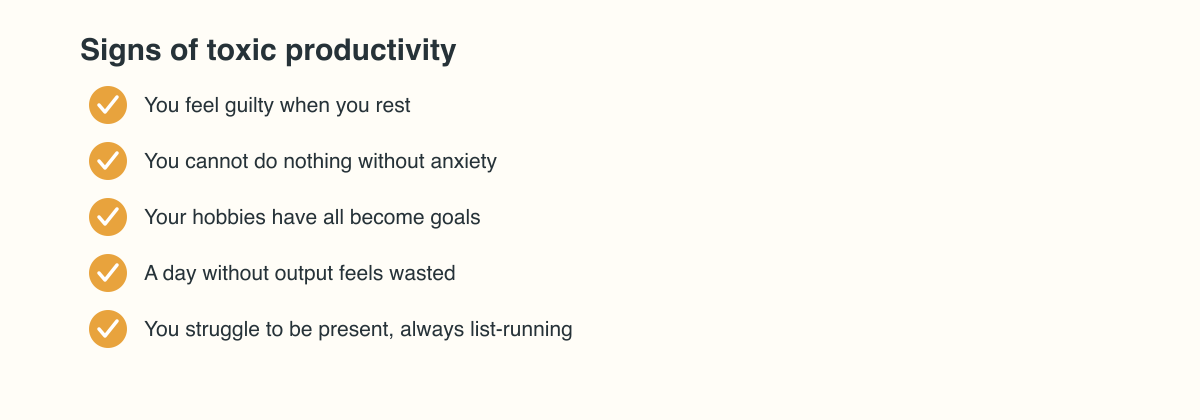
Toxic productivity is easy to mistake for being organised or driven. Some honest signs it has tipped over:
- You feel guilty when you rest, as though relaxing is something you have to justify or earn.
- You cannot do nothing. Idle time makes you anxious, so you fill every gap with a task, a podcast, a productive-feeling activity.
- Your hobbies have all become goals. The reading is for self-improvement, the running is for a personal best, the side-project is a potential business. Nothing is just for fun.
- You measure your days by output and feel that a day without visible achievement was wasted.
- You struggle to be present, mentally running through your to-do list during dinner, holidays or time with people you love.
- You feel your worth depends on what you produced today, and a low-output day lands as a personal failure.
The core tell is the guilt. When rest consistently makes you feel bad rather than restored, productivity has stopped being a tool and started being a taskmaster.
Why toxic productivity backfires
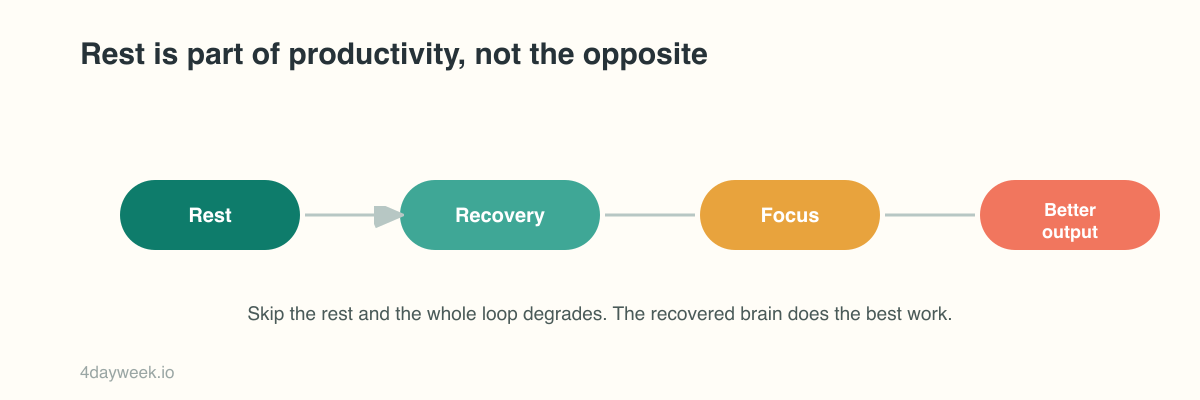
Here is the irony at the heart of it: toxic productivity makes you less productive, not more.
Real productivity depends on rest. Focus, creativity, problem-solving and good decisions all require a recovered brain. When you never truly switch off, you operate in a permanently depleted state, doing more hours of worse work. Ideas dry up. Mistakes creep in. And the constant low-grade guilt is itself exhausting.
There is a recovery loop that high performers understand and toxic productivity ignores: rest is not the opposite of productivity, it is a part of it. Athletes do not train 24/7, because they know recovery is when the gains happen. The same is true of knowledge work. The person who genuinely rests on Sunday does better work on Monday than the one who spent Sunday feeling guilty about not working.
Toxic productivity also runs a straight road to burnout. A life with no real off-switch and no guilt-free rest is not sustainable, and the crash, when it comes, wipes out far more productivity than any amount of resting would have.
Where toxic productivity comes from
Toxic productivity does not appear from nowhere. A few forces stack up to plant that guilty voice in your head.
- Hustle culture. Years of "rise and grind" messaging taught a generation that rest is laziness and busyness is virtue. Toxic productivity is that message, internalised so thoroughly you no longer need anyone else to enforce it.
- Social media. Feeds full of 5am routines, side-hustles, optimised morning rituals and other people's relentless output create a constant, quiet pressure to be doing more. Rest starts to feel like falling behind.
- The optimisation mindset. A culture obsessed with productivity hacks, self-improvement and "levelling up" can turn every corner of life, sleep, hobbies, holidays, into another thing to optimise, until nothing is allowed to just be.
- Economic anxiety. When the future feels precarious, constant productivity can feel like the only insurance. Resting feels risky, as though slowing down for a moment might cost you.
- Conditional self-worth. Underneath it all is often the belief that your value depends on what you produce. If you are only worthy when you are achieving, then rest becomes a threat to your sense of self.
Seeing these roots matters, because it makes clear that toxic productivity is not a personal defect. It is a predictable response to a culture that has spent years equating human worth with output. And what was learned can be unlearned.
Work-Life Balance Jobs with Genuinely Reduced Hours
Save one to come back to it — it's free.



How to break the cycle
Unlearning toxic productivity takes practice, because the guilt is deeply wired in. Some approaches that work:
- Reframe rest as productive. Genuinely absorb the idea that recovery is part of doing good work, not a break from it. You are not being lazy on your day off. You are doing the thing that makes the rest of your week possible.
- Separate your worth from your output. You are not a machine measured by daily units produced. Your value as a person does not rise and fall with your to-do list. This is the hardest and most important shift.
- Schedule genuinely purposeless time. Deliberately plan things with no goal attached: a walk with no step target, a book with no lesson, an afternoon with no plan. Protect them like meetings.
- Let hobbies be pointless. Reclaim at least one activity that exists purely because you enjoy it, with no productivity, improvement or monetisation attached.
- Notice and challenge the guilt. When the "you should be doing something useful" voice starts up during your downtime, name it: "that is toxic productivity talking." Naming it drains its authority.
- Practise being present. When you are resting or with people, actually be there, rather than half-present with a to-do list running in the background.
The bigger picture
Toxic productivity is what happens when a culture that worships output gets inside your head so thoroughly that you police yourself, feeling guilty for the rest you desperately need.
It is fed by an environment that treats busyness as virtue and rest as slacking. Which is why it is so much easier to unlearn in a workplace that models the opposite: one that treats rest as normal, values outcomes over visible effort, and genuinely expects you to have a full life outside work. When your employer builds the week around a sustainable life, it becomes a lot easier to believe that your Sunday afternoon is allowed to just be a Sunday afternoon.
That is the quiet logic behind the four-day week and reduced-hours work: protected rest is not the enemy of good work, it is the engine of it. Sometimes the most productive thing you can do is genuinely, guiltlessly, nothing at all.
Frequently asked questions
What is toxic productivity? An unhealthy, compulsive obsession with being productive all the time, to the point where rest and leisure trigger guilt. It goes beyond work into free time, where everything has to feel useful or optimised.
How is toxic productivity different from just being productive? Healthy productivity is a tool you use and can set down. Toxic productivity rules you: you cannot rest without guilt, cannot do nothing, and feel that any unproductive time is wasted or shameful.
How is it different from workaholism? Workaholism is a compulsion specifically to work, treated as a behavioural addiction. Toxic productivity is the broader guilt that makes any rest feel like laziness, affecting your whole relationship with downtime, not just your job.
Why is toxic productivity bad? Because it backfires. Without real rest, focus, creativity and output decline, and burnout becomes far more likely. Rest is part of productivity, not the opposite of it.
How do I stop toxic productivity? Reframe rest as productive, separate your self-worth from your output, deliberately schedule purposeless time, keep at least one hobby that is purely for fun, and challenge the guilt when it appears during your downtime.
Want work that lets you rest without guilt? Browse four-day-week and reduced-hours roles on 4dayweek.io.




Get 4-day week jobs in your inbox
Create a free account to receive curated opportunities weekly.
Sign up for freeFree forever. No spam, unsubscribe anytime.