
Some workplace problems arrive with a bang. A resignation, a blow-up, a team falling apart.
Quiet cracking is not one of them. It is the person who is still turning up, still doing the work, still saying "fine" when you ask, while something underneath slowly gives way. Nobody sounds an alarm, because from the outside almost nothing looks wrong.
That is exactly why it is dangerous. Named only recently, quiet cracking describes a slow erosion that a surprising number of teams are living through right now, and it is quietly costing an enormous amount. Here is what it is, how to spot it, and what actually helps.
What is quiet cracking?
Quiet cracking is a persistent, low-level feeling of unhappiness at work that gradually wears down an employee's engagement, confidence and performance over time.
The word "cracking" is doing the work here. This is not a sudden break. It is a hairline fracture that spreads slowly: a little less enthusiasm each week, a little more disengagement, a growing sense of being stuck or overlooked, until one day the person is barely holding on and no one quite noticed it happen.
The term was coined by the learning platform TalentLMS, which put a name to something managers were sensing but could not label. Unlike more visible problems, quiet cracking hides in plain sight, because the people experiencing it usually keep showing up and keep saying they are okay.
Quiet cracking by the numbers
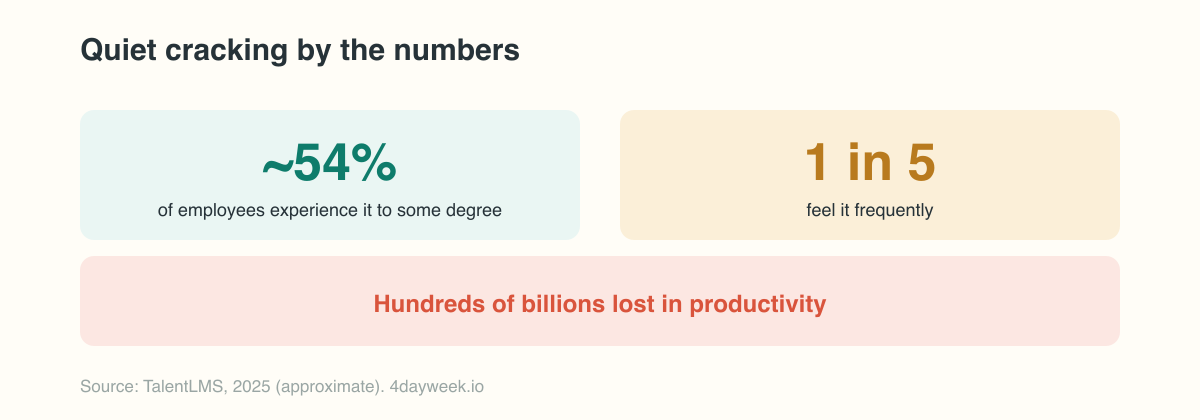
The reason quiet cracking landed as a term is that the data behind it is striking. TalentLMS research (a 2025 survey of employees) found:
- Around half of employees experience quiet cracking to some degree, with roughly one in five feeling it frequently.
- Employees experiencing it are dramatically more likely to feel undervalued and insecure about their jobs.
- People who receive no training or development are far more likely to feel insecure at work, a major driver of the whole thing.
- The estimated cost of the resulting disengagement runs into the hundreds of billions in lost productivity.
Those numbers describe something structural, not a handful of unhappy individuals. When half your workforce is quietly cracking, that is a system telling you something.
Quiet cracking vs burnout vs quiet quitting
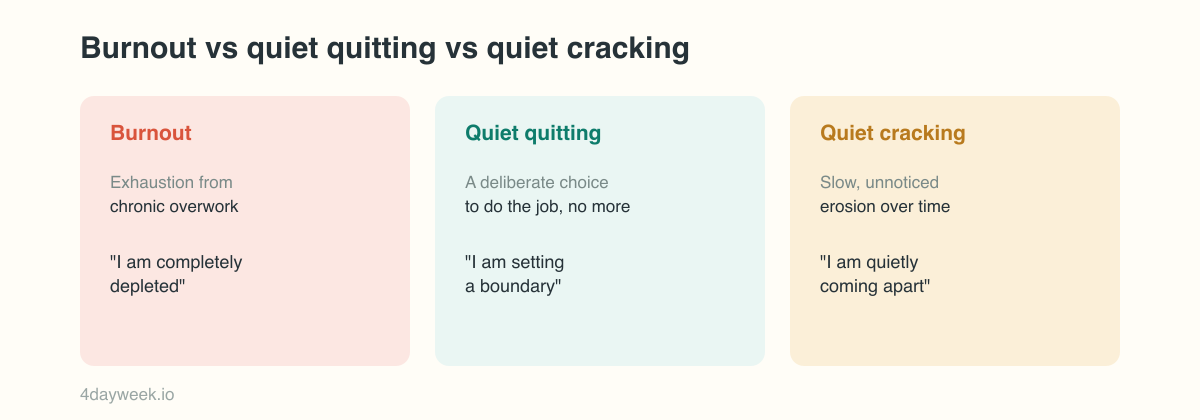
Quiet cracking gets lumped in with its noisier cousins, but it is genuinely distinct, and the differences matter for how you respond.
| What it is | The core feeling | |
|---|---|---|
| Burnout | Exhaustion from chronic overwork and stress | "I am completely depleted" |
| Quiet quitting | A deliberate choice to do the job and no more | "I am setting a boundary" |
| Quiet cracking | Slow, persistent unhappiness that erodes you over time | "I am quietly coming apart, and I am not sure why" |
The key distinctions:
- It is not (just) exhaustion. Unlike burnout, quiet cracking does not always come from being overworked. You can be quietly cracking while your workload is perfectly manageable, because the problem is often meaning, growth and security, not just hours.
- It is not a decision. Quiet quitting is a conscious act of withdrawing extra effort. Quiet cracking is not chosen. It happens to people, gradually, often without them realising until it is well advanced.
- It is harder to see. Both burnout and quiet quitting eventually show up (in sick days, in dropped effort). Quiet cracking can stay invisible for a long time, which is why it does so much quiet damage before anyone acts.
The signs of quiet cracking
Because it is subtle, quiet cracking is easy to miss, in yourself and in others. Watch for:
- A slow fade in enthusiasm for work you used to care about
- Feeling persistently undervalued, or that your effort goes unnoticed
- A creeping sense of being stuck, with no clear path forward
- Low-level anxiety about job security, even without an obvious threat
- Disengaging bit by bit: contributing less, speaking up less, caring less
- A vague, hard-to-name unhappiness that follows you but never quite tips into crisis
Any one of these can be a passing mood. The signature of quiet cracking is the slow, steady accumulation, the sense that the baseline has quietly dropped and stayed down.
What causes quiet cracking?
Quiet cracking grows in the gaps where people stop feeling invested in. The main drivers:
- Job insecurity. Uncertainty about the future (layoffs in the air, unclear expectations, economic anxiety) keeps people in a low, draining state of alert.
- No growth. When there is no learning, no development and no path forward, capable people stagnate and slowly lose heart. This is why a lack of training shows up so strongly in the data.
- Feeling undervalued. Effort that goes unrecognised, contributions that go unnoticed, and a sense that you do not really matter to the organisation.
- Lack of meaning or connection. Work that feels pointless, or a disconnect from colleagues and purpose, leaves nothing to hold onto.
Notice what is mostly absent from that list: raw workload. Quiet cracking is less about being crushed by hours and more about being quietly neglected. It is what happens when a workplace stops actively investing in the people inside it.
How to fix quiet cracking
You cannot fix quiet cracking with a fruit bowl and a wellbeing poster. Because it is driven by security, growth and value, the fixes have to be real.
If you are experiencing it:
- Name it. Recognising "this is quiet cracking, not just a bad month" breaks the spell of thinking something is wrong with you. Usually there is not.
- Get specific. Pin down which of the drivers is biggest for you: insecurity, stagnation, or feeling unseen. Vague unhappiness is hard to act on. A named cause is not.
- Ask for what is missing. A growth conversation, a stretch project, clearer feedback. Sometimes the crack can be repaired where you are.
- Take the signal seriously. If the investment is not coming, and it keeps eroding you, that is real information about whether the job is right.
Work-Life Balance Jobs with Genuinely Reduced Hours
Save one to come back to it — it's free.



If you manage a team:
- Invest in growth. Training, development and a visible path forward are among the strongest antidotes, because they directly counter the insecurity and stagnation at the root of it.
- Recognise people. Specific, genuine acknowledgement of good work does more than any perk.
- Create security and clarity. Straight talk about expectations and the future lowers the background anxiety that feeds quiet cracking.
- Protect people's time and energy. A humane, sustainable week gives people the capacity to stay engaged rather than slowly checking out.
How managers can catch it early
Quiet cracking is a manager's blind spot by design, because the people experiencing it keep showing up and keep saying they are fine. Catching it takes deliberate attention.
- Look for the fade, not the flare. You are watching for a slow decline, less initiative, quieter in meetings, a gradual drop in energy, not a dramatic incident. The change is gradual and easy to miss week to week.
- Ask better questions. "How are you doing?" gets "fine". Questions like "what is getting in your way lately?" or "do you feel like you are growing here?" get closer to the truth.
- Watch your quiet high-performers. The people most at risk are often reliable, capable staff who have stopped being stretched or recognised. Because they still deliver, they are the easiest to neglect.
- Track the drivers, not just the mood. Ask honestly: is this person growing? Do they feel secure? Do they feel valued? Those three levers predict quiet cracking better than any engagement-survey smiley face.
- Make it safe to be honest. People will not admit to quietly cracking in a culture where struggling is risky. Psychological safety is what turns a private erosion into a conversation you can actually act on.
The managers who catch quiet cracking early are the ones who treat "fine" with healthy suspicion and pay attention to the slow signals, rather than waiting for a resignation letter to explain what they missed.
The bigger picture
Quiet cracking is what happens when work stops giving people a reason to stay whole: no growth, no recognition, no security, no meaning. It is a slow leak, and slow leaks are easy to ignore until the tank is empty.
The organisations that do not have a quiet-cracking problem tend to share a trait. They treat people as worth investing in, and they build work around a sustainable life rather than a grind that quietly wears people down. That is a big part of why reduced-hours and four-day-week employers tend to see stronger engagement: when a company competes on how well it treats people, it cannot afford to let them quietly crack.
If you are the one cracking, it is worth remembering the fault usually is not yours. Sometimes the healthiest repair is not trying harder to feel okay in a place that stopped investing in you. It is finding one that will.
Frequently asked questions
What is quiet cracking? A persistent, low-level unhappiness at work that slowly erodes an employee's engagement, confidence and performance over time. It is subtle and often unnoticed, because the person usually keeps showing up and keeps saying they are fine.
How is quiet cracking different from burnout? Burnout is about exhaustion from too much work and stress. Quiet cracking is a slower, quieter erosion driven more by insecurity, stagnation and feeling undervalued than by workload, so you can be quietly cracking even with a manageable job.
How is quiet cracking different from quiet quitting? Quiet quitting is a deliberate choice to do your job and no more. Quiet cracking is not chosen. It happens to people gradually, often without them realising, and it tends to reduce performance rather than being a conscious boundary.
What causes quiet cracking? The main drivers are job insecurity, a lack of growth or development, feeling undervalued, and a loss of meaning or connection at work. Notably, it is often not about excessive hours.
How do you fix quiet cracking? With genuine investment in people: growth and development, real recognition, security and clarity, and humane, sustainable working conditions, rather than surface-level perks.
Quietly coming apart at work? Browse four-day-week and reduced-hours roles at people-first employers on 4dayweek.io.




Get 4-day week jobs in your inbox
Create a free account to receive curated opportunities weekly.
Sign up for freeFree forever. No spam, unsubscribe anytime.