
One company in our dataset takes Thursday off. Exactly one. Every other company running a genuine 4-day week clusters around the same choice, and the distribution is so lopsided it barely qualifies as a competition.
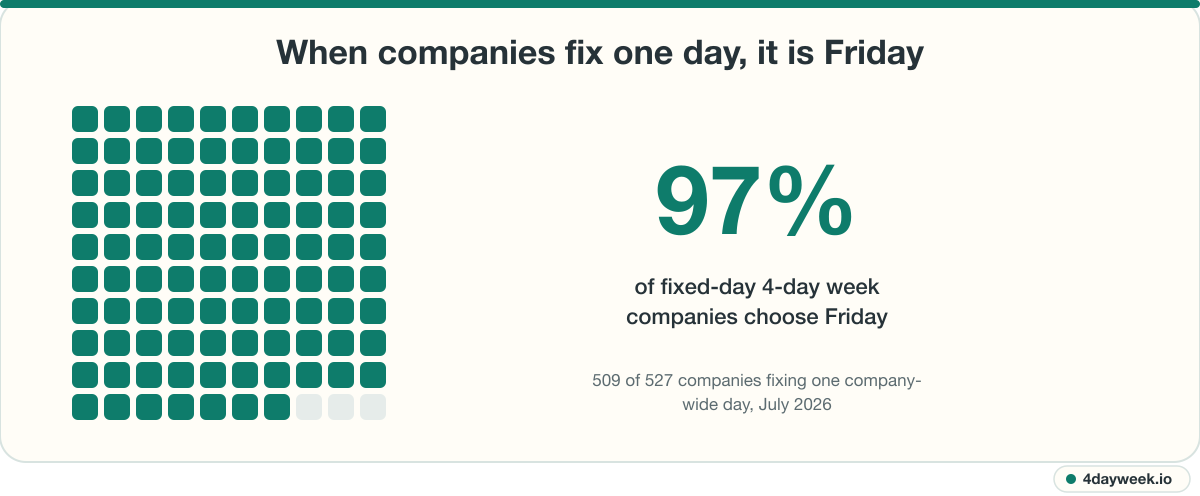
Most 4-day week companies take Friday off. As of July 2026, among 561 full pay 4-day week companies with a recorded day-off policy on our tracker, 509 (91%) choose Friday. Among the 527 that fix a single company-wide day, Friday's share reaches 97%.
That is the short answer. The long answer involves a stampede toward Friday, a small Monday contingent, a government that just mandated the day almost nobody picks voluntarily, and one delightfully contrarian Thursday.
What day do 4-day week companies take off?
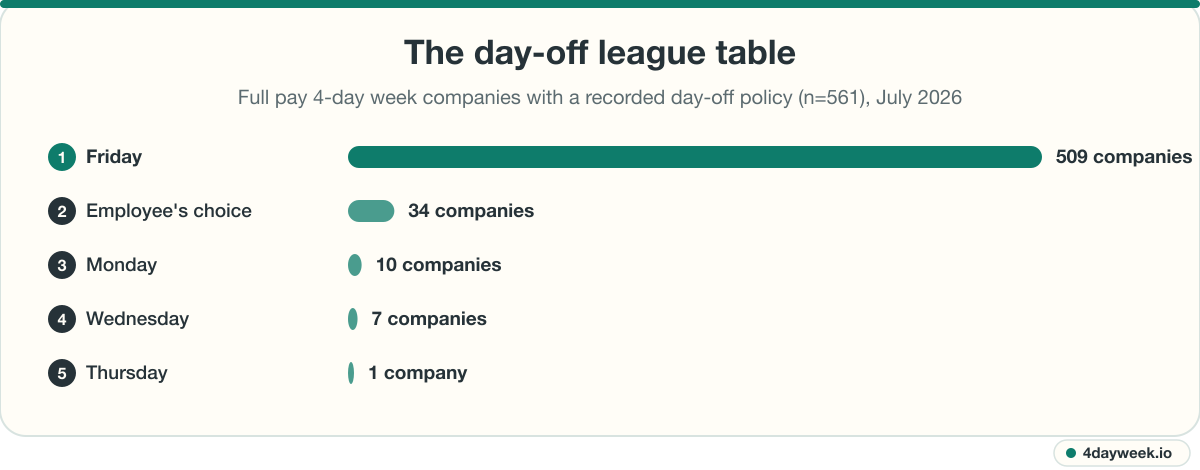 First, the data behind the claim. We track 737 companies with 4-day week (36 hours or less) policies, 364 of them with public evidence links. Of those, 666 run the schedule at full pay and 71 run a pro-rata version at 80% pay. Within the full pay group, 561 have a recorded day-off policy. Here is how they split as of July 2026.
| Day off | Companies | Share (n=561) |
|---|---|---|
| Friday | 509 | 91% |
| Employee's choice | 34 | 6% |
| Monday | 10 | 2% |
| Wednesday | 7 | 1% |
| Thursday | 1 | under 1% |
Two honest cuts of the same numbers. Across everyone with a recorded policy, Friday takes 91% (509 of 561). But "employee's choice" is a policy, not a day. Count only the 527 companies that fix one company-wide day and Friday's share climbs to 97% (509 of 527). Use whichever cut matches the question you are asking; we publish both.
The pro-rata companies lean the same way, with more freedom in the mix. Of the 66 with a recorded day-off policy, 39 close on Fridays, 26 let employees choose, and exactly 1 picks Monday (as of July 2026).
One caveat we would rather name than bury: this is a tracker, not a census. 364 of the 737 companies have public evidence links, 17 are employer-verified with us, and the rest come from public reporting and our own research. If your company runs a Wednesday policy we missed, we want to hear about it.
New to the schedule itself? Our 4-day work week guide covers the definitions: 36 hours or less, and for the full pay version, no salary cut.
Why does Friday win?
 Nobody has run a controlled trial pitting Friday against Wednesday, so treat what follows as reasoning, not settled science. Four forces stack up in Friday's favor.
The three-day weekend is the prize. A consolidated block of rest is the thing people picture when they imagine a shorter week: a real stretch to travel, parent, build, or do absolutely nothing. The strongest wellbeing evidence available points at rest and recovery. In the six-month trials analyzed in Nature Human Behaviour (Fan, Schor, Kelly and colleagues, 2025), burnout fell from 2.83 to 2.38 on a 1 to 5 scale across 2,896 employees at 141 organizations in six countries, with gains driven partly by reduced fatigue and fewer sleep problems. The study measured income-preserving 4-day weeks as a whole rather than the choice of day, but it fits the intuition that an unbroken stretch of recovery is where the value lives.
Coordination is cheapest on Friday. Clients, partners and sister teams expect responses Monday to Thursday. Many white-collar workplaces already treat Friday as the soft day: fewer meetings, lighter deadlines, quieter inboxes. Closing the day that carries the least collaborative load costs the least.
One shared day keeps operations simple. If everyone is off together, there is no coverage rota to manage and no spreadsheet tracking who is in. Meetings compress into four shared days, which forces exactly the calendar pruning most 4-day companies rely on anyway.
Shutdown economics favor a full stop. A company-wide day off means no commutes, and for office-based teams, a building that can go dark for the day. That point is first principles rather than a study we can cite. But two governments reached for this exact lever in 2026, at national scale. More on that below.
There is also the recruiting angle. "We take Fridays off" needs zero explanation in a job ad. It is legible in a way that "flexible Fridays, manager permitting" never will be.
Is Monday or Wednesday ever the smarter day off?
The voluntary numbers are stark: 10 companies pick Monday, 7 pick Wednesday, and 1 picks Thursday (n=561, as of July 2026). But the minority case deserves a fair hearing.
The Wednesday argument says recovery should be spaced, not pooled. Two short sprints with a rest day in the valley between them, so energy never sags into a midweek slump. The Monday argument extends the weekend from the other side, kinder to weekend travelers and slow Sunday nights. Both sound plausible. We have found no controlled research showing either beats Friday on wellbeing or output, so we file this under open questions that practitioners genuinely debate.
Monday carries one practical quirk worth knowing: in the US and UK, a good number of public holidays already land on Mondays, so a Monday-off policy partly overlaps with days the team would have had off anyway.
Revealed preference remains the loudest signal in our data. When companies choose freely, 97% of those fixing a single day choose Friday (509 of 527, July 2026).
Why did Sri Lanka mandate Wednesdays off?
Here is the twist. In March 2026, the day almost no company picks voluntarily became the most talked-about day off in the world.
Facing fuel shortages amid the Middle East crisis, Sri Lanka's President Anura Dissanayake ordered a public-sector 4-day week with Wednesdays declared public holidays, effective immediately, covering government agencies and educational institutions. Hospitals, ports and emergency services were exempt, and officials cited roughly six weeks of fuel reserves (Seoul Economic Daily, March 17, 2026).
Why Wednesday? Sri Lanka's Ministry of Public Administration explained that Friday was rejected because it would create a three-day shutdown from Friday through Sunday and disrupt work continuity (as reported by Open, March 2026). Read that next to our table. Companies pick Friday because a full three-day stop is exactly what they want to give people. A government in crisis picked Wednesday because a full three-day stop was exactly what it could not afford. Same calendar shape, opposite goal. It is the clearest natural experiment yet in what the day-off choice is actually for.
To be clear about what this is: a crisis shutdown measure to save fuel, not a permanent 100:80:100 policy, and nobody should score it as a wellbeing experiment.
Work-Life Balance Jobs with Genuinely Reduced Hours
Save one to come back to it — it's free.

The Philippines moved the same month, differently. Memorandum Circular 114, effective March 9, 2026, put national government agencies on a 4-day onsite arrangement through a compressed workweek or one work-from-home day, to conserve energy (GMA News). The Civil Service Commission's guidelines of July 16, 2026 confirm employees "still complete 40 hours a week" (Manila Times). That is a 4x10, not a genuine 4-day week: the same hours folded into fewer days. The distinction matters enough that we keep a dedicated explainer on 4x10 versus the 4-day week.
What if employees pick their own day off?
Not every company fixes a day. 34 of the 561 full pay companies (6%) let each person choose their own day off, and in the pro-rata group the model is far more common: 26 of 66 companies, or 39% (as of July 2026).
The appeal is obvious. A parent might want Wednesday to match the school week. A climber wants Friday for long weekends in the mountains. Client-facing teams keep five-day coverage without anyone working five days.
The costs are real too. The company never fully exhales together, the quiet shared day disappears, and scheduling meetings turns into calendar Tetris. It also muddies the recruiting message, because a candidate reading the ad cannot picture their week until they ask. Coverage math can quietly pressure new joiners toward whichever day nobody else wanted. And there is a third model you will meet in the wild: the rota, where half the team takes Friday and half takes Monday, alternating, so the business stays open five days while everyone still works four.
What should you check before accepting a 4-day week job?
Five questions worth asking before you sign.
- Fixed day, rota, or choice? All three appear in our tracker, and they feel very different to live with. A fixed Friday is a promise; a rota is a negotiation; choice is freedom with coordination costs.
- Is pay 100% or pro-rata? Of the 737 companies we track, 666 run the schedule at full pay and 71 pay 80%. Both are legitimate offers. They are not the same offer.
- Is the day protected? Ask what happens in crunch weeks, whether meetings creep onto the off day, and whether anyone senior actually takes it.
- Policy or pilot? 364 of the 737 companies have public evidence links and 17 are employer-verified with us. Either way, get the policy in writing before you resign anything.
- Every week or every other? A 9-day fortnight hands back every second Friday rather than all of them. Still a real schedule, just a different one.
And know the competition before you stroll in casually. Genuine 4-day week jobs drew 5.1 apply clicks per live job over a 60-day window as of July 2026, versus 0.42 for jobs offering 5-day flexibility perks: roughly 12x the pull per vacancy. We unpack the full picture in our demand versus supply analysis.
When you are ready, browse the live jobs. Every listing shows its schedule type on the card, so you can see who actually gives Friday back before you click a thing.
Frequently asked questions
Do all 4-day week companies take the same day off? No, but it is close. As of July 2026, 91% of full pay 4-day week companies with a recorded day-off policy close on Fridays (509 of 561). Another 34 let employees choose their day, 10 pick Monday, 7 pick Wednesday, and 1 picks Thursday.
Is a compressed 4x10 the same as a 4-day week? No. A 4x10 packs 40 hours into four days. A genuine 4-day week is 36 hours or less, and at the 666 full pay companies we track, it comes with no salary cut. We always report the two separately.
Does research say which day off is healthiest? Not yet. The six-month trials in Nature Human Behaviour (2025) found burnout fell from 2.83 to 2.38 on a 1 to 5 scale (2,896 employees, 141 organizations, six countries), but they tested the income-preserving 4-day week as a whole, not Friday against other days. Day-off choice is still an open question.
Can I get a 4-day week without changing jobs? Sometimes, and it is worth trying first. Our guide on how to ask your boss for a 4-day week walks through the business case, the trial framing, and the evidence to bring to the meeting.
The data says Friday. The job board tells you who is giving it back.




Get 4-day week jobs in your inbox
Create a free account to receive curated opportunities weekly.
Sign up for freeFree forever. No spam, unsubscribe anytime.