
Most people asking for flexible working don't realise they're standing on a legal right.
They send a nervous email, hope for the best, and treat a "no" as final.
It doesn't have to be. In the UK, requesting flexible working is a day-one legal right, and the rules around it just got stronger. This guide is the plain-English version of what the law actually gives you in 2026: the right to request, the narrow set of reasons an employer can say no, the brand-new "reasonableness" test, and exactly what to do if you're refused.
(This is general guidance for the UK, not legal advice. For your own situation, check Acas and gov.uk.)
Is flexible working a legal right in the UK?
Two things often get muddled, so let's separate them:
- You have a legal right to request flexible working. ✅
- You do not have an automatic right to get it. ❌
Your employer must consider a request properly and can only refuse for specific business reasons (below). But they can still say no if one of those reasons genuinely applies.
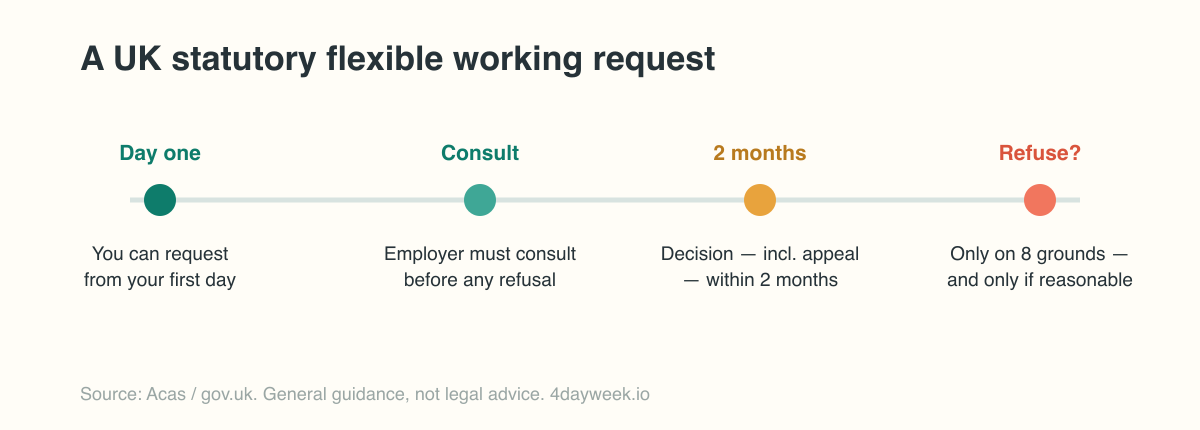
The big change: since 6 April 2024, this is a day-one right. You used to need 26 weeks' service before you could even ask. Not any more, you can request from your first day in the job.
What the law gives you
Under the current rules, a statutory flexible working request comes with real protections:
- Day-one right. No qualifying service period.
- Two requests per year. You can make two statutory requests in any rolling 12-month period (up from one).
- A two-month decision window. Your employer must deal with your request, including any appeal, within two months, unless you both agree to extend it.
- A duty to consult. Your employer must consult you before turning a request down, no silent rejections.
- No need to plead your case. You no longer have to explain what effect your request might have on the business, or how to deal with it. (You still can, and it helps, but you don't have to.)
A "statutory" request just means one that formally invokes these rights: put it in writing, date it, state that it's a statutory flexible working request, say what change you want and when you'd like it to start.
The new 2025 "reasonableness" test
Here's the part that's genuinely new, and the reason 2026 is a good time to understand your rights.
Under the Employment Rights Act 2025, an employer will no longer be able to simply cite one of the eight grounds and be done. They'll only be able to refuse where it is reasonable to do so, and they'll have to explain why they consider the refusal reasonable.
In plain terms: the bar for saying "no" is rising. A refusal that's vague, box-ticking, or not properly thought through is on far shakier ground than it used to be. (The exact commencement date and the updated Acas Code are being finalised, check Acas for the current position.)
The 8 grounds an employer can refuse on
An employer can only reject a statutory request for one (or more) of these eight business reasons:
| # | Ground for refusal |
|---|---|
| 1 | The burden of additional costs |
| 2 | A detrimental effect on ability to meet customer demand |
| 3 | Inability to reorganise work among existing staff |
| 4 | Inability to recruit additional staff |
| 5 | A detrimental impact on quality |
| 6 | A detrimental impact on performance |
| 7 | Insufficiency of work during the periods you propose to work |
| 8 | Planned structural changes |
If the reason you're given doesn't genuinely fit one of these, and, increasingly, isn't reasonable, the refusal may be open to challenge.
What counts as "flexible working"?
Flexible working is much broader than "working from home". A statutory request can cover any change to when, where or how much you work, including:
- A four-day week or a nine-day fortnight
- Compressed hours (your full hours in fewer days)
- Part-time or reduced hours
- Flexible start and finish times (flexi-time)
- Remote or hybrid working
So the same legal route that gets you home two days a week can also get you a shorter working week. It's the mechanism behind a lot of reduced-hours arrangements.

How to make a request that gets a "yes"
The law gives you the right to ask. Whether you get a yes still comes down to how you ask. The strongest requests do three things:
1. Make the business case, not just the personal one. You don't legally have to, but showing how the arrangement still gets the work done (or done better) makes it far easier to approve.
2. Solve the cover problem. Pre-empt the eight grounds. Explain who covers what, how customers are still served, how quality holds up. You're handing your manager the answers to their own objections.
3. Put it in writing, properly. A clear, dated, statutory request starts the two-month clock and creates a record. If you'd like the wording, see our flexible working request email template, this rights guide tells you what you're entitled to; the template shows you how to write the ask.
What your written request should include
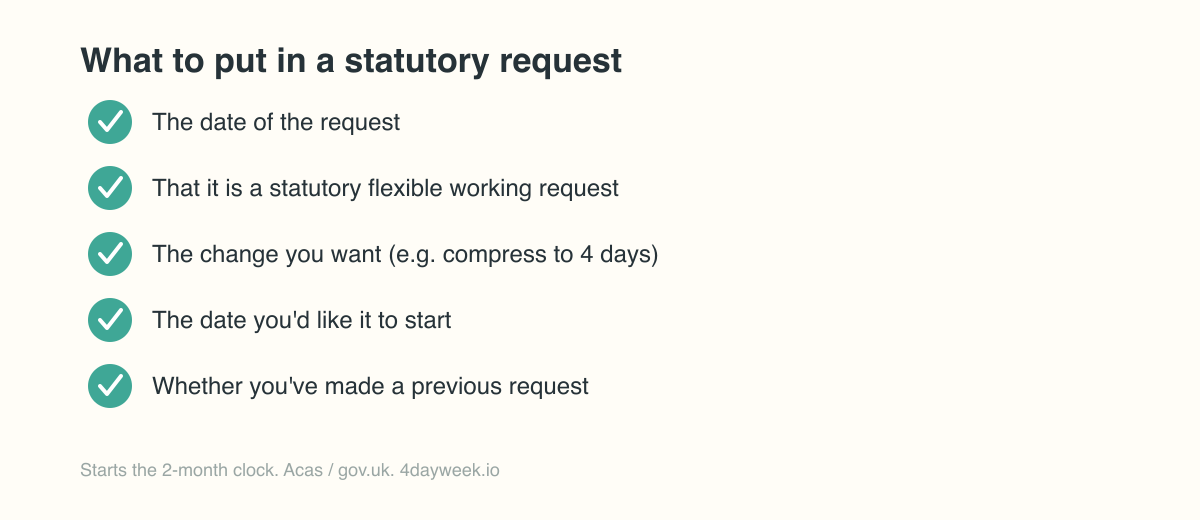
To count as a statutory request, and start the two-month clock, put it in writing and include:
- The date of the request.
- A line stating it is a statutory request for flexible working.
- The change you're asking for (for example, "compress my hours into four days" or "work from home three days a week").
- The date you'd like it to start.
- Whether you've made a previous statutory request, and when.
Work-Life Balance Jobs with Genuinely Reduced Hours
Save one to come back to it — it's free.


You're no longer legally required to explain the effect on the business or how it could be dealt with, but voluntarily addressing it is one of the best ways to get a yes.
Strong request vs weak request
The law is the same for everyone; the outcome often isn't. The difference is usually in the framing:
| Weak request | Strong request |
|---|---|
| "I'd prefer to work from home." | "I'd like to work from home three days a week from March, keeping Tuesdays and Thursdays in the office for team days." |
| No mention of the work | "Here's how I'll stay reachable and how my output stays the same or improves." |
| Silent on cover | "Here's how my responsibilities are covered on my non-office days." |
| Vague timing | A clear start date and a suggested trial period |
Offering a trial period is especially powerful, it lowers the risk for your employer and gives you a track record to point to.
A note on being treated unfairly
You're protected for making a request. An employer must not treat you badly, or dismiss you, because you asked for flexible working. If a request is handled unreasonably, refused on wrong facts, or you're penalised for making one, that's when Acas and, potentially, an employment tribunal come in.
What to do if your request is refused
A "no" isn't necessarily the end.
- Ask for the specific ground. They must tell you which of the eight reasons applies, and, under the new rules, why it's reasonable.
- Appeal. Many employers offer an appeal, and any appeal still has to fit inside the two-month window. Use it to address their stated concern head-on.
- Check it was handled properly. If your employer didn't deal with the request reasonably, didn't decide within the time limit, or relied on incorrect facts, you may be able to take a claim to an employment tribunal. Acas can advise, and Acas early conciliation is usually the first step.
- Reapply later. You get two requests a year, a refusal now doesn't stop a stronger request in a few months, especially if circumstances change.
And if the answer is a hard, unreasonable no in a role that won't budge? That's information. Plenty of employers have already built flexible and reduced-hours working into how they operate, no fight required.
Frequently asked questions
Do I have a legal right to flexible working in the UK? You have a day-one right to request it (since 6 April 2024). You don't have an automatic right to receive it, but your employer can only refuse on one of eight business grounds, and, under the Employment Rights Act 2025, only where it's reasonable.
How many flexible working requests can I make? Two statutory requests in any rolling 12-month period.
How long does my employer have to respond? Two months from your request to a final decision, including any appeal, unless you both agree to extend it.
Can my employer just say no? Only for one of the eight statutory business reasons, and increasingly only where that refusal is reasonable and explained. A vague or unreasonable refusal may be challengeable.
Does flexible working include a four-day week? Yes. A statutory request can cover a four-day week, a nine-day fortnight, compressed or part-time hours, flexi-time, and remote or hybrid working, any change to when, where or how much you work.
Want an employer who already says yes? Browse four-day-week, compressed and flexible-hours jobs on 4dayweek.io →




Get 4-day week jobs in your inbox
Create a free account to receive curated opportunities weekly.
Sign up for freeFree forever. No spam, unsubscribe anytime.