
Some of your best work almost certainly happened in a couple of undisturbed hours. No meetings, no pings, just you and a hard problem, and at the end of it something genuinely good. Now think about how many of your working days contain any of that at all.
Deep work is the name for those rare, high-value stretches, and for a way of working that deliberately protects them. It rests on a claim that should worry anyone who measures their job in hours: if focused output is what actually moves your career and your company forward, then most of a long, scattered day is padding.
Deep work is professional activity performed in a state of distraction-free concentration that pushes your cognitive abilities to their limit. The term was coined by author Cal Newport, who contrasts it with shallow work: logistical, low-value tasks usually done while distracted.
What is deep work?
The idea comes from Cal Newport, a computer-science professor at Georgetown University, in his 2016 book Deep Work: Rules for Focused Success in a Distracted World. He defines deep work as the professional activities you perform in a state of distraction-free concentration that push your cognitive capabilities to their limit. These efforts, he argues, create new value, improve your skill, and are hard to replicate.
Set against it is shallow work: the logistical, non-cognitively-demanding tasks, often performed while distracted, that keep a working day ticking over without producing much of lasting worth. Answering routine email, sitting in status meetings, formatting a document, chasing an update. None of it is useless exactly. It is just low in value, easy for almost anyone to do, and quietly capable of eating a whole week.
Newport's argument is not that shallow work should vanish. It cannot. His argument is that most knowledge workers have the ratio badly wrong, spending their days almost entirely shallow, then wondering why the important, difficult things never get finished. Deep work is the deliberate correction: protecting real, uninterrupted time for the work that actually counts.
Deep work vs shallow work
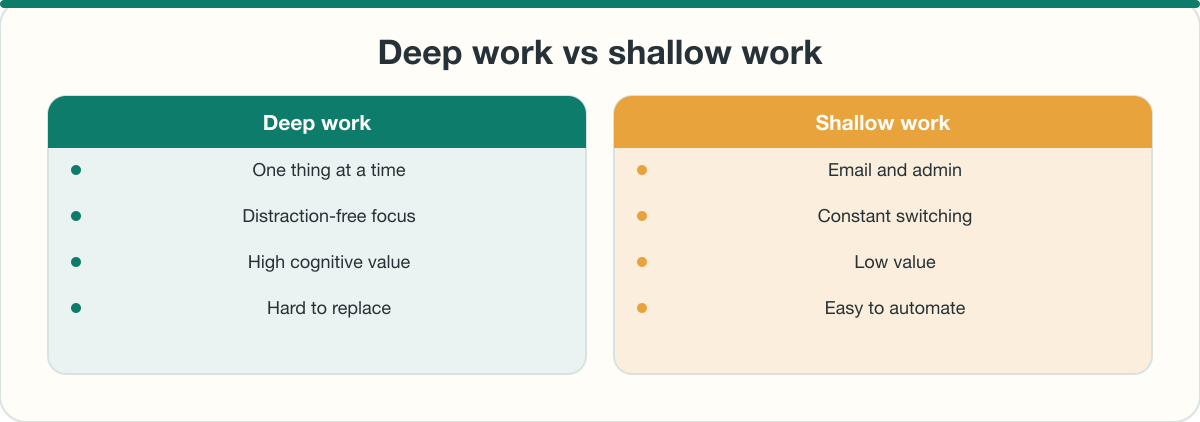 The clearest way to see the difference is side by side. Not every task is one or the other, but most lean firmly in one direction, and being honest about which is the first step to rebalancing your week.
| Deep work | Shallow work | |
|---|---|---|
| What it is | Cognitively demanding work done in full focus | Logistical, low-effort tasks |
| Attention required | Distraction-free, single task | Fragmented, often done while distracted |
| Value created | High, and hard for others to replicate | Low, and easy to replicate |
| Typical examples | Writing, coding, design, analysis, strategy, real problem-solving | Most email, status meetings, admin, chasing updates |
| Effect on your skill | Compounds it over time | Leaves it flat |
| How it feels | Effortful, absorbing, satisfying | Busy, easy, oddly draining |
The trap is that shallow work feels productive. Clearing forty emails gives you a visible pile of "done". A morning of deep work on one hard problem can look, from the outside, like you barely did anything. Yet one of those mornings usually matters more than a fortnight of inbox triage. Busyness and output are not the same thing, and confusing them is how talented people stay stuck.
Why does deep work matter more now?
Two trends are pulling in opposite directions, and the gap between them is where the opportunity sits.
The first is that the valuable work is getting deeper. As routine tasks get automated or commoditised, the work that pays well and that machines cannot easily do is the demanding, creative, analytical kind. The exact work that needs sustained focus.
The second is that the modern workplace is getting shallower. Open-plan offices, always-on chat, the expectation of an instant reply, back-to-back video calls: most jobs are now engineered to interrupt you constantly. Interruptions are expensive. Research by Gloria Mark at the University of California, Irvine has found it takes a long time to fully refocus after a single interruption, and we dig into those numbers in our piece on context switching. Stack up dozens of switches a day and the deep hours simply never happen.
So the people and companies who can still concentrate hold a growing advantage, precisely because the ability is becoming rare. This is also why the fight over where and how we work matters so much. Some of the strongest objections to blanket office mandates, which we cover in our guide to the return to office debate, come down to a simple point: a noisy open-plan floor is often the worst possible place to do work that needs quiet and focus.
How do you actually do deep work?
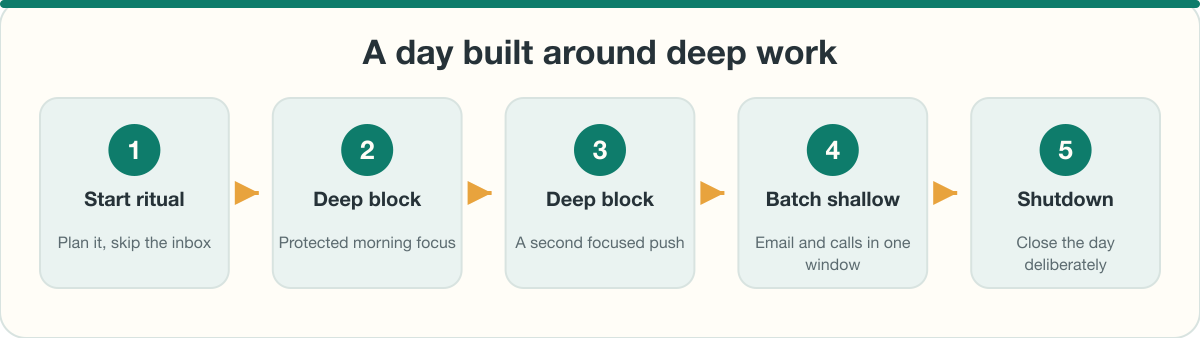 Deep work is a skill, not a personality trait. You build it with structure, not willpower. A handful of practices do most of the heavy lifting.
-
Block the time on purpose. Deep work rarely happens by accident in the gaps of a busy day, because there are no gaps. You have to schedule it. Put one or two protected blocks in your calendar, ideally 60 to 90 minutes, and treat them as real appointments. Morning tends to work best, before the day fills with other people's demands.
-
Single-task, ruthlessly. Deep work and multitasking cannot coexist. During a block, you do one thing and only that thing. Everything else waits. This is monotasking applied with intent, and it is the core mechanic of going deep.
-
Practise notification hygiene. You cannot concentrate next to a device built to fragment your attention. Close every tab and app you do not need. Silence notifications. Put the phone in another room, not just face down. The mere presence of a phone within reach has been shown to reduce available attention even when you are not touching it.
-
Build a start ritual. A short, repeatable routine tells your brain it is time to go deep. Same place, same time, a specific first action, maybe a particular drink. Rituals reduce the friction of starting, which is where most deep sessions die.
-
Batch the shallow work. You still have to answer email and attend to admin. Do it in a couple of dedicated windows a day rather than letting it interrupt everything. Batching keeps the shallow work from colonising the hours that should be deep.
-
Run a shutdown routine. Newport recommends a firm end to the working day: review what is done, capture loose threads on tomorrow's list, and then genuinely stop. A clean shutdown stops work from bleeding into your evening as low-grade background anxiety, and it means you start the next day sharp rather than frayed.
If you struggle to sit still for a full block, start smaller. A single focused sprint, even 25 minutes with a timer, builds the muscle. The pomodoro technique is a simple on-ramp for exactly this, and the length of the block matters less than the fact that nothing interrupts it.
Work-Life Balance Jobs with Genuinely Reduced Hours
Save one to come back to it — it's free.



What are the four deep-work philosophies?
Newport also sketches four ways to fit deep work into a real life, and it helps to know which one suits yours rather than forcing a single template.
The monastic approach cuts out shallow work almost entirely, suited to people whose value comes from one deep pursuit. The bimodal approach carves the calendar into long deep stretches, say a few days, then opens the rest to everything else. The rhythmic approach, the most practical for most jobs, makes deep work a daily habit at the same time each day so it becomes automatic. The journalistic approach drops into deep work whenever a gap appears, which is effective but demanding, because switching into focus at a moment's notice is a hard skill in itself.
Most people should start rhythmic. A consistent daily block asks the least of your willpower, because after a couple of weeks you are not deciding to do it, you just do.
How does deep work make a shorter week possible?
Here is where deep work stops being a productivity tip and becomes an argument about the whole shape of work.
If the genuinely valuable output happens in a few focused hours, then the rest of a long day is not where the value is. It is padding: shallow tasks, half-attention, meetings that could have been a message, and the slow leak of switching between all of it. A person doing four hours of real deep work surrounded by four hours of shallow busywork is, in the ways that matter, doing about four hours of work.
This dovetails with Parkinson's Law, the observation that work expands to fill the time available. Give a task a full day and it takes a full day. Give it a tight, focused block with a firm deadline and it often gets done in a fraction of the time, because the padding has nowhere to hide. Deep focus plus a real constraint is a genuinely powerful combination.
Follow that logic all the way and you arrive at the four-day week. A four-day week is, in a sense, deep work applied to the whole week: strip out the slack, protect the focus, and judge people on what they produce rather than how many hours they are visibly present. The companies running it well tend to report that output holds or even rises, because the extra day off forces exactly the ruthless prioritising that deep work demands. Fewer meetings, less busywork, more protected attention.
That is why this is not only a personal skill. You can be a deep-work devotee and still spend your days fragmented if the culture around you rewards constant availability over real output. The best environments protect focus by design. If you want to work somewhere that treats concentration as the point rather than an inconvenience, you can browse four-day-week and reduced-hours roles on 4dayweek.io.
Frequently asked questions
What is deep work? Deep work is professional activity performed in a state of distraction-free concentration that pushes your cognitive abilities to their limit. The term comes from Cal Newport. It stands in contrast to shallow work, the low-value logistical tasks like most email and meetings that are usually done while distracted.
Who came up with the term deep work? Cal Newport, a computer-science professor at Georgetown University, popularised it in his 2016 book Deep Work: Rules for Focused Success in a Distracted World. He argues that the ability to focus deeply is becoming both more valuable and more rare.
How do I start doing deep work? Schedule one or two protected blocks of 60 to 90 minutes, work on a single task with all notifications off and your phone out of the room, and batch shallow tasks like email into separate windows. Start with shorter focused sprints if a full block feels like too much, and build from there.
Does deep work mean working longer hours? No, usually the opposite. The point of deep work is that a few genuinely focused hours produce more than a long, scattered day. Done well, it lets you finish the valuable work in less time, which is the same logic behind compressed schedules and the four-day week.
Want a job that protects your focus instead of fragmenting it? Browse four-day-week and reduced-hours roles on 4dayweek.io.




Get 4-day week jobs in your inbox
Create a free account to receive curated opportunities weekly.
Sign up for freeFree forever. No spam, unsubscribe anytime.