
Right now, you might be reading this with eleven tabs open, a chat pinging, and half an ear on a meeting. It feels efficient. Look at all the things being handled at once.
Except almost nothing is actually being handled. Your attention is just bouncing between them, paying a small tax on every jump, and doing all of it slightly worse than if you did one at a time.
Monotasking is the quiet rebellion against that. It is the underrated skill of doing one thing at a time, fully, and it turns out to be far more productive than the frantic juggling we have come to treat as normal. Here is why multitasking fails, what single-tasking gives you, and how to actually do it.
What is monotasking?
Monotasking, also called single-tasking, is the practice of focusing your full attention on one task at a time until it is done or you reach a natural stopping point, rather than splitting your attention across several things at once.
It sounds almost too simple to need a name. But in a world engineered for constant interruption, doing one thing at a time has become a genuine skill, and an increasingly rare one. Monotasking is the deliberate choice to close the other tabs, silence the notifications, and give a single task the undivided attention it needs.
Why multitasking is a myth
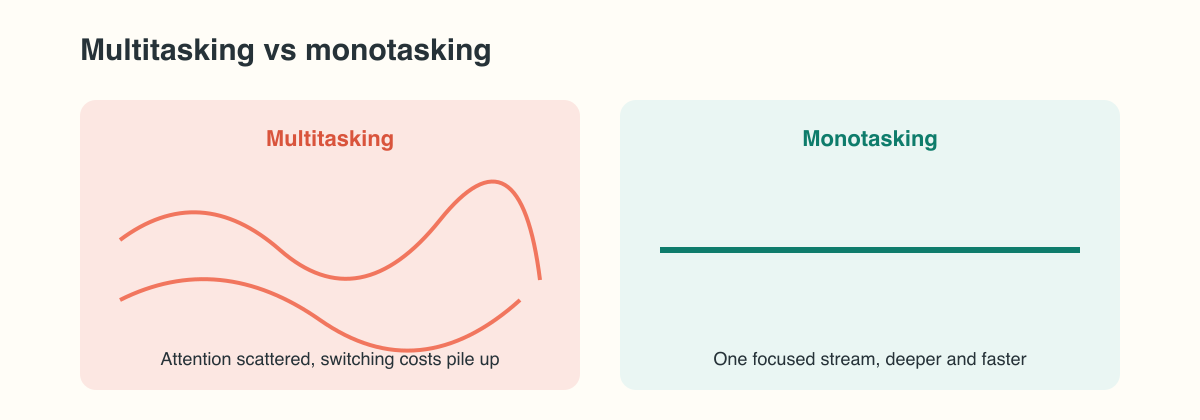
Here is the uncomfortable truth that decades of research keeps confirming: for anything that requires real thought, you cannot actually multitask.
The brain does not process two demanding tasks simultaneously. What it does instead is switch rapidly between them, and every switch carries a cost. Each time you jump from writing to email to a chat message and back, your brain has to disengage from one context and reload another. That reloading takes time and mental energy, and it does not happen cleanly. A residue of the last task lingers, so you are never fully present on the new one.
Stack up hundreds of these switches a day and the cost is enormous. Studies of attention have estimated that constant task-switching can waste a substantial portion of the working day and significantly increase errors. Other research has found it can take many minutes to fully refocus after an interruption. What feels like efficient juggling is actually a slow, leaky, error-prone way to work.
The "multitasking" that does work is combining a mindless task with a thinking one, like walking while talking. The moment both tasks need real attention, you are not multitasking. You are just switching, and paying for it.
The benefits of monotasking
When you stop switching and start single-tasking, several things improve at once:
- Better quality work. Undivided attention catches nuance, spots errors, and produces more thoughtful output.
- Faster completion. Counterintuitively, doing tasks one at a time usually finishes them sooner than juggling, because you are not paying the switching tax over and over.
- Less mental fatigue. Constant switching is exhausting. Focusing on one thing is far less draining, so you have more left at the end of the day.
- Deeper focus. Monotasking is the doorway to "deep work", the state of absorbed concentration where your best and most valuable work happens.
- Lower stress. The scattered, always-behind feeling of juggling ten things eases when you are genuinely handling one.
- More presence. The habit spills into life. Single-tasking a conversation or a meal, actually being there for it, is its own quiet upgrade.
How to start monotasking
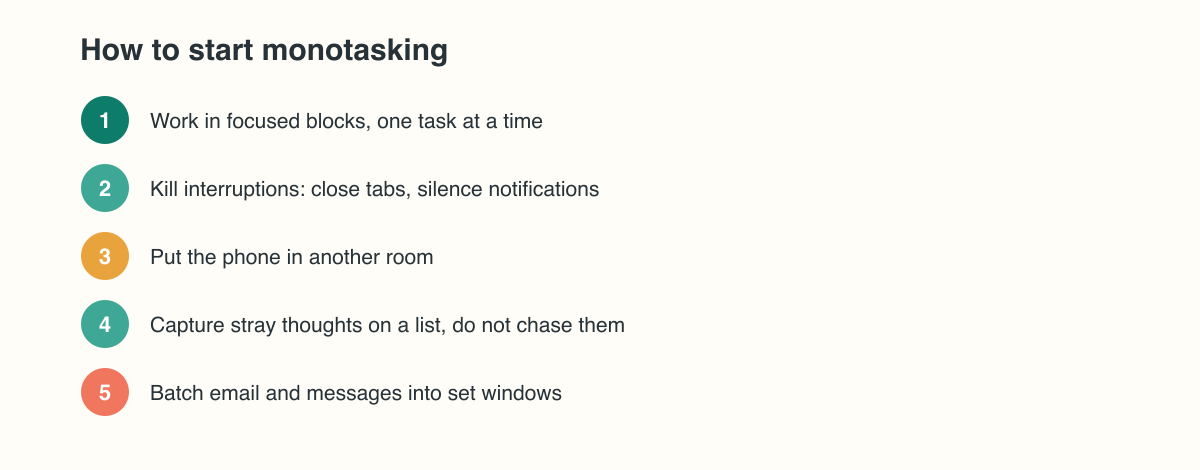
Monotasking is simple in theory and hard in a world built to interrupt you. A few practices that make it stick:
- Work in focused blocks. Give a single task a protected slot (say 30 to 90 minutes) and do only that. Time-blocking your day into single-task chunks is the backbone of monotasking.
- Kill the interruptions. Close every tab and app you do not need. Silence notifications. Put the phone in another room. You cannot monotask next to a device engineered to fragment your attention.
- One thing on the screen. Full-screen the task you are doing. Out of sight really is out of mind.
- Capture, do not chase. When a stray thought or new task pops up mid-focus, jot it on a list and return to it later, rather than switching to it now. This protects the focus without losing the idea.
- Batch the small stuff. Group shallow tasks like email and messages into a couple of dedicated windows a day, instead of letting them interrupt everything.
- Start small. If constant switching is your default, begin with a single 25-minute focused block and build from there. The focus muscle strengthens with use.
Monotasking and your phone
Any honest discussion of monotasking has to talk about the single biggest obstacle to it: the smartphone.
Modern phones and apps are engineered, deliberately and expensively, to fragment your attention. Notifications, badges, infinite feeds and the little dopamine hit of a new message all exist to pull you away from whatever you are doing. You are not weak-willed for struggling to focus next to one. You are up against billion-dollar design.
This is why the most effective monotasking habit is often physical distance from the phone. Not just silencing it, but putting it in another room while you work. Out of reach genuinely beats out of sight, which beats face-down-but-buzzing. The mere presence of a phone on the desk has been shown to reduce available attention, even when it is not being used.
The same goes for your computer. The browser with twenty tabs, the chat app in the corner, the email tab you "just keep open", each is a small open door to distraction. Monotasking often comes down to a simple, slightly ruthless act: closing the doors. One task, one window, nothing else within reach.
Common objections to monotasking
A few push-backs come up often, and they are worth answering:
- "But my job requires me to juggle." Some roles do involve responding to many inputs. But even then, most people have some work that deserves deep focus, and the fix is to protect blocks for it, not to abandon focus entirely. Juggling all day, every day, is usually a sign of a poorly designed workflow, not an inevitability.
- "I get bored focusing on one thing." That restlessness is often withdrawal from constant stimulation, not genuine boredom. It tends to fade within a few minutes of settling into a task, and gets easier the more you practise.
- "Multitasking makes me feel productive." It does, and that is exactly the trap. The feeling of busyness is not the same as the reality of output. Monotasking often feels calmer and slower while actually producing more.
Work-Life Balance Jobs with Genuinely Reduced Hours
Save one to come back to it — it's free.



Monotasking, deep work and Parkinson's Law
Monotasking is not a standalone trick. It is the foundation of a more focused way of working.
It is the entry point to deep work, the practice of long, uninterrupted concentration on cognitively demanding tasks, which is where the highest-value work tends to get done. You cannot go deep while switching every ninety seconds. Monotasking is what makes depth possible.
It also pairs neatly with Parkinson's Law, the observation that work expands to fill the time available. When you combine a tight, focused block (monotasking) with a firm deadline, you get a powerful effect: the work compresses, the padding falls away, and you produce a surprising amount in a short, concentrated burst. This is a big part of why a shorter, focused working day can match or beat a long, scattered one.
The workplace catch
Here is the honest limitation. You can be a monotasking devotee and still spend your days fragmented, because most workplaces are actively hostile to focus.
Open-plan offices, always-on chat, the expectation of instant replies, back-to-back meetings: modern work is often designed to interrupt you constantly, then wonders why nothing deep gets done. You can silence your own notifications, but you cannot always silence a culture that treats a two-minute response time as a measure of commitment.
So while monotasking is a genuinely valuable personal skill, it thrives or dies on the culture around it. The workplaces that get the most out of people are increasingly the ones that protect focus: fewer meetings, no expectation of constant availability, and a respect for uninterrupted work. It is the same instinct behind the four-day week, which forces exactly this kind of ruthless focus by removing the slack that scattered, switch-heavy work hides in. Give people fewer hours and protected attention, and monotasking stops being a personal struggle and becomes just how the work gets done.
Frequently asked questions
What is monotasking? Focusing your full attention on one task at a time until it is done or reaches a natural break, instead of juggling several tasks at once. It is also called single-tasking.
Is multitasking really bad for productivity? For anything requiring real thought, yes. The brain does not do two demanding tasks at once, it switches between them, and each switch costs time and energy and increases errors. Constant switching can waste a large share of the working day.
What are the benefits of monotasking? Better-quality work, faster completion, less mental fatigue, deeper focus, lower stress and more presence. Doing one thing well usually beats doing several things at once, badly.
How do I start monotasking? Work in focused time blocks on a single task, close unnecessary tabs and silence notifications, keep one thing on your screen, capture stray thoughts on a list instead of chasing them, and batch small tasks like email into set windows.
How is monotasking related to deep work? Monotasking is the foundation of deep work. You cannot reach long, absorbed concentration while switching constantly, so single-tasking is what makes genuinely deep, high-value work possible.
Want a job that protects your focus instead of fragmenting it? Browse four-day-week and reduced-hours roles on 4dayweek.io.




Get 4-day week jobs in your inbox
Create a free account to receive curated opportunities weekly.
Sign up for freeFree forever. No spam, unsubscribe anytime.