
There's a particular kind of tired that a two-week holiday can't touch.
You come back, clear your inbox, and by Wednesday it's as if you never left.
For a growing number of people, the answer isn't another holiday. It's a career break, a deliberate step away from work for months, or even a couple of years, to travel, retrain, care for family, recover, or just think.
It sounds terrifying and indulgent in equal measure. It's neither, if you plan it. This guide covers what a career break actually is, how to fund one, how to explain the gap to future employers, and how to come back, ideally into work that doesn't leave you needing another break.
What is a career break?
A career break is an extended, intentional period away from paid work, typically anywhere from a few months to two years, after which you intend to return to your career.
The key words are intentional and return. This isn't drifting or unemployment. It's a planned pause with a plan to come back.
People take them for all kinds of reasons:
- Travel or a long-held personal project
- Caring for children or relatives
- Study, retraining or a career pivot
- Recovering from burnout or illness
- Simply resetting after a decade at full tilt
There's no single right reason. The only thing that separates a career break from just "being out of work" is that you're driving it.
Types of career break
Not all breaks look the same, and knowing which kind you're taking shapes how you plan it:
- The travel break. The classic, weeks or months seeing the world. Highly fundable if you plan the budget, and easy to explain to future employers.
- The caring break. Time out to look after children, a partner or ageing parents. Often the least "chosen" and the most necessary, and increasingly understood by employers.
- The study or reskilling break. Stepping out to retrain, complete a qualification, or pivot into a new field. This one often adds to your CV rather than leaving a gap.
- The recovery break. Time to heal from burnout or illness. The goal isn't a highlight reel, it's coming back well. There's no shame in it.
- The portfolio break. Building something of your own, a business, a book, a body of work. It can blur into freelancing, which is handy for the finances.
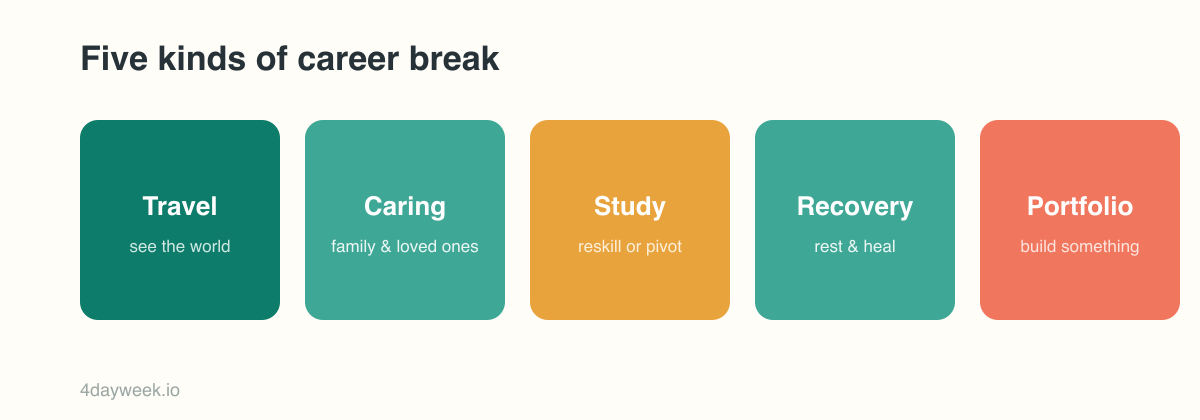
Most real breaks are a blend. Naming yours helps you set a realistic length, budget and return plan, and gives you the clear story you'll need later.
Career break vs sabbatical: the crucial difference
People use these interchangeably. They shouldn't, because the difference changes how much risk you're carrying.
| Job held for you? | Typical length | Who arranges it | |
|---|---|---|---|
| Sabbatical | Yes, your role is protected | 1–3 months (sometimes up to a year) | Your current employer |
| Career break | Usually not, you leave your role | Months to ~2 years | You, on your own terms |
If your employer offers a sabbatical, that's usually the lower-risk route, you get the time without giving up the job. A career break is the option when you want longer, or a clean slate, and you're willing to plan for the fact that there's no job automatically waiting.
That planning is the whole game.
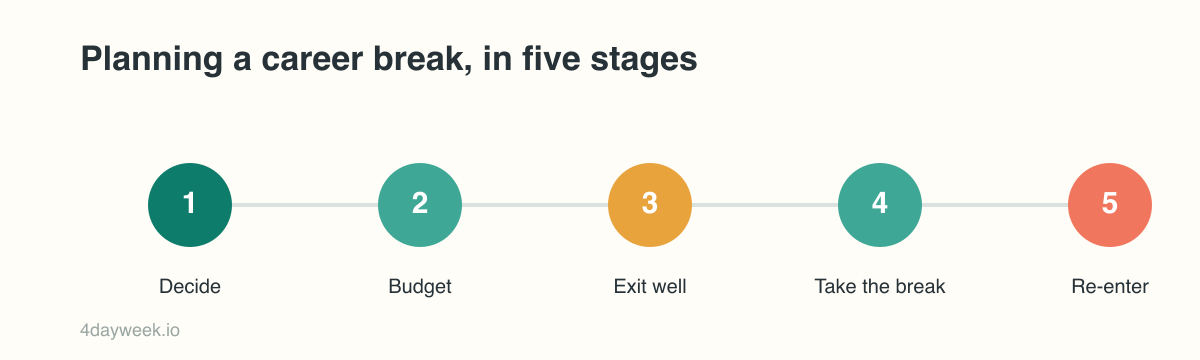
Step one: the money
Let's be honest, this is what stops most people. And it should be the first thing you solve, not an afterthought.
Work out three numbers before you do anything else:
- The cost of the break itself. Travel, tuition, or simply your normal living costs for however long you'll be off.
- A re-entry runway. Finding a job takes time. Budget for at least three to six months of living costs on top of the break, the cushion that stops you panic-accepting the first offer that comes along.
- Your monthly "burn". What you actually spend each month. Multiply it out. That's your target.
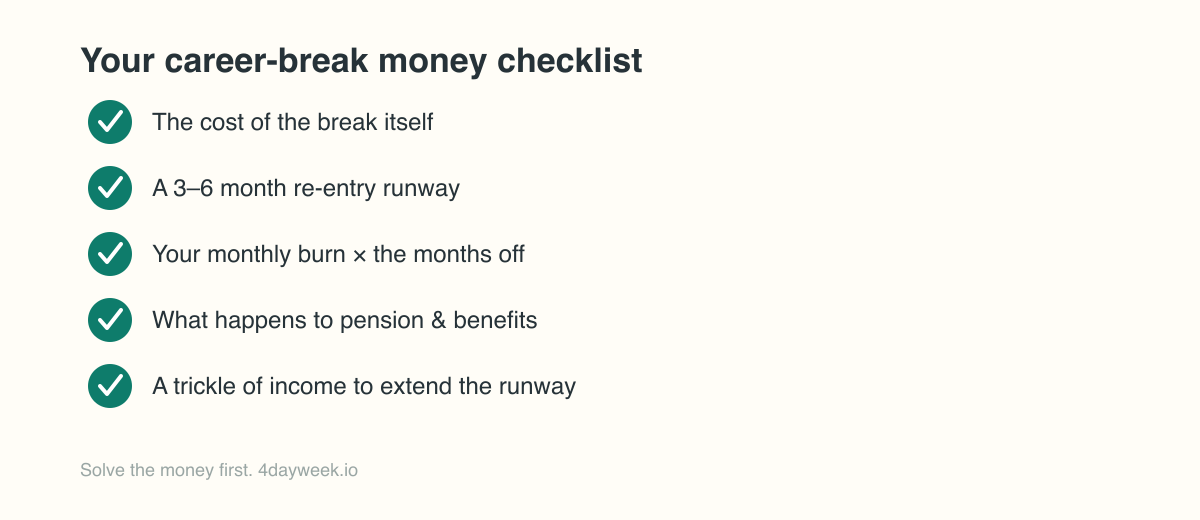
Then reduce the risk:
- Build the fund before you leave, treat it like a savings goal with a date.
- Look at whether you can keep a trickle of income (freelance, part-time, consulting) to extend your runway.
- Understand what happens to your pension, health cover and any benefits while you're out.
A career break fails when the money runs out before you're ready to return. Solve that, and most of the fear disappears.
Step two: leave well
How you exit matters more than you'd think, because the people you leave behind are your future references and, sometimes, your route back.
- Give proper notice and hand over cleanly.
- Tell your manager it's a deliberate break, not a dramatic exit.
- Stay on good terms. "Boomerang" hires, people rejoining a former employer after time away, are increasingly common, and a warm bridge is worth keeping.
Before you resign, it's always worth asking about a sabbatical or a reduced-hours arrangement first. If your employer says yes, you may not need to take the full risk of a break at all.
Step three: keep a foot in the door
A break doesn't have to mean vanishing.
- Keep your skills lightly warm, a course, a side project, occasional freelance work.
- Stay loosely connected to your network so you're not starting cold when you return.
- If you're travelling or caring, that's fine too, you don't owe anyone constant productivity. Just keep one thread you can pull on when you come back.
Work-Life Balance Jobs with Genuinely Reduced Hours
Save one to come back to it — it's free.


Step four: explaining the gap (it's fine, honestly)
The single biggest worry: "won't a gap on my CV scare off employers?"
Far less than it used to. Career gaps have become normal, and good employers care more about what you can do than whether your timeline is unbroken. Some even see a well-spent break as a sign of maturity and initiative.
The trick is to have a clear, confident narrative:
- Name it plainly: "I took a planned career break to [travel / care for family / retrain]."
- Show intention and what you got from it, perspective, skills, clarity.
- Pivot fast to why you're excited to be back and what you bring now.
No apologising. A break you chose and planned is a strength you can talk about, not a hole to hide.
Step five: coming back (ideally on your terms)
Here's the part people miss: you don't have to return to the exact same intensity you left.
For a lot of people, the smoothest re-entry is not a full-throttle five-day grind, it's flexible or reduced-hours work that lets you ramp back up gently and keep the balance the break gave you.
- Ease in with reduced hours. A part-time or flexible-hours role is a gentler on-ramp than 40+ hours from a standing start.
- Look for employers who value life outside work, the kind that already offer four-day weeks and flexible schedules tend to be exactly the ones who won't blink at a career break.
- Protect what you learned. If the break taught you that your old pace wasn't sustainable, don't walk straight back into it.
A career break can be the reset that changes how you work forever, not a detour you have to apologise for.
Common career-break mistakes to avoid
Most breaks that go wrong go wrong for the same handful of reasons. Sidestep these and you're most of the way there:
- Underestimating the runway. Running out of money is the number-one reason a break turns stressful. Budget the re-entry cushion, not just the break.
- Cutting all ties. Vanishing completely makes the return harder. Keep a few warm contacts and one live skill.
- No end point. "I'll figure it out" is fine for a month, risky for a year. Set a rough return date and a trigger ("when savings hit X, I start applying").
- Letting the story drift. Decide early how you'll describe the break, so you're not improvising in an interview later.
- Returning to the exact thing that burned you out. If the break was a reset, don't undo it in week one by sprinting straight back into an unsustainable role.
A career break is a project. Treat it like one and the fear turns into a plan.
Frequently asked questions
What counts as a career break? An intentional, extended period away from paid work, usually months to a couple of years, taken to travel, study, care for someone, recover, or reset, with the plan of returning to work afterwards.
How long should a career break be? As long as you can fund and justify with a clear story, commonly 3 months to 2 years. Longer breaks need a stronger re-entry plan and more runway.
Will a career break hurt my job prospects? Usually not, if you can explain it clearly and confidently. Career gaps are far more accepted than they once were, and a well-spent break can read as maturity and initiative.
Career break vs sabbatical, which is better? A sabbatical keeps your job open, so it's lower-risk if your employer offers one. A career break gives you more freedom and time but no guaranteed role to return to. Ask about a sabbatical first.
How do I afford a career break? Budget for the break plus a 3–6 month re-entry runway, save the fund before you leave, and consider light freelance or part-time income to extend how long you can stay out.
Coming back from a break? Ease in on your terms. Browse four-day-week, part-time and flexible roles on 4dayweek.io →




Get 4-day week jobs in your inbox
Create a free account to receive curated opportunities weekly.
Sign up for freeFree forever. No spam, unsubscribe anytime.