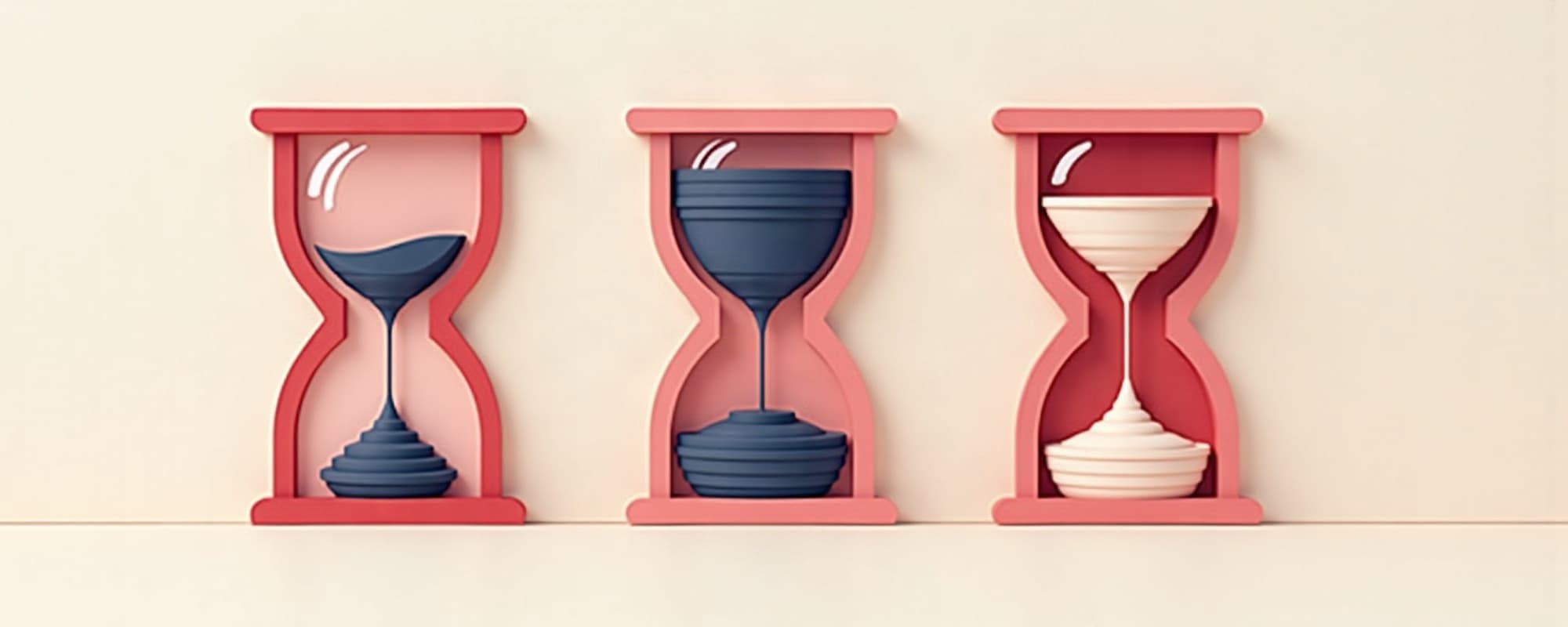
The most expensive worker in the building isn't the one who's off sick.
It's the one who dragged themselves in, feverish, exhausted, or quietly burnt out, and spent the day producing a fraction of their usual work while spreading their cold around the office.
That's presenteeism. It's everywhere, it's largely invisible, and it costs more than the sick days everyone worries about.
What is presenteeism?
Presenteeism is being at work but not actually working at your full capacity, showing up while ill, exhausted, distracted or mentally disengaged, and getting far less done than usual.
The person is present. The productivity isn't.
It's the opposite of absenteeism (being absent from work), and it takes a few common forms:
- Coming in physically unwell and functioning at half speed.
- Working through burnout or exhaustion, running on fumes.
- Being at your desk but mentally checked out, the overlap with quiet quitting.
- "Digital presenteeism", staying online, replying instantly and looking busy to prove you're working, especially from home.
Why presenteeism costs more than absenteeism
This is the counterintuitive part, and it's why researchers keep sounding the alarm.
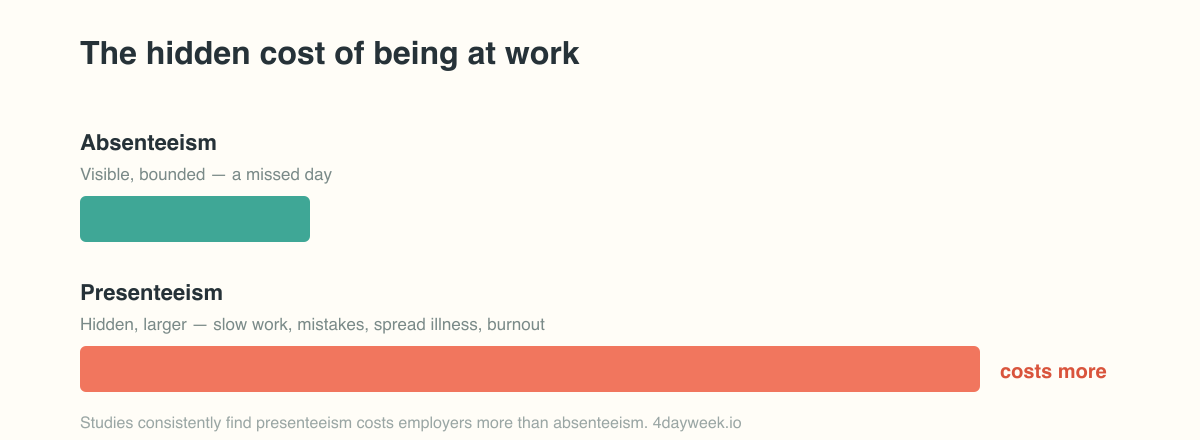
When someone's absent, the cost is visible and bounded, a missed day, a covered shift. When someone's present but impaired, the cost is hidden and often bigger: work done slowly, done wrong, or not really done at all, plus mistakes, accidents, and illness passed to colleagues.
Studies of workplace health have repeatedly estimated that presenteeism costs employers substantially more than absenteeism, often by a wide margin, precisely because it's so hard to see and measure. You can count sick days. You can't easily count the output that quietly evaporated from someone who shouldn't have been at their desk.
It's a rare problem where doing the "responsible" thing, showing up no matter what, is often the more expensive choice for everyone.
What causes presenteeism?
People don't push through illness or exhaustion for fun. The pressure is structural:
- Fear of being seen as slacking. In cultures that prize visible effort, taking a sick day feels risky.
- No safety net. Where sick pay is thin or absent, people work because they can't afford not to.
- Heavy workloads. If the work simply piles up while you're off, "off" never feels like an option.
- Always-on norms. When responsiveness is the measure, being offline feels like being absent.
- Job insecurity. Uncertain times push people to over-demonstrate their commitment.
Notice the theme: presenteeism is what happens when a workplace rewards hours and visibility over outcomes and health.
The remote-work twist: digital presenteeism
Working from home was supposed to end the theatre of looking busy. In some places it made it worse.
Without a manager seeing you at your desk, the temptation is to prove you're working, replying to messages within seconds, green dot always on, sending the late-night email to be noticed. That's digital presenteeism: performing work instead of doing it, often while quietly burning out.
Monitoring software makes it worse, not better. Watch people harder and they'll perform harder, which is not the same as producing more.
Presenteeism, absenteeism and leaveism
It helps to see presenteeism next to its relatives, three different ways the boundary between work and health breaks down:
| Term | What it is |
|---|---|
| Absenteeism | Being absent from work (e.g. off sick) |
| Presenteeism | Being present but not functioning, ill, exhausted or checked out |
| Leaveism | Working during time off, answering email on holiday, or using annual leave to catch up on work you couldn't finish |
Leaveism is the newest and sneakiest: people burning their own holiday to stay on top of a workload, so the rest that leave is supposed to provide never actually happens. All three point at the same root problem, a culture where stepping back, for any reason, feels unsafe.
How managers can spot presenteeism
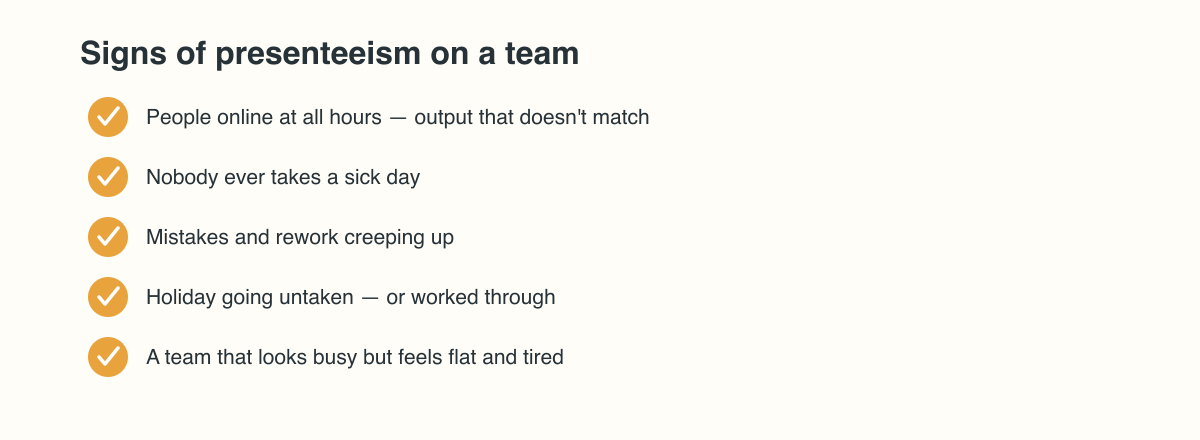
Because it's invisible by design, presenteeism rarely shows up in a report. The signals are subtler:
- People online at all hours but output that doesn't match the hours.
- Nobody ever takes a sick day, which sounds great and almost never is.
- Mistakes and rework creeping up, especially from usually-reliable people.
- Holiday going untaken, or worked through.
- A team that looks busy and productive but feels quietly flat and tired.
If your team never switches off and never calls in sick, that's not a sign of a healthy, committed workforce. It's often a warning light.
Work-Life Balance Jobs with Genuinely Reduced Hours
Save one to come back to it — it's free.



How to fix presenteeism
You can't solve presenteeism by telling people to "look after themselves" while keeping everything that causes it. It takes structural change:
- Measure outcomes, not hours. Judge work by what gets done, not by who's visibly online longest. This single shift removes most of the incentive to perform.
- Make rest safe. A real sick-leave culture, where taking a day off ill is normal and unpunished, costs far less than a workforce that soldiers on at half capacity.
- Cut the workload, not just the hours. Reducing time only works if the work is genuinely prioritised, not crammed.
- Kill always-on norms. Respect off-hours; don't reward the midnight reply.
- Give time back. The most effective antidote is fewer, better-used hours, a four-day week or reduced-hours schedule that lets people arrive rested and leave with something in the tank.
Companies that make these changes don't just feel nicer. They recover the hidden output that presenteeism was quietly draining away.
The business case for tackling presenteeism
For any manager weighing this up, presenteeism is one of the clearest examples of where doing the humane thing and the profitable thing are the same thing.
- You're already paying for it. The salary is spent whether the person is producing or just present. Presenteeism means you're buying attendance and getting a fraction of the output, the worst deal in the building.
- The savings are hidden but huge. Because impaired-but-present work never shows up as a line item, the cost is easy to ignore, which is exactly why it's so large and so recoverable.
- Health compounds. Let people recover properly and you avoid the escalation from "run down" to burnout to long-term absence, the genuinely expensive end of the spectrum.
- Trust pays. Teams that feel safe to rest and are judged on outcomes tend to be more engaged, more productive and more loyal than teams performing wellness while quietly falling apart.
You don't fix presenteeism by caring more about it in the abstract. You fix it by changing what you reward, and the return on that change is output you were losing without ever seeing it leave.
The bigger picture
Presenteeism is what you get when you treat time at a desk as a proxy for value. It never was.
A rested person working four focused days will out-produce an exhausted one grinding through five, the extra day was often presenteeism wearing a productive costume. Give people the time and the safety to actually recover, and you don't lose output. You stop leaking it.
Frequently asked questions
What is presenteeism? Being at work, in person or online, but not functioning at full capacity, because you're ill, exhausted, distracted or disengaged. You're present, but your productivity isn't.
Why does presenteeism cost more than absenteeism? Because the lost productivity is larger and much harder to see. Absence is visible and bounded; impaired-but-present work drains output through slow work, mistakes, spread illness and burnout, costs that don't show up on any sick-day report.
What is digital presenteeism? Performing work remotely, staying constantly online, replying instantly, looking busy, to prove you're working, rather than actually being productive. It's common in always-on remote cultures.
How do you reduce presenteeism? Measure outcomes instead of hours, make taking sick days safe, cut workloads rather than just time, respect off-hours, and give people genuine time to recover, for example through a four-day or reduced-hours week.
Want work that values your output, not your hours online? Browse four-day-week and reduced-hours roles on 4dayweek.io →




Get 4-day week jobs in your inbox
Create a free account to receive curated opportunities weekly.
Sign up for freeFree forever. No spam, unsubscribe anytime.