The 40-Hour Work Week
How did we end up working 40 hours a week? The complete history, from hunter-gatherers to the modern 4-day week movement.
The Earliest Workers
When survival was the job
hrs/week
Hunter-gatherers spent just 20 hours a week finding food — then agriculture came along and made everything harder.
Before clocks, calendars, or corporations, our ancestors worked to survive, and they were surprisingly efficient at it. Anthropologist Richard Lee’s landmark 1960s study of the !Kung Bushmen found they spent just 15–20 hours per week on food procurement, with the rest devoted to leisure, socializing, and rest.

However, the full picture is more nuanced. A 2019 Cambridge study published in Nature Human Behaviour (led by Dr. Mark Dyble) found that Agta foragers in the Philippines spent roughly 24 hours per week on out-of-camp activities plus about 20 hours on domestic tasks, totalling around 44 hours. Crucially, farmers in the same study worked approximately 10 hours more per week than foragers.
The Neolithic Revolution (~10,000 BC) paradoxically increased working hours. As humans transitioned from foraging to farming, the demands of agriculture (tilling, planting, harvesting, storing) created longer and more rigid work schedules. The shift to “civilization” came at the cost of leisure.
~44 hrs
Total weekly productive hours (foragers, including domestic work)
Cambridge / Nature Human Behaviour, 2019“The amount of work per capita increased with the evolution of culture, and the amount of leisure per capita decreased.”
Key Events
Hunter-gatherer societies — Small nomadic groups work 15–20 hours per week on food procurement, spending the rest on social activities and rest.
Neolithic Revolution — The shift to agriculture paradoxically increases working hours. Farming demands more sustained, seasonal labor than foraging.
Early settlements form — Permanent settlements create new types of work: construction, irrigation, food storage, and early trade.
Ancient Civilizations
Structure, rest days, and the first labor laws
hrs/week
Egyptian tomb builders already had 8-hour days, lunch breaks, and regular days off — 5,000 years ago.
Ancient Egypt offers some of the earliest documented evidence of structured work schedules. At Deir el-Medina, the village that housed the workers who built the pharaohs’ tombs, ostraca (inscribed pottery shards) record an 8-day-on, 2-day-off cycle with roughly 8-hour workdays and a noon lunch break. Workers also received additional festival days off throughout the year.

In Rome, free artisans typically worked around 6 hours per day, from dawn until approximately noon. The Roman calendar included numerous public holidays and festival days. In 321 AD, Emperor Constantine decreed Sunday as an official day of rest, one of the earliest state-mandated weekly rest days.
The Jewish tradition of Sabbath represents one of the oldest codified weekly rest days in human history, predating most state labor regulations by millennia. It’s important to note that these relatively moderate working arrangements applied to free workers and artisans only—not to enslaved people, whose conditions were vastly different.
~6 hrs
Daily working hours for Roman free artisans
“The Sabbath was made for man, not man for the Sabbath.”
Key Events
Egyptian labor records begin — Deir el-Medina workers operate on an 8-day-on, 2-day-off cycle with 8-hour days and midday breaks.
Sabbath codified — The Jewish Sabbath becomes one of the earliest codified weekly rest days, mandating one day of rest in seven.
Constantine decrees Sunday rest — Emperor Constantine makes Sunday an official Roman rest day, one of the first state-mandated weekly days off.
The Medieval Period
Saints’ days, harvest rhythms, and a genuine debate
hrs/week
Medieval workers may have had 8+ weeks of holidays a year, with daily rhythms dictated by seasons, not clocks.
The medieval working calendar is one of history’s most debated topics. Some historians argue that medieval English peasants, particularly after the Black Death of 1348–1350 (which created severe labor shortages), worked as few as 150 days per year. Others put the figure closer to 250 or more.
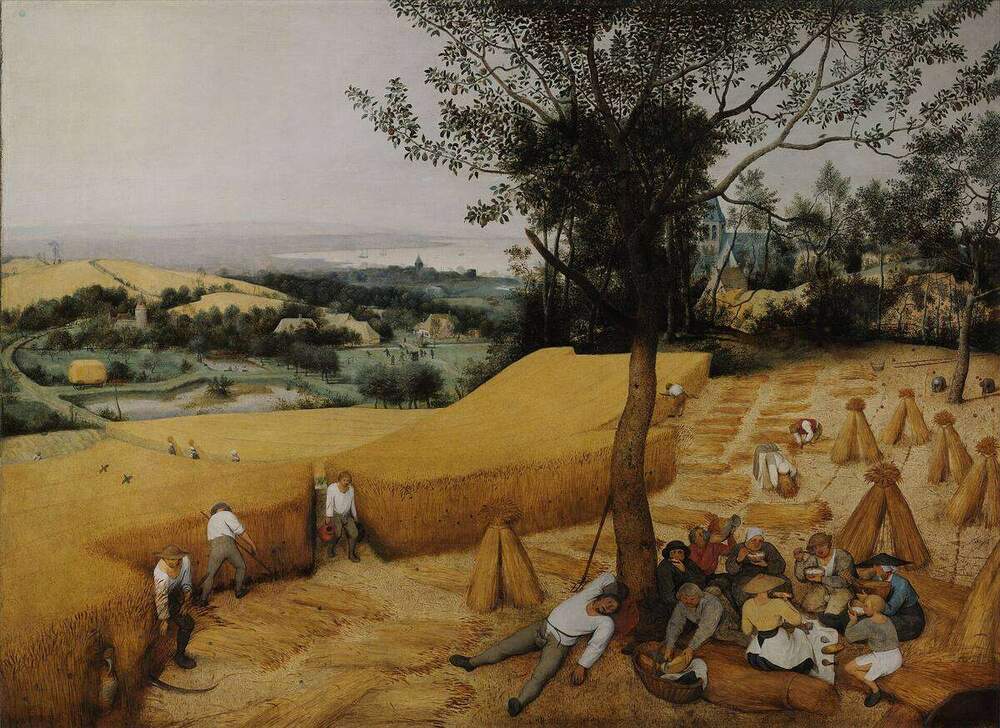
What’s not disputed is that the medieval calendar was punctuated by an extraordinary number of holidays. The Church calendar mandated 8+ weeks of holidays, plus frequent saints’ days (roughly one per week in some regions). However, it would be misleading to attribute all non-working days to religious holidays. Weather, seasonal agricultural cycles, and economic conditions also played major roles.
Daily hours varied dramatically by season: as few as 8 hours in winter (limited by daylight) to as many as 16 in summer. Most workers took substantial meal breaks and, in many regions, an afternoon rest period. The rhythm of work was dictated by nature, not by the clock.
~150 days
Working days/year in post-Black Death England (debated; some estimates reach 250+)
8–16 hrs
Daily hours varying by season (dawn to dusk with breaks)
“The labouring man will take his rest long in the morning; a good piece of the day is spent afore he come at his work; then he must have his breakfast… at noon he must have his sleeping time.”
Key Events
Church calendar takes shape — The medieval Church mandates 8+ weeks of holidays plus frequent saints’ days, creating a work calendar driven by religion and season.
The Black Death — Plague kills 30–60% of Europe’s population. Surviving workers gain enormous bargaining power, and working conditions improve significantly.
Statute of Labourers (England) — Parliament attempts to freeze wages and force laborers to work. This is evidence of how much power workers had gained post-plague.
The Industrial Revolution
When the clock became the boss
hrs/week
Factories destroyed centuries of reasonable working patterns — 16-hour days, 6-day weeks, children as young as 4.
The Industrial Revolution upended millennia of work patterns virtually overnight. The factory system demanded rigid, clock-driven schedules, and the results were brutal. Workers, including children as young as 4 or 5, labored for 14–16 hours per day, 6–7 days per week, in dangerous conditions with no breaks, sick pay, or safety protections.
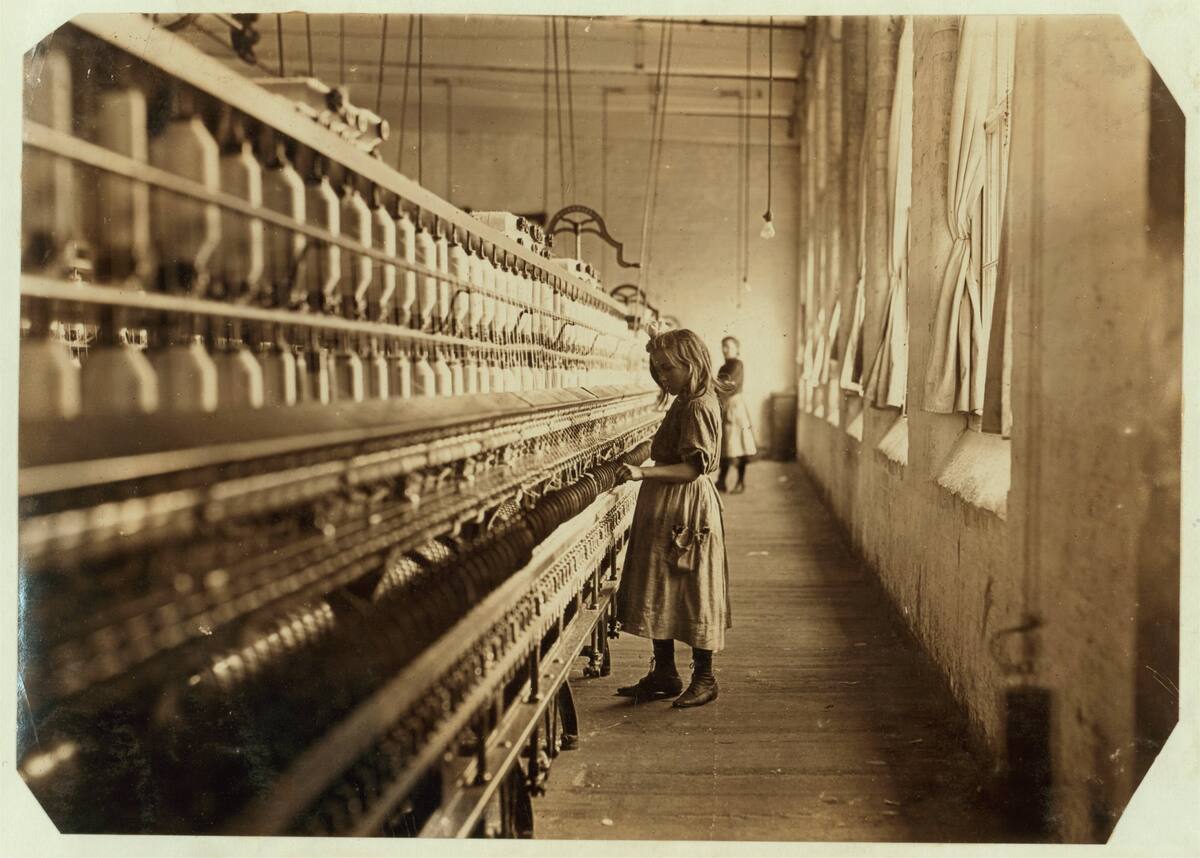
The scale of exploitation was staggering. In early textile mills, children made up a significant portion of the workforce, operating machinery that regularly maimed and killed. Coal mines employed children as young as 5 as “trappers,” sitting alone in darkness for 12+ hours opening ventilation doors.
The horrors of industrial labor sparked the first organized push for working-time regulation. Britain led the way: the Factory Act of 1833 limited child labor (though enforcement was weak), the Ten Hours Act of 1847 restricted women and children to 10-hour days, and the Factory and Workshops Act of 1878 finally banned employment of children under 10.
14–16 hrs
Typical factory working day, 6–7 days per week
Age 4–5
Youngest children employed in factories and coal mines
“The House will not forget that it is the labour of children which is in question - labour exacted from children of the tenderest years.”
Key Events
Factory system emerges — Textile mills in northern England pioneer the factory model: rigid hours, clock-driven shifts, and gruelling 14–16 hour days.
First Factory Act (UK) — Limits child labor in textile mills. Children 9–13 restricted to 8 hours/day. Under 9 banned from factory work.
Ten Hours Act (UK) — Limits women and children under 18 to 10 hours per day in textile factories—a landmark victory for labor reformers.
Factory and Workshops Act (UK) — Consolidates earlier acts and bans all employment of children under 10. Extends protections beyond textiles to all industries.
The Labor Movement
Eight hours labour, eight hours recreation, eight hours rest
hrs/week
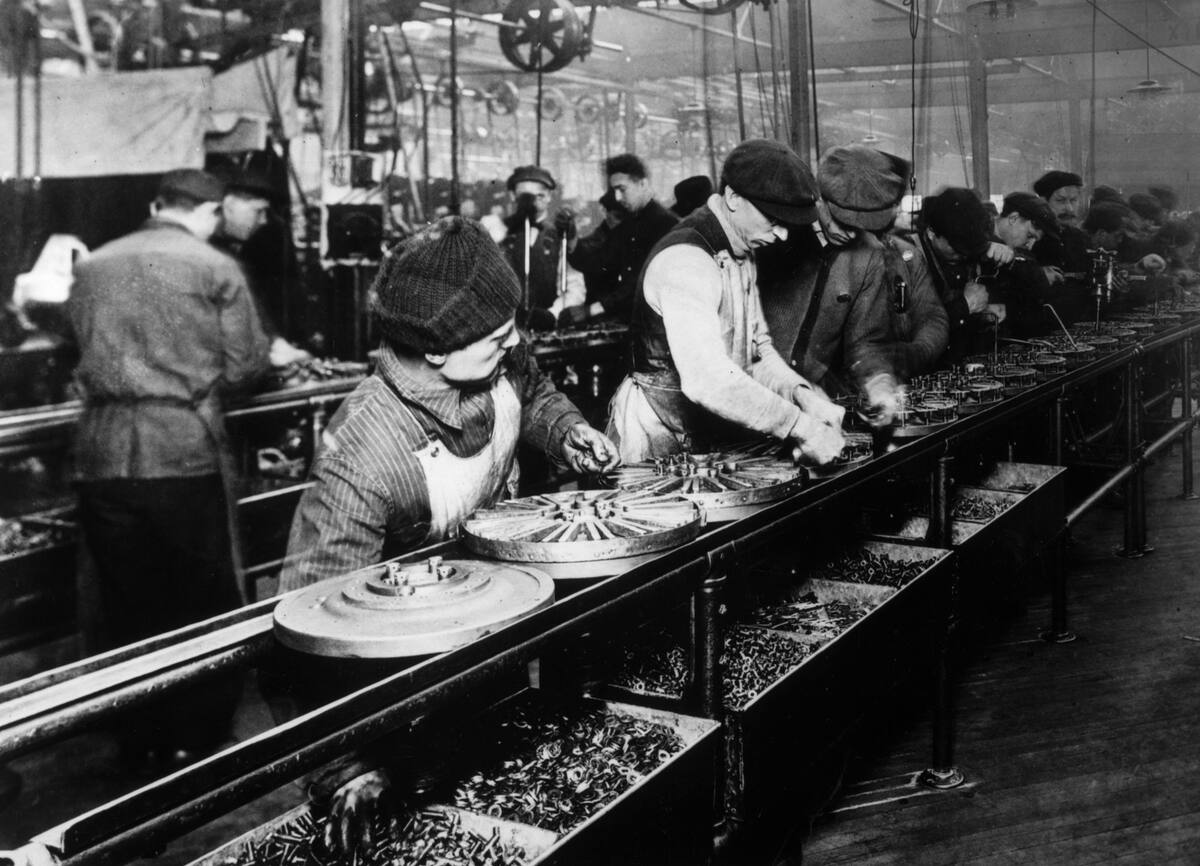
Henry Ford proved shorter hours meant higher productivity — and in 1938, the 40-hour week became US law.
The fight for reasonable working hours produced some of history’s most dramatic labor struggles. In 1817, Welsh social reformer Robert Owen coined the famous slogan: “Eight hours labour, eight hours recreation, eight hours rest.” It would take over a century for this vision to become reality.
The path was violent. In 1886, the Haymarket Affair in Chicago—a rally supporting workers striking for an 8-hour day—ended in a bombing and police gunfire that killed multiple people. Despite the tragedy, the 8-hour movement gained unstoppable momentum.
Then came Henry Ford. In 1914, Ford shocked the business world by simultaneously doubling wages to $5 per day and introducing the 8-hour workday (the same announcement). In 1926, Ford formally adopted the 5-day, 40-hour work week—not primarily out of altruism, but because he discovered that well-rested, well-paid workers were more productive and could afford to buy his cars.
Ford’s success proved the business case. In 1938, the Fair Labor Standards Act made the 40-hour work week federal law in the United States, establishing overtime pay for anything beyond 40 hours.
$5/day
Ford’s revolutionary wage (double the prevailing rate) introduced alongside the 8-hour day in 1914
Ford Motor Company“Eight hours labour, eight hours recreation, eight hours rest.”
“We know from our experience in changing from six to five days and from 48 to 40 hours that we can get at least as great production in five days as we can in six.”
Key Events
Robert Owen’s 8-hour vision — Welsh reformer Robert Owen campaigns for “8 hours labour, 8 hours recreation, 8 hours rest”—a radical idea for its time.
Illinois passes first US 8-hour law — The first American state to legislate an 8-hour workday, though enforcement is limited.
Haymarket Affair, Chicago — A rally for the 8-hour day turns deadly when a bomb explodes and police open fire. The tragedy galvanizes the international labor movement.
Ford doubles wages + 8-hour day — Henry Ford introduces $5/day wages (double the norm) and the 8-hour workday in the same announcement, shocking the business world.
Ford adopts the 5-day week — Ford Motor Company formally adopts the 5-day, 40-hour work week. Other manufacturers soon follow.
Fair Labor Standards Act (US) — The 40-hour work week becomes federal law. Employers must pay overtime for hours beyond 40 per week.
The Modern Standard
Productivity soared. Hours didn’t fall.
hrs/week
Productivity has risen 6x since 1950, yet working hours barely budged — we’re still on a 1930s schedule.
After the 40-hour week became law, many expected working hours to continue declining. In 1930, the economist John Maynard Keynes famously predicted that by ~2030, his grandchildren would enjoy “three-hour shifts or a fifteen-hour week.” He was spectacularly right about productivity—and spectacularly wrong about hours.

Productivity has risen roughly 6x since 1950 in developed economies. If Keynes’s prediction had held, we’d be working around 7 hours per week. Instead, the 40-hour week became entrenched as a cultural norm rather than a minimum floor—and for many knowledge workers, actual hours crept well above 40.
The rise of email in the 1990s and smartphones in the 2000s created an “always-on” culture that blurred the boundary between work and rest. By the 2010s, burnout had become a recognized occupational health concern, and a growing number of voices began asking: if we’re so much more productive, why are we still working 1930s hours?
~6x
Productivity increase since 1950 (yet working hours barely decreased)
US Bureau of Labor Statistics15 hrs
Keynes’s predicted 2030 work week (from his 1930 essay)
Economic Possibilities for our Grandchildren“Three-hour shifts or a fifteen-hour week may put off the problem for a great while.”
Key Events
Keynes’s 15-hour prediction — In “Economic Possibilities for our Grandchildren,” Keynes predicts 15-hour work weeks by ~2030. Right about productivity, wrong about hours.
Post-war economic boom — The 40-hour week becomes the global standard. Productivity rises rapidly, but working hours plateau rather than continuing to decline.
Email transforms work — Corporate email adoption creates expectations of constant availability. The boundary between work and personal time begins to erode.
Smartphone era begins — The iPhone launches, accelerating the “always-on” work culture. Work email, Slack, and notifications follow workers everywhere.
Still counting
Time since the 5-day work week was established
May 1, 1926 - Ford Motor Company
The 4-Day Week Movement
From experiment to global shift
hrs/week
92% of companies in the UK’s landmark trial carried on with the 4-day week after it ended. The data is in.
After decades of stagnation, the idea of reducing working hours made a dramatic comeback in the mid-2010s. Iceland led the way with groundbreaking trials between 2015 and 2019, testing a 35–36 hour week across 2,500 public sector workers. The results were unequivocal: productivity maintained or improved, and worker wellbeing increased dramatically. The trials were declared an “overwhelming success.”

In 2018, New Zealand estate planning firm Perpetual Guardian ran a formal 4-day week trial and published the results. Job performance held steady on four days, the share of staff who felt able to manage their work-life balance rose from 54% before the trial to 78% after it, and stress fell 7 points (45% → 38%). CEO Andrew Barnes went on to co-found 4 Day Week Global, which now coordinates trials worldwide.
The movement accelerated rapidly. Microsoft Japan reported a 40% productivity boost in 2019. The world’s largest 4-day week pilot—involving 61 UK companies and 2,900 workers in 2022—found that 56 of the 61 companies (92%) carried on with the 4-day week afterwards, and 18 made it permanent. Germany launched its own major pilot in 2024 with similarly encouraging results.
What started as a fringe idea has become a serious business strategy, backed by data from thousands of workers across dozens of countries.
“This is not about working harder or faster—it’s about working smarter. Reduced hours force organizations to strip away the inefficiencies that bloat the standard work week.”
Key Events
Iceland trials — 2,500 public sector workers trial 35–36 hour weeks. Productivity maintained or improved, wellbeing increased. Declared an “overwhelming success.”
Perpetual Guardian trial (NZ) — NZ firm trials a 4-day week: job performance holds steady, and the share of staff able to manage their work-life balance rises from 54% to 78%. CEO Andrew Barnes co-founds 4 Day Week Global.
Microsoft Japan’s “Work Life Choice Challenge” — Microsoft Japan gives all 2,300 employees Fridays off for a month. Productivity jumps 40%.
UK pilot: world’s largest trial — 61 companies and 2,900 workers trial a 4-day week for 6 months. 56 of them (92%) carry on afterwards and 18 make it permanent. Revenue stays broadly the same (+1.4% on average).
Germany pilot launches — 45 German companies begin a 6-month 4-day week trial organized by 4 Day Week Global, with similarly encouraging early results.
Ready for your own4-day work week?
Hundreds of companies have already made the switch. Browse jobs with shorter hours, or explore the research behind the movement.