
It's 9pm. Your phone lights up. It's work.
For a growing number of people around the world, they can now legally leave it until morning, and their employer can't punish them for it.
That's the right to disconnect. In some countries it's the law. In others, including the UK and US, it's still somewhere between a promise and a hope. Here's exactly where things stand in 2026, and how to reclaim your evenings whether or not the law is on your side yet.
What is the right to disconnect?
The right to disconnect is the right to switch off from work outside your contracted hours, to not monitor, read or answer work messages, calls and emails when you're off, and to not be penalised for it.
It's a direct response to a problem smartphones created: the working day stopped ending. "A quick email" at 10pm became normal, and the line between work and life quietly dissolved. The right to disconnect is an attempt to draw that line back, in law.
Crucially, it doesn't ban after-hours contact outright. It protects your right to not respond until you're back on the clock, without it counting against you.
Which countries have a right to disconnect?
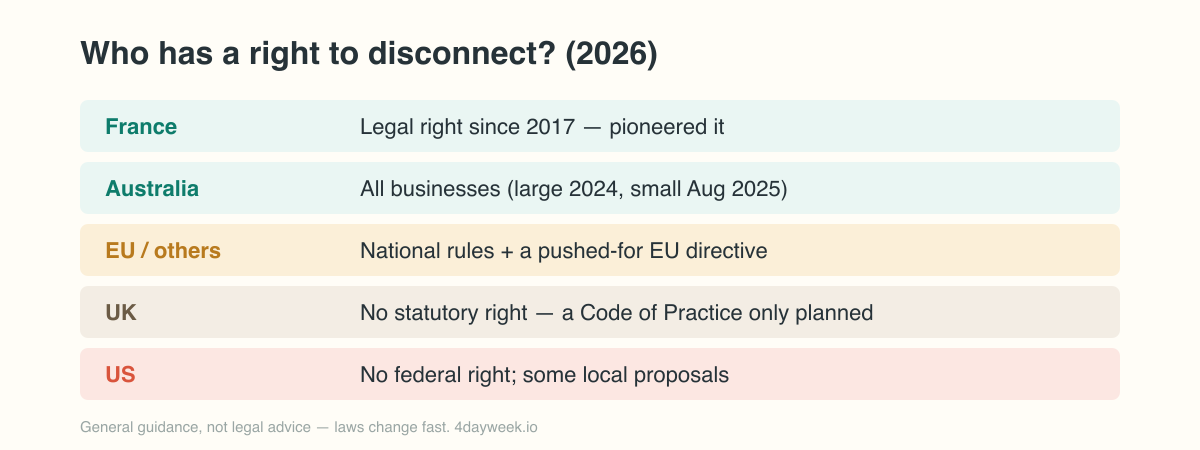
The picture varies enormously by country, and it's moving fast.
| Country | Status (2026) |
|---|---|
| France | Pioneered it, a legal right to disconnect since 2017 |
| Australia | In force for all businesses (large employers 2024, small from August 2025) |
| EU | Parliament has pushed for an EU-wide directive; several member states have their own rules |
| UK | No statutory right, a Code of Practice is only planned (see below) |
| US | No federal right; some states/cities have explored local versions |
France got there first, requiring larger companies to negotiate rules on switching off.
Australia now has the most sweeping version: employees can refuse unreasonable work contact outside their hours, and as of August 2025 the protection extends to small businesses too, meaning it now covers workplaces of every size.
Do you have a right to disconnect in the UK?
Short answer: no, not in 2026.
This trips people up, because it was widely talked about. The government's "Make Work Pay" plans floated a "right to switch off". But it was never included in the Employment Rights Act 2025. Instead, the plan is to deliver it later through a statutory Code of Practice rather than a hard law, and, as things stand, no consultation on it has even begun.
So while ministers have said the commitment remains, there is no enforceable right to disconnect in the UK today. For now, switching off is a matter of your contract, your employer's culture, and the boundaries you set yourself.
What about the US?
There's no federal right to disconnect in the United States. A handful of states and cities have floated or debated local proposals, but nothing sweeping has taken hold nationally. For most US workers, after-hours boundaries remain a matter of company policy and personal negotiation.
A closer look at how the laws work
The countries that have acted haven't all done the same thing, there's a spectrum from "hard right" to "have a conversation about it":
- France (2017) requires companies over a certain size to negotiate the terms of employees' right to disconnect, how and when after-hours contact is (and isn't) expected. It set the template the rest of the world has borrowed from.
- Australia (2024–25) took a firmer line: employees have a legal right to refuse unreasonable contact outside working hours, with the workplace tribunal able to step in on disputes. What counts as "reasonable" depends on things like the urgency, the employee's role, and how they're compensated.
- Ireland introduced a Code of Practice giving employees the right to disconnect and to not be penalised for it, softer than a hard statute but still a formal standard.
- Other EU states, including versions in countries like Belgium, Italy, Spain and Portugal, have their own rules, and the European Parliament has pushed for an EU-wide directive.
The common thread: nobody is banning the late-night email outright. They're protecting your right to not answer it until you're back on the clock.
Does the right to disconnect actually work?
Honestly, the jury's still out, and it's worth being straight about that.
Supporters point to reduced stress, clearer boundaries and a cultural signal that off-time is real. Sceptics note that laws are only as strong as their enforcement, that many carve out "reasonable" exceptions broad enough to drive a truck through, and that a determined always-on culture can find ways around a rule.
The most honest read: a right to disconnect helps most where it shifts the default, where "not replying at 9pm" becomes normal and unremarkable rather than a career risk. Where it's a box-ticking policy nobody enforces, it changes little. Which is exactly why the deeper fix isn't just legal, it's cultural.
How to switch off from work (even without a law)
Work-Life Balance Jobs with Genuinely Reduced Hours
Save one to come back to it — it's free.



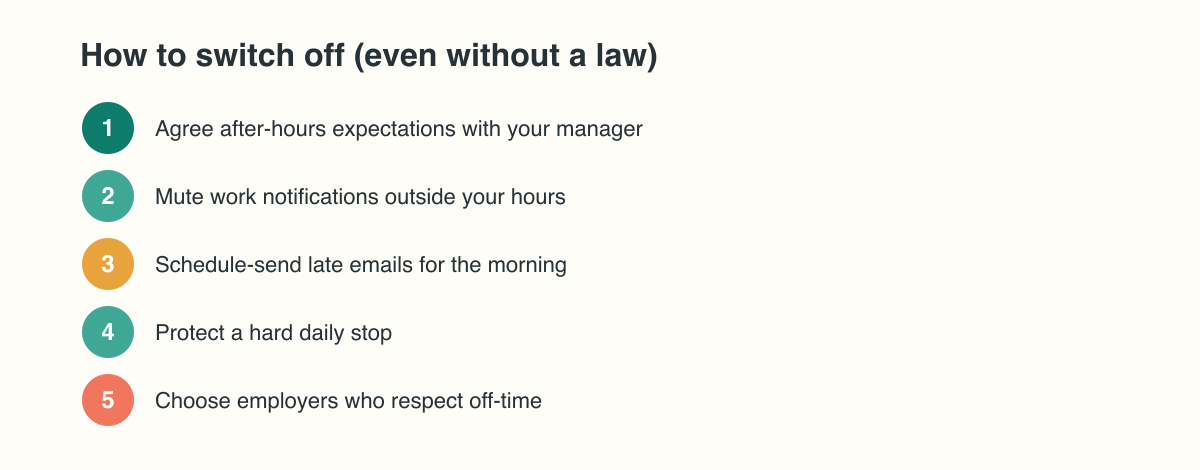
You don't have to wait for legislation to get your evenings back. Most of the benefit comes from boundaries you can set yourself:
- Agree the expectation. Ask your manager directly: is there a genuine need to be reachable after hours, or just a habit? Naming it often ends it.
- Mute after hours. Turn off work notifications outside your hours. If it's truly urgent, people will call.
- Schedule-send. Writing an email at night? Schedule it for the morning so you don't set a 24/7 norm for your team.
- Protect a hard stop. Decide when your day ends and defend it, a real finish line makes the hours before it more focused (that's Parkinson's Law working for you).
- Choose employers who mean it. The strongest boundary is a culture that already respects your time.
That last one matters most. A right to disconnect fights the symptom; a genuinely humane workplace removes the cause. The kind of employers offering four-day weeks and reduced-hours roles tend to be the ones who never expected you to be on call at 9pm in the first place, because the whole point is that your time is yours.
What a good disconnect policy looks like (for employers)
If you run a team and want the benefits without waiting for a law, you can set your own standard. The strong ones share a few features:
- Clear default hours when people are, and aren't, expected to respond, so no one has to guess.
- A genuine urgent-only carve-out. Define what counts as a real emergency, so "urgent" doesn't quietly mean "whenever the boss is awake."
- Leaders who model it. A policy dies the moment a manager fires off 11pm emails and expects replies. Culture is set by what leaders do, not what the handbook says.
- Schedule-send as the norm. Encourage people writing out of hours to schedule messages for the morning, so one person's late night doesn't become everyone's.
- Judge outcomes, not response speed. The moment fast replies stop being a proxy for commitment, the pressure to be always-on evaporates.
The best policy isn't a document. It's a culture where switching off is normal, expected, and never held against you.
Frequently asked questions
What is the right to disconnect? The right to ignore work communications outside your contracted hours, not reading or answering emails, calls or messages when you're off, without being penalised for it.
Which countries have a right to disconnect? France (since 2017) and Australia (all businesses as of August 2025) have clear laws; several EU countries have their own rules and the EU Parliament has pushed for a directive. The UK and US have no statutory right.
Does the UK have a right to disconnect in 2026? No. It was never part of the Employment Rights Act 2025; the government only plans to introduce one later via a statutory Code of Practice, and no consultation has started yet.
How can I switch off from work without a legal right? Agree after-hours expectations with your manager, mute work notifications outside your hours, schedule-send late emails, protect a hard daily stop, and choose employers with a culture that respects off-time.
Want a job that respects your evenings by default? Browse four-day-week and reduced-hours roles on 4dayweek.io →




Get 4-day week jobs in your inbox
Create a free account to receive curated opportunities weekly.
Sign up for freeFree forever. No spam, unsubscribe anytime.