"Rise and grind." "Sleep when you're dead." "Hustle harder."
For most of the last decade, this was not a fringe attitude. It was the background music of ambition: a steady message that if you were not working all the time, you did not want it badly enough.
That message is now curdling. A generation that grinded through its twenties on the promise of eventual freedom has mostly found exhaustion instead, and it is quietly, and sometimes loudly, opting out. This is what hustle culture actually is, why it does not deliver what it promised, and what is replacing it.
What is hustle culture?
Hustle culture is the belief that relentless work and personal sacrifice are the necessary, admirable price of success, and that anything less than total commitment is a kind of failure.
Its core move is to turn overwork into a virtue. Long hours are not a problem to be solved, they are proof of your ambition. Rest is not a human need, it is a guilty indulgence you have to earn. Your job is not a thing you do, it is who you are.
You can hear it in the language: rise and grind, no days off, team no-sleep, the glorification of the 80-hour week and the founder who "hasn't taken a holiday in years." It is ambition, repackaged as a moral obligation to never stop.
Where hustle culture came from
Hustle culture did not appear from nowhere. A few forces stacked up in the 2010s to make it the dominant story about work.
- Startup mythology. The tech boom sold the image of the heroic founder building an empire on ramen and no sleep. Overwork became the origin story every ambitious person was supposed to want.
- Social media. Platforms turned productivity into performance. The 5am routine, the packed calendar, the "grind" content: work stopped being private and became something you displayed.
- Economic anxiety. Flat wages, expensive housing and precarious jobs made "just outwork everyone" feel less like a choice and more like survival. If the system is not going to look after you, the logic went, hustle is the only safety net.
- The gig economy. A whole category of work reframed having no boundaries, no benefits and no off-switch as "being your own boss."
Put together, these turned a personal work ethic into a full-blown culture, one that treated your willingness to burn yourself out as the truest measure of how much you deserved.
The signs you have absorbed hustle culture
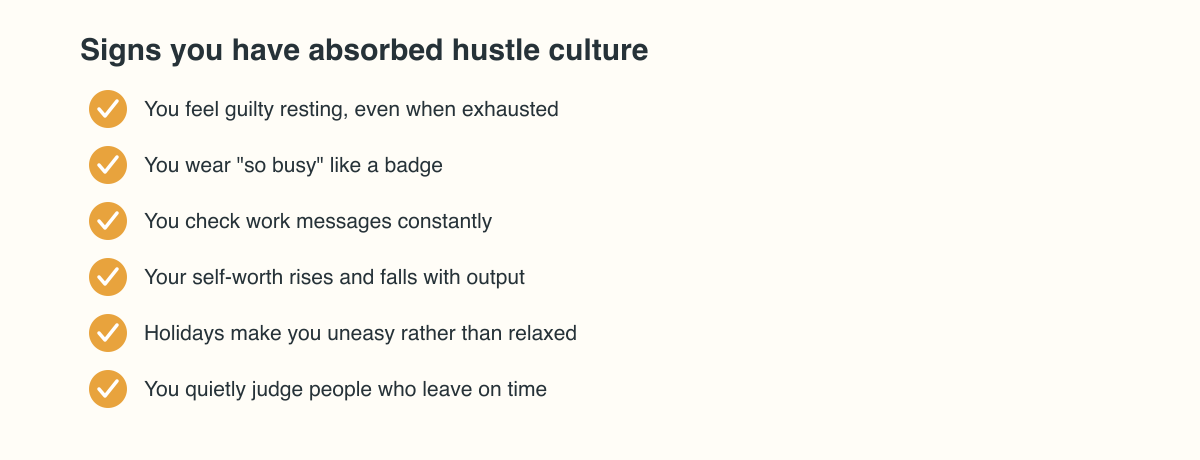
Hustle culture is sneaky because it feels like ambition from the inside. Some tell-tale signs it has got into your head:
- You feel guilty resting, even when you are exhausted and have earned it.
- You wear being busy like a badge, and answer "how are you?" with "so busy."
- You check work messages constantly, and feel anxious when you cannot.
- Your sense of self-worth rises and falls with how productive you were today.
- You struggle to switch off, and holidays make you uneasy rather than relaxed.
- You quietly judge people who leave on time, or admire people who never do.
None of these make you a bad person. They make you someone marinated in a message that has been everywhere for years. Naming it is the first step to loosening its grip.
Why hustle culture does not even work
Here is the part that should end the argument, and mostly gets ignored: past a fairly modest point, working more does not produce more.
The research on working hours is remarkably consistent. Beyond somewhere around 40-50 hours a week, output per hour falls off a cliff. People make more mistakes, think less clearly, and spend the extra hours producing work that is slower and worse. Long stretches of overwork are associated with higher stress, worse health, and eventually burnout, which takes people out of the game entirely.
There is also a quieter mechanism at play. When you give work unlimited time, it expands to fill it (a pattern known as Parkinson's Law). The hustle-culture worker grinding twelve-hour days is often not producing twice as much as a focused person doing six good hours. They are producing a similar amount, stretched thin, with the extra time absorbed by tiredness, meetings and busywork that looks like effort.
So the grand bargain of hustle culture, sacrifice everything now for success later, tends to fail on its own terms. A lot of people pay the price (their health, their relationships, their twenties) and do not collect the reward.
The real cost of hustle culture
The damage from hustle culture is not abstract. It lands in three very concrete places.
Your health. Chronic overwork is a genuine physical risk, not just a wellbeing talking point. Long working hours are associated with higher rates of stress, poor sleep, anxiety and depression, and, in the most serious research, an elevated risk of cardiovascular problems. The body was not built to run at full throttle indefinitely, and it eventually sends the bill.
Your relationships. Time is finite. Every evening given to the grind is an evening not given to a partner, a friend, a child, or yourself. Hustle culture quietly frames these as acceptable losses on the road to success. Years later, they often turn out to be the things that actually mattered.
Your actual performance. The cruelest cost is that the grind erodes the very thing it claims to build. A depleted, sleep-deprived, chronically stressed person does worse work, makes more mistakes, and is more likely to burn out entirely and be forced to stop. Hustle culture eats its own promise.
The tragedy is that all of this is sold as ambition. People are encouraged to sacrifice their health, their relationships and, eventually, their effectiveness, and to feel virtuous while doing it. When you add up what hustle culture actually costs against what it reliably delivers, the maths is grim.
The backlash: how the story is changing
The cultural mood has turned, and fast. The last few years have produced a whole vocabulary for stepping off the treadmill:
- Quiet quitting: doing your job and no more, refusing the unpaid extra hustle-culture assumed it was owed.
- Anti-hustle and "soft life" movements: an open rejection of grind-for-grind's-sake in favour of balance and wellbeing.
- The rise of remote and flexible work: people discovering that where and how long they work is negotiable after all.
- The four-day week: the clearest sign of all that a shorter, saner week is moving from fringe idea to mainstream expectation.
This is not a generation getting lazy, whatever the headlines say. It is a generation doing the maths, watching hustle culture deliver burnout instead of freedom, and deciding the trade was never worth it.
Work-Life Balance Jobs with Genuinely Reduced Hours
Save one to come back to it — it's free.



Hustle culture vs sustainable work
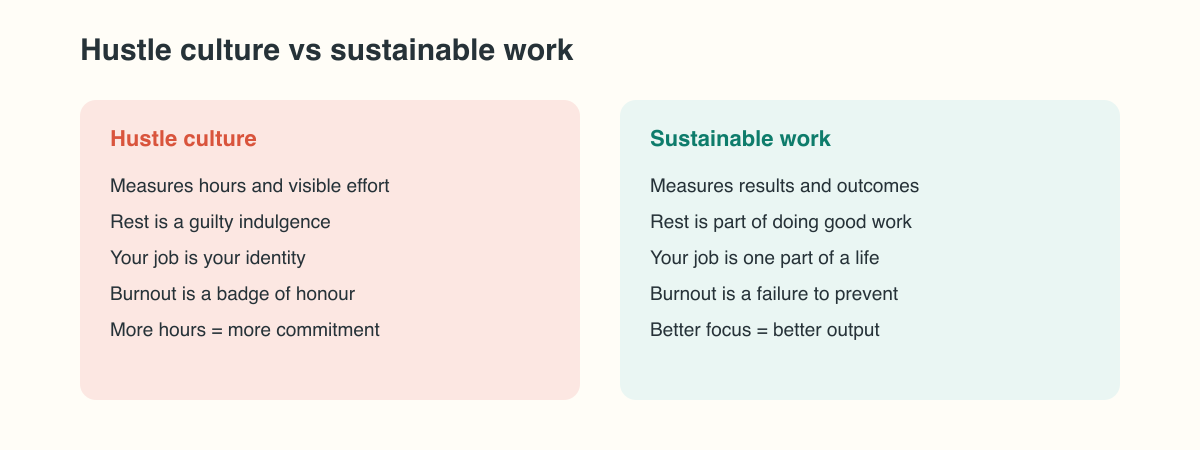
The opposite of hustle culture is not doing nothing. That is the false choice hustle culture always offers: grind or fail. The real alternative is sustainable, focused work.
| Hustle culture | Sustainable work |
|---|---|
| Measures hours and visible effort | Measures results and outcomes |
| Rest is a guilty indulgence | Rest is part of doing good work |
| Your job is your identity | Your job is one important part of a life |
| Burnout is a badge of honour | Burnout is a system failure to prevent |
| More hours = more commitment | Better focus = better output |
Sustainable work says you can be ambitious and rested. You can care deeply about your job and still switch off at the end of the day. You can produce excellent work in reasonable hours, precisely because you are not running on empty.
What comes next
The end of hustle culture is not the end of ambition. It is the end of confusing exhaustion with achievement.
The organisations pulling ahead now are the ones that figured this out: that a rested, focused team doing four good days beats a depleted one grinding through five or six. That trust and outcomes get more out of people than pressure and surveillance ever did. It is the whole logic behind the companies now offering four-day weeks and genuinely flexible work: they are not less ambitious, they are just done pretending that the grind was ever the point.
Wasn't the whole promise of all that hard work supposed to be a better life? Hustle culture quietly forgot to include the life. What comes next puts it back in.
Frequently asked questions
What is hustle culture? The belief that constant work and self-sacrifice are the price of success, and that rest is something to feel guilty about. It reframes overwork as ambition, identity and virtue.
Why is hustle culture bad? Because the evidence does not support it. Beyond a point, longer hours produce diminishing returns and more mistakes, not more output, while raising the risk of stress, poor health and burnout. Many people pay the cost and never get the promised reward.
Is hustle culture over? It is clearly in retreat. Trends like quiet quitting, the soft-life movement, flexible work and the four-day week all reflect a widespread rejection of grinding for its own sake. Ambition is not dead, but the idea that it requires exhaustion is fading.
What is the opposite of hustle culture? Sustainable work: focused, results-driven work done in reasonable hours, where rest is treated as part of performing well rather than a weakness. It rejects the false choice between grinding and giving up.
How do I break out of hustle culture? Start by noticing the guilt around rest and questioning it. Measure your days by what you actually achieved, not how busy you felt. Protect your off-hours, and, where you can, choose employers who value outcomes over visible hours.
Ready to be ambitious without the grind? Browse four-day-week and reduced-hours jobs on 4dayweek.io.




Get 4-day week jobs in your inbox
Create a free account to receive curated opportunities weekly.
Sign up for freeFree forever. No spam, unsubscribe anytime.