
It is Sunday afternoon. The light is starting to fade. And somewhere around 4pm, a familiar knot arrives in your stomach.
The weekend was fine. Tomorrow has not happened yet. But your body has already started bracing for it.
That feeling has a name now: the Sunday scaries. It is one of the most common shared experiences in modern working life, and while a mild version is completely normal, a weekly wave of real dread is worth paying attention to. Here is what causes it, who gets it worst, and how to get your Sundays back.
What are the Sunday scaries?
The Sunday scaries are the anxiety, dread and low mood that build on a Sunday (usually the evening) as the working week approaches.
It is anticipatory anxiety. Nothing bad is actually happening on Sunday. Your mind is simply running ahead to Monday, pre-loading the stress of the week before it starts. The name is light-hearted, but the feeling is real: a tight chest, a restless mind, a Sunday evening that gets quietly swallowed by thoughts of work.
For some people it is a faint background hum. For others it is a genuine weekly slump that ruins Sunday from lunchtime onward. Either way, you are very much not alone.
How common are the Sunday scaries?
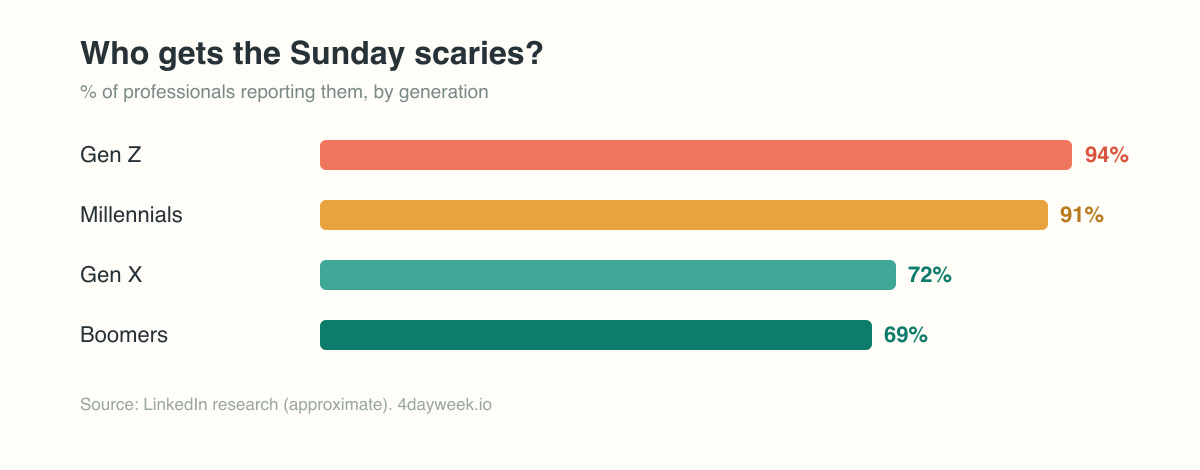
Very. Research by LinkedIn has found that the large majority of professionals experience the Sunday scaries, with figures reported in the region of two-thirds to four-fifths of workers depending on the survey.
And they hit younger workers hardest. That same research found the highest rates among Gen Z and millennials (well over 80%, and by some measures north of 90%), compared with lower rates among older generations.
There is a clear front-runner for the cause, too. When asked what drives the dread, the most common answer by far is worrying about the workload ahead, followed by the struggle of balancing professional and personal to-do lists.
Read that back for a second. The single biggest cause of Sunday-night dread is not Mondays in the abstract. It is the weight of the work waiting on the other side of the weekend.
Why do we get them?
The Sunday scaries are your brain doing something it is very good at: anticipating threat. If your working week reliably contains stress (a heavy workload, a difficult manager, a job that leaks into your evenings), your mind learns to see Monday as the start of that, and it starts flinching in advance.
A few things make it worse:
- A workload that never quite fits the week. If Friday always ends with more undone than done, Sunday becomes the moment you remember it.
- Blurred boundaries. When work bleeds into your evenings and weekends, there is no clean "off," so the dread has nowhere to stop.
- The Sunday itself. Sleeping in, then a slow, unstructured day can leave too much space for the mind to wander toward Monday.
- A genuine mismatch. Sometimes the dread is accurate. If you consistently dread going back, that is information about the job, not a flaw in you.
That last point matters. A little Sunday-evening reluctance is human. A heavy, every-week sense of dread is a signal, and it is worth being honest about what it is telling you.
The physical symptoms (it is not just in your head)
People often assume the Sunday scaries are purely a mood, a bit of glumness about the weekend ending. For a lot of people, though, they show up in the body. Anticipatory anxiety is a physical state, and it can bring:
- A racing heart or a tight chest
- A knot or churning feeling in the stomach, and sometimes nausea
- Trouble getting to sleep on Sunday night, which then makes Monday genuinely harder
- Irritability or a short fuse with the people around you
- A headache, or a heavy, tired, "flat" feeling
None of this is dramatic or dangerous on its own. But it is worth naming, because when you know the tight chest and the restless Sunday night are the scaries doing their thing, they are easier to ride out. And if the physical symptoms are severe or frequent, that is all the more reason to take the underlying cause seriously rather than white-knuckling through it every week.
When it is more than the Sunday scaries
For most people, the scaries are a normal, passing wave that lifts once Monday is underway. Sometimes, though, the Sunday dread is the visible tip of something bigger.
It is worth speaking to a doctor or a mental-health professional if:
- The dread does not lift on Monday, and low mood or anxiety follows you through the week
- It comes with panic, persistent sleeplessness, or a sense of hopelessness
- It is affecting your appetite, your relationships, or your ability to function
The Sunday scaries themselves are not a clinical condition. But anxiety and depression are real, treatable, and nothing to power through alone. Knowing the difference between "I do not fancy Monday" and "I feel like this most of the time" is important, and there is no weakness in getting help with the second one.
Are the Sunday scaries getting worse?
There is a good case that they are. The younger-generation figures are striking: Gen Z and millennials report the Sunday scaries at far higher rates than older workers, which suggests the problem is growing rather than fading as the workforce changes.
A few modern forces seem to be feeding it. The always-on culture of smartphones and remote work means the weekend never fully closes, so there is no clean break for the dread to stop at. Economic uncertainty and job insecurity add a background hum of anxiety about work. And the same LinkedIn research found that a significant share of people felt the pandemic had caused or worsened their Sunday anxieties, as the boundary between work and home eroded for millions at once.
In other words, the Sunday scaries are not a quirk of individual anxiety so much as a symptom of how work has changed: longer reach, blurrier boundaries, and less genuine time to switch off. That also points at the fix. The trend is not inevitable, and the workplaces moving toward reasonable hours and real time off are quietly running it in reverse.
How to beat the Sunday scaries

The good news: a lot of the weekly dread responds well to a few deliberate changes. Think of these in two layers: things that soothe the symptom, and the deeper fix underneath.
Soothe the symptom
- Close the loop on Friday. Spend the last 20 minutes of your week writing down where everything stands and your top three priorities for Monday. The dread often comes from a fear of the unknown. A plan on paper shrinks it.
- Protect the weekend. Try to keep work genuinely out of it. No "quick" Sunday-night email checks. Every time you peek, you re-open the week early.
- Build a Sunday wind-down. Give Sunday evening a gentle shape you look forward to: a walk, a proper meal, a film, an early night. A ritual gives the anxiety something to bump up against.
- Move your body. Exercise is one of the most reliable ways to take the edge off anticipatory anxiety. A Sunday walk or workout genuinely helps.
- Get Monday morning ready on Sunday. Clothes out, lunch sorted, bag packed. A frictionless Monday morning makes the whole thing feel less like a cliff edge.
- Name it. Simply recognising "ah, these are the Sunday scaries, they will pass by mid-morning tomorrow" takes some of their power away. They almost always fade once Monday actually starts.
Work-Life Balance Jobs with Genuinely Reduced Hours
Save one to come back to it — it's free.



Fix the cause
Here is the honest part. If you dread every single Sunday, no amount of scented candles will fix it, because the problem is not really Sunday. It is what Sunday is a gateway to.
When the number-one cause of the dread is "worrying about the workload," the real questions are:
- Is the workload actually doable in the hours you are given?
- Does the job respect your evenings and weekends, or quietly claim them?
- Do you get enough genuine rest to face the week, or do you start Monday already depleted?
If the answers are bad, the Sunday scaries are working exactly as designed. They are an early-warning system telling you the deal is off.
The Sunday scaries and the shape of the week
There is a bigger point hiding in all of this, and it is the reason the Sunday scaries are so universal.
We built a five-day week that, for a lot of people, does not leave enough room to actually recover. Two days off, one of which gets eaten by chores and errands, and by Sunday afternoon the tank is not full again. So the dread arrives not because Monday is uniquely awful, but because the week ahead feels longer than the rest you got.
This is why the people least likely to get the Sunday scaries tend to be the ones with genuinely reasonable working weeks. Give someone a workload that fits their hours, real boundaries around their time, and enough recovery to arrive rested, and the dread has very little to feed on.
It is also part of the case for a shorter week. A four-day week does not just add a day of leisure. It changes the maths of rest: three days to recover instead of two, and a Friday that is genuinely yours. People who have made the switch often report the same small, telling change: Sunday evenings stop being something to survive.
You should not have to spend a seventh of your weekend bracing for the week. If you consistently do, it may be less about learning to manage the dread and more about finding work that does not require it. Plenty of employers now build their weeks around a rested, sustainable life, not against it.
Frequently asked questions
What are the Sunday scaries? The anxiety and dread that build on a Sunday, usually the evening, as the working week approaches. It is anticipatory anxiety: your mind running ahead to Monday and pre-loading the stress before it arrives.
Why do I get the Sunday scaries so badly? Often because the week ahead genuinely contains stress: a workload that does not fit your hours, blurred boundaries that let work into your evenings, or not enough real rest at the weekend. Younger workers report them most, and "worrying about the workload" is the top trigger.
Are the Sunday scaries a sign I should quit my job? Not on their own. A mild, occasional version is normal. But heavy dread every single week is a signal worth listening to. If the cause is an unmanageable workload or a job with no boundaries, that points at the role, not at you.
How do I stop the Sunday scaries? Plan Monday before you leave on Friday, keep work out of the weekend, build a calming Sunday wind-down routine, exercise, and get Monday morning ready in advance. If the dread is relentless, look harder at whether the job itself is sustainable.
Do the Sunday scaries ever go away? The weekly version usually fades within an hour or two of Monday actually starting. The deeper pattern tends to disappear when the underlying job becomes genuinely manageable, which is why people at reduced-hours and four-day-week companies report them far less.
Tired of dreading the week? Browse four-day-week and reduced-hours jobs on 4dayweek.io and give your Sundays back.




Get 4-day week jobs in your inbox
Create a free account to receive curated opportunities weekly.
Sign up for freeFree forever. No spam, unsubscribe anytime.