
You answer the late email because it feels rude not to. You take on the extra project because saying no feels risky. You skip lunch, again, because there is too much to do.
None of these feel like a big deal in the moment. Stacked up over months and years, they are how a job quietly expands until there is very little of your life left around it.
Boundaries are how you stop that from happening. Not by caring less or working less hard, but by protecting the time and energy that let you do good work and still have a life outside it. Here is how to set them well, including how to say no, how to handle pushback, and why they are so much easier to keep in some workplaces than others.
What are boundaries at work?
Boundaries at work are the limits you set around your time, workload, availability and emotional energy, so that your job stays a healthy part of your life rather than consuming all of it.
A boundary is simply a line that says: this far, and no further. I finish at a reasonable time. I do not answer messages at midnight. I do not take on more than I can actually do. I do not absorb everyone else's stress as my own.
It helps to clear up a myth straight away. Boundaries are not about being difficult, lazy or uncommitted. They are the opposite. They are what allows you to keep showing up, engaged and capable, year after year, instead of flaming out. The person with good boundaries is often the most reliable one on the team, precisely because they are not running on empty.
Why boundaries matter
Without boundaries, work behaves like water: it flows into every available space. A job with no limits does not stay the same size, it grows, quietly, until it has claimed your evenings, your weekends and your headspace.
The cost of that shows up as burnout, resentment, damaged relationships and worse work. Chronic overwork does not make you more productive, it makes you more depleted, and depleted people do slower, sloppier work while feeling worse doing it.
Boundaries are the antidote. They keep your workload sustainable, protect the rest that makes you effective, and preserve the parts of your life that have nothing to do with your job. They are not a nice-to-have. They are basic maintenance for a working life you can actually sustain.
The four types of boundaries to set
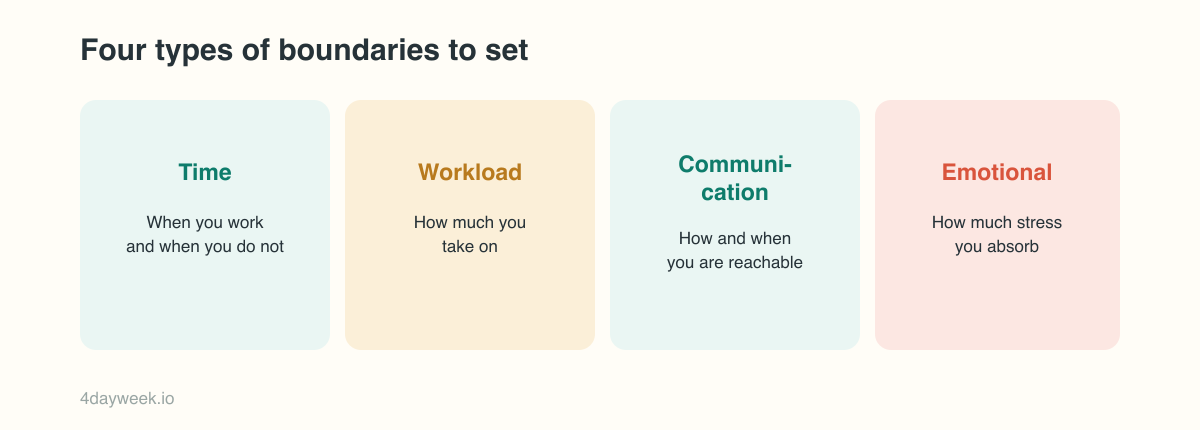
Most work boundaries fall into four buckets. It helps to know which ones you are weakest on.
1. Time boundaries. When you work and when you do not. A real start and finish time, protected breaks, and genuinely switching off in the evenings and at weekends. This is the boundary most people struggle with most.
2. Workload boundaries. How much you take on. Being realistic about capacity, not automatically saying yes to every request, and flagging when something has to give if new work lands.
3. Communication boundaries. How and when you are reachable. Not being on call around the clock, muting notifications outside work hours, and resisting the expectation of instant replies.
4. Emotional boundaries. How much of other people's stress and drama you absorb. Caring about your work without carrying the whole organisation's anxiety home with you.
Most people are fine on one or two of these and leak badly on the others. Naming your weak spot is the first step to fixing it.
How to set a boundary (that actually holds)
A boundary you announce but do not keep is worse than no boundary at all. Here is how to set one that sticks:
- Get clear on the line yourself. Decide exactly what the boundary is before you communicate it. "I finish at 5:30 and do not check email after that" is a boundary. "I want better balance" is a wish.
- Communicate it calmly and early. You rarely need a dramatic announcement. Often it is just quietly, consistently doing the thing: logging off at a set time, replying to the late message in the morning.
- Be matter-of-fact, not apologetic. State it as a normal practice, not a favour you are begging for. "I'll pick this up first thing tomorrow" needs no apology.
- Offer an alternative where it helps. "I can't take that on this week, but I could look at it next week" or "I can do X or Y, not both, which is the priority?" This keeps you collaborative while still holding the line.
- Hold it, especially when tested. Boundaries get tested, usually early. The first time you answer the 10pm email, you have quietly reset the expectation. Consistency is what makes a boundary real.
How to say no
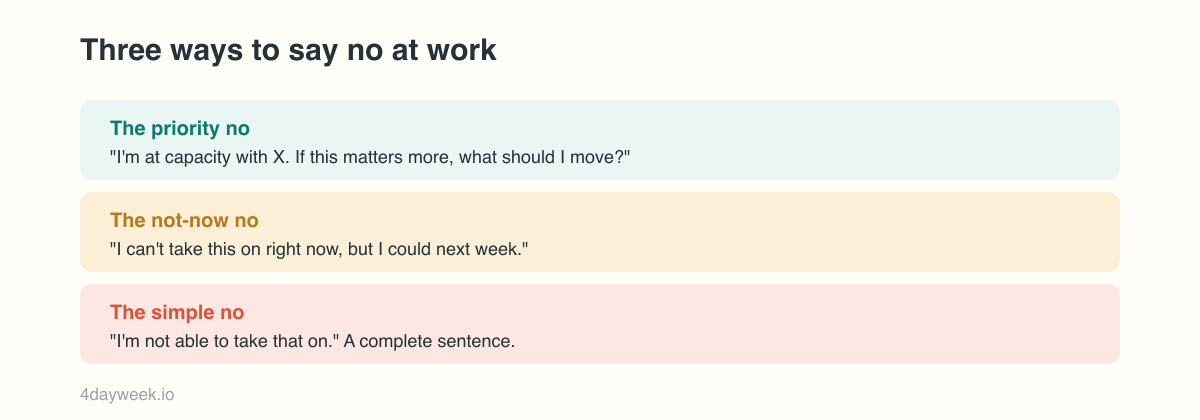
Most boundary problems are really a difficulty saying no. A few ways to do it that protect both the boundary and the relationship:
- The priority no: "I'd love to help, but I'm at capacity with X. If this is more important, what should I move?" This makes the trade-off visible and puts the choice back where it belongs.
- The not-now no: "I can't take this on right now, but I could next week." A no to the timing, not the person.
- The simple no: "I'm not able to take that on." Complete sentence. You do not owe a long justification for protecting your time.
Saying no is a skill, and like any skill it gets easier with practice. The first few are uncomfortable. It gets much easier once you see the sky does not fall.
Handling pushback
Sometimes a boundary meets resistance. That does not mean you were wrong to set it.
- Stay calm and consistent. Do not argue or over-explain. Restate the boundary plainly and move on.
- Separate the request from the guilt. Someone being disappointed is not proof you did something wrong. You are allowed to protect your time even when it is inconvenient for others.
- Watch the pattern. If reasonable boundaries are consistently punished, that is important information. A workplace that treats a 6pm finish or an unanswered weekend email as a problem is telling you something about its culture.
That last point is the crucial one, and it leads to the part willpower cannot solve on its own.
Work-Life Balance Jobs with Genuinely Reduced Hours
Save one to come back to it — it's free.



Boundaries in a remote and hybrid world
Working from home was supposed to make boundaries easier. For a lot of people, it did the opposite. When your office is your kitchen table and your commute is a ten-second walk, the line between "work" and "home" can dissolve entirely. The laptop is always there. The work is always one glance away. There is no leaving the building to mark the end of the day.
That makes deliberate boundaries more important remotely, not less. A few that help specifically with working from home:
- Create a hard stop. Without a commute to end the day, invent one: a set finish time, a short walk, closing the laptop and physically putting it away. Give your brain a signal that work is over.
- Separate the spaces if you can. Even a corner that is "the work zone", packed away at the end of the day, helps your mind switch off. Working from bed or the sofa blurs the line further.
- Turn off the tools. Log out of work chat and email outside your hours. The green "available" dot is a boundary you control.
- Resist the always-on proof. Remote workers often over-compensate by being hyper-responsive to prove they are working. Fight that. Being trusted to deliver should not require being permanently visible.
Hybrid and remote work are genuinely brilliant for balance when the boundaries are strong. Without them, "work from anywhere" quietly becomes "work everywhere, all the time".
When the problem is the culture, not your boundaries
Here is the honest truth about work boundaries: they are far easier to keep in some places than others.
In a healthy workplace, finishing on time and switching off in the evening is simply normal. Nobody blinks. In an always-on culture, every boundary is a small act of resistance you have to defend, over and over, against an expectation that you should be endlessly available. You can have excellent boundaries and still be exhausted from constantly defending them.
So while personal boundaries genuinely matter, they are not the whole answer. The deeper fix is a culture that respects people's time by default, where the boundaries are baked into how the place works rather than something each person has to fight for alone.
That is exactly what reduced-hours and flexible employers tend to offer. A four-day week, protected off-hours and a genuine respect for life outside work mean the boundaries are built into the job, not left entirely to your willpower. It is a lot easier to switch off at the end of the day when the whole company expects you to. If you find yourself defending every boundary against a culture that resents it, the most powerful boundary of all may be choosing an employer who respects your time in the first place.
Frequently asked questions
What are boundaries at work? The limits you set around your time, workload, availability and emotional energy so your job does not take over your life. Examples include finishing at a set time, not answering messages out of hours, and not taking on more than you can handle.
Are work boundaries bad for my career? No. Good boundaries prevent burnout and keep your work sustainable, which makes you more reliable over time, not less. People with clear boundaries are often the most dependable on a team because they are not running on empty.
How do I set a boundary at work? Decide exactly what the line is, communicate it calmly and without apology, offer an alternative where it helps, and, most importantly, hold it consistently, especially the first few times it is tested.
How do I say no at work without damaging relationships? Frame it around priorities ("I'm at capacity, what should I move?"), timing ("not now, but next week"), or simply state it plainly. You do not owe a long justification for protecting your time.
What if my workplace does not respect my boundaries? That is a sign about the culture, not a failure of your boundaries. Personal limits are much easier to keep at employers who respect people's time by default, which is why culture matters as much as willpower.
Want boundaries built into the job, not fought for? Browse four-day-week and reduced-hours roles on 4dayweek.io.




Get 4-day week jobs in your inbox
Create a free account to receive curated opportunities weekly.
Sign up for freeFree forever. No spam, unsubscribe anytime.