
For every live genuine 4-day week job on our board, there are more than 500 registered job seekers (571,000+ registrations against 1,102 live listings as of July 2026). That is not a typo. It is the shape of the market, measured on our own platform, and it is the clearest picture we can draw of how far demand for a shorter week has run ahead of supply.
Demand for genuine 4-day week jobs far exceeds supply. As of July 2026, 571,000+ registered job seekers face roughly 1,102 live genuine 4-day week listings, and each listing draws 5.1 apply clicks per vacancy versus 0.42 for jobs offering 5-day flexibility perks.
How big is the gap between 4-day week demand and supply?
 Start with the demand side: 571,000+ registered job seekers, with registrations accumulated from 2021 to July 2026. An honest note on that figure: registrations pile up over five years, and not every account is actively hunting this month. Keep that in mind. The apply-click data below measures live behavior, and it points the same direction.
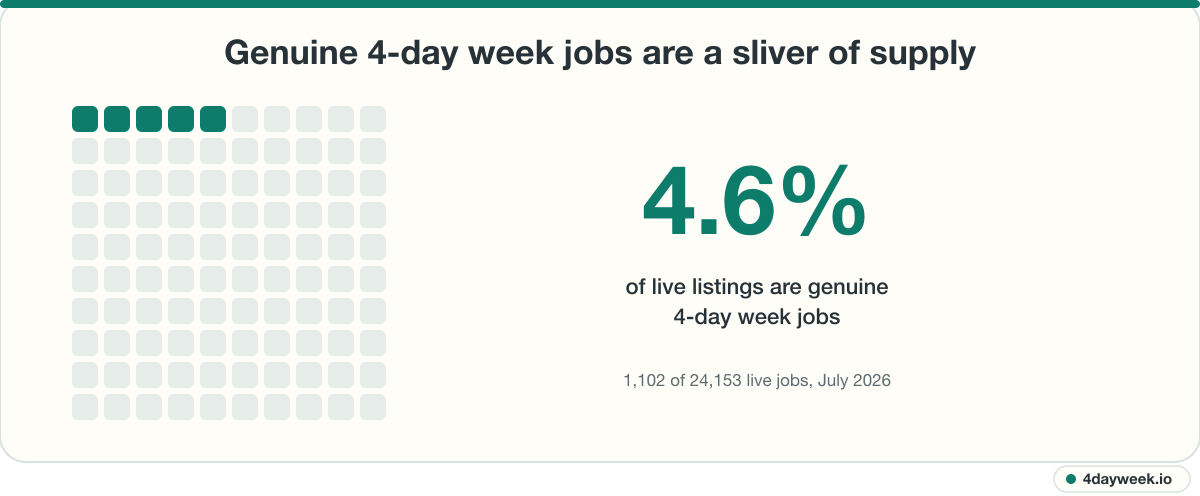
Now the supply side. At our July 2026 snapshot the board carried 24,153 live jobs. Only 1,102 of them, about 4.6%, were genuine 4-day week roles at 36 hours or less. Even on a job board built around reduced-hours work, genuine 4-day week jobs are a sliver.
Behind those listings sit 737 companies tracked with 4-day week (36 hours or less) policies, 364 of them with public evidence links. Of the 737, 666 run the schedule at full pay and 71 run pro-rata at 80% pay; 17 are employer-verified with us. Among companies reporting weekly hours, 623 operate at 32 hours and 63 at 36 (as of July 2026).
So the headline arithmetic is stark: over half a million registered seekers, about a thousand live genuine listings. The gap is not subtle.
What do apply clicks per job actually show?
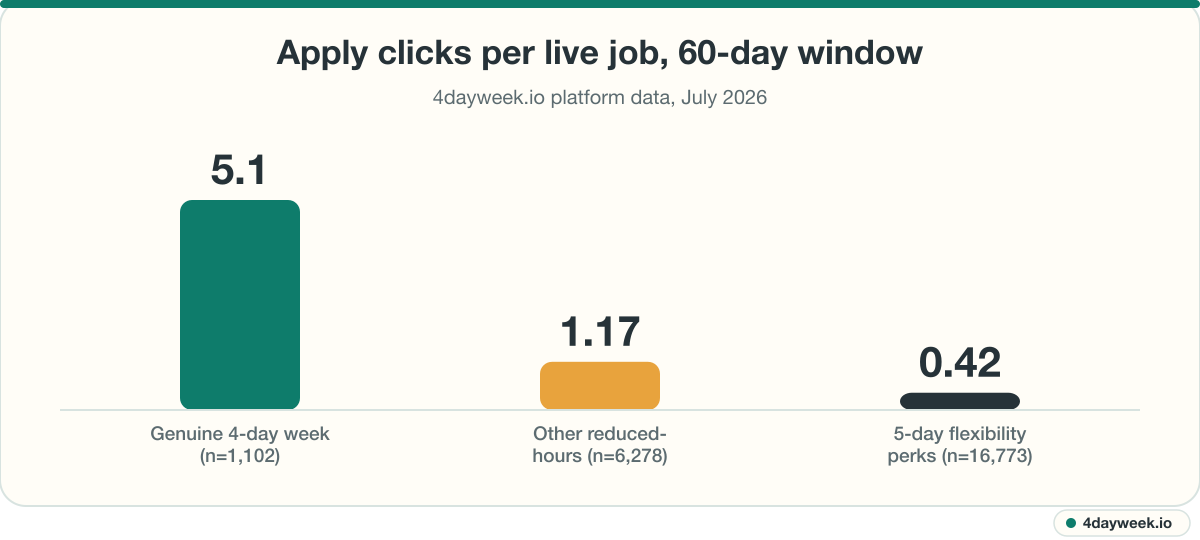 Here is measured candidate pull across a 60-day window to July 2026, live jobs only, with no featured-listing confound at the snapshot.
| Job group | Apply clicks (60 days) | Live jobs | Clicks per job |
|---|---|---|---|
| Genuine 4-day week (full pay and pro-rata) | 5,667 | 1,102 | 5.1 |
| Other reduced-hours schedules | 7,335 | 6,278 | 1.17 |
| 5-day week with flexibility perks | 6,976 | 16,773 | 0.42 |
The headline: a genuine 4-day week job draws roughly 12x the apply clicks per vacancy of a 5-day flexibility-perk job (5.1 against 0.42). It also draws about four times the pull of other reduced-hours schedules such as 9-day fortnights, half-day Fridays and part-time roles (5.1 against 1.17).
Quick definitions. The flexibility-perk bucket covers 5-day jobs sold on unlimited PTO, generous PTO, no-meeting days, flex Fridays, enhanced parental leave, and workplace awards. The other reduced-hours bucket covers 9-day fortnights, half-day Fridays, part-time roles and compressed schedules: everything that reshapes the week without being a genuine 4-day week at 36 hours or less.
Notice the totals before the ratios. The perk bucket actually collected more raw clicks than the 4-day bucket (6,976 against 5,667), because there are 15 times as many perk jobs. Raw totals reward whoever lists the most. Per vacancy, the story flips completely, which is exactly why we normalize.
Why is apply clicks per job the honest metric?
An apply click is a candidate clicking through from a listing to the employer's own application form. It is an application started, not a finished submission. Nearly all application activity on our platform is this kind of external click-through, and we cannot see who completes a form on the employer's side. So we count what we can observe, and we say so plainly.
Two more choices keep the comparison clean. We divide by live jobs so that a big bucket cannot win on volume alone. And the snapshot carries no featured-listing confound, so paid placement is not inflating the 4-day bucket. All platform figures will be re-frozen on the day this publishes; the numbers above are as of July 2026.
What this metric cannot tell you: conversion to hire, quality of fit, or how many clicks one specific role in one specific city will get. It measures relative candidate interest across schedule types on one platform, dated and with the fractions shown. That is all we claim for it.
What is the catch with this data?
Here is the caveat, up front rather than in a footnote. Our audience self-selects. People register with us because they want reduced-hours work, and our ranking surfaces genuine 4-day week jobs prominently. Both effects push the same way, so the 12x ratio reflects demand among reduced-hours-seeking candidates, not the whole labor market. Nobody should quote it as proof that 4-day week jobs get 12x more interest everywhere.
But notice what the caveat does not do. If you are an employer offering a genuine 4-day week, a pool that self-selected for reduced-hours interest is not a distortion of your target market. It is your target market, over half a million registrations deep. The ratio tells you what happens when your role stands in front of exactly the people you want to reach: it wins, by an order of magnitude.
What should employers take from the 12x gap?
First, perks do not substitute for structure. Jobs offering unlimited PTO, no-meeting days or flex Fridays drew 0.42 apply clicks per vacancy in this audience; genuine 4-day week jobs drew 5.1. Candidates can tell the difference between a calendar courtesy and time actually returned, and in a news cycle full of return-to-office mandates, the schedule itself is the magnet.
Second, precision matters. A compressed 4x10 is 40 hours in four days, and reduced-hours candidates know it. If you offer 32 or 36 hours, say so. If you offer a 4x10, call it that. Our explainer on 4x10 versus the 4-day week draws the line in detail.
Third, the outcome evidence for the genuine version keeps strengthening. In Nature Human Behaviour (Fan, Schor, Kelly and colleagues, 2025), six-month income-preserving 4-day week trials across 2,896 employees at 141 organizations in six countries saw burnout fall from 2.83 to 2.38 on a 1 to 5 scale and job satisfaction rise from 7.07 to 7.59 on a 0 to 10 scale, with gains driven partly by improved work ability, reduced fatigue and fewer sleep problems.
Fourth, a second differentiator is lying on the table. At our snapshot, 87.5% of live listings carried no published salary (18,663 of 24,153, July 2026). That is an industry-wide transparency gap, not a quirk of reduced-hours hiring. A genuine 4-day week plus a posted salary range separates a job ad twice in the same market.
How can job seekers compete for 4-day week roles?
The same scarcity that delights employers makes your search harder. At 5.1 apply clicks per vacancy, you are rarely early to a genuine 4-day week listing. Practical moves follow from the data.
Work-Life Balance Jobs with Genuinely Reduced Hours
Save one to come back to it — it's free.


Move fast and aim precisely. Fresh listings collect clicks quickly, so check often and prioritize roles where your evidence is strongest. Companies with public evidence links (364 of the 737 tracked) give you a policy you can read before you invest a weekend in the application form.
Widen the aperture beyond the strict 4-day week. Other reduced-hours schedules sit at 1.17 clicks per vacancy across 6,278 live jobs: more than five times the supply of genuine 4-day week roles, with a fraction of the crowd. A 9-day fortnight or half-day Friday is not the full prize, but it is a real schedule and a much shorter queue.
Know the remote squeeze. Among live genuine reduced-hours jobs, 1,596 are hybrid, 962 are onsite and just 425 are remote: about 14% (425 of 2,983, July 2026). If you will only accept remote plus a shorter week, you are hunting the scarcest slice of an already scarce market. A hybrid role within commuting distance multiplies your options several times over.
And remember the other path entirely: converting the job you already have. Our guide on how to ask your boss for a 4-day week covers the business case, the trial structure, and the evidence to bring. Zero competition from other candidates.
Where does the 4-day week job market go next?
Supply is growing from a small base: 737 companies tracked with 4-day week (36 hours or less) policies as of July 2026, against registrations that have accumulated to 571,000+ since 2021. Demand is not waiting patiently for supply to catch up.
2026 has already produced two unusual signals. In March, Sri Lanka mandated a public-sector 4-day week with Wednesdays off to conserve fuel (Seoul Economic Daily), and the Philippines moved national agencies to a compressed 4-day onsite arrangement for energy savings (GMA News). Both are crisis measures, and the Philippine version is a 4x10 rather than a genuine 4-day week. But when governments reach for the shape of the shorter week under pressure, the idea moves further into the mainstream conversation.
The voluntary corporate side has its own patterns. We recently published the first data cut of which day 4-day week companies take off: 91% of full pay companies with a recorded day-off policy pick Friday. And for the broader research picture, our 4-day week statistics hub collects trials, adoption data and survey evidence in one place.
Our read: the 12x gap is an early-mover advantage that will not last forever. List a genuine 4-day week role today and you stand nearly alone in front of half a million self-selected candidates. Wait a few years and a shorter week may simply be table stakes.
If you are hiring, list where those candidates already are. If you are looking, browse the live jobs: the schedule type sits on every card, with salary shown wherever employers publish it.
Frequently asked questions
How many genuine 4-day week jobs are live right now?
About 1,102 as of the July 2026 snapshot, out of 24,153 live listings on the board, or roughly 4.6%. The count moves daily, and every platform figure is re-frozen when we republish the data.
What exactly counts as an apply click?
A candidate clicking through from a listing to the employer's own application form. It marks an application started, not a completed submission, because completion happens on the employer's side where we cannot see it. We report clicks precisely because we can stand behind them.
Does a compressed 4x10 count as a genuine 4-day week?
No. A 4x10 folds 40 hours into four days. A genuine 4-day week is 36 hours or less, at full pay at the 666 full pay companies we track. We report the two separately in every dataset we publish.
How many companies actually offer a genuine 4-day week?
As of July 2026 we track 737 companies with 4-day week (36 hours or less) policies, 364 of them with public evidence links. Of those, 666 run full pay and 71 run pro-rata at 80% pay, with 17 employer-verified. Among companies reporting weekly hours, 623 run 32-hour weeks and 63 run 36-hour weeks.
Over half a million people want a shorter week and about a thousand live jobs offer one, so be early on whichever side of that gap you stand.




Get 4-day week jobs in your inbox
Create a free account to receive curated opportunities weekly.
Sign up for freeFree forever. No spam, unsubscribe anytime.