
Nobody handed in a resignation letter.
They just… stopped.
Stopped answering Slack at 9pm. Stopped volunteering for the extra project. Stopped pretending the mission was their whole life.
That's quiet quitting. And despite the name, it isn't really about quitting at all. It's about people quietly deciding to do the job they're paid for, and not a scrap more.
The phrase went viral for a reason: it named something millions of people were already feeling. But most of the takes miss what's actually going on. Quiet quitting isn't a laziness epidemic. It's a signal. And the data behind it points to a fix that has nothing to do with beanbags or pizza Fridays.
What is quiet quitting, really?
Quiet quitting is doing exactly what your job requires, meeting your responsibilities, while withdrawing the extra, unpaid discretionary effort that many workplaces quietly assume they're entitled to.
No staying late as a default. No picking up three other people's work for free. No treating "above and beyond" as the baseline.
It's worth being precise, because the term gets thrown around loosely:
- Quiet quitting is not doing a bad job. Quiet quitters still do their work.
- Quiet quitting is not slacking off or "acting your wage" in the sense of neglecting duties.
- Quiet quitting is a boundary, a refusal to let work expand to fill every waking hour.
Put like that, it starts to sound less like a crisis and more like… a reasonable response to years of scope creep.
Where the term came from
"Quiet quitting" went viral on social media in 2022, when a short video reframed a familiar feeling: you're not obligated to go above and beyond for a job that wouldn't do the same for you.
It struck a nerve because it named something people had been doing for years without a word for it. The phrase is new; the behaviour is ancient. What changed is that a generation raised on "hustle harder" finally said the quiet part out loud, and gave it a name that spread.
Signs you might be quiet quitting
It's rarely a conscious decision. It creeps in. A few tell-tale signs:
- You do what's asked, and nothing extra.
- You've stopped volunteering for projects you'd once have jumped on.
- You log off on time and feel a small flush of guilt (then let it go).
- You've mentally filed the job under "just a job".
- The idea of "going the extra mile" quietly makes you tired.
None of that makes you a bad employee. It usually means the balance between what you give and what you get back has tipped, and your energy is protecting itself.
The data behind it
Here's where it stops being a vibe and starts being measurable.
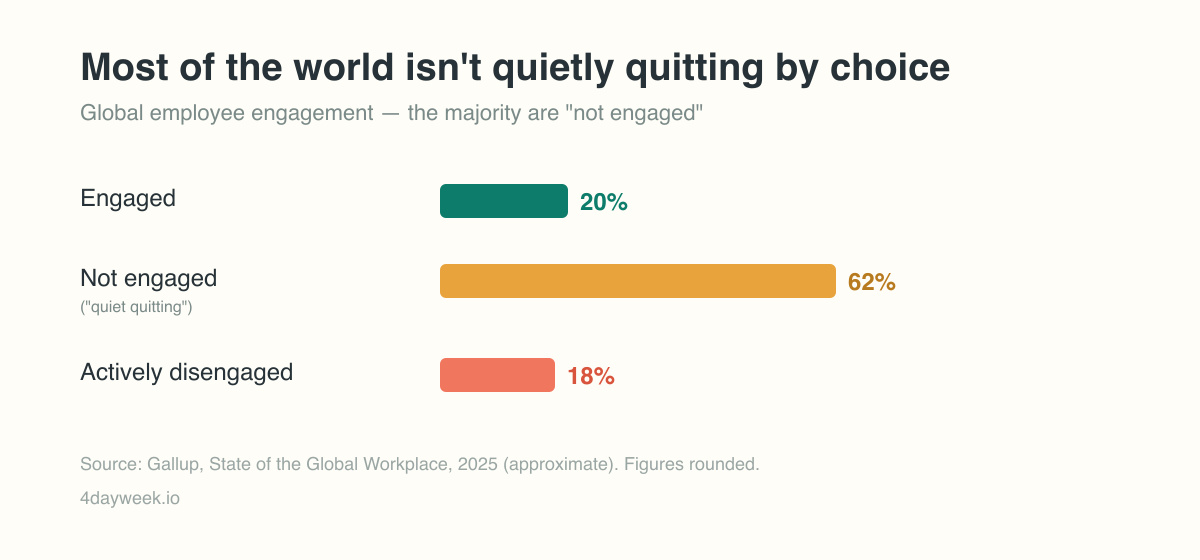
Gallup, which has tracked employee engagement globally for decades, finds that only around one in five employees worldwide are "engaged" at work. The clear majority, roughly 6 in 10, are "not engaged", present, doing the minimum, psychologically checked out.
That "not engaged" group is quiet quitting. It's the same behaviour, measured before the phrase existed.
Two more numbers matter:
- Disengagement is expensive. Gallup estimates lost productivity from low engagement runs into the trillions of dollars a year, on the order of 9% of global GDP.
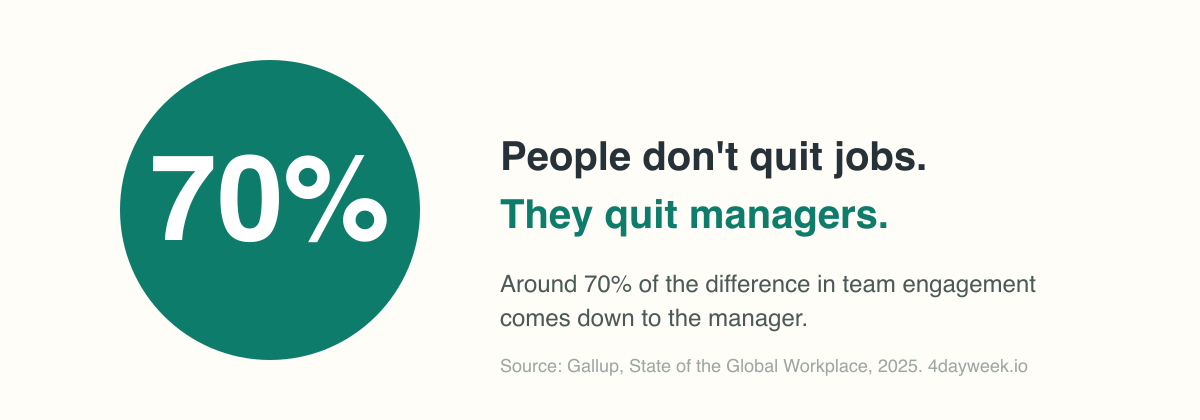
- It's largely a management problem. Gallup attributes around 70% of the variance in team engagement to the manager. People don't quietly quit jobs so much as they quietly quit bad management and bad conditions.
The takeaway is uncomfortable but clarifying: quiet quitting isn't mostly about workers getting lazier. It's about the deal between people and work getting worse.
Why it's happening
If effort feels worth it, people give it. When it doesn't, they stop. Quiet quitting spikes wherever that equation breaks:
- Always-on culture. Laptops and phones erased the line between work and life. "A quick email" at 10pm became normal, and unpaid.
- Reward that never comes. Years of "go the extra mile and you'll be looked after" that quietly turned into more work for the same pay.
- Burnout. You can't pour from an empty cup. Chronic overload forces people to ration their energy, and discretionary effort is the first thing to go. (See our guide to the 8 signs of workplace burnout.)
- A values mismatch. A generation that watched hustle culture deliver exhaustion, not freedom, is simply less willing to sacrifice their whole life for a job.
None of that is fixed with a wellbeing webinar.
Quiet quitting vs quiet firing
Quiet quitting has a mirror image that gets far less airtime: quiet firing.
That's when an employer quietly disengages from you, no development, no interesting work, no path forward, no raise, nudging you toward the door without ever having the conversation.
| What it is | Who's disengaging | |
|---|---|---|
| Quiet quitting | Employee does the job, withholds the extra | The employee |
| Quiet firing | Employer withholds growth, support, reward | The employer |
| Reclaiming your time | Deliberately choosing boundaries or reduced hours | A conscious, healthy choice |
The first two are symptoms of a broken relationship. The third is what it looks like when someone decides to fix it on their own terms.
Is quiet quitting a bad thing?
Honestly? It depends who you ask, and it's worth being straight about the trade-offs.
For employers, widespread quiet quitting is a warning light. It means people have stopped believing effort pays off, and that's a retention and productivity problem you can't hire your way out of.
Work-Life Balance Jobs with Genuinely Reduced Hours
Save one to come back to it — it's free.



For workers, setting boundaries is often healthy, not cynical. Refusing to work unpaid overtime isn't a moral failing. Protecting your evenings so you don't burn out is self-preservation.
The unhealthy version is quiet quitting as resignation, staying somewhere that drains you, doing the minimum, slowly going numb. That helps no one. If you've mentally checked out, the honest question isn't "how little can I do?" It's "is this the right job?"
What employers should actually do
You don't re-engage people with perks. You re-engage them by making the deal fair again:
- Give time back, for real. The single most powerful re-engagement lever is fewer hours, not more benefits. A four-day week or reduced-hours schedule says we value your life outside work louder than any slogan.
- Fix the managers. If 70% of engagement is down to managers, train and support them like it matters, because it does.
- Protect boundaries. Respect off-hours. Reward outcomes, not hours online.
- Make effort worth it again. Pay, progression, and purpose that people can actually feel.
Companies that do this don't have a quiet-quitting problem. They have a queue of people who want to work there.
What to do if you're quietly quitting
If you've pulled back, it's worth asking why.
If you're setting healthy boundaries in a job you basically like, good. Keep them. That's sustainable.
But if you've checked out because the job is quietly eroding you, boundaries alone won't fix it. Sometimes the honest move isn't doing less at a job that's wrong for you, it's finding one that's right.
That doesn't mean grinding somewhere new. It means finding an employer whose normal is what you're currently having to fight for: reasonable hours, respect for your time, a life outside the logo.

The real fix
Quiet quitting is what happens when work takes more than it gives back.
So the fix isn't to guilt people into caring more. It's to change the deal, to build work around a life, instead of squeezing a life around work.
That's the whole idea behind the four-day week. Not doing less that matters, doing the same work in less time, with the hours you save handed back to you. It's why engaged, rested people at reduced-hours companies aren't quietly quitting: they've got nothing to quietly quit from.
Wasn't technology meant to give us time back? Quiet quitting is a whole generation asking that question out loud.
Frequently asked questions
What is quiet quitting in simple terms? Doing your job as required, but no more, stepping back from the unpaid extra effort, overtime and always-on availability that many workplaces treat as the default.
Is quiet quitting the same as slacking off? No. Quiet quitters still meet their responsibilities. It's about withdrawing discretionary extra effort, not neglecting the actual job.
Why are so many people quiet quitting? Gallup's data shows only about 1 in 5 employees are engaged worldwide. The causes are structural: always-on culture, burnout, effort that stopped feeling rewarded, and a values shift away from hustle culture.
What's the opposite of quiet quitting? Genuine engagement, which employers earn through fair pay, good management, respect for boundaries, and giving time back (for example via a four-day week), not through perks.
Is quiet quitting bad? Setting healthy boundaries is reasonable and often necessary. The harmful version is staying disengaged in a job that's wrong for you, at which point changing jobs usually beats slowly going numb.
Tired of a job that takes more than it gives? Browse four-day-week and reduced-hours roles on 4dayweek.io →




Get 4-day week jobs in your inbox
Create a free account to receive curated opportunities weekly.
Sign up for freeFree forever. No spam, unsubscribe anytime.