
We have a word for having too much to do until it breaks you: burnout.
We're strangely silent about its opposite, having too little that matters, until that breaks you too.
That's boreout. It's real, it's more common than anyone admits, and because it hides behind a busy-looking screen, most people suffering from it don't even have a name for what's wrong.
What is boreout?
Boreout is a state of chronic boredom, under-stimulation and meaninglessness at work that damages your wellbeing, the mirror image of burnout.
The term was coined by two Swiss consultants, Peter Werder and Philippe Rothlin, in their 2007 book on the subject. Their insight was counterintuitive but obvious once said: you can be made ill not just by too much work, but by too little meaningful work.
Boreout has three core ingredients:
- Boredom, long, empty stretches with nothing engaging to do.
- Being under-challenged, work far below your skills and capacity.
- Loss of meaning, the sense that what you do doesn't matter.
The cruel twist: sufferers often look the busiest. To avoid being handed more dull work, or to hide that they have too little, people stretch tasks out, keep a spare email open, and perfect the art of appearing occupied. It's exhausting to fake productivity all day, which is part of why boreout hurts.
Boreout vs burnout
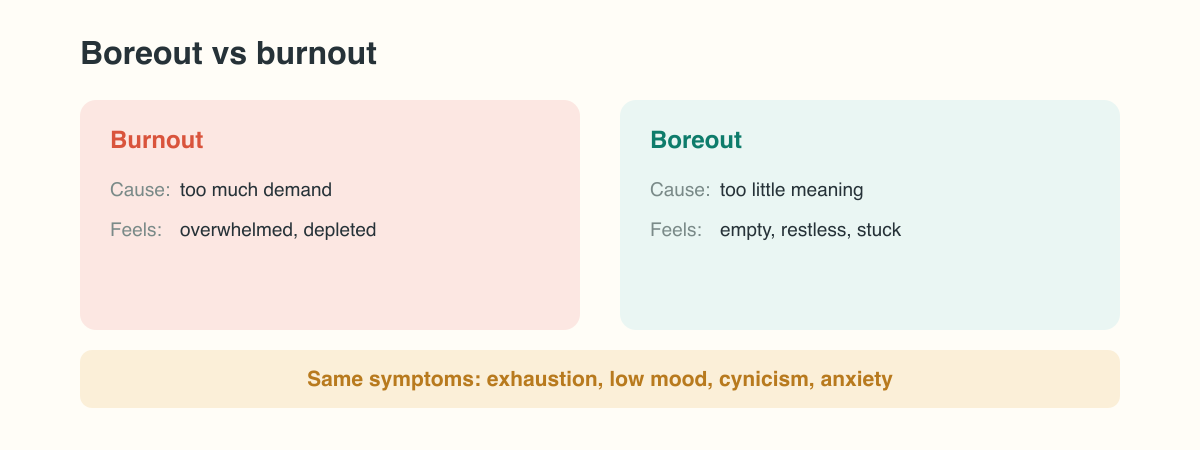
They sound like opposites, and in their cause they are, but they arrive at a strikingly similar place.
| Burnout | Boreout | |
|---|---|---|
| Cause | Too much demand, not enough recovery | Too little meaningful work, under-challenged |
| Feels like | Overwhelmed, depleted, can't switch off | Empty, restless, stuck, invisible |
| Shared symptoms | Exhaustion, low mood, cynicism, anxiety | Exhaustion, low mood, cynicism, anxiety |
That shared bottom row is why boreout is so often missed. Someone describes feeling exhausted and low, everyone assumes overwork, and the actual problem, chronic under-use, goes unaddressed (and sometimes gets "treated" with a holiday that changes nothing).
The signs of boreout
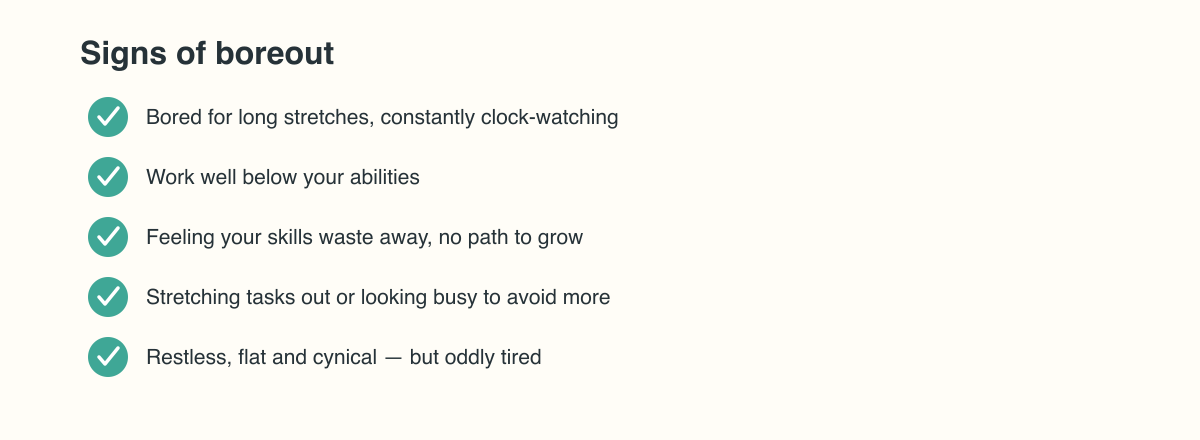
Boreout creeps in quietly. The tell-tale signs:
- You're bored for long stretches and constantly clock-watching.
- Your work is well below your abilities, you could do it half-asleep.
- You feel your skills wasting away and no path to grow.
- You stretch tasks out to fill the day, or look busy to avoid more dull work.
- You feel restless, flat and cynical, but also weirdly tired.
- The Sunday-night dread is about emptiness, not overload.
If several of those ring true, the problem may not be that you're overworked. It may be that you're profoundly underused.
What causes boreout?
It's tempting to blame yourself, shouldn't I just be grateful for an easy job? But boreout is usually a job-design problem, not a character flaw:
- Too little meaningful work to fill the role.
- A mismatch between your skills and what the job asks of you.
- No autonomy, no room to take on more, improve things, or own anything.
- No growth, nowhere to develop, so your capabilities stagnate.
- Bureaucracy and make-work, effort that produces motion, not meaning.
An easy job sounds like a dream until you're living it. Humans need challenge and purpose; remove them and "easy" curdles into miserable.
The health effects of boreout
Because boreout hides behind an easy workload, its toll gets dismissed, what's there to complain about? But chronic under-stimulation is a genuine stressor, and the effects are real:
- Low mood and depression, as days blur into meaningless repetition.
- Anxiety, often from the effort of hiding it and the fear of being "found out" as underused.
- Fatigue, the peculiar tiredness of an under-stimulated brain, plus the exhaustion of faking busyness.
- Falling self-worth, as capable people watch their skills rust and start to doubt them.
- Physical symptoms, sleep problems, headaches, that stress produces regardless of its source.
The point isn't to rank boreout against burnout. It's that being profoundly underused is not the cushy problem it sounds like, it can quietly erode you.
Boreout and remote work
Remote work can make boreout easier to hide and harder to escape. Alone at home, with no colleagues to bounce off and no incidental buzz of an office, an under-full role can feel even emptier. The isolation compounds the under-stimulation. And because no one can see you, the temptation to stretch two hours of work across eight, filling the void with the performance of being busy, is stronger than ever.
If you're remote and quietly going stir-crazy with too little that matters, you're not imagining it, and you're not alone.
Boreout vs quiet quitting vs rust-out
Work-Life Balance Jobs with Genuinely Reduced Hours
Save one to come back to it — it's free.



These related terms get tangled, so it's worth separating them:
- Boreout, you want meaningful work but the job doesn't provide it. The disengagement is imposed by the role.
- Quiet quitting, you choose to withdraw extra effort, often as a boundary against overwork. The disengagement is a deliberate response.
- Rust-out, a close cousin of boreout: gradually coasting and disengaging over time until your skills and motivation seize up.
The overlap is real, but the driver differs: boreout is being starved of meaning; quiet quitting is rationing your effort. Both are cured by the same thing, meaningful work in a job that respects your time.
How to fix boreout
The instinct is "just give them more to do." But piling on more meaningless work makes boreout worse. The real fix is meaning and autonomy:
- Name it honestly. Admitting you're under-challenged (not lazy, not ungrateful) is the first step.
- Ask for more meaningful work, not just more tasks. Volunteer for a project you'd actually care about.
- Seek autonomy. Room to improve a process, own an outcome, or learn something new can reignite engagement.
- Push for growth, training, a stretch goal, a sideways move that uses more of you.
- If the role can't stretch, change it. Sometimes the job is simply too small for you, and the honest fix is a bigger one.
And here's the reduced-hours angle worth sitting with: if a job genuinely only contains three days of meaningful work, forcing it to fill five manufactures boreout, all that empty, task-stretching, looking-busy time. A four-day week or reduced-hours role can compress a role down to the work that actually matters, so your time is spent doing something real rather than performing occupation. Less time, more meaning, is often the cure, not more hours of the same emptiness.
For managers: how to spot and prevent boreout
If you lead a team, boreout is easy to miss precisely because the symptoms look like quiet compliance. Watch for the person who's always "fine", never stretched, and quietly fading. To prevent it:
- Match work to capacity. Regularly check whether people are genuinely challenged, not just busy. An underused high performer is a flight risk and a wellbeing risk at once.
- Delegate meaning, not just tasks. Hand over ownership of outcomes people can care about, not just chores to fill a timesheet.
- Make growth real. Stretch projects, learning, and a visible path forward keep capable people engaged.
- Right-size the role. If a job simply doesn't contain enough meaningful work, be honest about it, reshape it, combine it, or move to a schedule that fits the actual work rather than padding it out to five days.
The cost of ignoring boreout is the same as ignoring burnout: your best people quietly leave, or quietly check out. Under-using talented people isn't kind. It's a slow waste, of them, and of what they could do.
Frequently asked questions
What is boreout? A state of chronic boredom, under-stimulation and lack of meaning at work that harms your wellbeing, essentially the opposite of burnout, caused by having too little meaningful work rather than too much.
What's the difference between boreout and burnout? Burnout comes from too much demand and not enough recovery; boreout comes from too little meaningful, challenging work. Despite opposite causes, they share symptoms, exhaustion, low mood, cynicism, anxiety, which is why boreout is often mistaken for burnout.
What are the signs of boreout? Persistent boredom and clock-watching, work well below your abilities, feeling your skills waste, stretching tasks to fill time, and feeling restless, flat and cynical yet tired.
How do you fix boreout? Seek more meaningful work and autonomy rather than just more tasks, push for growth, and, if the role is simply too small, move to one that uses you. Compressing an under-full role into fewer, focused hours can also help.
Underused and restless? Find a role that actually uses you. Browse four-day-week and reduced-hours jobs on 4dayweek.io →




Get 4-day week jobs in your inbox
Create a free account to receive curated opportunities weekly.
Sign up for freeFree forever. No spam, unsubscribe anytime.