
Somewhere between "I need a two-week holiday" and "I'm quitting to travel", there's a third option most people never consider.
A sabbatical.
An extended, agreed break from work, with your job waiting for you when you get back.
Sabbaticals used to be the preserve of tenured professors. Not any more. Tech firms, charities, consultancies and scale-ups now offer them to keep good people from burning out and walking away for good. Searches for "sabbatical" have never been higher, because more of us are quietly wondering whether there's a way to step off the treadmill without ending our careers.
There is. This guide covers exactly what a sabbatical is, how long they last, whether you get paid, the rules in the UK and US, which companies offer them, and how to ask for one without torching the relationship on your way out the door.
What is sabbatical leave?
A sabbatical is a longer period of leave, typically one to three months, sometimes up to a year, that you take with your employer's agreement and return from to the same (or an equivalent) role.
The two words that matter: extended and agreed.
Extended, because a sabbatical is measured in months, not the odd day here and there. Agreed, because, unlike simply resigning, your job is protected while you're away.
People take them for all sorts of reasons: to travel, to write, to study, to care for family, to recover from burnout, or simply to remember what they're like when work isn't the centre of everything. The point isn't what you do with the time. The point is that the time is yours, and there's a job to come back to.
It's worth being clear about what a sabbatical isn't:
- It's not annual leave. Holiday is your legal entitlement, taken in days or weeks. A sabbatical is a separate, discretionary arrangement measured in months.
- It's not a career break, though the two overlap. A career break usually means leaving your role entirely, with no guaranteed job to return to. A sabbatical keeps your role open. (More on that distinction below.)
- It's not a sabbatical in the biblical or academic sense either, those come with their own rules. Here we mean the modern, work-world version.
How long is a sabbatical?
There's no fixed length, because there's no law setting one. In practice, most fall into three bands:
| Length | Typical use | How common |
|---|---|---|
| 1 month | A proper reset, minimal disruption to the team | Most common entry-level offer |
| 2–3 months | Travel, a big personal project, real recovery | The classic "sabbatical" |
| 6–12 months | Study, retraining, extended caring or travel | Rarer, usually senior/long-tenured staff |
A common pattern in company policies is to tie the length to your service: for example, a month off after five years, building to longer breaks the longer you stay. It's a retention tool as much as a perk, a reason to stick around rather than jump ship.

Paid vs unpaid: will you actually get money?
This is the question everyone really wants answered. The honest reply: it depends entirely on the employer, and many sabbaticals are unpaid or only partly paid.
Here's how the three models compare:
| Model | What it means | The catch |
|---|---|---|
| Paid sabbatical | Full or reduced salary while you're away | Rare and prized; usually reserved for long service |
| Partly paid | A percentage of salary, or a lump sum | A common "generous" middle ground |
| Unpaid sabbatical | No salary, but your job (and often benefits) is held | You fund the time yourself, plan the finances early |
Even an unpaid sabbatical is valuable, because the thing being protected isn't just this month's pay, it's your role, your seniority, and your place on the team. You're swapping income for time, with a guaranteed way back. For a lot of people, that trade is the whole point.
Two things to check in any policy before you get excited:
- Do benefits continue? Pension contributions, health cover and holiday accrual may pause during an unpaid sabbatical. Ask.
- Is there a payback clause? Some paid sabbaticals require you to stay for a set period afterwards, or repay the money if you leave. Read the small print.
How to prepare financially for an unpaid sabbatical
If your sabbatical is unpaid, the maths is the whole plan. Get it right and the time feels like freedom; get it wrong and it feels like a countdown.
- Know your monthly number. Add up what you actually spend in a normal month. Multiply by the length of the break. That's your minimum.
- Add a buffer. Life doesn't pause, build in a cushion for the unexpected, plus a little for whatever you're taking the sabbatical to do.
- Save it before you go. Treat the fund like a goal with a deadline. Automating a monthly transfer for six to twelve months beforehand is the least painful route.
- Check what pauses. Confirm what happens to pension contributions, health cover and holiday accrual while you're away, and budget for anything you'll need to cover yourself.
- Consider a trickle of income. A little freelance or part-time work can stretch an unpaid break a long way without undoing the point of it.
The reassuring part: because your job is protected, you're not also budgeting for a job hunt on the other side. You're funding time, not unemployment.
Your sabbatical rights in the UK and US
Let's be blunt, because this trips a lot of people up:
There is no statutory right to a sabbatical in either the UK or the US.
No law says your employer has to give you one. A sabbatical is a contractual or discretionary arrangement, it exists because your company chooses to offer it, or because you negotiate it. That's very different from something like the UK's day-one right to request flexible working, which is backed by law.
What that means for you:
- Check your contract and staff handbook first. If there's a written sabbatical policy, it will spell out eligibility, length and pay. Follow it.
- If there's no policy, you're negotiating. That's not a dead end, plenty of sabbaticals happen by individual agreement. It just means the case is yours to make.
- Get it in writing. However informal the conversation, confirm the dates, the pay, what happens to benefits, and that your role is protected, by email at minimum.
(This is general guidance, not legal advice. For your specific situation, check your contract and, in the UK, resources like Acas.)
Companies that offer sabbatical leave
Sabbaticals have quietly become a mainstream retention perk, especially among the kind of progressive, people-first employers that also embrace reduced hours and remote work.
On 4dayweek.io alone, dozens of companies advertise a sabbatical benefit, including names you'll recognise:

From Airbnb and Duolingo to remote-first pioneers like Buffer and Automattic, fintechs like Wise, and life-sciences firms like Biogen and Genentech, the common thread is employers who treat time off as an investment in people, not a cost.
Work-Life Balance Jobs with Genuinely Reduced Hours
Save one to come back to it — it's free.


It's the same philosophy behind the four-day week: rested people do better work. Companies that offer sabbaticals tend to score well on the other things that make work sustainable, too.
👉 Browse companies with generous time-off policies or explore roles at employers offering flexible hours and reduced-hours schedules.
How to ask for a sabbatical (without burning a bridge)
Here's where most people freeze. Asking for months off feels like admitting you're not committed. Framed right, it's the opposite, it's a plan to come back and give more.
Five steps that work:
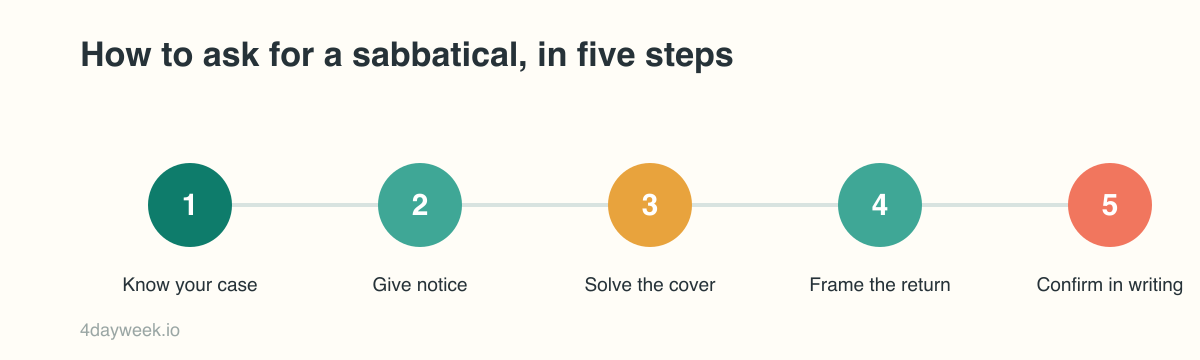
1. Know your case. Why now, why you, and what you'll do to make it painless. "I'd like three months from September" lands better than "I'm exhausted."
2. Give as much notice as you can. Notice is the single biggest thing that turns a "no" into a "yes". Three to six months lets your team plan around your absence.
3. Solve the cover problem for them. Managers fear the gap, not the request. Come with a plan: who covers what, what you'll hand over, what can wait.
4. Frame it around returning. Make the pitch about coming back recharged, loyal and ready, not about escaping. A sabbatical is a reason to stay, and smart employers know it.
5. Confirm it in writing. Dates, pay, benefits, and your role on return. Kindly, clearly, on the record.
If the answer is still no? That's useful information too. It might be time to look for an employer whose values match yours.
Sabbatical vs career break vs reduced hours
A sabbatical is one way to buy back time, but it's not the only one. If a clean months-long break isn't on the table, you have options:
| Option | Job protected? | Best for |
|---|---|---|
| Sabbatical | Yes, role held | A defined break, then straight back in |
| Career break | Usually not | A longer or open-ended step away |
| Reduced hours (4-day week, 9-day fortnight, part-time) | Yes, you keep working | Ongoing balance, not a one-off break |
The mistake is assuming it's all-or-nothing, grind flat-out or quit. It isn't.
A sabbatical gives you a reset. A career break gives you longer. And a genuinely reduced-hours job gives you the time back permanently, a four-day week at full pay, a nine-day fortnight, or flexible hours that fit your life.
Wasn't technology meant to give us time back anyway? A sabbatical is one way to claim some of it. Building a career around reduced hours is another.
Frequently asked questions
Is a sabbatical paid? Sometimes. It depends entirely on the employer, sabbaticals can be fully paid, partly paid, or unpaid. Paid sabbaticals are rarer and usually reserved for long-serving employees. Even unpaid, your job is protected while you're away.
How long can a sabbatical be? Most sabbaticals run from one to three months, though some employers offer up to a year. There's no legal maximum, the length is set by company policy or by what you negotiate.
Do I have a right to a sabbatical in the UK? No. There's no statutory right to a sabbatical in the UK (or the US). It's a discretionary or contractual arrangement, check your contract or staff handbook, and be prepared to make the case if there's no formal policy.
What's the difference between a sabbatical and a career break? A sabbatical keeps your job open for you to return to. A career break usually means leaving your role entirely, with no guaranteed job on return. A sabbatical is the lower-risk option if your employer offers one.
Can I be refused a sabbatical? Yes, because there's no legal right to one, an employer can decline. Giving plenty of notice and proposing a clear cover plan gives you the best chance of a yes.
Ready for time that's yours all year round, not just once a decade? Browse four-day-week and reduced-hours jobs on 4dayweek.io →




Get 4-day week jobs in your inbox
Create a free account to receive curated opportunities weekly.
Sign up for freeFree forever. No spam, unsubscribe anytime.