
You have probably seen it, or at least heard the story secondhand. Someone reaches their limit, walks into a meeting, and resigns on the spot. No careful handover, no two-week runway, sometimes a parting speech. The frustration that had been building quietly for months finally spills out all at once, in public.
That is revenge quitting, and it was one of the most talked-about workplace behaviours of 2025.
What is revenge quitting?
Revenge quitting means resigning abruptly, and often dramatically, after pent-up frustration and resentment boil over. The exit is sometimes timed or delivered to make a point: to a manager who ignored the warning signs, or to a company that took the effort for granted.
It sits at the far end of a spectrum of workplace unhappiness. Some people disengage quietly and stay. Some cling on out of fear. Revenge quitters do the opposite of both. They leave, and they want it felt.
Commentators named it a top workplace trend for 2025, and the timing is worth unpacking, because it says a lot about how stuck a lot of people feel right now.
Why is revenge quitting on the rise?
 The short version: a lot of people are unhappy, they have been holding it in, and the pressure has to go somewhere.
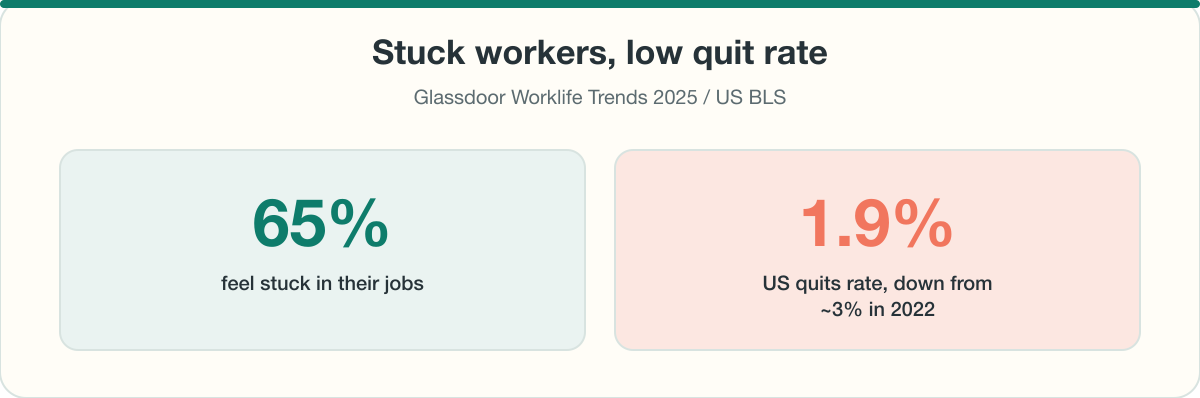
Glassdoor's Worklife Trends 2025 report found that around 65% of professionals feel "stuck" in their jobs. That is a striking figure. Roughly two-thirds of workers describing themselves as unable to move, unable to grow, or simply becalmed in a role that no longer goes anywhere.
At the same time, fewer people are actually quitting. The US quits rate tracked by the Bureau of Labor Statistics has fallen to roughly 1.9%, down from a peak near 3% in 2022. So the surface looks calm. Underneath, frustration keeps building precisely because people are staying put rather than leaving.
That gap is the fuel. When workers feel trapped but stop leaving, resentment accumulates with nowhere to go. Glassdoor and other commentators (Forbes flagged it in December 2024) predicted revenge quitting could surge in 2025 as the job market improved and more of those stuck workers finally saw an exit open up. The moment the door cracks, the people who have been simmering longest are often the first ones through it, and some of them slam it on the way out.
The trend is often associated with Gen Z, the group most likely to expect fair treatment, transparency and progression, and least willing to quietly absorb the opposite for years on end.
What does revenge quitting actually look like?
It is not always a dramatic scene, though it can be. In practice it takes a few recognisable forms:
- The abrupt resignation. No notice, or the bare legal minimum, delivered cold. Part of the point is the shock.
- The pointed exit. A resignation timed to cause maximum inconvenience: right before a launch, mid-project, or the day a big deadline lands.
- The public statement. A resignation letter, or a post, that names the grievances rather than smoothing them over. The goodbye doubles as a complaint.
- The clean walkout. Less theatrical, but still sudden. Someone who has clearly checked out mentally hands in notice the instant they have something else lined up, with no interest in a graceful handover.
The common thread is emotion in the driving seat. A planned resignation is a decision. A revenge quit is a release.
How is revenge quitting different from quiet quitting and job hugging?
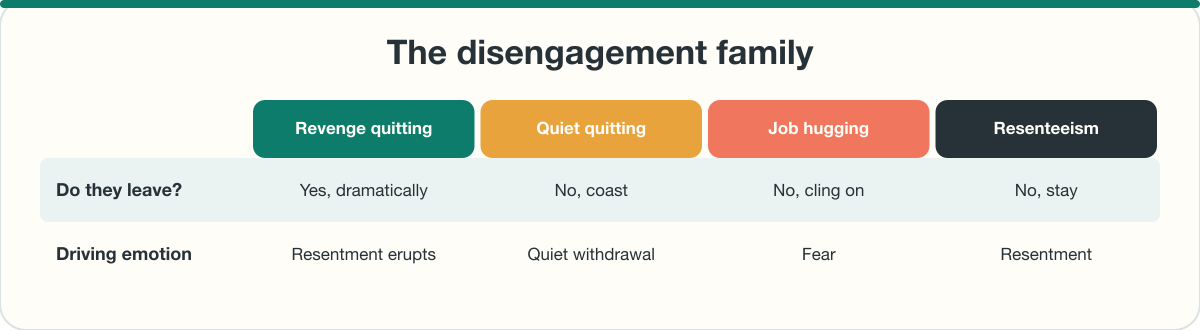 It is easy to lump every unhappy-at-work behaviour into one bucket. They are not the same, and the differences matter.
| Behaviour | Do they leave? | Driving emotion | What you see |
|---|---|---|---|
| Revenge quitting | Yes, abruptly | Resentment that boils over | A sudden, pointed exit |
| Quiet quitting | No, they stay | Disengagement | Doing the job description and no more |
| Job hugging | No, they cling on | Fear and insecurity | Staying put even when unhappy |
| Resenteeism | No, they stay | Simmering resentment | Visibly unhappy but unwilling to go |
Revenge quitting is the loud cousin of some much quieter behaviours. Quiet quitting is when people stay but withdraw their extra effort, doing what the role requires and nothing more. Job hugging is almost the mirror image: clinging to a job out of fear in a cooler market, even when it no longer satisfies. Resenteeism is staying in a role you actively resent, unhappy but unwilling or unable to leave.
Here is the connection worth noticing. Job hugging and revenge quitting come from the same place. Both grow out of that stuck feeling in a cool job market. The difference is what happens at the end. A job hugger holds on. A revenge quitter, having held on too long, eventually explodes out. The resentment a hugger swallows is the same resentment a revenge quitter finally acts on. Same root, opposite exit.
Why does revenge quitting usually backfire?
The grievance can be completely real and the method can still cost you. That is the hard truth most of the hot takes skip past.
- Burned bridges. Industries are smaller than they feel. The manager you humiliate on the way out can turn up on an interview panel a few years later, or know someone who does.
- References. A dramatic exit makes an honest reference awkward at best. You may need that former employer to vouch for you sooner than you think.
- No runway. Quitting in a blaze of feeling often means quitting without the next thing secured, or without the savings to cover the gap. The satisfaction fades a lot faster than the rent does.
- The story follows you. "Why did you leave your last job?" is a standard interview question. "I quit on the spot because I'd had enough" is a hard answer to make sound good, however justified it was at the time.
None of this means the anger is wrong. Being overworked, underpaid or ignored is a legitimate reason to leave. The problem is that a revenge quit spends your leverage on a single moment of catharsis, and leaves you carrying the cost long after the audience has moved on.
What should you do instead?
The alternative is not to swallow it and stay. It is to leave in a way that serves the future you, not just the furious you.
- Name the problem first, if it is fixable. Sometimes the issue is workload, or pay, or a manager who genuinely did not realise how close to the edge you were. A direct conversation, or a counteroffer worth weighing, can occasionally change the maths. Sometimes it cannot, and that clarity is useful too.
- Line up the next thing. Leverage comes from options. A role secured, or a runway saved, turns a desperate exit into a chosen one.
- Plan the exit. Give proper notice, hand over cleanly, and keep it civil even if they did not earn it. Our guide on how to quit your job walks through doing it with your reputation intact.
- Take the lesson with you. Whatever pushed you to the edge is data. Use it to choose the next employer more carefully, rather than landing somewhere that repeats the pattern.
Work-Life Balance Jobs with Genuinely Reduced Hours
Save one to come back to it — it's free.



A dignified exit is not about protecting the company's feelings. It is about protecting your own leverage, references and options. Anger is information. It does not have to be your resignation strategy.
What does revenge quitting tell employers?
For an employer, a revenge quit is tempting to write off as one person's bad character or bad day. That is almost always the wrong read.
A sudden, angry resignation is rarely the start of a problem. It is the end of one. By the time someone quits in a rage, they have usually spent months trying to be heard in quieter ways: through flat energy, through the small withdrawals that show up as quiet quitting or resenteeism long before anyone hands in notice.
If revenge quitting is rising while your quits rate looks reassuringly low, that is not comfort. It can mean you are sitting on a workforce full of stuck, simmering people who have not left yet. The calm is the warning. The ones who go loudly are simply the first to reach the limit that plenty of others are still holding at.
The fix is not stricter exit policies. It is fewer reasons to reach boiling point in the first place: manageable workloads, fair pay, genuine progression, and managers who act on the quiet signals before they turn into loud ones.
The root cause is usually overwork
Strip away the drama and most revenge quits trace back to the same short list of causes. Feeling overworked. Feeling undervalued. Feeling that your time was treated as limitless and your effort as invisible. The resignation is loud, but the cause was usually a slow grind that nobody addressed.
Which points at the durable fix, for individuals and employers alike. The antidote to a workforce on the edge is not a better offboarding script. It is work that respects people's time in the first place.
That is the whole premise behind reduced-hours and flexible companies. A company that protects your evenings, pays you fairly for a sane week, and measures output rather than hours simply gives you far less to resent. You are less likely to reach a breaking point when the job is not quietly breaking you. And if you do decide to move, you can do it from a place of choice rather than fury.
If your current job has you closer to the edge than you would like, the better answer than a dramatic exit is a better job to walk toward. Browse four-day-week and reduced-hours roles on 4dayweek.io.
Frequently asked questions
What is revenge quitting? Revenge quitting is resigning abruptly, and often dramatically, after built-up frustration and resentment boil over. The exit is sometimes timed or delivered to make a point to a manager or employer. It was named one of the top workplace trends for 2025 and is often linked to Gen Z.
Why is revenge quitting happening now? A lot of workers feel stuck. Glassdoor's Worklife Trends 2025 report found around 65% of professionals feel "stuck" in their jobs, while the US quits rate has fallen to roughly 1.9% (US Bureau of Labor Statistics), down from near 3% in 2022. Frustration builds while people stay put, and it tends to release as the job market improves.
Is revenge quitting a good idea? Rarely, even when the grievance is real. It can burn bridges, complicate references and leave you without a financial runway. A planned, dignified exit protects your leverage and reputation while still getting you out of a job that no longer works.
How is revenge quitting different from quiet quitting? Quiet quitting means staying in the job but withdrawing your extra effort. Revenge quitting means leaving, suddenly and pointedly. The two often share a root cause: a stuck, resentful worker who has stopped feeling heard.
The best answer to a job worth leaving is a job worth choosing. Find four-day-week and reduced-hours roles on 4dayweek.io.




Get 4-day week jobs in your inbox
Create a free account to receive curated opportunities weekly.
Sign up for freeFree forever. No spam, unsubscribe anytime.