
Quitting well is a skill, and almost nobody teaches it. Most of us learn it in a hurry, halfway through a bad week, and we get exactly one attempt per employer to get it right. The reassuring part is that a graceful exit follows a pattern you can prepare long before you ever hand in your notice.
To quit your job gracefully, first make sure it is genuinely time to leave rather than a rough patch you could fix. Sort your finances and your next move, tell your manager in person before anything is put in writing, serve proper notice, and hand over your work well. Leave people glad they worked with you.
How do you know it is really time to quit?
Every job has bad weeks. The skill is telling a passing storm from a permanent climate.
Some problems are fixable, and quitting over them is an overreaction you may regret. A brutal but temporary crunch, a single difficult project, a clash with one colleague, a workload you have never actually asked to rebalance: these often respond to a direct conversation with your manager before they respond to a resignation. If you have not yet raised the issue plainly, you have not really tested whether the job can change.
Other problems are structural, and no amount of patience will move them. A values mismatch you cannot reconcile. A ceiling with no path through it. Chronic overwork that recovers on Sunday afternoon and returns by Sunday night. A manager who micromanages or undermines you as a matter of habit. When the same complaint survives every quarter, every reorganisation and every promise that things will calm down, it is not a phase. It is the job.
Watch for one particular trap: staying only because leaving feels frightening. Clinging to a role you have outgrown purely for the safety of the familiar has a name, job hugging, and it quietly costs you years. Fear of change is a reason to plan a careful move, not a reason to stay put indefinitely.
There is also a difference between a job that is wrong and a body that is exhausted. Sometimes what feels like "I have to quit" is really "I have to rest", and a proper holiday, a firmer boundary, or a rebalanced workload solves it. If you are genuinely burnt out, build recovery into the plan, so that you are choosing your next step from a steady place rather than a depleted one. A decision made while running on empty is rarely the one you would make a fortnight later.
A simple test: if a fair version of your problems were fixed tomorrow, would you be happy to stay? If yes, try to fix them first. If you would still be updating your CV, it is time.
What should you sort before you quit?
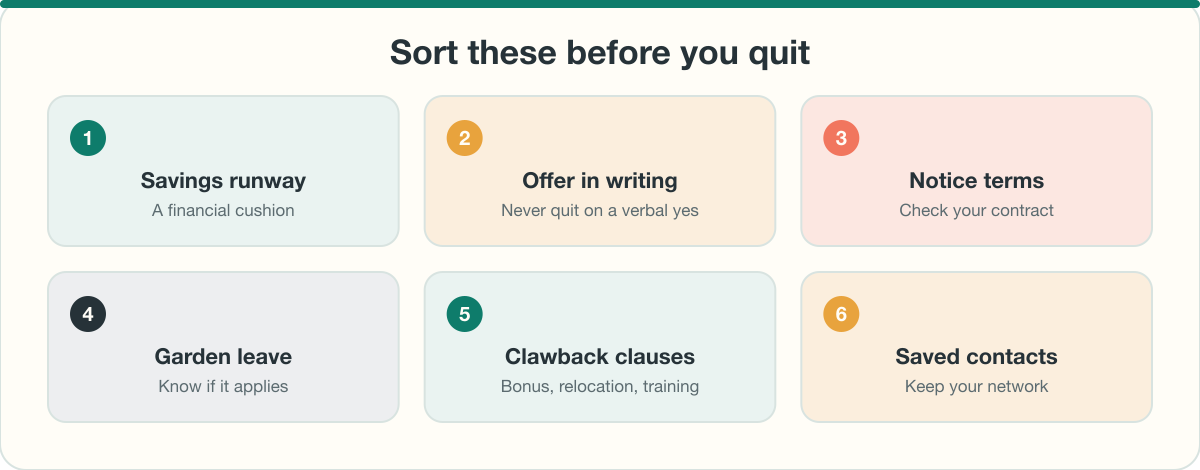 Resigning on a wave of emotion is how good decisions turn into money worries. Before you say a word, get these things in order.
Your finances. Know your runway. If you are leaving without a role lined up, work out how many months your savings genuinely cover, then add a buffer, because job hunts nearly always run longer than planned. If you are moving straight to a new job, confirm the offer in writing before you resign from the old one.
Your next move. You do not always need another job signed and sealed, but you do need a plan, whether that is a new role, a defined break, freelance work, or a considered career change. "Anywhere but here" is a feeling, not a plan, and it tends to lead to the same job with a different logo.
Your notice and exit terms. Read your contract before you resign. Know your notice period, whether you might be placed on garden leave, how much accrued holiday you are owed, and anything unusual like clawback clauses on bonuses or training costs. These details change your leaving date and your final pay, so you want no surprises.
Here is a checklist to run before you hand anything in.
| Sort this first | Why it matters |
|---|---|
| Confirm your savings runway (plus a buffer) | Job hunts run longer than expected; a buffer keeps the decision calm |
| Get any new offer in writing | A verbal yes is not a job; never resign against a promise |
| Read your contract's notice terms | Your leaving date and final pay depend on it |
| Check garden leave and accrued holiday | Both affect when you actually stop and what you are paid |
| Note any clawback clauses | Bonus or training repayments can bite on the way out |
| Save personal files and contacts (within policy) | Access is usually cut the moment you resign |
Do this quietly and in your own time. There is no need to announce a search you have not finished.
How do you quit gracefully?
Once you have decided and prepared, the exit itself is a short, well-worn sequence. Follow it in order.
- Tell your manager first, in person or on a call. Before HR, before colleagues, before any written notice. A resignation your manager hears from someone else, or reads as a cold email, spends goodwill you will want later. Keep the conversation calm and brief: you have decided to move on, and here is roughly when.
- Give proper notice. Serve the notice your contract requires. If timing is tight, you can ask to leave earlier by agreement, but start from what you owe, not what you wish.
- Put it in writing. Follow the conversation with a short, professional letter confirming your resignation and your last day. Our guide on how to write a resignation letter has copyable templates for exactly this.
- Hand over like a professional. Document what only you know. Tie off or clearly label open work. Introduce the people who will pick things up. A clean handover is the single strongest thing you can do for your reputation and your reference.
- Stay the course in your final weeks. The temptation to coast is real. Resist it. The last impression is the one people keep, and a strong finish is remembered far longer than a strong middle.
None of this asks you to pretend you are staying, or to gush. It asks only that you leave things better than a walkout would, which is a low bar with a high payoff.
How do you handle the emotions and a counteroffer?
Quitting is emotional even when it is right. Guilt at leaving a team, anxiety about the unknown, a strange grief for a chapter ending, all of it is normal, and none of it means you have chosen wrongly. Feel it, then follow your plan anyway.
Expect one curveball. When you resign, a good employer may come back with a counteroffer: more money, a new title, a promise that things will change. It can be genuinely tempting, and occasionally it is the right call, but it deserves a clear head rather than a flattered yes. The reasons you decided to leave rarely vanish because the salary moved. We cover exactly when to accept one and when to walk in our guide to the counteroffer. Decide against your original reasons, not against the size of the offer.
What should you never do when quitting?
Work-Life Balance Jobs with Genuinely Reduced Hours
Save one to come back to it — it's free.



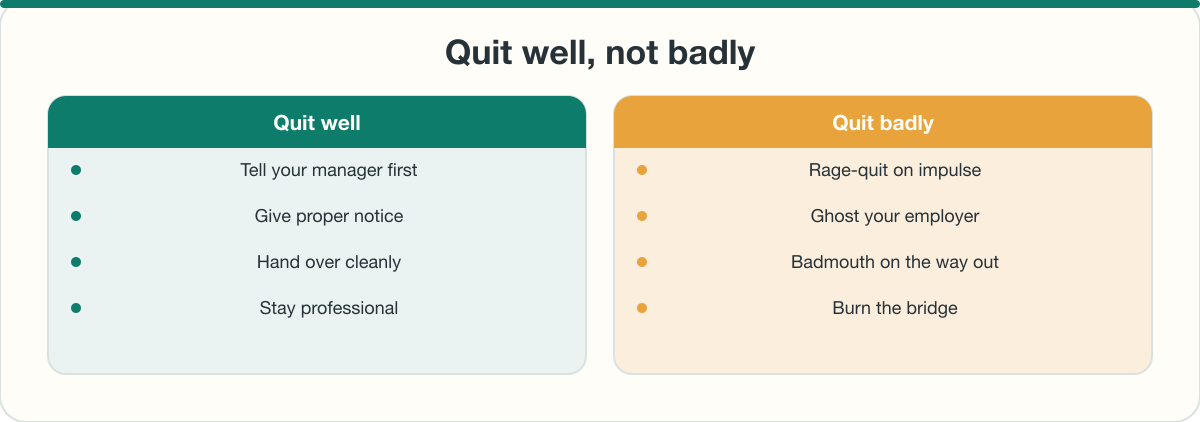 Some exits sabotage the person leaving far more than anyone they are angry at. Avoid these.
Rage-quitting. Storming out in a single heated moment feels powerful for about an hour and follows you for years. If you are furious, wait. Sleep on it, run your checklist, then resign like an adult on a Tuesday morning.
Ghosting. Simply not showing up, going silent, or vanishing mid-project is a breach of trust (and often of contract). It converts colleagues who would have championed you into people who warn others about you.
Badmouthing on the way out. Venting to colleagues, torching your manager in the exit interview, or posting your grievances online rarely lands the blow you imagine. It mostly narrows the small world you will keep bumping into.
Coasting or quiet sabotage. Downing tools, withholding knowledge, or leaving a mess for the next person is the sort of thing references quietly remember.
The contrast is stark, and worth holding in mind as you go. Quitting well means giving notice, handing over cleanly, staying professional and keeping your reasons to yourself. Quitting badly means walking out, going quiet, settling scores and leaving wreckage. The first costs you a few careful weeks. The second can cost you a reference, a network, and a good night's sleep for years. Choose the few weeks.
What is the best reason to leave?
The strongest reason to quit is not to escape something, but to move toward something better. And increasingly, better does not only mean more money or a grander title. It means work that respects your time.
If the thing driving you out is exhaustion, an always-on culture, or a schedule that swallowed your evenings and weekends, aim your next move at an employer who has actually fixed that. A growing number now advertise four-day weeks and reduced-hours roles on full pay, alongside compressed weeks, nine-day fortnights and genuine flexibility. Leaving a job that burned you out for one that hands your time back is the version of quitting nobody regrets.
Prepare well, exit gracefully, and point yourself somewhere worth the change.
Frequently asked questions
How do I know if I should quit my job or stick it out? Test whether your main problems are fixable or structural. If a workload spike, one bad project or a single conflict is the issue, try a direct conversation with your manager first. If the problems are chronic (a values mismatch, no growth, ongoing overwork) and survive every quarter, it is time to plan your exit.
Should I quit before I have another job lined up? Only if your finances allow it and you have a genuine plan. Work out how many months your savings cover, add a buffer, and know what you are moving toward. If you can, line up the next role or a defined break first, because job hunts usually take longer than expected.
How do I quit without burning bridges? Tell your manager in person before anything is written, serve your proper notice, confirm it in a professional letter, and hand over your work cleanly. Avoid rage-quitting, ghosting and badmouthing. A calm, generous exit protects your reference and your network.
What should I do if my employer makes a counteroffer? Weigh it against the original reasons you decided to leave, not against the money on the table. A counteroffer rarely fixes a structural problem like culture or overwork. Take time to decide rather than accepting on the spot.
Ready to leave for work that respects your time? Browse four-day-week and reduced-hours jobs on 4dayweek.io




Get 4-day week jobs in your inbox
Create a free account to receive curated opportunities weekly.
Sign up for freeFree forever. No spam, unsubscribe anytime.