
You stay an extra hour to finish something. You eat lunch at your desk, again. You answer a "quick question" on Slack at nine in the evening. None of it shows up on a payslip. All of it is work.
For a lot of white-collar workers, that quiet, uncounted extra has become just part of the job. Worth knowing, then, what it actually is, what the law says about it, and how to push back without torching your career.
What counts as unpaid overtime?
Unpaid overtime is any work you do beyond your paid, contracted hours without extra pay. It includes staying late, working through lunch, answering messages after hours, and taking work on holiday: often unrecorded, unrewarded, and quietly expected.
It covers the obvious cases and a lot of quieter ones that rarely get counted:
- Staying late. The extra hour, or three, after your official finish time, done often enough to become the norm rather than the exception.
- Working through lunch. Skipping the break you are entitled to and calling it "just getting on with it".
- After-hours messages. Replying to emails, Slack pings and "quick questions" in the evening, at weekends, or from the sofa.
- Leaveism. Working while technically on holiday or off sick, clearing the inbox from a sunlounger so it does not swallow you on your return.
Individually, each feels small. Added up across a week, a month, a career, it is a serious amount of free labour. And because so much of it is invisible, done at home, off the clock, out of hours, it rarely gets acknowledged, let alone paid.
How common is unpaid overtime?
Common enough to be almost invisible. In many white-collar workplaces, a bit of unpaid extra is not the exception, it is the unspoken part of the job description. The late finish, the working lunch, the "just before you log off" request have been normalised to the point where refusing them can feel like the odd behaviour.
Part of the reason is cultural. Long hours get read as commitment. Leaving on time gets read, unfairly, as coasting. That is the machinery of presenteeism: the pressure to be seen working, or seen online, regardless of whether the extra hours actually produce anything.
Remote and hybrid work has quietly made it worse for a lot of people. When the office is your kitchen table, the boundary between "on" and "off" blurs, and the laptop is always one glance away. The commute that once forced a hard stop has gone, and for many the workday has expanded to fill the space it left behind.
Is unpaid overtime legal?
 This is general information, not legal advice. Employment law varies by country, state and contract. Check your own contract and a qualified adviser or your local labour authority before acting on anything here.
The honest answer surprises people: often, yes, unpaid overtime is perfectly legal. Whether you must be paid for extra hours depends heavily on where you are and what your contract says.
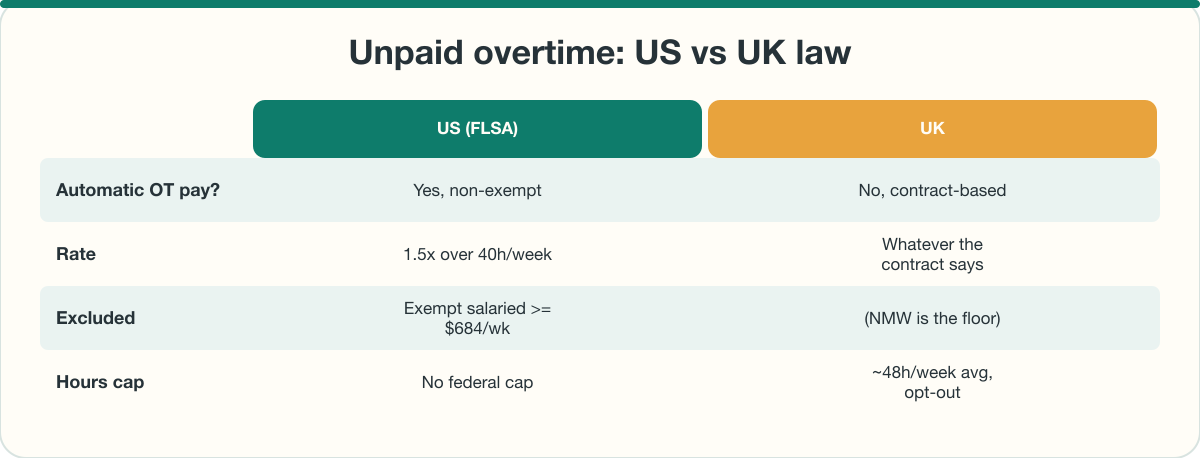
In the United States, the Fair Labor Standards Act (FLSA), enforced by the US Department of Labor, requires that "non-exempt" employees be paid at least 1.5 times their regular rate for any hours worked over 40 in a workweek. The catch is the "exempt" category. Employees in bona fide executive, administrative or professional roles who are paid on a salary basis of at least $684 per week, or highly-compensated employees earning at least $107,432 per year, are generally exempt from overtime pay. In plain terms, a salaried exempt employee can lawfully be required to work extra hours with no extra money.
In the United Kingdom, there is no automatic legal right to be paid for overtime at all. According to gov.uk, whether overtime is paid depends entirely on your employment contract. Two backstops still apply. Your average pay must not fall below the National Minimum Wage once it is spread across all the hours you actually work, and the Working Time Regulations 1998 limit average working time to 48 hours a week, although workers can sign an opt-out of that cap.
| United States (FLSA) | United Kingdom | |
|---|---|---|
| Automatic right to overtime pay? | Yes, for non-exempt employees | No automatic right; depends on your contract |
| The core rule | At least 1.5x the regular rate for hours over 40 in a workweek | Overtime is paid only if your contract provides for it |
| Who can be worked extra for no extra pay | "Exempt" staff: executive, administrative or professional roles paid on a salary basis of at least $684 a week, or those earning at least $107,432 a year | Salaried staff whose contracts do not provide for overtime pay |
| The backstop | Federal overtime and minimum-wage rules apply to non-exempt staff | Pay must not drop below the National Minimum Wage averaged over hours worked; average working time capped at 48 hours a week (workers can opt out) |
| Source | US Department of Labor (FLSA) | gov.uk / Working Time Regulations 1998 |
So in both countries, a salaried professional can often be asked to work well beyond their nominal hours without a penny extra, entirely within the law. That does not make it a good idea, for them or for the employer.
Why is unpaid overtime a false economy?
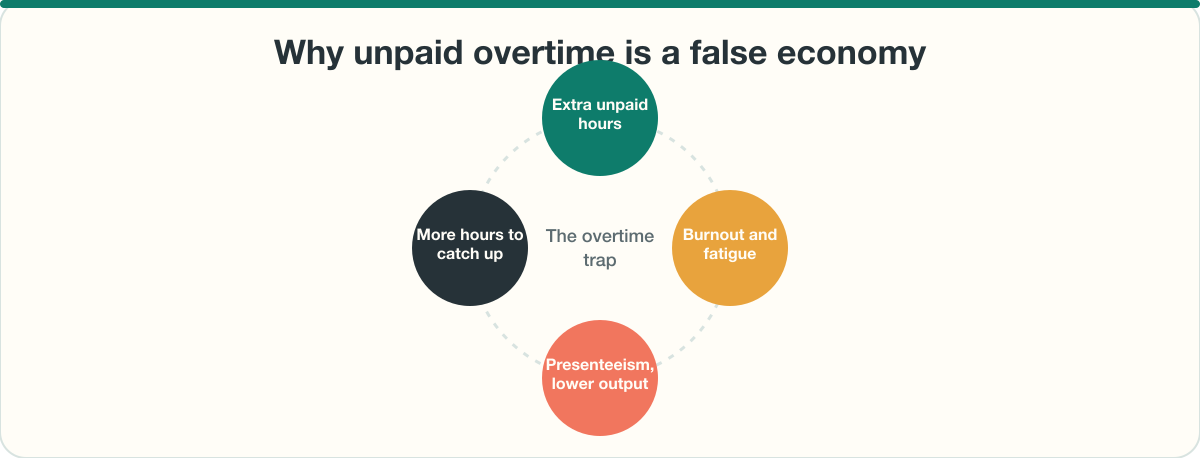 On paper, free labour looks like a bargain for the employer. In practice it is one of the least efficient things a business can lean on, because the hours are only cheap if you ignore what they cost.
- Burnout. Hours that never switch off wear people down. A burned-out employee is slower, more error-prone and more likely to leave, and replacing them is expensive.
- Presenteeism over output. When the culture rewards visible hours, people optimise for looking busy rather than getting things done. You get more time logged and less actually finished.
- Lower real productivity. Tired brains produce worse work. The eleventh hour of the day is rarely as sharp as the third, so the extra time often buys diminishing, sometimes negative, returns.
- Quiet resentment. People notice when their goodwill is treated as a permanent free resource. Over time, unpaid overtime corrodes the very discretionary effort it depends on.
The uncomfortable truth for any employer who relies on it: unpaid overtime tends to buy the appearance of productivity while eroding the real thing. The hours go up, the output does not follow, and the bill arrives later as turnover and burnout.
How can you push back on unpaid overtime?
Work-Life Balance Jobs with Genuinely Reduced Hours
Save one to come back to it — it's free.



You cannot always rewrite your contract or your company's culture single-handed. But you have more room than the habit suggests. A few practical moves:
- Track your hours. For a couple of weeks, write down what you actually work, including the evening messages and the skipped lunches. Most people underestimate it. Hard numbers turn a vague grievance into a conversation you can have.
- Clarify the expectation. Ask, plainly, whether the extra hours are genuinely expected or simply assumed. Sometimes the pressure is real; sometimes it is a story you have told yourself. Either way, naming it helps.
- Set boundaries and hold them. Decide when your day ends and defend it. Our guide on how to set boundaries at work covers doing this without wrecking your reputation.
- Use the right to disconnect where it exists. A growing number of countries give workers a legal or contractual right to disconnect outside working hours. If yours does, it is a legitimate backstop for switching off.
- Escalate if it breaches your contract or the law. If your pay is dipping below the minimum wage once the real hours are counted, or your contract does promise overtime you are not receiving, that is worth raising formally, and taking to a qualified adviser or your labour authority if it is not resolved.
The goal is not to do the bare minimum. It is to make sure the effort you give is chosen, valued and sustainable, rather than extracted by default.
What do good employers do instead?
The best employers do not solve unpaid overtime with a policy. They solve it by measuring the right thing.
When a company judges people on output rather than hours logged, the incentive to perform lateness disappears. Nobody needs to stay visible until seven if the work is done and the results are clear. That single shift, from time-served to work-delivered, quietly removes most of the machinery that produces unpaid overtime in the first place.
This is where reduced-hours and four-day-week models earn their keep. A four-day-week or reduced-hours role forces the question that long-hours cultures avoid: what actually needs doing, and how little time can it honestly take? Companies that make the switch tend to strip out the low-value meetings and busywork that unpaid overtime usually props up, and protect people's evenings on purpose rather than raiding them by default.
That is the real fix. Not just a rule that bans after-hours email, useful as that can be, but a culture that values what you produce in a reasonable week and then lets you have your life back. If pushing back changes nothing and the culture will not budge, leaving on your own terms is a legitimate answer, and our guide on how to quit your job covers doing it cleanly.
If your current job treats your unpaid hours as a renewable resource, the durable answer is to find one that does not. Browse four-day-week and reduced-hours roles on 4dayweek.io.
Frequently asked questions
Is unpaid overtime legal? Often, yes, depending on where you are and your contract. In the US, the FLSA (US Department of Labor) exempts salaried "exempt" staff, broadly executive, administrative or professional roles paid at least $684 a week, from overtime pay. In the UK, gov.uk states there is no automatic right to overtime pay at all; it depends on your contract. This is general information, not legal advice, so check your own contract and a qualified adviser.
What counts as unpaid overtime? Any work beyond your paid, contracted hours that you are not paid extra for: staying late, working through lunch, answering emails and messages after hours, and "leaveism", which is working while on holiday or off sick.
Do salaried employees get paid for overtime? Frequently not. In the US, exempt salaried employees can lawfully be required to work extra hours with no extra pay. In the UK, salaried staff are only entitled to overtime pay if their contract provides for it, subject to minimum-wage and 48-hour working-time backstops.
How do I stop working unpaid overtime? Track your real hours, clarify whether the extra time is genuinely expected, and set and defend clear boundaries. Use a right to disconnect if your country offers one. If the hours breach your contract or drag your pay below the minimum wage, raise it formally and seek qualified advice.
Your unpaid hours are not free, and the right employer knows it. Find four-day-week and reduced-hours roles on 4dayweek.io.




Get 4-day week jobs in your inbox
Create a free account to receive curated opportunities weekly.
Sign up for freeFree forever. No spam, unsubscribe anytime.