Most advice about burnout stops right where you need it most. It tells you how to spot the warning signs, then falls quiet on the harder question of what to do next. Recovery is where the real work happens, and it looks nothing like a long weekend and a quiet promise to be better next quarter.
Recovering from burnout means reducing the chronic stress that caused it, then rebuilding your energy, routine and relationship with work in stages. Rest helps, but rest alone rarely fixes it. Genuine recovery changes the conditions you return to, not just how tired you feel on a given morning.
This article is about that recovery process, not about how to recognise burnout in the first place. If you are still working out whether what you feel qualifies, start with our guide to the signs of workplace burnout, then come back. From here on, we will assume you know, and focus on getting well and staying well.
What does recovering from burnout actually mean?
It helps to be precise about what you are recovering from. The World Health Organization, in its ICD-11 classification, describes burn-out as an occupational phenomenon rather than a medical condition. It defines it as a syndrome resulting from chronic workplace stress that has not been successfully managed, with three dimensions: exhaustion, increased mental distance from or cynicism about your job, and reduced professional efficacy. Those three closely mirror the dimensions the psychologist Christina Maslach spent decades researching: emotional exhaustion, depersonalisation or cynicism, and a reduced sense of personal accomplishment.
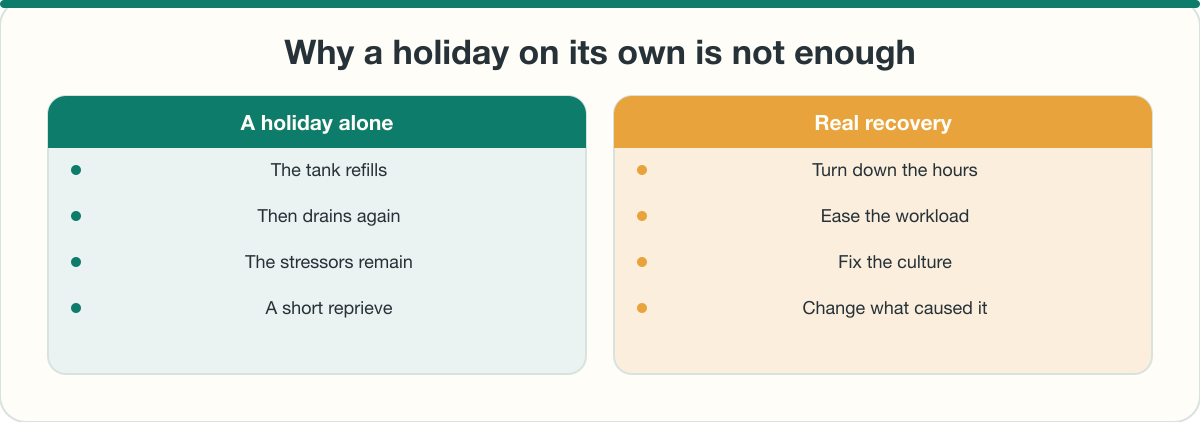
Read that definition again and notice what it points to. Burnout is a response to conditions. It is what happens when stress runs on, unmanaged, for too long. That one word, chronic, is why a fortnight in the sun so often fails to fix it. You come back rested, walk into the same overloaded inbox and the same impossible workload, and within a week the exhaustion is back as if you never left.
So recovery is not mainly about feeling less tired. It is about removing or reducing whatever drained you, and only then rebuilding what it cost you. A holiday treats the symptom. Recovery treats the cause. If you take only one idea from this article, make it that one, because everything else follows from it.
What are the stages of burnout recovery?
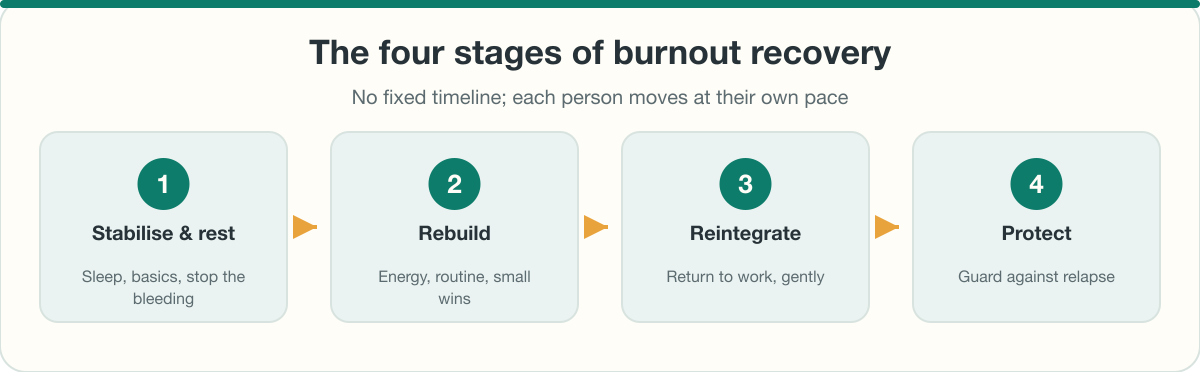 There is no neat, universal ladder out of burnout, and anyone who sells you a fixed number of tidy steps is overselling. That said, most recoveries move through recognisable phases, and knowing roughly where you are helps you resist the urge to skip ahead. Think of them less as boxes to tick and more as a direction of travel.
| Stage | What it involves | What it is not |
|---|---|---|
| Stabilise and rest | Taking the pressure off, sleeping properly, getting basic health back. Reducing hours or taking leave where you can | A cure on its own. Rest without change is a pause, not recovery |
| Rebuild energy and routine | Gentle structure, movement, reconnecting with people and things outside work, doing a little of what you enjoy again | Forcing yourself back to full capacity before you are ready |
| Reintegrate to work | A phased, deliberate return with a lighter, renegotiated workload and clear boundaries | Quietly slipping back into the exact pattern that broke you |
| Protect against relapse | Changing the hours, workload or culture that caused it, so the same thing cannot simply recur | A one-off fix you can tick off and forget |
The mistake most people make is treating stage one as the whole journey. They rest, feel a bit better, and race straight back into the fire. Rest restores just enough energy to function, which is exactly why it feels like the answer, and exactly why it is a trap on its own. Without the later stages, you are recovering into the same environment that made you ill.
How long does it take to recover from burnout?
The honest answer is that it varies a great deal, and no one can give you a reliable date. Recovery time depends on how long the stress went on, how deep the exhaustion runs, whether you have support, and, above all, whether the underlying cause is actually removed. Someone who reduces their workload and returns to a supportive team recovers on a very different timescale from someone who goes back to the same overload with nothing changed.
What is clear is that it is usually slower than people expect and rarely linear. You will have better weeks and worse ones. A good day is not a finish line, and a bad one is not a relapse. Trying to rush it tends to backfire, because burnout recovery is one of the few things that genuinely cannot be forced through willpower. Willpower, after all, is often what got you here.
The most useful thing you can do is stop measuring recovery in days off and start measuring it by how much has actually changed in the conditions you work under. That is the number that predicts whether you stay well, and it is entirely within your influence in a way that a calendar is not.
How do you return to work after burnout?
Going back is the moment recovery is most easily undone. Handled well, it consolidates everything you have rebuilt. Handled badly, it drops you straight back where you started. A few things make the difference.
- Return in a phased way if you possibly can. A gradual build-up of hours and responsibility, rather than full throttle from day one, gives your recovery something to stand on. Many employers and occupational health teams will support a phased return if you ask for one.
- Renegotiate the workload, do not just resume it. If you go back to the exact volume of work that broke you, the outcome is not a mystery. This is the moment to have the honest conversation about what is realistic, what can be dropped, and what genuinely has to change.
- Rebuild your boundaries deliberately. Burnout thrives where work has no edges. Decide in advance when you finish, when you are unreachable, and what you will no longer absorb. Our guide on how to set boundaries at work walks through how to make them stick.
- Watch for the old patterns. If you tend towards overwork, notice the pull to prove yourself by doing too much, too soon. That tendency has a name and a momentum of its own, which we cover in our piece on workaholism.
If the thought of returning fills you with a persistent, low-level dread rather than ordinary nerves, that is worth taking seriously in its own right. Our companion guide to work anxiety covers where that feeling comes from and what actually helps.
How do you stop burnout coming back?
 This is the part the holiday-and-hope approach always skips, and it is the part that matters most. Burnout came from somewhere. If that somewhere is left unchanged, recovery is temporary by design.
Work-Life Balance Jobs with Genuinely Reduced Hours
Save one to come back to it — it's free.



Relapse prevention comes down to three levers: hours, workload and culture. If you are routinely working long weeks, carrying more than any one person reasonably can, or embedded in a culture that treats being permanently available as the baseline, no amount of personal resilience will hold indefinitely. Resilience is not the antidote to an unsustainable job. Structure is.
That is why the conditions of the job itself are so decisive. A role with genuinely reasonable hours, a workload that fits the time available, and a culture that expects people to switch off gives your recovery something solid to rest on. This is precisely where reduced-hours models earn their keep. A four-day week or another compressed or reduced-hours arrangement does not just hand back a day. It structurally caps the overwork that drives burnout, and builds real recovery time into every single week rather than saving it up for an annual holiday that never quite undoes the damage.
If you have concluded that your current workplace simply cannot offer that, changing the environment is a legitimate and often the most effective form of relapse prevention. Choosing an employer that respects people's time by default does more for long-term recovery than any productivity hack, because it removes the cause instead of endlessly managing the symptom.
When should you get professional help?
This article is general wellbeing guidance, not medical advice. Burnout can overlap with, or mask, conditions like depression and anxiety, and it is not something you have to sort out alone or purely through lifestyle changes.
If your symptoms are severe, if they persist despite rest and changes, or if you are struggling with your mood, your sleep or thoughts of not wanting to be here, please speak to a GP or a qualified mental-health professional. In the UK, charities such as Mind offer free information and a listening ear if you are not sure where to start. A doctor can help you understand what is going on and what support, which might include time off, talking therapy or other treatment, is right for you. None of this is a sign of weakness or failure, and reaching out early tends to make recovery faster and steadier, not slower.
Frequently asked questions
Can you recover from burnout without changing jobs? Often, yes, if the underlying causes can be addressed where you are. That usually means genuinely reducing your workload, reshaping your hours and rebuilding boundaries, with support from your manager. Recovery only tends to fail when people rest but change nothing about the conditions that caused the burnout in the first place.
How long does burnout recovery take? It varies widely and rarely runs to a fixed schedule. The length depends on how long and how severe the stress was, how much support you have, and, most of all, whether the root cause is actually removed. Expect it to be slower and less linear than you would like, with better and worse weeks along the way.
Is rest enough to recover from burnout? Rest is necessary but usually not sufficient. Because burnout comes from chronic, unmanaged stress, resting without changing the source only pauses it. A holiday can restore enough energy to function, and then the same overloaded environment refills the tank with stress within weeks. Lasting recovery pairs rest with real changes to hours, workload and culture.
How do I return to work after burnout without relapsing? Return gradually if you can, renegotiate the workload rather than simply picking it back up, set clear boundaries before day one, and watch for the old habits of overwork. Above all, make sure something in the underlying conditions has genuinely changed, because going back to an unchanged job is the single biggest cause of relapse.
Ready for work that builds real recovery time into every week? Browse four-day-week and reduced-hours roles on 4dayweek.io.




Get 4-day week jobs in your inbox
Create a free account to receive curated opportunities weekly.
Sign up for freeFree forever. No spam, unsubscribe anytime.