
Scroll TikTok for five minutes and you will meet someone narrating their workday from the sofa, laptop half open, describing a job that pays the bills and asks for almost nothing back. No frantic pings. No 8pm "quick calls". They call it a lazy girl job, and millions of people are nodding along.
It is one of those phrases that sounds like a joke and turns out to be a manifesto. The label is provocative on purpose. The feeling underneath it is real, and it is worth taking seriously rather than mocking.
What is a lazy girl job?
A lazy girl job is a low-stress, adequately paid, boundaried role, often remote, that you can do well without it swallowing your identity or your evenings. The name is deliberate marketing. The real idea is refusing burnout and hustle culture, not doing as little as possible.
The point is not zero effort. It is proportion. You do the job you are paid for, you do it competently, and then you close the laptop and get your life back. Nobody is being defrauded. The salary is fair for the work, the work fits inside the hours, and your sense of self does not live or die by your job title.
Where did the term come from?
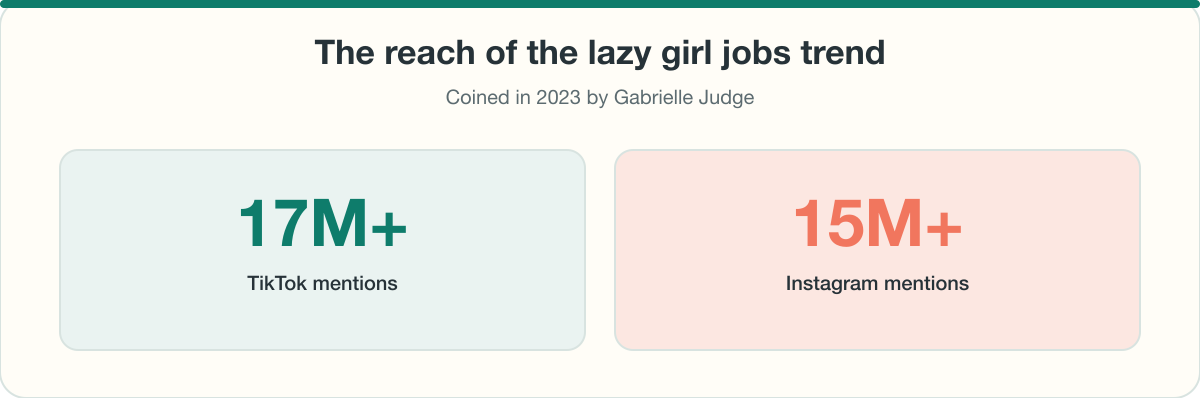 The phrase "lazy girl job" was coined in 2023 by Gabrielle Judge, a former corporate tech worker who posts online as "antiworkgirlboss" (also known as Ms Anti Work). She started making content after burning out in a demanding role, and she has been open that the name is provocative marketing designed to grab attention and start an argument about toxic workplace expectations.
It worked. The hashtag has drawn well over 17 million mentions on TikTok and more than 15 million on Instagram. Judge has repeatedly said the term is not actually about being lazy. It describes a job that is low stress, pays enough to live on, respects your boundaries and lets you decentre work from your identity. In other words, the "lazy" is bait. The substance is boundaries.
Is a lazy girl job actually about being lazy?
No, and this is where most hot takes go wrong.
Read the label literally and it sounds like a celebration of coasting. Listen to what people are actually describing and it is something calmer: a role where the demands are reasonable, the pay is fair, and the job does not follow you home. That is not laziness. That is a functioning deal between an employer and a person.
The word "lazy" is doing a specific job here. It is a deliberate provocation aimed at a culture that treats anything less than total devotion as failure. When "going above and beyond" becomes the unspoken baseline, simply doing your actual job on your actual hours starts to feel rebellious. Call that rebellion "lazy" and you expose how warped the baseline has become.
Judge has also made the point that this is not a women-only idea. Men can have lazy girl jobs too. The "girl" is branding, part of the same tongue-in-cheek packaging as "lazy". The underlying want, low-stress work that pays fairly and leaves room for a life, is universal.
How is it different from quiet quitting?
Lazy girl jobs sit in a family of workplace terms that all describe the same shift in mood. They are close cousins, but not identical.
| Term | What it describes | The core move |
|---|---|---|
| Lazy girl job | Choosing a low-stress, fairly paid, boundaried role on purpose | Pick a job that fits a life |
| Quiet quitting | Staying in your job but withdrawing unpaid extra effort | Do the role, not the overtime |
| Acting your wage | Matching your effort to your actual pay | Refuse unpaid scope creep |
The difference is mostly about direction. Quiet quitting and acting your wage are things you do inside a job you already have, dialling your effort back to what you are actually paid for. A lazy girl job is a choice you make going in: you deliberately seek out a role that is calm by design, rather than fighting to carve calm out of a demanding one.
All three are reactions against the same thing. For years, hustle culture sold the idea that work should be your passion, your identity and your personality all at once. A lot of people tried that, burned out, and quietly decided the trade was not worth it.
What is drawing people to lazy girl jobs?
The trend did not appear from nowhere. It caught fire among people, especially younger workers, who had watched the promised rewards of relentless ambition fail to arrive. You might feel the pull if a few of these ring true:
- You have hit burnout once already and have no wish to repeat it.
- Your job follows you into evenings and weekends, and you have started to resent it.
- The "dream job" you chased turned out to cost more of your life than it gave back.
- You would happily trade a bigger title for calmer days and reliable finishing times.
- You want work to fund your life, not to be your entire personality.
None of that is a red flag. It is a fairly healthy set of priorities that an older script simply did not have words for. What the lazy girl job trend really did was give that set of priorities a name, even if it picked a cheeky one on purpose. The provocation is the point: label something reasonable as "lazy" and you force a conversation about why reasonable ever came to feel like slacking.
What are the honest trade-offs?
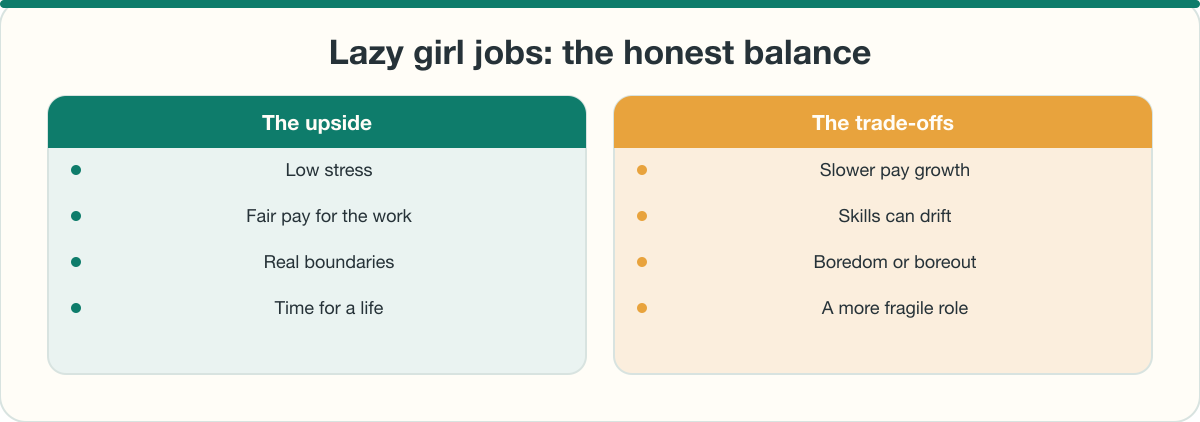 Here is where balance matters, because the trend has a shadow side that the cheerful videos skip.
A genuinely low-stress, easy role can be lovely for a season. It can also become a trap. Coasting has real costs, and pretending otherwise would be dishonest:
- Pay ceilings. The calmest roles are often not the best paid, and they may not grow much. Choosing low stress can mean choosing slower salary growth.
- Skill drift. If a job never stretches you, your skills can stall. That is fine for a while and risky over years, especially in fast-moving fields.
- Boredom. Under-stimulation has its own name, boreout, and it can be as draining as overwork. A job with too little in it can hollow you out just as a job with too much can.
- Fragility. A role that exists only because nobody is looking closely can vanish in a reorganisation. Being genuinely useful is its own kind of security.
Work-Life Balance Jobs with Genuinely Reduced Hours
Save one to come back to it — it's free.



It is also worth separating a deliberate choice from its anxious opposite. Clinging to a comfortable role purely out of fear of the job market is job hugging, a different behaviour driven by insecurity rather than a considered decision about how you want to work.
None of this means the instinct is wrong. Wanting low-stress, fairly paid, boundaried work is completely reasonable. The trap is confusing "boundaried" with "checked out". The healthy version protects your time. The unhealthy version quietly disengages from work you could actually enjoy, which tends to leave people more restless, not less.
There is also a line worth naming clearly. A lazy girl job is not the same as deceiving your employer, doing deliberately poor work, or secretly running two full-time jobs at once. That last one, sometimes called overemployment, is a different thing entirely and comes with real professional and legal risk. The point of the healthy version is honesty: fair work for fair pay, done in the open, with your evenings genuinely your own.
Can you get the good version without the label?
Yes, and this is the part the hashtag tends to miss.
Most people chasing a lazy girl job do not actually want to do nothing. They want the same thing reduced-hours employers already offer on purpose: a job with a clear edge, where the work fits the hours and rest is built in rather than stolen back in secret. The difference is that a good four-day-week or reduced-hours role gives you that openly, so you never have to perform "busy" or feel guilty for logging off.
Think about what the trend is really asking for. Low stress. Fair pay. Respected boundaries. Time and energy left over for a life. A four-day week or reduced-hours role delivers exactly that, without the resentment, the pretending, or the quiet dread that you are getting away with something. You are not underworking a demanding job. You are working a reasonable one.
That is a much sturdier foundation than coasting. When the deal is fair, you can care about your work again without it costing you your evenings, because the structure protects both. Compare that to the guilt-driven need to always be doing more, and the appeal of a calmer, honest arrangement becomes obvious.
There is a subtle but important difference here. A coasting job asks you to keep your head down and hope nobody notices how little it demands, which is a slightly anxious way to live. A reduced-hours job asks nothing of the sort. The lighter load is the official arrangement, agreed and out in the open, so you can do good work on Monday to Thursday and genuinely switch off on Friday without looking over your shoulder. One version depends on staying invisible. The other depends on delivering. Only the second is something you can build a career on.
If the pull of the lazy girl job is really the pull of a life outside work, the answer is not to hide. It is to find an employer whose normal is your ideal, and stop having to fight for it.
Want the honest version of a low-stress, fairly paid role? Browse four-day-week and reduced-hours jobs on 4dayweek.io.
Frequently asked questions
Is a lazy girl job actually lazy? No. Despite the name, it describes a low-stress, adequately paid role with healthy boundaries, not doing poor work or nothing at all. Gabrielle Judge, who coined the term in 2023, has said the word "lazy" is deliberate provocation aimed at toxic workplace expectations.
Can men have lazy girl jobs? Yes. Judge has said explicitly that men can have lazy girl jobs too. The "girl" in the phrase is branding, part of the tongue-in-cheek packaging, not a rule about who the idea is for.
Is a lazy girl job the same as quiet quitting? They are close cousins but not identical. Quiet quitting means withdrawing unpaid extra effort from a job you already have, while a lazy girl job means deliberately choosing a low-stress, boundaried role in the first place. Both push back against hustle culture.
What are the downsides of a lazy girl job? The main trade-offs are slower pay growth, the risk of skills stalling, boredom or boreout from under-stimulation, and the fragility of a role that exists only while nobody is paying attention. Boundaried work is healthy, while quietly checking out of work you could enjoy usually is not.
Stop performing "busy" and start protecting your time for real. See reduced-hours and four-day-week roles on 4dayweek.io.




Get 4-day week jobs in your inbox
Create a free account to receive curated opportunities weekly.
Sign up for freeFree forever. No spam, unsubscribe anytime.