
A few years ago, the confident move was to leave. Workers hopped roles every couple of years, banked a pay rise with each jump, and treated loyalty as a mug's game. Then the market turned. Now a lot of those same people are doing the opposite: gripping the job they have with both hands and refusing to let go.
There is a name for it now. Job hugging. And the reasons behind it say a lot about how nervous the world of work has become.
What is job hugging?
Job hugging is when employees cling to their current role rather than moving on, driven by fear and insecurity in a cooler labour market. The consultancy Korn Ferry popularised the term in August 2025, as job-hopping slowed and workers began to prize security over the risks of a new start.
It is the mirror image of the "great resignation". Instead of leaving for something better, people stay put for something safer, even when the role no longer excites them, pays them what they are worth, or teaches them anything new. The hug is defensive. You hold on because letting go feels dangerous.
Where did the term come from?
The phrase was popularised by Korn Ferry in August 2025. The consultancy used it to describe a clear behavioural shift: after a stretch of confident job-hopping, employees were suddenly staying put, spooked by layoffs, hiring freezes and a general sense that the ground had become less stable.
It is worth being precise about who said what. Korn Ferry gave the behaviour its catchy name. The most-quoted numbers behind it come from a separate source, and it helps to keep them straight.
How common is job hugging?
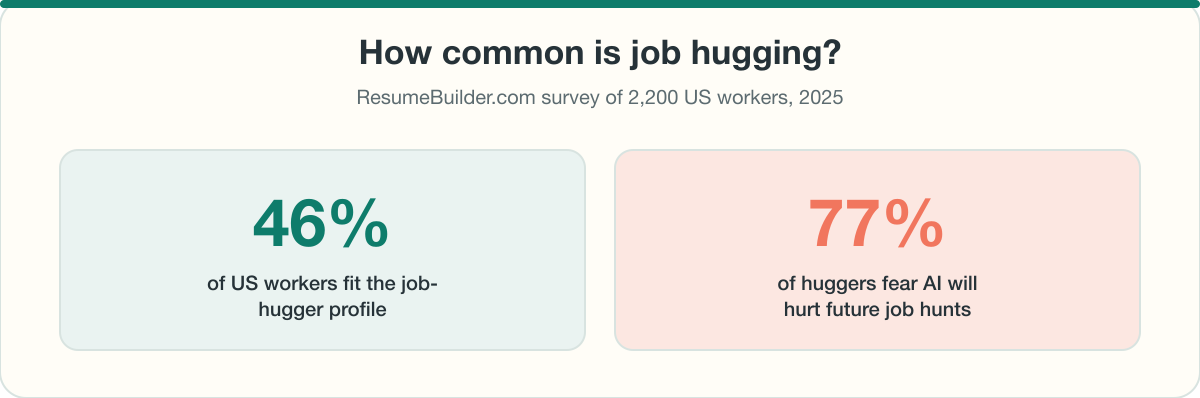 Fairly common, if the survey data is anything to go by.
A ResumeBuilder.com survey of 2,200 US workers, also from August 2025, found that around 46% fit the "job hugger" profile, meaning they are staying in their current role largely because of the risks of leaving. Roughly 95% of them cited concerns about the job market, and about 77% said they were very or somewhat worried that AI will make it harder to find a job in future.
Put those figures next to the official data and the picture holds together. The US quits rate, tracked by the Bureau of Labor Statistics, has hovered around 2%, well below the churn of the job-hopping years. Fewer people are quitting, and the ones who stay are increasingly staying out of caution rather than contentment.
| Figure | What it measures | Source |
|---|---|---|
| ~46% | US workers who fit the "job hugger" profile | ResumeBuilder.com (Aug 2025) |
| ~95% | Job huggers citing job-market concerns | ResumeBuilder.com (Aug 2025) |
| ~77% | Job huggers worried AI will make future job hunts harder | ResumeBuilder.com (Aug 2025) |
| ~2% | US monthly quits rate | US Bureau of Labor Statistics |
The headline is simple. Almost half of workers are staying put, and most of them are doing it because they are frightened of the alternative, not because they love where they are.
Why is it happening now?
Fear does not appear from nowhere. A few forces are pushing people to hold on:
- A cooler labour market. Hiring has slowed in many sectors, and open roles are harder to land than they were during the hiring frenzy. When fewer doors are open, you cling to the one you are already through.
- Layoffs and headlines. Waves of redundancies, especially in tech, have made "last in, first out" a real fear. Starting somewhere new can feel like volunteering to be the most vulnerable person in the room.
- AI anxiety. As the ResumeBuilder.com data shows, roughly 77% of job huggers worry AI will make future job hunts harder. That uncertainty makes any known quantity, even a mediocre job, feel safer than the unknown.
- The end of easy raises. During the job-hopping years, moving was the fastest route to a pay rise. When that premium shrinks, the incentive to jump shrinks with it.
None of these are irrational. Caution in an uncertain market is sensible. The problem is what happens when caution hardens into a permanent crouch, when a reasonable pause turns into a years-long refusal to look up at all.
Job hugging vs resenteeism: what is the difference?
It is easy to lump every "staying put" behaviour together, but job hugging and resenteeism are not the same thing.
| Why the person stays | The dominant feeling | |
|---|---|---|
| Job hugging | Fear of the market, need for security | Anxiety |
| Resenteeism | Stuck, but openly bitter about it | Resentment |
Job hugging is driven by fear. You stay because leaving feels risky, and you might genuinely be fine with the job itself. Resenteeism is what happens when someone stays in a role they actively resent, visibly unhappy but unwilling or unable to leave. The two can overlap, and a fearful hugger can curdle into a resentful one over time, which is exactly the drift worth avoiding.
Both are cousins of quiet quitting, where people stay but quietly withdraw their extra effort. The common thread is a workforce that has stopped moving and started bracing.
What are the risks of hugging your job?
 Staying put is not free, even when it feels safe. The costs are just slower and quieter than the risks of leaving.
- Stagnation. A role you have outgrown stops teaching you things. Comfort and growth rarely live in the same place.
- Falling behind on pay. If external hires and job-movers are commanding higher salaries, staying can quietly leave you underpaid for your experience.
- Skills atrophy. Skills that are not stretched go stale. In a market where AI is reshaping whole job categories, standing still can be riskier than it looks.
- Feeling trapped. The longer you cling out of fear, the more your confidence can shrink, until leaving feels impossible even when it would be the right move.
The cruel irony is that job hugging can create the very fragility it is trying to avoid. Cling too long and you become less employable, not more, which makes you cling harder. It is a loop worth breaking before it tightens.
What should you do instead?
Work-Life Balance Jobs with Genuinely Reduced Hours
Save one to come back to it — it's free.



The answer is not to fling yourself into a risky move for its own sake. It is to replace fear-based staying with deliberate choices. A few work well:
- Grow on purpose where you are. If you are staying, stay actively. Take the stretch project, learn the new tool, ask for responsibility. Make the years count instead of letting them pass.
- Keep your skills and options warm. Stay in touch with your network, keep your CV current, and notice what the market values. Options are not disloyalty. They are insurance.
- Negotiate your actual value. If you are underpaid for what you now do, the honest first step is often a conversation, not a resignation. Our guide on how to ask for a raise walks through making the case with evidence.
- Make a considered move when you are ready. When you do decide to move, move toward something, not just away from fear. That means choosing an employer and a schedule you actually want, rather than the first exit available.
The goal is agency. Staying can be the right call. Fear making the call for you is the problem.
What does job hugging mean for employers?
For employers, a workforce full of huggers can look deceptively healthy. Turnover drops. Roles stay filled. On paper, retention improves.
Underneath, it can mask serious disengagement. People who stay only because they are afraid to leave are not the same as people who stay because they want to. They tend to give less discretionary effort, take fewer useful risks, and quietly check out while remaining on the payroll. The moment the market warms, some of them will bolt.
There is a second-order cost too. When your best people stay only because moving feels risky, you lose the honest signal that healthy turnover normally gives you. A team that would have voted with its feet in a warmer market instead sits tight and simmers, so the problems that would have surfaced as resignations surface as flat productivity and quiet cynicism instead. By the time hiring picks up again, you can end up with both the disengagement now and the exodus later.
Retention bought with fear is brittle. Retention earned with a genuinely good job is not.
The real antidote to fear-based staying
Here is the honest reframe. The opposite of job hugging is not reckless job-hopping. It is having work worth staying for, so that staying is a choice rather than a hostage situation.
When a job pays fairly, respects your time and gives you a life outside it, you do not have to grip it out of fear. You stay because it is good, and you would leave with your head held high if it stopped being good. That is real security, the kind that comes from being well treated and employable, not from being too scared to move.
That is what genuinely progressive employers offer, and it is why reduced-hours and flexible companies tend to keep people without having to frighten them. It is also the difference between a lazy girl job chosen for calm and a role clung to in dread. If you want to trade the fearful hug for a job you would actually choose, the move is to look for one worth choosing.
Ready to stop clinging and start choosing? Browse four-day-week and reduced-hours roles on 4dayweek.io.
Frequently asked questions
What does job hugging mean? Job hugging is when employees cling to their current role instead of moving on, out of fear and insecurity in a cooler labour market. The consultancy Korn Ferry popularised the term in August 2025, as job-hopping slowed and workers began to value security over the risk of a new start.
How many workers are job hugging? A ResumeBuilder.com survey of 2,200 US workers in August 2025 found that around 46% fit the "job hugger" profile. Roughly 95% cited job-market concerns, and about 77% worried that AI would make future job hunts harder.
Is job hugging the same as resenteeism? No. Job hugging is staying out of fear and a need for security, and you might be fine with the job itself. Resenteeism is staying in a role you actively resent. A fearful hugger can slowly turn into a resentful one, which is worth avoiding.
Is job hugging a bad thing? Not always. Caution in an uncertain market is reasonable. It becomes a problem when fear-based staying leads to stagnation, falling behind on pay, skills going stale, or feeling trapped. The healthier path is to grow deliberately, keep your options warm, and move on your own terms when ready.
Security should come from good work, not fear of leaving. Find reduced-hours and four-day-week jobs on 4dayweek.io.




Get 4-day week jobs in your inbox
Create a free account to receive curated opportunities weekly.
Sign up for freeFree forever. No spam, unsubscribe anytime.