
You handed in your notice expecting a weight to lift. Instead your manager shut the door, told you how much the team relies on you, and slid a pay rise across the table to make you stay. The clean exit you had rehearsed suddenly feels a lot messier.
A counteroffer is flattering, and that is exactly what makes it hard to think about clearly. Before you say yes to the relief of not changing anything, it helps to know what you are actually being offered and why.
A counteroffer is a revised deal your current employer puts to you after you resign, usually more money, sometimes a promotion or better conditions, aimed at persuading you to stay instead of joining the new company. It is a retention move, not a spontaneous reward for good work.
Why do employers make counteroffers?
Not because they suddenly noticed your brilliance. They make them because losing you at short notice is expensive and disruptive, and a counteroffer is often the cheapest way to make that problem go away.
Think about what your resignation actually costs the business. There is the recruiter's fee, or the hours spent writing a job advert and sifting applications. There are interviews that pull senior people off their own work. There is the gap while your seat sits empty and your projects stall. There is onboarding a replacement who will take months to reach your speed, and the quiet risk that the new hire turns out to be a poor fit. On top of all that sits everything in your head that never made it into a document, the context and relationships that walk out of the door with you.
Set against that, a few thousand pounds to keep you for another six or twelve months can look like a bargain to your employer. That does not make it a bad offer, but it does mean the motive is usually about their short-term convenience, not a change of heart about your long-term worth. Worth remembering when the compliments start flowing.
Do most people who accept a counteroffer really leave within a year?
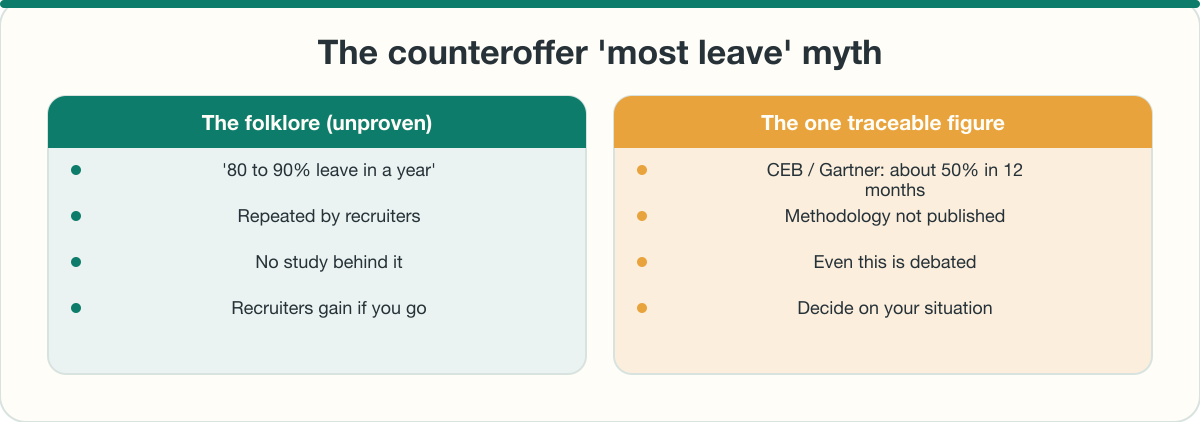 You have probably seen the scary line: something like "80% of people who accept a counteroffer leave within six to twelve months anyway." It gets repeated in blog posts and by recruiters as if it were settled science. It is not.
When you actually go looking for the study behind that number, there isn't one. No large, credible piece of research supports the 70 to 90 percent figures that get thrown around. They appear to be recruiter folklore, passed from article to article until they sound authoritative. And recruiters, it is worth noting, have an obvious interest in talking you out of staying put.
The most-cited figure that traces back to a real source comes from CEB, the research firm now part of Gartner, which put the share of counteroffer-accepters who leave within twelve months at roughly 50%. Even that number is debated, its methodology is not widely published, and there is no big systematic study that pins it down with confidence.
So here is the honest takeaway. The number is unproven, which means it should not be doing your thinking for you. Do not stay because a statistic frightened you, and do not leave because one did either. Decide on your actual situation, because that is the thing the averages can never see.
What are the real pros and cons?
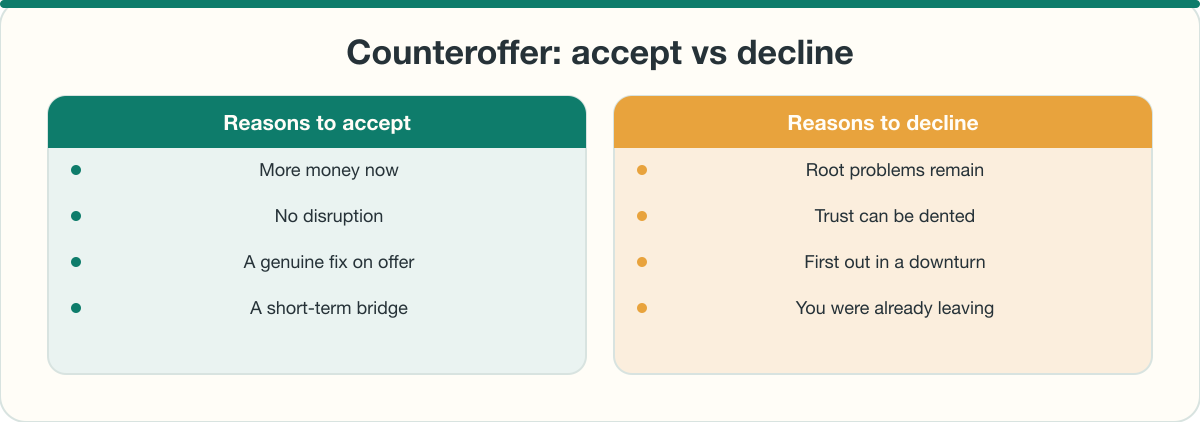 Strip out the myth and a counteroffer becomes a normal decision with genuine upsides and real risks. The upsides are easy to feel: more money in your account now, and none of the upheaval of starting somewhere new. You keep your commute, your colleagues, your login that already works, and the quiet competence of knowing exactly how everything runs.
The risks are slower to surface, which is what makes them dangerous. The biggest one is simple. The reasons you started job-hunting rarely change just because they threw money at you. If you were leaving over a crushing workload, a political culture, a manager you had stopped trusting, or a ceiling on your growth, an extra few percent does not touch any of that. Pay was often the symptom, not the disease, and the disease is still there on Monday.
There is a trust cost too. Both sides now know you were ready to walk. Some managers file that away, and a known flight risk can quietly be passed over for the sensitive project or the next promotion. If a downturn arrives and the business has to make cuts, the person who already tried to leave is not always the one they fight hardest to keep. There is also a plain arithmetic point: a counteroffer is sometimes just next year's raise handed to you early, which means you have spent your leverage and may be back in the same spot in twelve months.
| Reasons to accept | Reasons to decline |
|---|---|
| Pay really was the only problem and you are otherwise happy | You were leaving over workload, culture, management or growth, none of which cash fixes |
| The offer fixes structural things in writing, not just salary | The offer is money only, with a vague promise that things will change |
| The new role turned out to have late red flags | The new role is genuinely better on what made you look |
| A short-term life reason makes staying practical right now | You will likely be seen as a flight risk and passed over later |
| The counteroffer closes a real, provable gap to market pay | It is really just your next raise brought forward |
What should I ask myself before deciding?
A counteroffer is a decision best made with a cool head, so put a few honest questions to yourself before you answer.
Why did I start looking in the first place? Write the reasons down. If money is not near the top of that list, money is unlikely to fix it.
Has anything actually changed apart from the number? A real change looks like a new manager, a redefined role, or a formal flexible-working arrangement in writing. A promise to "keep an eye on your workload" is not a change.
Why did it take a resignation to get this? If you were worth more, why were you not already being paid it? The answer tells you something about how the company operates.
How will they see me in six months, once the relief has worn off? Be honest about whether the goodwill lasts.
Is the new role genuinely better on the things that made me leave, or just different? If the grass only looks greener, that matters. If it is actually greener, that matters more.
When does accepting a counteroffer make sense?
Plenty of advice tells you to reject every counteroffer on principle. That is too tidy. There are situations where staying is the smart move.
If pay was honestly the only issue, you like the work, you rate your manager, and the counteroffer closes a genuine gap to the market, then staying can be entirely rational. Loyalty that is fairly paid is not a weakness.
It can also make sense when the offer fixes the structural problem, not just the salary. If your employer moves you to a different team, redraws your remit, or agrees a four-day week or compressed schedule in writing, they are addressing the cause rather than buying silence. The test is whether the thing that made you leave is actually different, and whether it is documented rather than promised in a corridor.
Work-Life Balance Jobs with Genuinely Reduced Hours
Save one to come back to it — it's free.



And sometimes the new job is the real problem. If due diligence late in the process surfaced red flags, an unstable team or a boss who interviews charmingly and manages badly, then a counteroffer that keeps you somewhere known can be the lesser risk. Whatever you agree, get it in writing with dates and specifics, exactly as you would with any serious change to your terms.
How do I turn a counteroffer down gracefully?
If you decide to go, decline warmly and briefly. You do not owe anyone a debate, and you want the relationship intact, because industries are small and today's manager is tomorrow's reference.
Keep it short, appreciative and final:
"Thank you, genuinely. It means a lot that you want me to stay, and I have thought about it properly. My decision is about the direction I want my career to take, not about the money, so I am going to move on. I want to leave things in great shape and make the handover as smooth as I can."
Notice what it does not do. It does not reopen the negotiation, it does not criticise anyone, and it does not leave a door ajar that you have already decided to close. If they push, stay kind but hold the line: "I really appreciate it, but I have made my decision."
From there, treat the exit professionally. A clean resignation letter and a well-handled notice period protect the reputation you have spent years building. If the whole process still feels daunting, our guide on how to quit your job walks through the practical steps.
What if the real problem was overwork, not the pay?
Here is where a lot of counteroffers quietly fail. If you went looking because you were exhausted, always on, and losing your evenings and weekends to a job that never switched off, then a bigger salary buys you a slightly better-paid version of the same burnout. The number changes; the Sunday-night dread does not.
Staying anyway has its own names. Clinging on because leaving feels scary is job hugging, and it tends to end in stagnation. Staying while quietly seething is resenteeism, which is harder on you than it ever is on your employer. A counteroffer that only adds money can push you straight into either one.
If time, not pay, was the real issue, the fix is a role that treats your hours as part of the deal rather than an afterthought. Reduced-hours and four-day-week employers are not a fringe any more, and a shorter week on the same salary is effectively a raise for every hour you work. Browse flexible-hours and four-day-week companies that already build their offers around your time, or start with the full board of reduced-hours roles at 4dayweek.io/jobs. If that is the itch, no counteroffer at your current desk will scratch it.
Frequently asked questions
Should I resign just to trigger a counteroffer and get a raise? No. It is a high-risk bluff. If you resign hoping to be talked out of it and they simply accept, you have talked yourself out of a job you wanted to keep. And if they do counter, they now know your loyalty has a price and that you were willing to leave to get it. If you want more money, ask for it directly rather than staging an exit.
Will accepting a counteroffer damage how my employer sees me? It can, though it varies by manager. Some take it entirely in their stride. Others quietly recategorise you as a flight risk, which can affect who gets handed the high-stakes project or the next step up. The way to protect yourself is to make sure any counteroffer you accept comes with a real, documented change, not just a warmer tone and a bigger number.
I have already verbally accepted the new job. Can I still take a counteroffer? Legally you usually can, but weigh the cost. Backing out after accepting burns a bridge with the new employer and the recruiter, and word travels in most industries. Do it only if something genuinely significant has changed, and never purely because staying is the easier path this week.
Is more money on its own a good enough reason to stay? Only if money was the actual problem. If you were unhappy about workload, culture, growth or your manager, extra pay treats the symptom and leaves the cause intact. Be honest with yourself about why you started looking, because that reason is what you will still be living with once the pay rise stops feeling new.
Ready to find work that respects your time as much as your talent? Browse thousands of four-day-week and reduced-hours roles at 4dayweek.io/jobs.
A counteroffer answers one question, whether they can pay you more. Only you can answer the one that actually matters: why you wanted to leave in the first place.




Get 4-day week jobs in your inbox
Create a free account to receive curated opportunities weekly.
Sign up for freeFree forever. No spam, unsubscribe anytime.