
There is a difference between the flutter of nerves before a big presentation and the low, constant hum of dread that follows you into every working day. The first passes once the moment is over. The second does not, and it slowly wears you down.
Work anxiety is persistent worry, nervousness or dread connected to your job, distinct from the occasional stress that almost every role involves. It is common and widespread. Ordinary stress spikes and then settles. Work anxiety lingers, showing up in your body, your mood and the way you behave long after the working day should have ended.
If that pattern sounds familiar, you are not being dramatic and you are not alone. This is a genuine and remarkably common experience, and there are practical things that help. Here is what work anxiety is, where it comes from, how to cope, and how to tell when the real problem is the job rather than you.
What is work anxiety, and how is it different from normal stress?
Almost every job involves some stress, and not all of it is bad. A deadline sharpens your focus. A challenge you care about gets the adrenaline going. This kind of stress is short-lived and tied to a specific demand, and it fades once the demand passes. In small doses, it can even be useful.
Work anxiety is different in three ways. It is persistent rather than passing, so it does not switch off when the task is done. It is often generalised rather than specific, a background dread that is hard to pin to any single cause. And it tends to be out of proportion to the actual threat, keeping your nervous system on alert when there is nothing concrete to fight.
The scale of it is easy to underestimate. The World Health Organization estimates that depression and anxiety cost the global economy around one trillion US dollars every year in lost productivity. Behind a number that large are millions of ordinary people quietly dreading Monday, lying awake rehearsing conversations, and carrying a knot of tension they cannot quite put down. Work anxiety is not a rare or shameful glitch. It is one of the most common experiences of modern working life.
What causes work anxiety?
Work anxiety rarely has a single cause. More often it is a build-up of pressures that individually feel manageable and together become overwhelming. Some of the most common drivers:
- A workload that never ends. When there is always more to do than time to do it, your brain never gets the signal that it is safe to stop. The to-do list becomes a permanent, low-grade threat.
- Job insecurity. Worrying about restructures, layoffs or whether your role is safe is one of the most corrosive forms of work stress, precisely because it is so hard to resolve through your own effort.
- An always-on culture. When messages arrive at all hours and a fast reply is expected, work never fully ends. Without a clear line between work and life, the anxiety has nowhere to drain away.
- A toxic or high-blame environment. Fear of a critical boss, shifting expectations or being blamed when things go wrong keeps you braced for impact. Our guide to the signs of a toxic workplace covers when this tips from merely stressful into genuinely harmful.
- The Sunday-night dread pattern. For many people, work anxiety has a rhythm. It eases a little during the week, disappears on Saturday, then comes flooding back on Sunday evening as the working week looms. We cover this specific pattern, and what to do about it, in our piece on the Sunday scaries.
Naming your own main drivers is genuinely useful. Anxiety feels less overwhelming when it has a shape, and knowing which pressures are hitting hardest tells you where to aim any changes you can make.
What are the signs of work anxiety?
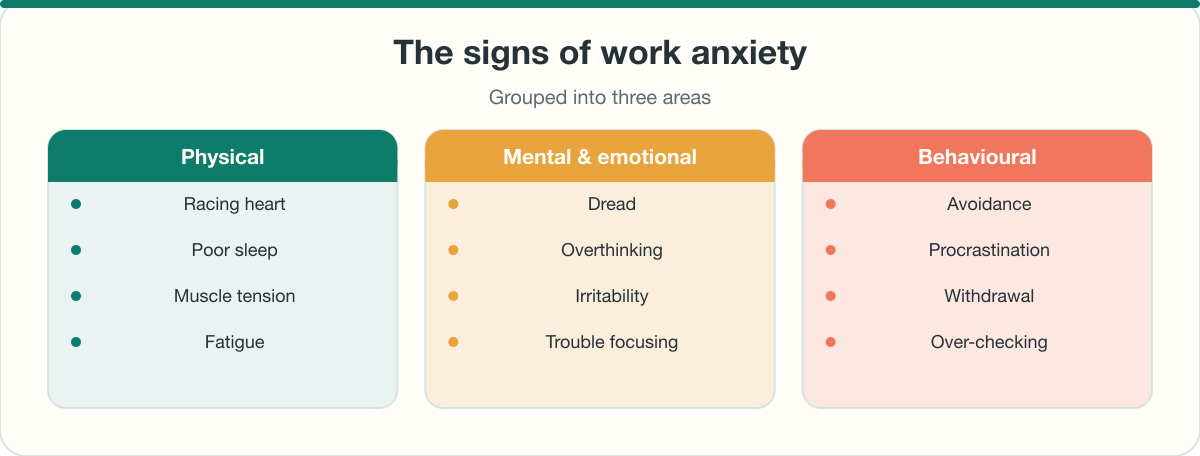 Work anxiety shows up in more places than your thoughts. It is a whole-body experience, and it often leaks into behaviour before you consciously register it. The signs tend to fall into three groups.
| Physical | Mental and emotional | Behavioural |
|---|---|---|
| Disrupted sleep, racing heart, tension headaches, stomach trouble, tight chest, constant fatigue | Persistent worry, trouble concentrating, irritability, a sense of dread, feeling on edge or overwhelmed | Procrastinating or avoiding tasks, calling in sick, withdrawing from colleagues, checking messages compulsively |
No one has every symptom, and the mix differs from person to person. What matters is the pattern over time. An occasional bad night before a big day is normal. Weeks of broken sleep, a permanent knot in your stomach and a growing urge to avoid work altogether point to something that deserves attention and care.
How do you cope with work anxiety?
There is no single switch that turns work anxiety off, but a combination of practical habits genuinely reduces it for most people. Start with one or two rather than trying to do everything at once.
- Protect a boundary between work and life. A hard finish time, notifications off in the evening, and genuinely switching off give your nervous system a chance to reset. If boundaries are hard for you to hold, our guide on how to set boundaries at work breaks down how to make them stick.
- Build a steadying routine. Anxiety feeds on chaos. Regular sleep, meals, movement and breaks give the day a predictable shape that is calming in itself. Sleep in particular is not optional; it is one of the strongest levers you have.
- Prepare, but do not over-rehearse. Reasonable preparation for the thing you are dreading reduces anxiety. Endlessly rehearsing worst-case scenarios feeds it. Learn to tell the difference, and stop at the point preparation turns into rumination.
- Talk to someone. Naming the anxiety out loud, to a trusted colleague, a manager or a friend, takes some of its power away. A good manager would often rather know you are struggling than watch your work quietly slide.
- Get professional support when you need it. If the anxiety is persistent or severe, this is a job for a professional, not something to tough out alone.
That last point matters enough to say plainly. This article is general wellbeing guidance, not medical advice. If work anxiety is affecting your sleep, your health or your ability to function, or if it persists despite your best efforts, please speak to a GP or a qualified mental-health professional. In the UK, charities such as Mind offer free information and support. Reaching out is a sign of good sense, not weakness.
Is it you, or is it the job?
One of the most helpful questions you can ask is whether the problem sits in you or in the situation. It is easy to assume you are simply not coping, when in fact you are responding reasonably to an unreasonable environment.
Work-Life Balance Jobs with Genuinely Reduced Hours
Save one to come back to it — it's free.



A few honest questions help you tell the difference. Does the anxiety lift when you are away from this particular job, then return the moment you go back? Would most reasonable people feel the same in your position? Is the workload genuinely impossible, or the culture genuinely hostile? If the dread is tightly bound to one specific job, and eases when you are out of it, that points at the situation rather than a flaw in you.
This distinction matters because the fix is different. If the pressure is coming from the job itself, the answer is not to squeeze more resilience out of yourself. Endlessly trying to cope better inside a broken situation is exhausting, and it rarely works. Sometimes the healthiest and most rational move is to change the situation.
What do lower-pressure workplaces do differently?
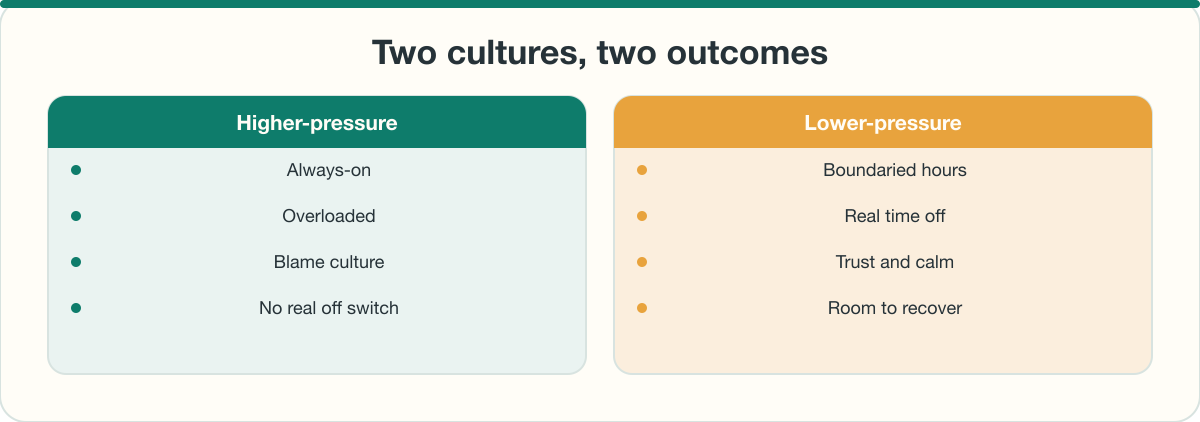 Not all workplaces produce the same amount of anxiety, and the difference is not about how nice everyone is. It is structural. Lower-pressure cultures tend to share a few features: workloads that fit the hours available, genuine respect for time off, no expectation of instant replies at all hours, and managers who treat mistakes as problems to solve rather than crimes to punish. When those things are in place, the chronic, background stress that fuels work anxiety simply has less to feed on.
This is where reduced-hours and four-day-week employers have a real edge. A shorter or more flexible week is not only about the extra time off. It reflects a culture that has decided work should fit around life rather than swallow it. Boundaries are built into how the place operates, recovery time is baked into every week, and the always-on expectation that drives so much anxiety is far weaker. None of this makes anxiety vanish, but it removes a great deal of what causes it in the first place.
If your anxiety has already tipped into something heavier, our guide on how to recover from burnout covers the recovery process in depth. And if you have concluded that your current job is the real source of the dread, it may be worth seeing what calmer, more boundaried work actually looks like. You can browse reduced-hours and four-day-week roles on 4dayweek.io and find employers who treat a sustainable pace as the point, not a perk.
Frequently asked questions
Is work anxiety a normal part of having a job? Some stress is normal and even useful, but persistent dread, worry or nervousness that does not switch off is not something you simply have to accept. Ordinary stress passes once a demand is met. Work anxiety lingers and affects your body, mood and behaviour, and it is worth addressing rather than enduring.
How is work anxiety different from ordinary stress? Ordinary stress is short-lived, tied to a specific task, and fades once that task is done. Work anxiety is persistent, often generalised rather than pinned to one cause, and frequently out of proportion to the actual threat. If the feeling follows you home and refuses to settle, it has moved beyond everyday stress.
How do I deal with anxiety at work day to day? Protect a firm boundary between work and life, keep a steady routine with real sleep and breaks, prepare for what you dread without endlessly rehearsing the worst, and talk to someone you trust. If it is persistent or severe, seek help from a GP or mental-health professional rather than trying to push through alone.
When should the answer be to leave the job? If your anxiety lifts away from a particular job and comes rushing back the moment you return, and the workload or culture is genuinely the driver, the problem may be the situation rather than you. In that case, moving to a healthier, more boundaried workplace can do more than any amount of individual coping.
Dreading Monday more often than not? Browse calmer, reduced-hours roles on 4dayweek.io.




Get 4-day week jobs in your inbox
Create a free account to receive curated opportunities weekly.
Sign up for freeFree forever. No spam, unsubscribe anytime.