
It is 11am on a Tuesday and someone is at the beach. Their laptop is at home, screen glowing, a mouse jiggler nudging the cursor every few minutes so the little status dot stays green. Later they will fire off one email at 9pm, timed to look diligent. As far as their manager knows, they were online all day.
That is a quiet vacation, and a surprising number of people are taking one.
What is quiet vacationing?
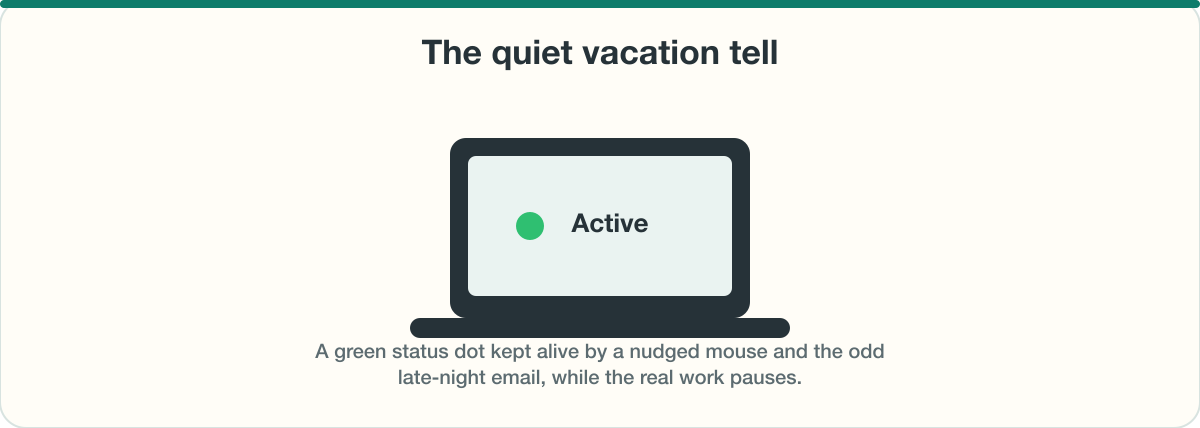
Quiet vacationing means taking time off, or quietly working far less, without telling your manager or formally booking paid time off. Think nudging the mouse to stay shown as active, or sending a late-night email to look online. The Harris Poll popularised the term in 2024, describing a workforce that would rather hide rest than request it.
A quiet vacation is not a booked holiday. It is time off taken in the shadows, disguised as a normal working day. The person is technically "at work" and technically not, and the whole performance exists to avoid a conversation they do not feel safe having.
Where did the term come from?
The phrase was popularised by The Harris Poll's 2024 "Out of Office Culture" report, which set out to understand how people actually use, and avoid using, their time off. The findings named a behaviour plenty of workers recognised instantly, even if they had never admitted to it.
The report landed because it captured a very modern contradiction. We have more tools to work from anywhere than ever, and many people use them not to take proper breaks but to fake presence while quietly stepping back. The freedom to be always reachable curdled into a pressure to always look reachable.
How common is a quiet vacation?
 More common than most managers would guess.
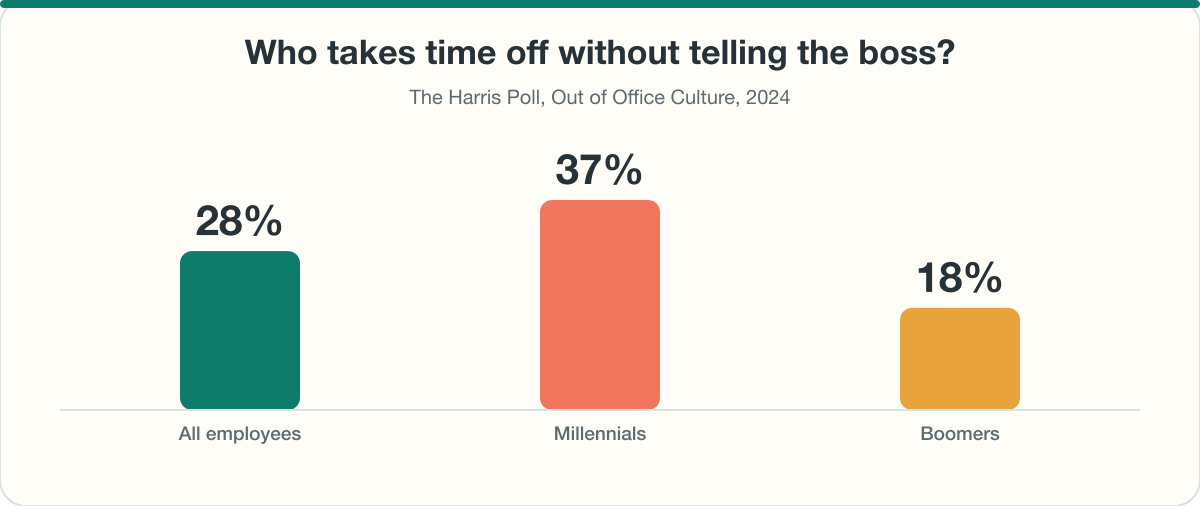
The Harris Poll's 2024 report found that 28% of employees had taken time off without telling their employer. It skewed heavily by generation: 37% of millennials had done it, compared with just 18% of boomers. Depending on how the poll's questions are framed, some readings put the figure closer to 4 in 10 workers engaging in some form of quiet vacationing.
Sitting behind all of this is a bigger problem with rest itself. Around 78% of US workers say they do not use all of their paid time off. People are leaving earned holiday on the table, then sneaking the rest they will not formally claim.
| Figure | What it measures | Source |
|---|---|---|
| 28% | Employees who took time off without telling their employer | The Harris Poll (2024) |
| 37% | Millennials who had done so, the highest of any generation | The Harris Poll (2024) |
| 18% | Boomers who had done so, the lowest of any generation | The Harris Poll (2024) |
| ~78% | US workers who do not use all their paid time off | Reported alongside the poll |
The generational gap is the tell. Quiet vacationing is most common among millennials and Gen Z, the groups most likely to say they fear looking like a "slacker" or worry about what happens to their deadlines while they are gone.
Why do people feel they have to hide rest?
 This is the question that matters, and it is more interesting than "are workers being sneaky".
People rarely hide things in cultures they trust. Quiet vacationing thrives in a specific environment: one where being seen to be online is treated as proof of value, where taking your full holiday is quietly frowned upon, and where stepping away feels like handing someone a reason to doubt you. A few forces drive it:
- Always-on expectations. When a green status dot becomes a moral scoreboard, people manage the dot instead of managing their work. Presence gets performed rather than earned.
- Unused-PTO guilt. With around 78% of US workers not using all their leave, taking time off can feel like an admission of not coping. So people take it in secret instead.
- Fear of looking like a slacker. Younger workers in particular often say they worry about being judged, especially in a nervy job market where they would rather not stand out as the person who was "always off".
- Deadline anxiety. If nobody covers your work while you are away, a real holiday just means the same pile waiting on your return. A quiet vacation can feel like the only way to breathe without falling behind.
Notice what every one of these has in common. They are symptoms of low trust and a culture that measures hours and visibility instead of results.
Quiet vacationing vs coffee badging vs quiet quitting
Quiet vacationing has siblings, and they are all reactions to the same visibility theatre.
| Term | The behaviour | What it signals |
|---|---|---|
| Quiet vacationing | Taking time off or working far less, in secret | Rest feels unsafe to request |
| Coffee badging | Showing face at the office briefly, then leaving | Presence mandates feel performative |
| Quiet quitting | Doing the job, withholding unpaid extra effort | The deal stopped feeling fair |
Each one is a quiet workaround. Coffee badging games an office-attendance rule by swiping in, grabbing a coffee and heading home. Quiet quitting games the effort expectation by doing exactly what is required and no more. Quiet vacationing games the always-on expectation by faking presence while actually resting. None of them is the disease. They are all the fever.
Is quiet vacationing a problem?
It is worth being fair here, because there are two sides.
For workers, the instinct is understandable. If your culture punishes visible rest, hiding it can feel like the only way to protect your health without risking your standing. Nobody should have to earn the right to switch off, and a lot of quiet vacationing is just tired people taking the break they were owed.
But it is not consequence-free. Teams genuinely do need to coordinate. If half a team is quietly offline while pretending otherwise, work can stall, colleagues can be left covering blind, and fairness breaks down between the people who hide rest and the people who cannot. Hidden time off also erodes the very trust that would make honest time off possible, which deepens the loop.
So the honest verdict is this: quiet vacationing is a rational response to a broken culture, and it quietly makes that culture a little more broken. The behaviour is a symptom. Blaming the worker misses the point.
Work-Life Balance Jobs with Genuinely Reduced Hours
Save one to come back to it — it's free.



What can you do if you keep hiding rest?
If you recognise yourself in the mouse-jiggling and the 9pm performance emails, it is worth pausing on what that is telling you. Hiding rest is tiring in its own right, a second job layered on top of the first. A few honest moves can help:
- Test the water on real time off. Book a genuine day and see what actually happens. Cultures are sometimes more reasonable than the fear suggests, and one openly taken day can reset your sense of what is allowed.
- Get cover agreed in advance. Much of the deadline anxiety behind quiet vacations comes from work with no backup. Agreeing who covers what before you step away removes the main reason to hide in the first place.
- Watch what your manager rewards. If they only ever praise visible busyness, that is useful information about the culture, and about whether it is the right long-term fit for you.
- Name the pattern to yourself. Repeatedly needing to fake presence is a signal that the deal is off, not proof that you are lazy. That reframe alone can make the next decision clearer.
If the honest conclusion is that rest will never feel safe where you are, that is not a personal failing. It is a mismatch, and the answer is a workplace where switching off does not require a cover story.
What actually fixes quiet vacationing?
You do not fix it by installing more monitoring or hunting for mouse jigglers. That just teaches people to hide better. You fix it by removing the reason to hide in the first place.
That means building a culture on trust and results rather than hours and visibility:
- Judge output, not the status dot. When people are measured on what they deliver, nobody needs to perform presence. This is the core of a results-only work environment, where the work speaks and the clock does not.
- Make taking leave normal and expected. Managers who visibly take their full holiday give everyone else permission to do the same. Unused PTO is a culture problem, not a personal failing.
- Offer genuine flexibility. When people can work flexibly and openly, they stop needing a secret version of it. Honest flexibility beats hidden flexibility every time.
- Design rest in, rather than leaving people to steal it. This is where reduced-hours models change the maths entirely.
That last point is the real answer. A four-day week or reduced-hours schedule builds proper rest into the structure of the job, so there is nothing to hide. You are not sneaking a Tuesday at the beach and jiggling a mouse to cover it. You have the day off, out in the open, because the week was designed to give it to you.
Compare that to a lazy girl job chosen just to lower the pressure, and the difference is honesty. When rest is designed into the deal, you never have to fake being online, because your time off is real, agreed and yours.
Want work where switching off is built in, not smuggled? Explore four-day-week and reduced-hours roles on 4dayweek.io.
Frequently asked questions
What is quiet vacationing? Quiet vacationing means taking time off, or quietly working much less, without telling your manager or booking paid time off. It includes tricks like nudging the mouse to keep your status active or sending a late email to look online. The Harris Poll popularised the term in 2024.
How common is quiet vacationing? The Harris Poll's 2024 report found 28% of employees had taken time off without telling their employer, rising to 37% among millennials and falling to 18% among boomers. Separately, around 78% of US workers say they do not use all of their paid time off.
Why do people take quiet vacations instead of booking leave? Usually because rest does not feel safe to request. Always-on cultures reward looking busy, unused-PTO guilt makes time off feel like weakness, and many workers, especially younger ones, fear being seen as a slacker or falling behind on deadlines.
How can employers stop quiet vacationing? Not with surveillance, which only teaches people to hide better. The fix is a culture built on trust and results rather than hours and visibility: judge output, make taking full leave normal, offer genuine flexibility, and design proper rest into the week, as reduced-hours and four-day-week models do.
Rest should be built into the job, not stolen back in secret. See reduced-hours and four-day-week roles on 4dayweek.io.




Get 4-day week jobs in your inbox
Create a free account to receive curated opportunities weekly.
Sign up for freeFree forever. No spam, unsubscribe anytime.