
You have earned it, you know you have earned it, and yet the words stick in your throat every time the moment comes. Most people would rather reorganise a spreadsheet for an hour than sit across from their manager and say a number out loud. That reluctance is exactly why a little preparation goes so far.
To ask for a raise, choose a good moment (after a clear win or during review season), bring evidence of your impact, name a specific figure backed by market research, and stay calm. If cash is genuinely off the table, negotiate time and benefits instead. Both are real pay.
When is the right time to ask for a raise?
Timing does a lot of the work before you say anything. There are four moments worth watching for, and the best asks usually sit where two or more of them overlap.
The first is your company's review cycle. Budgets get set and managers expect these conversations. If you wait until the numbers are locked, you have handed away your leverage, so flag your intention a month or two before decisions are made, while your manager can still fight for you.
The second is right after a clear win. Recency matters. A win from last week is vivid; a win from last spring has faded into "just your job".
The third is when your role has quietly grown. You are managing former peers, owning a senior system, or covering work that left with a departed colleague. If your responsibilities have climbed while your salary sat still, the gap is your argument.
The fourth is when you are simply paid below the market. Long-tenured staff often earn less than the new hire in the next seat. If the outside rate for your role has risen, that is a reason on its own.
A short early flag keeps you in control of the timing:
"I would like to set up a proper conversation about my compensation in the next few weeks. When would be a good time before the review round closes?"
How do I prepare for the conversation?
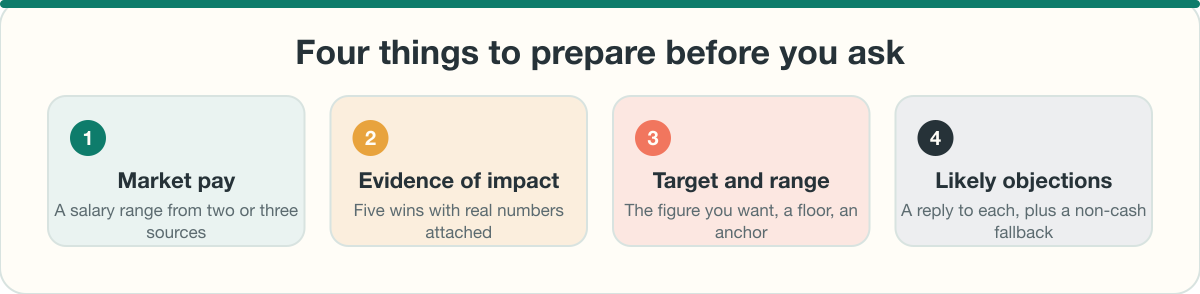 Preparation is what turns a nervous ask into a confident one. You are not walking in to plead; you are walking in with a case.
Start with the market. Look at salary data for your role, level and location across more than one source: public salary tools, recruiter benchmarks, job adverts, and honest conversations with peers. You want a defensible range, not a single lucky number you saw once.
Next, quantify your impact. Vague value is easy to wave away, so translate what you do into numbers. "I improved onboarding" is weak. "I rebuilt onboarding and cut first-week drop-off, worth roughly X new active users a month" is a case. Write down five concrete lines you can say from memory.
Then decide your target and your range. Pick the figure you actually want, set a floor you would accept, and choose a slightly higher anchor to open with. A specific number signals that you have done your homework in a way a fuzzy "a bit more" never does.
Finally, anticipate the objections. Almost every no comes in a predictable shape: no budget this cycle, wrong time of year, or "let's revisit later". Decide in advance what you will say to each, and what you will ask for instead if cash is blocked (more on that below).
| Prep step | What to do | Why it matters |
|---|---|---|
| Market research | Gather a salary range from two or three sources for your role, level and location | Turns your ask from a feeling into a benchmark nobody can dismiss |
| Evidence of impact | Write five achievements with concrete numbers attached | Makes your value hard to argue with and easy to recall on the spot |
| Target and range | Set the figure you want, a floor you will accept, and an anchor above the target | A specific number reads as serious; a vague one invites a vague reply |
| Objections | List the likely pushbacks and your reply to each, plus a non-cash fallback | Keeps you calm instead of stalling when the first "but" lands |
What do I actually say?
Keep the opening simple and warm. You do not need a long run-up. Book a dedicated slot rather than ambushing your manager in a corridor, then get to the point.
"Thanks for making the time. I want to talk about my salary. Over the past year I have taken on X and Y and delivered Z, and I would like us to bring my pay in line with that contribution."
Notice the framing. It is built on the value you deliver to the business, not on your rising rent or your friend's bigger salary. Managers can act on business value; they can do little with your personal budget, and leaning on need turns a case into a plea. Keep personal circumstances as your private motivation, not your argument.
State your number and then stop talking. Silence feels excruciating, and the instinct is to soften the ask with a nervous "but obviously if that is difficult..." Resist it. Let the number sit.
"Based on the market rate for this role and what I have delivered, I am looking for [figure]. How does that land with you?"
If your manager pushes back, stay level. You rarely win the whole thing in one meeting. Treat objections as information, not rejection.
"That is fair, and I would like to understand the constraints. What would it take to get there?"
Calm is a tactic, not just good manners. The measured person keeps the conversation open, and one you can return to.
How much should I ask for?
Ask for a specific figure, anchored slightly above your real target, and let the negotiation settle in your acceptable range. The exact size depends on your situation. If you are correcting a below-market salary or absorbing a much bigger role, the gap can be substantial, so ask for the full amount that closes it. If you are already fairly paid and pushing for a solid step up, a more modest number is realistic.
Two rules keep you grounded. First, anchor high but not absurd; a number that ignores reality damages your credibility. Second, ask for slightly more than you would accept, because negotiation almost always moves toward the middle.
And remember that salary is only one lever. A "no" on the cash figure is not a "no" on the deal, which is where most people leave value on the table.
What if they say no?
You will get one of three responses, and each has a different next move.
An enthusiastic yes is lovely and also a small trap. Get the agreement in writing (amount, effective date, any conditions) and thank them warmly. If it came too easily, note that you may have aimed low and file that for next time.
A "not right now" is the most common answer, and it is workable. Do not accept a vague promise of "later". Pin it down.
"I understand the budget is tight this quarter. Can we agree exactly what I need to demonstrate, and a specific date to revisit this with the increase in mind?"
Work-Life Balance Jobs with Genuinely Reduced Hours
Save one to come back to it — it's free.



Then get the goals in writing, make them measurable, and put the review date in both diaries. A soft "we'll see" tends to evaporate; a dated, documented plan tends to stick. This is also the moment for the non-cash levers below, which often live in a different budget from salary.
A firm no is the hardest, but it still tells you something. Ask what, if anything, would change the answer. If the honest reply is "nothing for a long while", you have learned that your growth is capped here, and that is worth knowing before you invest another two years. Test the wider market calmly. Even browsing what your skills command elsewhere resets your sense of your own worth, and an offer in hand is the strongest evidence of your value there is. Be honest about motive, too: staying purely out of comfort is its own quiet cost, a habit sometimes called job hugging that can keep you underpaid for years. If the no is permanent, it may be time to see who is hiring for reduced-hours roles that value your time as well as your output.
What can I negotiate beyond base salary?
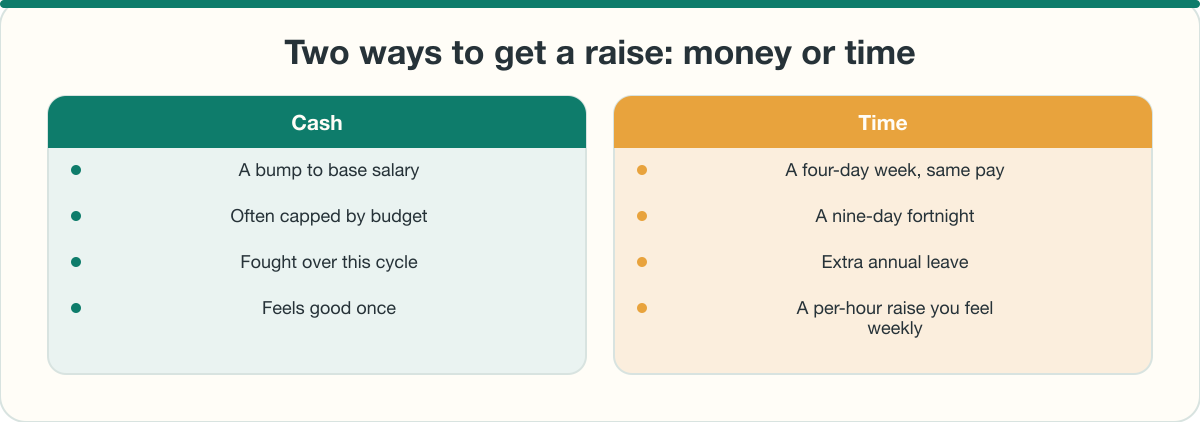 This is where the ask gets interesting, and where most people stop too early. Your total compensation is more than the number on your payslip. It includes your bonus, any equity, your title, your development budget, and, crucially, your time. Reduced or flexible hours on the same salary are a genuine pay rise per hour worked, and they frequently sit outside the tight salary pot, which makes them easier to grant when the answer to cash is "not this year".
Think about what a four-day week on full pay is actually worth. You keep the same salary and reclaim a fifth of your working life, which is a substantial raise per hour and one you feel every week. A nine-day fortnight, a block of extra annual leave, or a couple of guaranteed remote days work the same way: value that costs the business less than cash but improves your life immediately.
Framing matters here too. Reduced hours are not a favour; they are a serious form of compensation, and plenty of employers already offer them to keep good people. There is also real evidence that shorter, focused weeks do not tank output, partly because work expands to fill the time available, an idea known as Parkinson's Law.
"If the salary figure is not possible this cycle, I would like to talk about a four-day week on the same pay, or additional leave. That would work well for me and I know it is often easier on the budget."
Two practical notes. First, in many places a request for reduced or flexible hours can also follow a formal route with its own protections, so it is worth understanding your flexible-working request rights before you raise it. Second, put whatever you agree in writing, exactly as you would with a cash rise, so a friendly "yes, sounds good" does not fade the moment your manager gets busy.
| Lever | What to ask for | Why it can be easier to win than cash |
|---|---|---|
| Time | A four-day week or nine-day fortnight on the same salary, or extra leave | Sits outside the salary budget and reads as a per-hour raise you feel weekly |
| Flexibility | Guaranteed remote days or genuinely flexible hours | Low cost to the employer, high daily value to you |
| Bonus | A performance bonus tied to a clear goal | Comes from a different pot than base pay and rewards an outcome |
| Equity | Shares or options, or an improved existing grant | Preserves cash now while giving you a stake in the upside |
| Title | A title that matches the work you already do | Costs little today and lifts your market value at the next move |
| Development | A training budget, a conference, courses or a mentor | Framed as an investment, so it is an easy yes |
None of this is a consolation prize. For a lot of knowledge workers, a shorter week or reliable flexibility is worth more than a few extra percent on the salary, because it buys back the one thing a bigger number cannot.
Frequently asked questions
How often can I ask for a raise? Roughly once a year is reasonable, usually aligned with your review cycle. You can go sooner if something material has changed, such as a promotion in all but name, a big project delivered, or a formal offer from elsewhere. Asking every few months without new evidence wears thin fast.
Should I mention a competing offer? Only if it is real and you would genuinely consider taking it. A true offer is powerful leverage, but bluffing is risky; if they call it, you either walk or lose credibility. Present it as a fact you would rather not act on: "I have an offer at [figure], but I would prefer to stay if we can close the gap."
What if I am too nervous to negotiate? Nerves are normal and preparation is the cure. Write your opening line and your number on a card, rehearse them out loud, and remember you are asking a business question, not a favour. Booking a dedicated meeting rather than blurting it out in passing also removes a lot of pressure.
Is asking for a four-day week instead of a raise a step down? Not at all. Reduced hours on the same salary are a real form of compensation and, per hour worked, effectively a pay rise. Many strong performers choose time over cash, and a growing number of employers offer it precisely to attract people like you. It is a legitimate, forward-looking ask, not a compromise.
Ready to work somewhere that treats your time as part of the deal? Browse thousands of four-day-week and reduced-hours roles at 4dayweek.io/jobs.
Know your number, name it calmly, and remember: if the money is stuck, ask for your time back instead.




Get 4-day week jobs in your inbox
Create a free account to receive curated opportunities weekly.
Sign up for freeFree forever. No spam, unsubscribe anytime.