
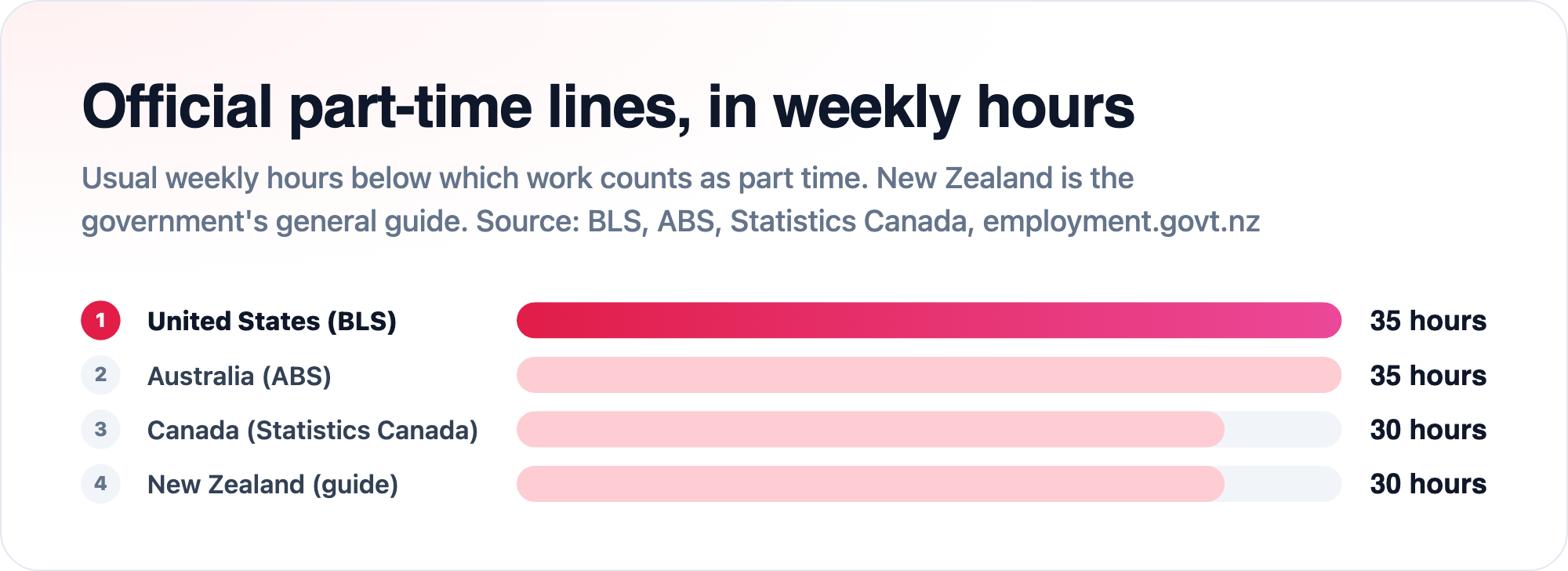
How many hours is part time? There is no single answer, because no one number is set everywhere. The US Bureau of Labor Statistics (BLS) counts you as part-time if you usually work fewer than 35 hours a week. Statistics Canada says fewer than 30. Australia's statistics office says fewer than 35. The UK government sets no specific number.
Those are statisticians' lines, not laws. The BLS says its definitions are "for statistical purposes only" and "not legal definitions". The US Department of Labor says the Fair Labor Standards Act (FLSA) "does not define full-time employment or part-time employment" and that this is "generally to be determined by the employer". So the honest answer depends on who is counting: a statistics office, a law, or your employer's contract.
(General information, not legal advice. Rules differ by country and by employer, and the sources are named in each section.)
What counts as part time in each country?
| Where | The part-time line | Source |
|---|---|---|
| United States, statistics | Usually fewer than 35 hours a week, at all jobs combined | BLS |
| United States, law | No definition in the FLSA; generally determined by the employer | Department of Labor |
| United States, ACA employer rules | For purposes of the employer shared responsibility provisions, full-time is on average at least 30 hours of service a week or 130 hours of service a month | IRS |
| Texas, state employees | Working less than a standard 40 hours in a week is part time in executive and judicial agencies and state higher education | Texas Comptroller |
| Canada, statistics | Usually fewer than 30 hours a week at the main or only job | Statistics Canada |
| Australia, statistics | Usually fewer than 35 hours a week in all jobs | ABS |
| United Kingdom | No specific number; a full-time worker will usually work 35 hours or more a week | GOV.UK |
| New Zealand | No legal definition; generally part time is under 30 hours a week | employment.govt.nz |
| Ireland | For Part 2 of the Act, a part-time employee's normal hours of work are less than those of a comparable employee | Protection of Employees (Part-Time Work) Act 2001, section 7 |
Three notes on that table. In the UK, GOV.UK says "There is no specific number of hours that makes someone full or part-time", so 35 is a usual full-time level, not a legal threshold. And in most EU countries Eurostat's part-time figures are self-assessed: the classification "is determined by the respondent's perception of their typical working hours". Eurostat lists the Netherlands, which applies a 35 hour limit, among the exceptions. The ABS page also lists alternative full-time thresholds it can use for extra measures: 30 hours, which it says the OECD uses, 38 hours, referenced in the Fair Work Act, and 40 hours, the traditional 8 hour day, 5 day week.
Is 20, 25, 28 or 30 hours a week part time?
Here are the lines from the table side by side, assuming one job. This is our reading of them, not a ruling, and the ACA line defines only full-time.
| Hours a week | US statistics (under 35) | US ACA line (30 or more is full-time) | Canada statistics (under 30) | Australia statistics (under 35) | New Zealand guide (under 30) |
|---|---|---|---|---|---|
| 20 | Part time | Not full-time | Part time | Part time | Part time |
| 25 | Part time | Not full-time | Part time | Part time | Part time |
| 28 | Part time | Not full-time | Part time | Part time | Part time |
| 30 | Part time | Full-time | Full-time | Part time | Full-time |
| 32 | Part time | Full-time | Full-time | Part time | Full-time |
| 35 | Full-time | Full-time | Full-time | Full-time | Full-time |
So 28 hours a week is below every line above, and so are 20 and 25: part time on the US, Canadian, Australian and New Zealand lines, and not full-time on the ACA line. At 30 the lines split: the US and Australian statistics still say part time, while the ACA line, Statistics Canada and the New Zealand guide say full-time. In the UK no hours figure settles it. Under the FLSA, the Department of Labor says it is generally for the employer to determine.
How many hours a week do part-time workers work?
In the US, the BLS Current Population Survey puts the average at 20.8 hours a week for part-time workers in 2025, against 41.9 for full-time workers. Here part time means fewer than 35 hours a week at all jobs combined. BLS says its 2025 annual estimates are 11-month averages that exclude October, and are not strictly comparable with other years. By our arithmetic, 20.8 ÷ 41.9 means the average part-timer works about half of the average full-time week.
That is an average. The BLS definition covers anyone from a few hours a week up to just under 35.
How many hours a day is a part-time shift?
The BLS American Time Use Survey measures it. In 2025, part-time workers worked 5.36 hours on an average day they worked, and 5.42 on an average weekday. Full-time workers worked 8.07 hours on an average day. It describes what people did, not what a shift must be. BLS says the survey was suspended from 1 October to 12 November 2025 and that it is not possible to quantify the effect of the shutdown on the estimates.
Hours a day are just weekly hours divided by the days you work. A 35 hour week over 5 days is 7 hours a day, which is a quick way to remember the BLS line. Here are the sums for common part-time weeks, using our arithmetic:
| Hours a week | Over 5 days | Over 4 days | Over 3 days |
|---|---|---|---|
| 16 | 3.2 hours | 4 hours | 5.33 hours |
| 20 | 4 hours | 5 hours | 6.67 hours |
| 24 | 4.8 hours | 6 hours | 8 hours |
| 28 | 5.6 hours | 7 hours | 9.33 hours |
Where the US 30-hour line comes from
The 30 hour line in the US is not part of the FLSA. The IRS uses it for the Affordable Care Act (ACA) employer shared responsibility provisions: a full-time employee is, for a calendar month, "an employee employed on average at least 30 hours of service per week, or 130 hours of service per month". The IRS says an employer with at least 50 full-time employees, "including full-time equivalent employees", on average during the prior year is an applicable large employer.
The IRS gives that definition "for purposes of the employer shared responsibility provisions". For the health insurance side, see our guide to how many hours you need to work to get health insurance. To see how part-timers are counted in those headcounts, read what FTE means.
Weekly hour limits are a different question
A limit says the most you can work, not the least. These are the limits and overtime thresholds we checked:
| Where | The rule | Source |
|---|---|---|
| United Kingdom | You cannot work more than 48 hours a week on average, normally averaged over 17 weeks; you can choose to opt out | GOV.UK |
| United States, federal | No limit in the FLSA on hours for employees aged 16 and older; unless exempt, covered employees get overtime pay at not less than one and a half times the regular rate for hours over 40 in a workweek | Department of Labor |
| California | For nonexempt employees aged 18 or older, overtime pay applies beyond 8 hours in a workday and 40 hours in a workweek; double time beyond 12 hours in a workday | California DIR |
| Canada, federally regulated employers | Standard hours are 8 a day and 40 a week; in most cases the weekly maximum is 48; hours beyond the standard hours are overtime | Canada.ca |
In California the 40 hours is an overtime threshold, not a part-time line, and the Canada.ca page above is written for federally regulated employers.
Our view: part time should leave room for a life
This section is opinion, not definition. Part-time work is the kind of work that leaves you time for other pursuits. A job whose schedule changes every week, or whose hours leave no room for anything else, is closer to full-time in its effect on your life than its label suggests.
Professional Part Time Jobs
Save one to come back to it — it's free.

A useful test is whether you could reasonably hold a second part-time job and manage both. If you could not, the first job was probably nearer to full-time than part-time.
It also helps to separate three deals. Acas says pay and leave are given pro rata for part-time employees, meaning in proportion to hours worked. A 4-day week at full pay is a different arrangement, where pay is not reduced. A 4-day week at 80% pay is pro rata. Our guide to the 4-day work week covers the first, and Pro Rata Jobs lists the second.
Can you ask to work part time?
 GOV.UK says flexible working rules are different in Northern Ireland. Elsewhere in the UK, it says "All employees have the legal right to request flexible working", from their first day in a job, and lists the number of hours they work among what can be requested. Employers must deal with requests in a "reasonable manner", and can refuse if they have a good business reason. See our guides to changing from full-time to part-time work and to what happens if an employer withdraws flexible working.
In the Netherlands, the government's Rijksoverheid site (in Dutch) says you can ask to change your hours if you work for a company with at least 10 employees and have been employed for at least six months (26 weeks). The 10-employee condition does not apply to a request to care for a child under 8 or for informal care. The request is in writing, at least 2 months before the start date. The employer's ground to refuse is a compelling business or service interest (in Dutch, "zwaarwegend bedrijfs- of dienstbelang"), and it must respond in writing at least 1 month before the start date. If it does not, the page says you may work as you requested.
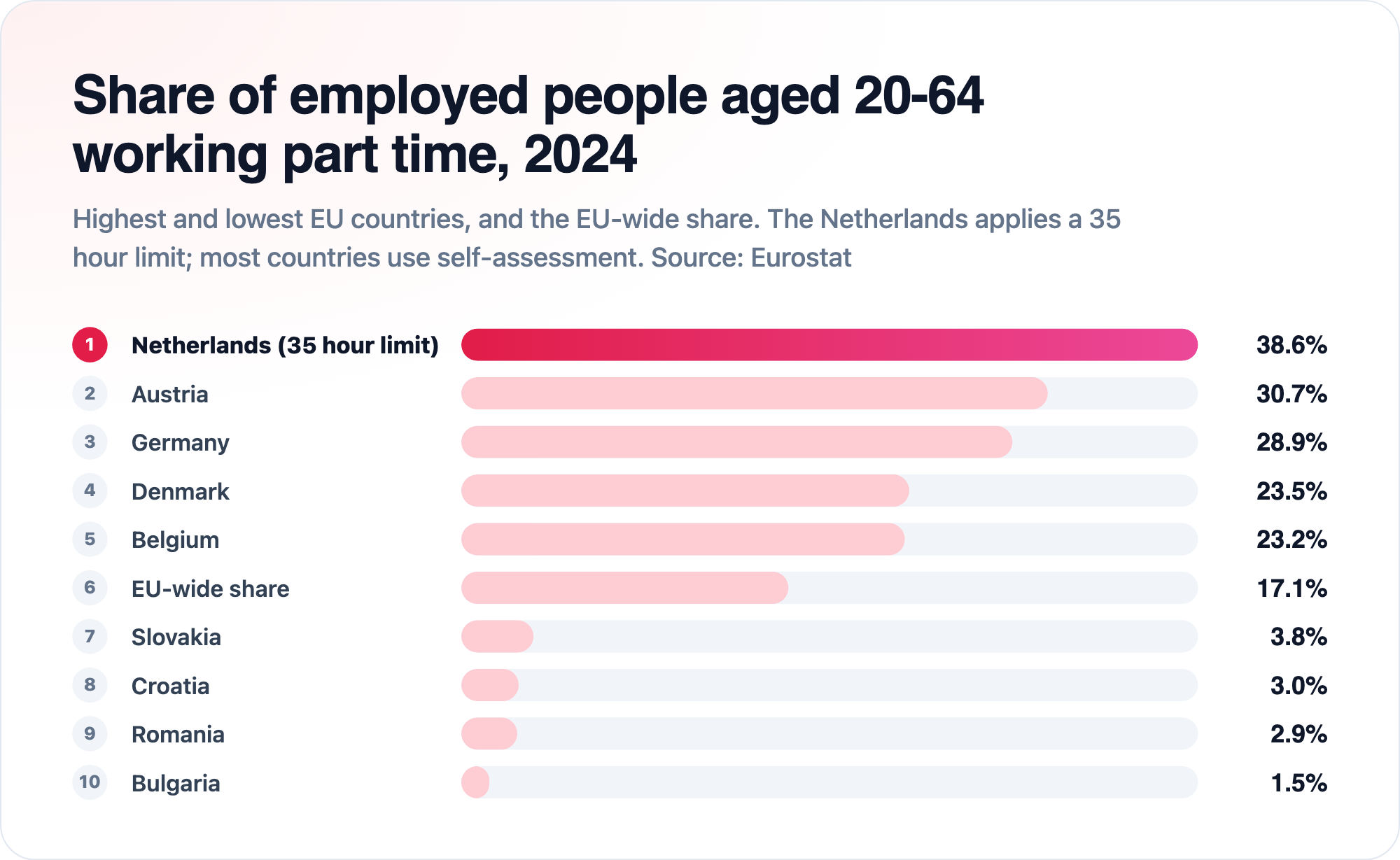
Eurostat puts the Netherlands highest in the EU for 2024, at 38.6% of employed people aged 20-64, ahead of Austria at 30.7%, Germany at 28.9%, Denmark at 23.5% and Belgium at 23.2%, against an EU-wide share of 17.1%. The Netherlands is not measured like most countries: Eurostat says it applies a 35 hour limit instead of asking respondents. The lowest shares were in Bulgaria (1.5%), Romania (2.9%), Croatia (3.0%) and Slovakia (3.8%). Eurostat also reports that 27.8% of employed women aged 20-64 in the EU worked part-time against 7.7% of men. These are the figures in Eurostat's statistics article; its live database has since revised Germany to 28.8% and EU women to 27.7%. The article does not say why the country shares differ, and we do not claim the Dutch right causes the Dutch share.
Part time, pay, holiday and FTE
GOV.UK says part-time workers should get the same treatment for pay rates, pension opportunities and benefits, holidays, training and career development, selection for promotion, transfer or redundancy, and opportunities for career breaks. Acas says benefits such as pay and leave are given pro rata, which means in proportion to hours worked, and names the law as the Part-time Workers (Prevention of Less Favourable Treatment) Regulations 2000, which extend to England, Wales and Scotland. GOV.UK adds that part-timers may not get overtime pay until they have worked over the normal hours of a full-time worker, and that an employer can treat them differently if it can be objectively justified, with health insurance as its example.
For the sums, use our pro rata salary calculator. For leave, read part-time holiday entitlement. For what FTE on a job advert means, read what FTE means.
Frequently asked questions
Is 28 hours a week part time?
28 hours is below every line in the comparison table above: 35, 35, 30 and 30 for part time, and 30 for the ACA's full-time line. The UK, Ireland and the FLSA set no part-time hours threshold. Under the FLSA it is generally for the employer to determine, so check your contract.
Is 30 hours a week part time or full-time?
It depends who is counting. The BLS and the ABS count 30 hours as part time, because their line is 35. The ACA's full-time line is 30, and Statistics Canada and the New Zealand guide count 30 as full-time.
Is 25 hours a week part time?
25 is below every numeric line above, so it is part time on the US, Australian, Canadian and New Zealand lines and not full-time on the ACA line.
How many hours is part time in Texas?
The Texas Comptroller's policy for state employees treats working less than a standard 40 hours in a week as part time, in executive and judicial agencies and state higher education. The federal FLSA does not define part-time work and leaves it to the employer.
How many hours a day is part time?
BLS 2025 averages are 5.36 hours on a day worked for part-time workers. Divide your weekly hours by the days you work to get your own figure: 20 hours over 4 days is 5 hours a day.
Summary: part-time job hours
- No single number defines part time: US statistics under 35, Australia under 35, Canada under 30, New Zealand generally under 30, and no specific number in the UK.
- The BLS definition is statistical, and the US FLSA defines neither full-time nor part-time work.
- The ACA's 30 hour line is the IRS's full-time definition for the employer shared responsibility provisions.
- The average US part-time worker works 20.8 hours a week and 5.36 hours on days worked.
- In the US the Department of Labor says the FLSA leaves it generally to the employer, so check your contract.
Looking for part-time roles? Browse part-time jobs on 4dayweek.io.




Get 4-day week jobs in your inbox
Create a free account to receive curated opportunities weekly.
Sign up for freeFree forever. No spam, unsubscribe anytime.