
FTE stands for full-time equivalent, a way of counting work in proportion to a full-time week. A full-time person is 1.0 FTE, and a part-time worker is scored in proportion to their hours, so working 80% of full-time hours is 0.8 FTE.
(General information, not legal or tax advice. The US figures are for the IRS rules named below.)
If you have just seen "0.8 FTE" or "1.0 FTE" on an advert, an offer or a payroll form, that is the whole idea: 1.0 is the full week and 0.8 is 80% of it.
The catch is the phrase "full-time". An FTE figure only means something once you know how many hours your employer counts as one. This guide covers the formula, why the same hours can give different answers, and what FTE means for pay, holiday and a 4-day week.
What does FTE mean?
Eurostat's glossary defines a full-time equivalent as "a unit to measure employed persons or students" in a way that makes them "comparable although they may work or study a different number of hours per week."
You get the unit by comparing the average hours someone works with the average hours of a full-time worker. Eurostat's example is a part-time worker employed for 20 hours a week where full-time work consists of 40 hours, who "is counted as 0.5 FTE." In sum form, that is 20 ÷ 40 = 0.5.
In a job, the comparison is with the hours your employer treats as full-time. Acas speaks of a full-time worker "in the same organisation". So the working formula is:
FTE = your weekly hours ÷ your employer's full-time weekly hours
Because FTE is a proportion, it can be added up. Eurostat says the workforce of an enterprise, activity or country can be added up and expressed as a number of full-time equivalents. The same sum works for a team, and there is a worked example in the questions at the end.
How do you calculate FTE?
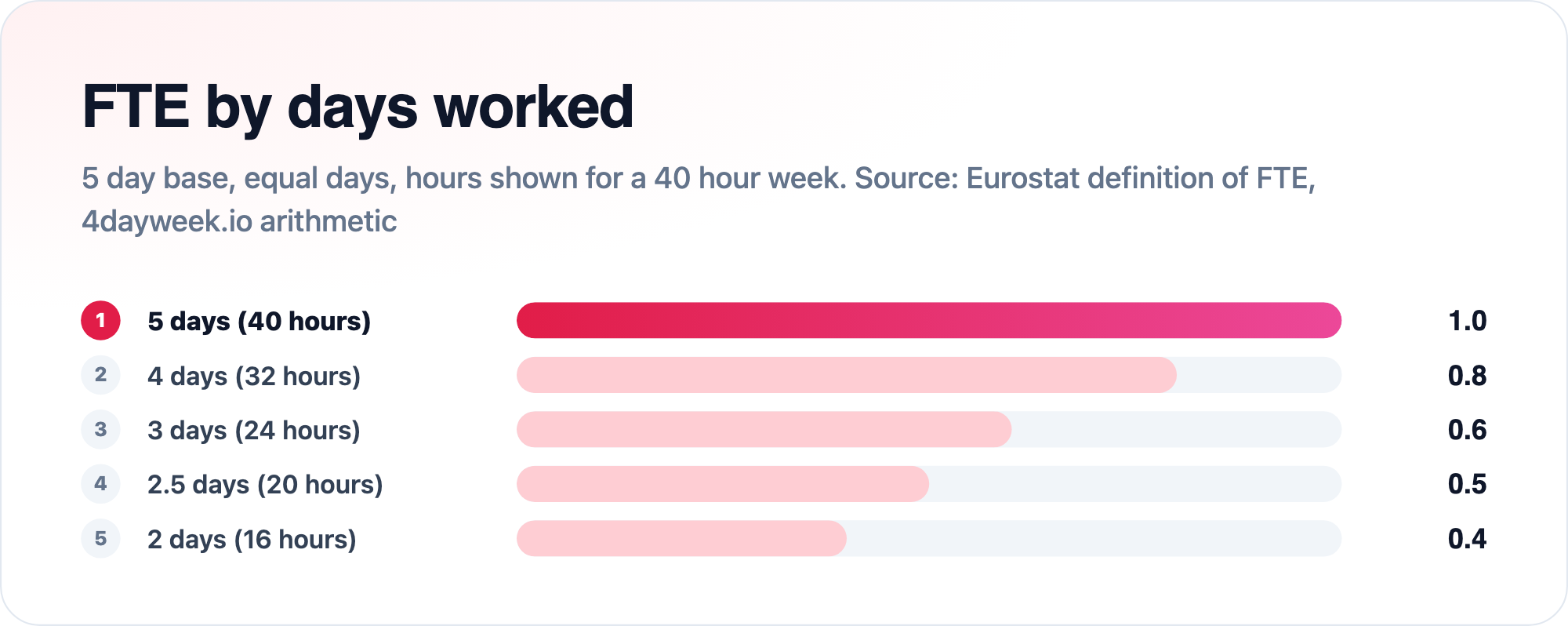 Divide the hours you work by the hours your employer counts as full-time. If full-time is 40 hours and you work 32, the sum is 32 ÷ 40 = 0.8 FTE.
If you think in days, use a 5 day base and assume the days are equal in length:
| Days worked | FTE | Hours on a 40 hour week | Hours on a 37.5 hour week |
|---|---|---|---|
| 5 | 1.0 | 40 | 37.5 |
| 4 | 0.8 | 32 | 30 |
| 3 | 0.6 | 24 | 22.5 |
| 2.5 | 0.5 | 20 | 18.75 |
| 2 | 0.4 | 16 | 15 |
Hours are less tidy than days, because the answer changes with the full-time week you divide by:
| Hours you work | FTE on a 40 hour week | FTE on a 37.5 hour week |
|---|---|---|
| 32 | 0.8 | 0.853 |
| 30 | 0.75 | 0.8 |
| 24 | 0.6 | 0.64 |
| 20 | 0.5 | 0.533 |
Four days is 0.8 FTE on both weeks, but 32 hours is 0.8 only against a 40 hour week. The figures are rounded to three decimal places.
Why can the same hours be a different FTE?
 Because full-time is not one number. GOV.UK says "There is no specific number of hours that makes someone full or part-time," but "a full-time worker will usually work 35 hours or more a week."
Here are three published figures that differ:
- NHS Agenda for Change contracts in England set the standard full-time week at 37.5 hours, excluding meal breaks (NHS Employers, Terms and Conditions Handbook, section 10).
- Two NHS Scotland circulars cut the full-time week. Circular PCS(AFC)2024/4 says "the standard working week for Agenda for Change staff reduced to 37 hours from 1 April 2024." Circular PCS(AFC)2026/2 says "from 1 April 2026 the full-time working week for Agenda for Change staff working in NHS Scotland will be 36 hours."
- For the US Affordable Care Act (ACA) employer shared responsibility provisions, the IRS defines a full-time employee, for a calendar month, as "an employee employed on average at least 30 hours of service per week, or 130 hours of service per month." The IRS gives that definition "for purposes of the employer shared responsibility provisions."
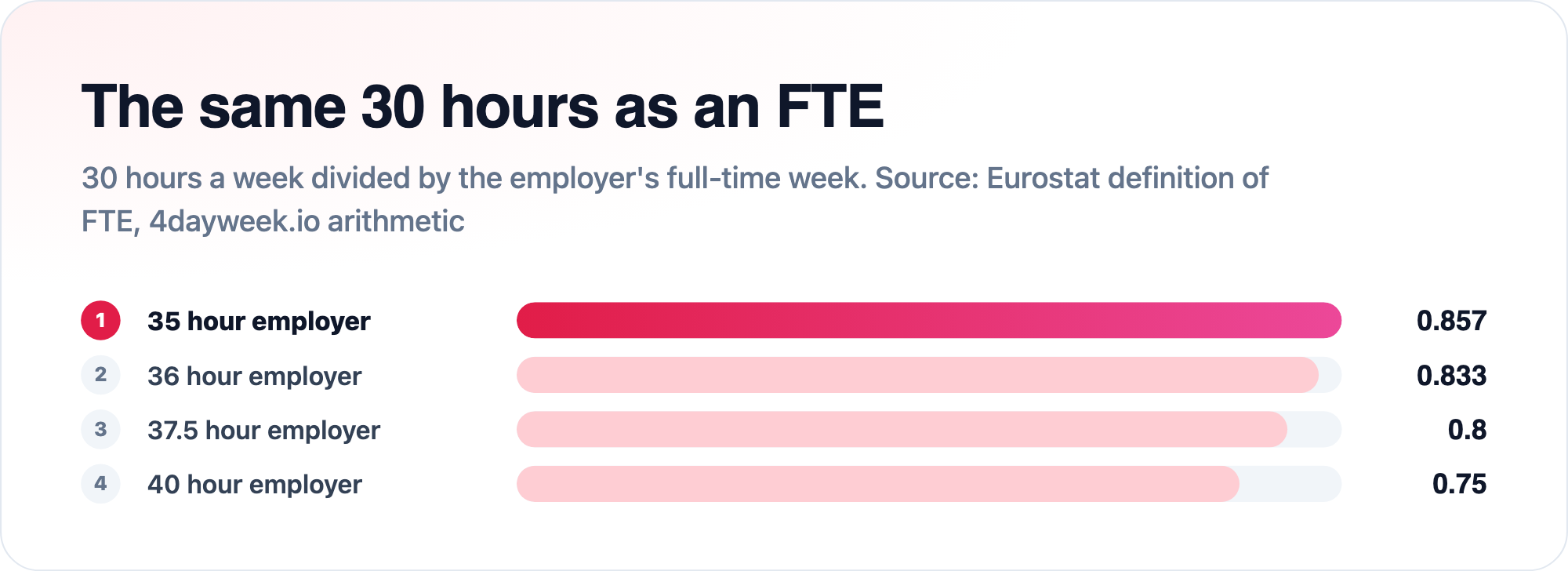
Divide the same 30 hours by four different full-time weeks and you get four different FTEs:
- 0.75 FTE where full-time is 40 hours (30 ÷ 40)
- 0.8 FTE where it is 37.5 hours (30 ÷ 37.5)
- 0.833 FTE where it is 36 hours (30 ÷ 36)
- 0.857 FTE where it is 35 hours (30 ÷ 35)
None of those is wrong. In a job, the full-time week you divide by is your employer's. The IRS counts below fix their own divisors.
What does your FTE mean for your pay?
Acas says "Benefits such as pay and leave are given pro rata for part-time employees and workers," and that "Pro rata means in proportion to hours worked." It measures that against a full-time comparator: "someone who works full time for the same employer and is on the same type of contract." Acas names the law as the Part-time Workers (Prevention of Less Favourable Treatment) Regulations 2000, which extend to England, Wales and Scotland.
GOV.UK says "Some benefits are applied 'pro rata' (in proportion to hours worked)." Its example is a bonus: if a full-time worker gets a £1,000 Christmas bonus and a part-time worker works half the number of hours, they should get £500.
For salary, FTE is the multiplier. Multiply a full-time salary by the FTE to get the pro rata figure:
- £50,000 full-time at 0.8 FTE: 50,000 × 0.8 = £40,000
- £42,000 full-time at 0.6 FTE: 42,000 × 0.6 = £25,200
- £30,000 full-time at 0.5 FTE: 30,000 × 0.5 = £15,000
For your own numbers, use our pro rata salary calculator. If you are weighing a move to fewer hours, see our guide to changing from full-time to part-time work.
Does FTE affect your holiday?
Acas lists leave alongside pay. It says both are given pro rata for part-time employees and workers, and that pro rata means in proportion to hours worked. Our guide to part-time holiday entitlement has the detail.
How do US employers use FTE?
The IRS uses FTE in at least two ways, and the counts differ. A US figure only makes sense once you know which rule it belongs to.
The ACA applicable large employer count
The IRS says that if an employer has "at least 50 full-time employees, including full-time equivalent employees," measured "on average during the prior year", it is an applicable large employer (ALE) for the current calendar year.
Non-full-time employees therefore count towards the 50 through their combined hours, not as one head each. For the FTE part, the employer combines the hours of service of all non-full-time employees for the month, counts no more than 120 hours for any one employee, and divides the total by 120. The IRS then has the employer add its total number of full-time employees for each month of the prior calendar year to the total number of full-time equivalent employees for each calendar month of the prior calendar year, and divide that total by 12.
Our arithmetic: 40 non-full-time employees each working 100 hours in a month give 40 × 100 = 4,000 hours, and 4,000 ÷ 120 = 33.3 FTEs that month.
Pro Rata Jobs
Save one to come back to it — it's free.


The small business health care tax credit count
This is a different count. The IRS instructions for Form 8941 (2025) include the line "You had fewer than 25 full-time equivalent employees (FTEs) for the tax year."
Here the hours basis is 2,080. Worksheet 2 line 2, "Hours of service per FTE", is 2,080, and the instructions say "Don't enter more than 2,080 hours for any employee." They also say to generally round the result down to the next lowest whole number, but "if the result is less than one, enter 1."
The wage test is also per FTE. For tax year 2025, the instructions say "You paid average annual wages for the tax year of less than $67,000 per FTE."
Our arithmetic, before the form's rounding: one employee's 1,040 hours in the year ÷ 2,080 = 0.5 FTE, and 2,080 hours is 1.0 FTE.
The two counts use different hours bases, 120 a month against 2,080 a year, so a figure from one cannot be read as the other. For who counts as full-time under the ACA, see our guide on how many hours you need to work per week to get health insurance.
Is a 4-day week 0.8 FTE?
It depends on what the employer counts as full-time.
| Employer's full-time week | Your week | FTE | What it is |
|---|---|---|---|
| 40 hours | 32 hours over 4 days | 0.8 | A 4-day week at 80% pay |
| 32 hours | 32 hours over 4 days | 1.0 | A 4-day week, pay not scaled down |
| 40 hours | 40 hours over 4 days (4x10) | 1.0 | A compressed week, not a 4-day week |
Where full-time is 40 hours, a 32 hour week is 0.8 FTE, and pro rata pay for it means 80%. Our Pro Rata Jobs page describes a 4-day week (80% pay) as one where "hours come down and pay scales with them."
Where the employer has moved its own full-time week to 32 hours, the same 32 hours is 1.0 FTE, so pay is not scaled down. That is the plain 4-day week, where pay is not reduced. The FTE number follows the employer's definition of full-time.
Watch the 4x10. Four ten hour days is 40 hours in 4 days, which is still 1.0 FTE where full-time is 40 hours. It is a compressed work week, not a 4-day week.
What should you ask about an FTE job advert?
When an advert says "pro rata" or "FTE", ask which hours the salary is for. GOV.UK describes pro rata as "in proportion to hours worked." For a part-time role, these questions are worth asking:
- What are the full-time hours here? That is the number that equals 1.0 FTE.
- Is the salary for the full-time week, or for the hours I would work?
- Does the contract state hours, FTE or both?
- How many hours a week is the role, and on which days?
- Is leave stated as a full-time figure to be scaled, or already scaled?
- If it is four days, is that 32 hours, or four long days adding up to 40?
Frequently asked questions
What does 1.0 FTE mean?
One full-time worker at that employer. Eurostat says a full-time person is counted as one FTE, so 1.0 FTE means working the employer's full-time hours, whatever number that is.
What does 0.8 FTE mean in hours?
80% of the employer's full-time hours: 32 hours where full-time is 40, and 30 where it is 37.5.
How do I add up FTE for a team?
Add each person's FTE. Ten people at 0.5 FTE each are 5.0 FTE. Three people at 1.0, two at 0.5 and one at 0.6 are 3 × 1.0 + 2 × 0.5 + 1 × 0.6 = 4.6 FTE.
Does 0.8 FTE mean 80% of the pay?
Where pay is pro rata, yes. Acas says pro rata means in proportion to hours worked. For example, a £50,000 full-time salary at 0.8 FTE is £40,000 (our arithmetic).
Is FTE counted the same way in every US rule?
No. The ACA applicable large employer count turns the combined monthly hours of non-full-time employees, capped at 120 for any one employee, into FTEs by dividing by 120. The small business health care tax credit count uses 2,080 hours. Name the rule whenever you quote a figure.
Looking for a 4-day week at 80% pay? Browse Pro Rata Jobs on 4dayweek.io.




Get 4-day week jobs in your inbox
Create a free account to receive curated opportunities weekly.
Sign up for freeFree forever. No spam, unsubscribe anytime.