
Your manager agreed you could work Tuesday to Thursday. You have done it for two years. Now a new head of department says everyone is back in five days from next month, and nobody seems to think your arrangement changes that.
It does. A flexible working arrangement that has been agreed and worked is normally a term of your contract, not a favour. Your employer cannot simply take it back. Removing it without your agreement is a variation of contract, and doing that unilaterally is a breach of contract.
(This is general guidance for the UK, not legal advice. For your own situation, check Acas and gov.uk.)
Can your employer take away flexible working you already have?
Not unilaterally, in most cases. When a request is accepted, the new pattern becomes a permanent change to your terms and conditions unless it was expressly agreed as something else. Changing a contractual term needs both sides to agree.
There are three situations where an employer can properly unwind an arrangement.
The first is your consent. If you agree to go back, that is a normal variation and it is lawful.
The second is a trial. If the arrangement was set up in writing as a temporary or trial period, it ends when the trial ends. This is why the wording at the start matters so much.
The third is a genuine flexibility clause. Some contracts reserve a right to change hours, location or duties. Acas says such a clause can only be used for reasonable changes, made with consultation and reasonable notice, or the employer may still be in breach of contract.
Outside those three, imposing a change is unlawful unilateral variation. The longer you have worked the pattern without complaint, the harder it becomes for an employer to argue it was never really part of your terms.
What if the arrangement was never put in writing?
It can still bind your employer. A contract can be varied by what people say and by what they do, not only by a letter from HR.
The clearest recent illustration is the case of Anna Owens, a receptionist at the Westville Hotel in Enniskillen. Before she started, the hotel agreed verbally that she could work a fixed three days, Tuesday to Thursday, around her childcare, and she worked that pattern for over a year and a half. Her signed contract said something else: 24 hours a week to a rota covering Monday to Sunday. Then a new general manager told her she would have to work a fully flexible seven-day rota, and when she explained why she could not, told her that her childcare was nothing to do with him.
The tribunal held that the spoken pattern formed part of her contract despite the written wording, and that imposing the change was a breach of contract. It also found indirect sex discrimination and unfair constructive dismissal, and awarded her almost £20,500. The judgment in Owens v Westville Hospitality Ltd (case 3870/24) was issued on 24 July 2026, and she was supported by the Equality Commission for Northern Ireland.
Owens rested on an actual agreement, even though it was only spoken. Where nothing was ever expressly agreed, Acas describes a weaker route, custom and practice. A practice can become contractual if it is reasonable, certain and "notorious", meaning generally well known, usually over a long period. But unlike an agreement, custom and practice cannot override what your written contract already says, so a manager's yes is worth far more than a habit.
So the practical advice is to create the paper trail now rather than after a dispute starts. Emails confirming the pattern, a rota that shows it, a manager's message approving it, or a payslip reflecting reduced hours all help. If you are about to ask for a change, our example email requesting flexible working hours gives you the wording to get the agreement recorded from the outset.
Do you have the right to ask in the first place?
Yes, from your first day. The Flexible Working (Amendment) Regulations 2023 removed the old 26 week qualifying period with effect from 6 April 2024. There is no longer any service requirement in Great Britain.
You can make two statutory requests in any rolling 12 month period, not two per calendar year. Your employer has two months to decide, including any appeal, unless you both agree to extend it. They also have to consult you before turning a request down.
A statutory request can cover:
- the days you work
- where you work
- the number of hours you work
- your start and finish times
One important caveat. Those 2023 Regulations state that they "extend to England and Wales and Scotland". Northern Ireland has not adopted them. In Northern Ireland you still need 26 weeks' continuous service, you can make only one application in any 12 months, and you must still explain the effect the change would have on your employer and how it could be dealt with. The timetable is different too: your employer holds a meeting within 28 days, gives a written decision within 14 days of that meeting, and you have 14 days to appeal. nidirect sets out the Northern Ireland position in full.
Can your employer refuse a flexible working request?
Only for one of eight statutory business reasons. They cannot refuse because they would prefer everyone in the office.
| Statutory ground | What it means in practice |
|---|---|
| Extra costs that will damage the business | The cost has to be real and material, not inconvenience |
| The work cannot be reorganised among other staff | They have looked at redistributing it and it does not work |
| People cannot be recruited to do the work | Genuine recruitment difficulty for the uncovered time |
| Quality will suffer | A concrete effect on output, not a general worry |
| Performance will suffer | Evidence rather than an assumption about home working |
| The business cannot meet customer demand | Coverage gaps at times customers actually need |
| Lack of work during your proposed hours | The hours you want are genuinely quiet |
| Planned changes to the workforce | A restructure that the change would cut across |
The bar rises in 2027. The Employment Rights Act 2025 adds a requirement that an employer may refuse only where it is reasonable to consider that one of these grounds applies, and that it must explain why the refusal is reasonable. Acas and the government both place this at autumn 2027, so it is not yet in force.
How many days a week do UK employers now want you in?
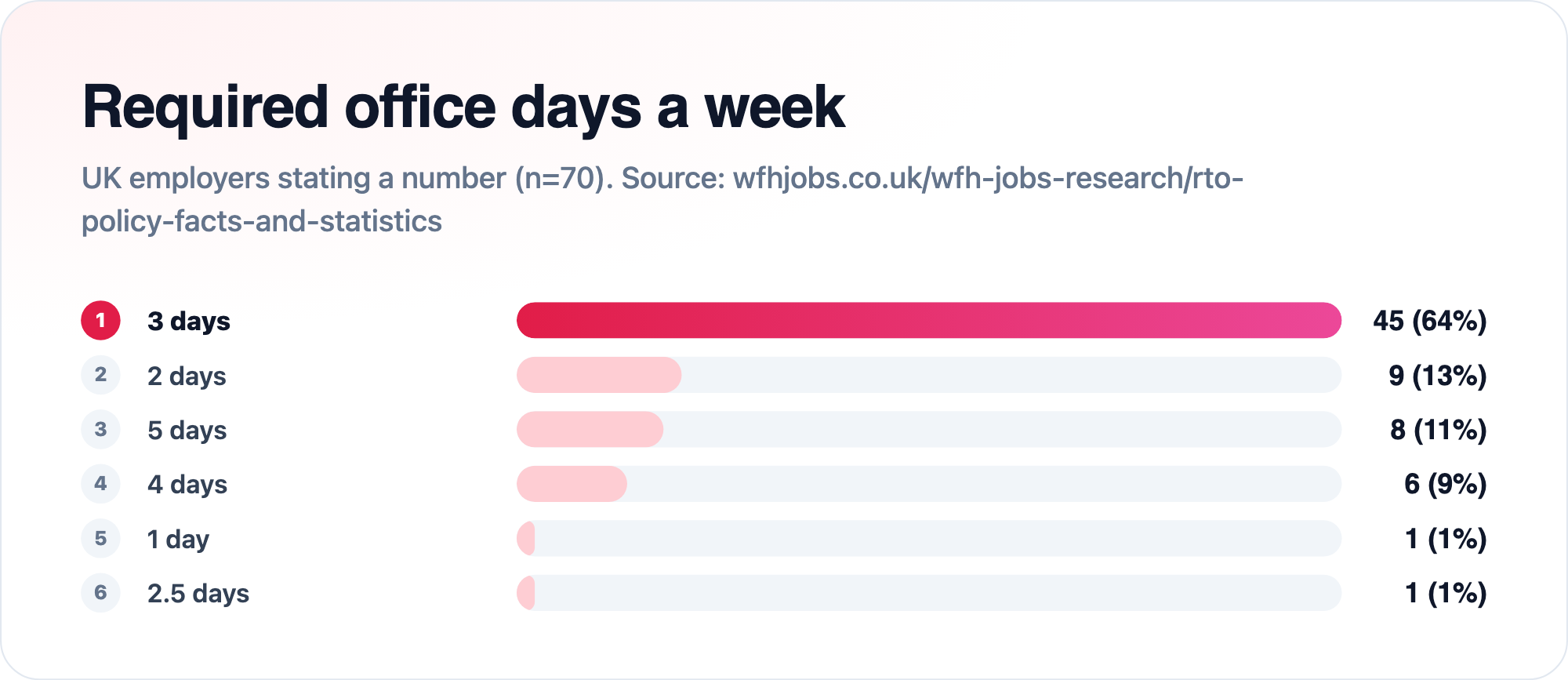 The backdrop is the return to office push. Research by WFH Jobs tracks the stated office policies of 100 of the UK's largest employers, 70 of which specify a number of office days.
Three days a week is the norm, chosen by 45 of those 70 employers, or 64%. A full five days is required by 8 of them, or 11%. Two days accounts for 9 employers, four days for 6, and a single day for just 1.
Read that as a picture of employers who announce policies rather than of the whole UK labour market. The researchers are explicit that large, London headquartered and financial services employers publicise their policies far more often and are over-represented in the sample.
As for why, employers cite collaboration, culture and training for early career staff. There is at least some evidence of a less flattering motive. A BambooHR survey of 1,504 full time salaried desk workers in the United States, fielded in March 2024, found that 25% of VP and C-suite executives admitted they had hoped for some voluntary turnover during a return to office. That is a US sample and a survey of attitudes, so treat it as a signal rather than proof. We look at the wider evidence in our guide to the return to office debate.
Which sectors are pushing hardest?
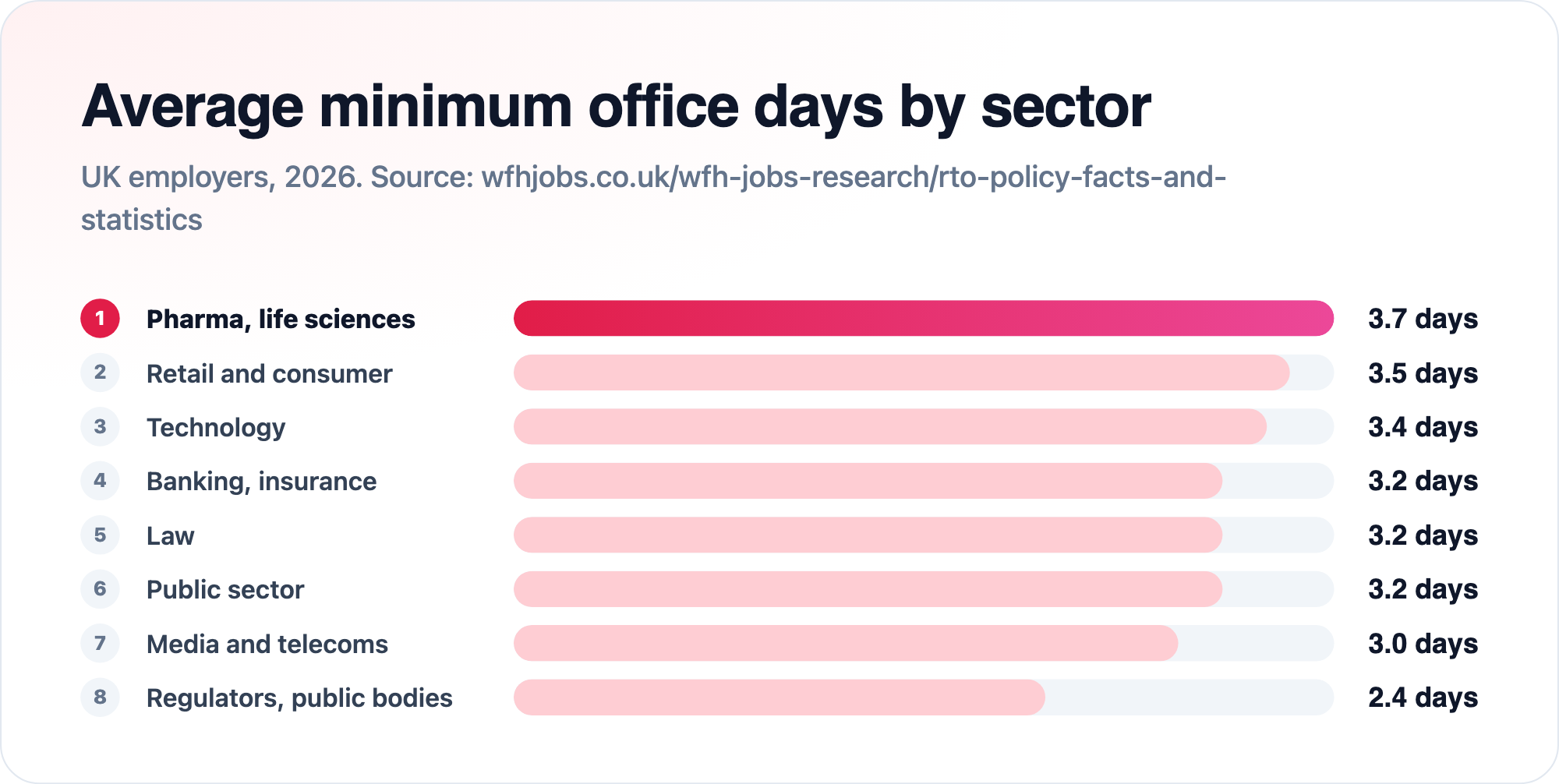 Pharmaceuticals and life sciences top the table at an average minimum of 3.7 office days a week, followed by retail and consumer at 3.5 and technology at 3.4. Banking and insurance, law and the public sector all sit at 3.2.
The most relaxed group is regulators and public bodies at 2.4 days, with media and telecoms next at 3.0. If your employer is in a sector near the top of that list, an arrangement that relies on goodwill rather than a contract is more exposed than most.
Are any employers still remote first?
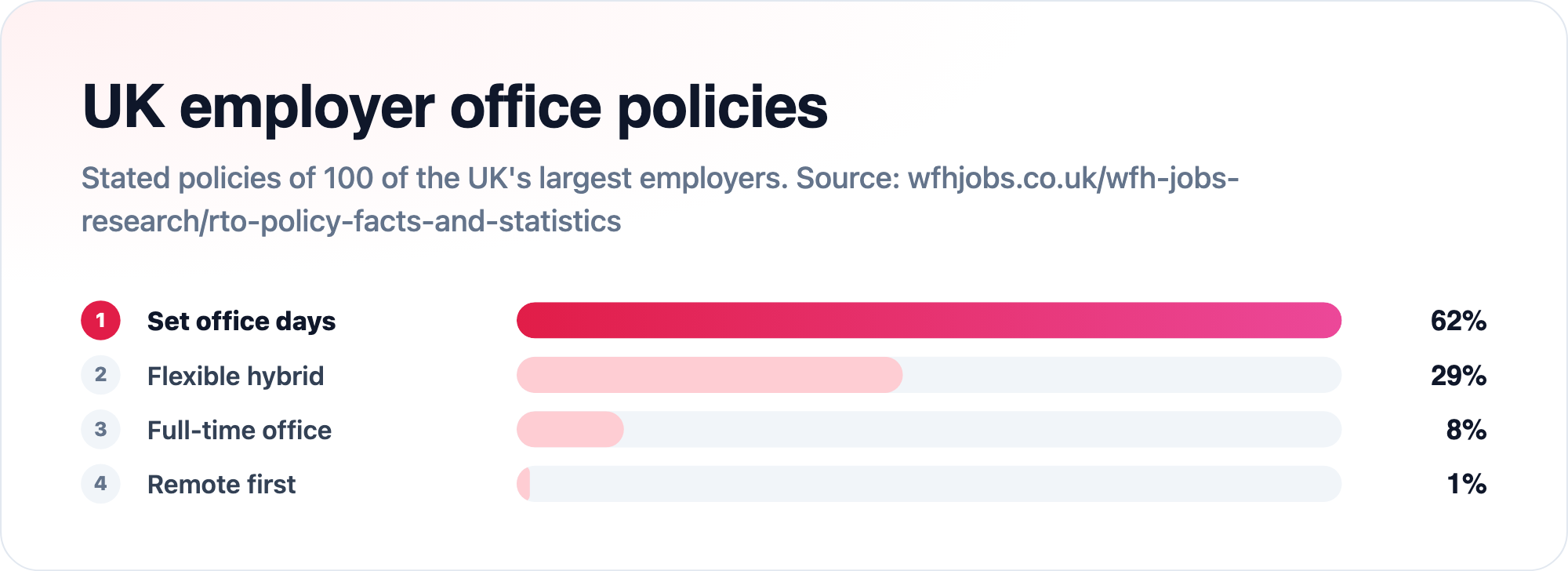 Very few. Of the 100 employers tracked, 62% have a policy of set office days and 29% publish a hybrid policy with no stated number of days. A further 8% require full time office attendance, and just 1% are remote first.
Flexible Hours Jobs
Save one to come back to it — it's free.


A hybrid policy without a fixed number of days leaves more room for your own arrangement. A move to set office days can collide with a pattern you already have.
When does withdrawing flexible working become discrimination?
Pulling an arrangement can be discriminatory even where the employer applies the same rule to everybody, because a blanket rule can hit some groups harder than others. In Great Britain that is indirect discrimination under section 19 of the Equality Act 2010. Northern Ireland has its own equivalent in the Sex Discrimination (Northern Ireland) Order 1976, and it is what the Owens tribunal found: a fully flexible seven-day rota put women, who still carry more of the childcare, at a particular disadvantage, and the hotel failed to justify it.
Two legal routes are easy to confuse. A duty to make reasonable adjustments is specific to disability, under section 20. A request tied to religion or belief is not a reasonable adjustments case; it runs as indirect discrimination under section 19.
Pregnancy and maternity cases sit alongside this. Murron Stewart, an estate agent, went part time after maternity leave and found her targets were not adjusted to reflect her reduced hours. A tribunal held she had been constructively and unfairly dismissed and discriminated against, and awarded her more than £47,000.
There is a practical reason these cases are argued as discrimination. Compensation for mishandling a flexible working request itself is capped at eight weeks' pay, and with a week's pay capped at £751 from 6 April 2026 that ceiling is £6,008. Discrimination awards are not capped, and they include injury to feelings.
What to do if it happens to you
Move quickly and in writing.
Start with a factual timeline to your manager and HR: what you asked for, when it was agreed, who agreed it, and how long you have worked that way. Say that you understood it to be a permanent contractual change, and ask them to confirm that or set out the legal basis for withdrawing it.
If they impose the change anyway, say clearly and in writing that you are working under protest. Acas is blunt about why this matters: if you carry on under the new terms without objecting in writing, your conduct can count as accepting the change. The easily missed detail is that a single email is not enough. Acas advises repeating the objection regularly while the dispute continues, and treating working under protest as a short term position while you resolve things or take legal action.
Raise a formal grievance next. You do not have to grieve before making a tribunal claim, but a tribunal can adjust compensation by up to 25% where a party unreasonably fails to follow the Acas Code. That adjustment applies to claims such as unfair dismissal and discrimination rather than to a flexible working complaint itself, which is another reason the discrimination route matters.
Then contact Acas for early conciliation, which you must do before lodging most tribunal claims.
Watch the clock, because it is changing. The current limit for most claims is three months less one day from the act you are complaining about. From 1 October 2026 that becomes six months, but only where the act or failure happens on or after that date. A withdrawal that lands in September 2026 keeps the three month clock even if you claim in November. Acas notes one further wrinkle: for breach of contract claims in Scotland the change happens on 9 November 2026.
How to spot an employer that will not claw it back
Flexibility that depends on one sympathetic manager is flexibility with an expiry date. The durable kind shows up in two places.
The first is measurement. Ask how performance is judged. An employer that talks about deliverables, goals and outcomes can absorb people working different patterns. One that talks about visibility, presence and being around for the team is measuring a proxy, and a proxy is what gets tightened the moment the mood changes.
The second is paperwork. Ask whether flexible arrangements are recorded as contractual variations or held as informal understandings, and whether the contract contains a flexibility clause. The answer tells you how much the promise is worth.
If you would rather start somewhere the arrangement is the job rather than a concession, browse flexible hours jobs, part time jobs or roles on a 9-day fortnight. For home based roles specifically, WFH Jobs lists UK work from home vacancies.
Frequently asked questions
Can my employer change my working hours without my agreement?
Not if the hours are a contractual term, which they usually are. They can do so where you consent, where the arrangement was a written trial, or where a genuine flexibility clause applies and is used reasonably. Otherwise it is a breach of contract.
Does a verbal flexible working agreement count?
Yes. A contract can be varied by what was said and by conduct. In the Owens case the spoken pattern held even though her written contract said Monday to Sunday. It is harder to prove than a written variation, so gather emails, rotas and payslips that show the pattern in practice.
How long does my employer have to answer a flexible working request?
Two months in Great Britain, including any appeal, unless you agree to extend. In Northern Ireland the employer holds a meeting within 28 days and gives a written decision within 14 days of it.
What if I already went back to the office before objecting?
Say so in writing as soon as you can and state that you are working under protest. The longer you work the new pattern without objecting, the stronger your employer's argument that you accepted the change, so do not leave it and do not rely on a single email.
Looking for a role where flexibility is built in rather than granted? Browse flexible hours jobs on 4dayweek.io.




Get 4-day week jobs in your inbox
Create a free account to receive curated opportunities weekly.
Sign up for freeFree forever. No spam, unsubscribe anytime.