
In Great Britain, GOV.UK says part-time workers who work regular hours for the whole year are entitled to at least 5.6 weeks' paid holiday. Acas says to multiply the days you work each week by 5.6. That is 16.8 days for a 3 day week and 22.4 days for a 4 day week.
(General information, not legal or tax advice. Great Britain rules unless a sentence says otherwise; Northern Ireland has its own rules, covered only where stated.)
How much holiday do part-time workers get?
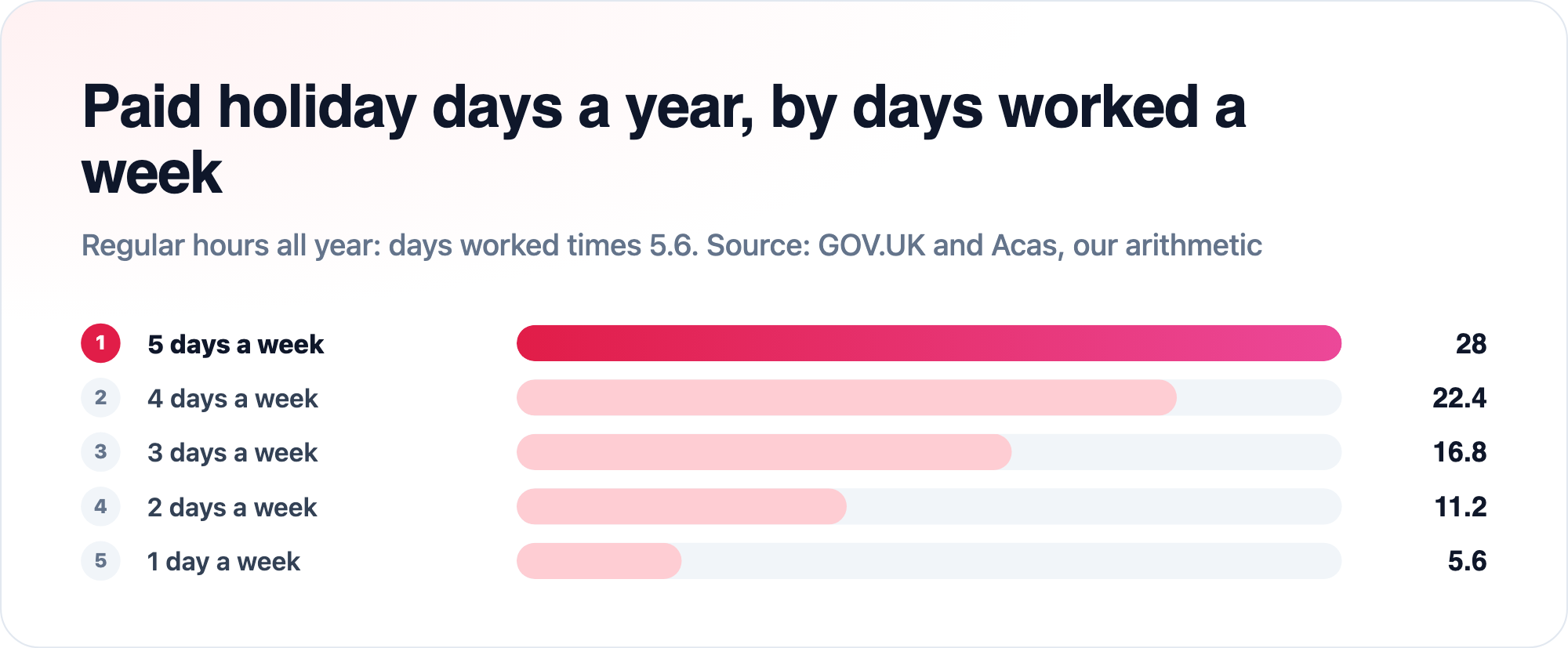 Acas says pro rata means in proportion to hours worked, and that leave is given pro rata for part-time employees and workers.
The yardstick is 5.6 weeks. GOV.UK says almost all people classed as workers are legally entitled to 5.6 weeks' paid holiday a year. GOV.UK adds that most workers on a 5-day week must receive at least 28 days.
There is a cap. Acas says statutory paid holiday is limited to 28 days, whatever the number of days a week someone works. GOV.UK's example is staff working 6 days a week, who are only entitled to 28 days. Acas also says that if an employer gives full-time workers more paid holiday than the legal minimum, they must give part-time workers more than the legal minimum.
| Days you work a week | Statutory minimum paid holiday a year, regular hours all year |
|---|---|
| 1 | 5.6 days |
| 2 | 11.2 days |
| 2.5 | 14.0 days |
| 3 | 16.8 days |
| 3.5 | 19.6 days |
| 4 | 22.4 days |
| 4.5 | 25.2 days |
| 5 | 28.0 days |
| 6 | 33.6 days, capped at 28 |
The table is our arithmetic: days a week multiplied by 5.6, the method Acas and GOV.UK print for a 3 day week, with the 28 day cap for Great Britain.
How do you work out part-time holiday in days and hours?
In days, use the table above.
In hours, GOV.UK's reforms guidance gives a worked example. Irene works a total of 30 hours over 4 days a week, 9 hours on Monday and Wednesday and 6 hours on Tuesday and Thursday. Her statutory entitlement in days is the lower of 28 days or 5.6 x 4 days, which is 22.4 days. Her average working day is 30 hours divided by 4 days, or 7.5 hours. So her statutory holiday for a full leave year is 22.4 days x 7.5 hours, which is 168.0 hours. GOV.UK adds that, depending on which days she takes off as leave, it will either be 6 hours or 9 hours from her total entitlement.
There is a shortcut, and it is our arithmetic rather than a GOV.UK figure: for regular hours spread over 5 days a week or fewer, weekly hours multiplied by 5.6 gives the hours of leave a year. For Irene, 30 x 5.6 is the same 168 hours. Over more than 5 days a week the 28 day cap applies first, so use GOV.UK's method above instead.
If a job advert gives a part-time role as an FTE figure, our guide to what FTE means explains it.
Do part-time workers get bank holidays?
Not necessarily. GOV.UK says bank or public holidays do not have to be given as paid leave, and that an employer can choose to include bank holidays as part of a worker's statutory annual leave. Acas says an employer can include bank holidays in the statutory 5.6 weeks, and that this is the same for full-time and part-time workers.
So your 5.6 weeks may already include them. Acas adds that some employers might give bank holidays in addition to the statutory minimum, and that you should check your contract to find out if bank holidays are included in your statutory holiday. When extra bank holidays are announced, Acas says whether you get the extra days off depends on your contract.
The awkward case is a bank holiday on a day you do not usually work. Acas says the employer cannot make you use that day as part of your holiday entitlement. Acas says employers can make workers take a bank holiday as part of their holiday entitlement if:
- the bank holiday falls on a day they usually work
- the workplace is shut or business stops on that day
Acas adds that the employer must either make this clear in the employment contract or give the workers notice that the day needs to be taken as part of their holiday entitlement.
In Acas's own example, Ali works 3 days a week, including Mondays, and Jo works 3 days a week but not Mondays. They both get the statutory 5.6 weeks, which includes bank holidays, and 16.8 days' holiday per year, and their employer closes the business on bank holidays. As more bank holidays fall on a Monday, Ali has to use more of their holiday entitlement for bank holidays than Jo.
For Northern Ireland, nidirect says the statutory minimum is 5.6 weeks, which can include bank and public holidays, and that you do not have a statutory right to paid leave on them. It adds that if you are part-time and your employer gives workers additional time off on bank holidays, this should be given pro rata to you as well, even if the bank holiday does not fall on your usual work day. We did not find that wording on the GOV.UK or Acas pages, so it is a Northern Ireland statement.
What happens if you start, leave or change your hours part way through the year?
Starting. For regular-hours workers in the first year of a job, GOV.UK says an employer can use an accrual system: a worker gets one-twelfth of their leave in each month. If a worker starts part way through the month, they can accrue one-twelfth of their leave from their first day, or GOV.UK says the employer can choose to calculate the first month's leave pro rata instead. Acas says employers must round up part days to the nearest half day in the first year, and cannot round down.
Our arithmetic for a 3 day week is 16.8 divided by 12, or 1.4 days a month, and for a 4 day week 22.4 divided by 12, or 1.87 days a month. Those figures are before rounding up to the nearest half day.
Leaving. GOV.UK says a worker may be able to take whatever is left of their statutory leave in their notice period, and that how much they get depends on how much of the leave year has passed or how much leave they have accrued.
Changing hours. Acas says that when a worker changes from full-time to part-time hours with the same employer, their holiday entitlement should be recalculated from the date the change happens, and the change does not affect any holiday accrued up to that date. Its example is Pat, who reduces from 40 hours a week to 20 hours a week 3 months into the holiday year, having taken no holiday. Pat's entitlement should still be calculated on 3 months at 40 hours and 9 months at 20 hours.
If you are asking to reduce your hours, see our guide to changing from full-time to part-time work. If your employer wants to change your days or hours against your wishes, read can my employer withdraw flexible working.
What about irregular hours and part-year workers?
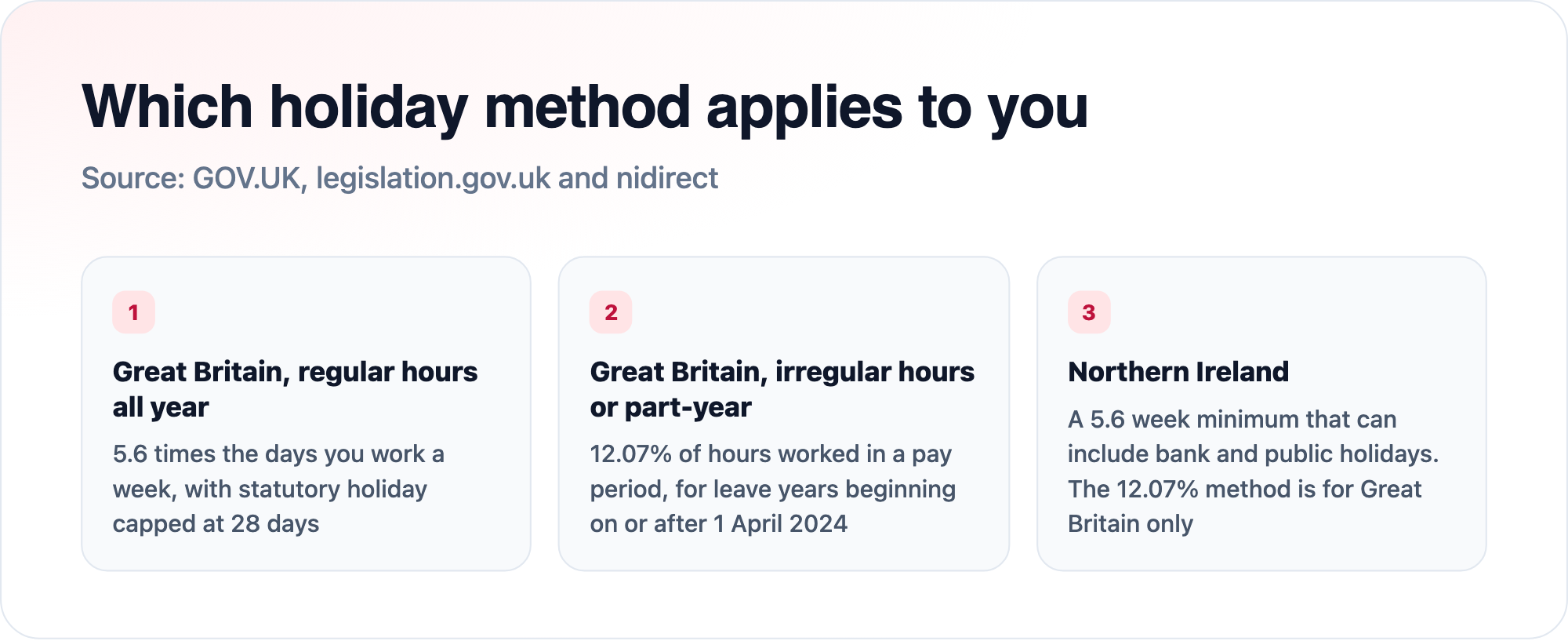 This is where 12.07% comes in. It is not the rule for part-timers who work regular hours all year. GOV.UK says people working irregular hours or part of the year are entitled to up to 5.6 weeks' statutory leave. For leave years beginning on or after 1 April 2024, GOV.UK says holiday entitlement for these workers is calculated as 12.07% of actual hours worked in a pay period.
It is a Great Britain rule only. Regulation 15B (the 12.07% rate) and regulation 15F (who counts) of the Working Time Regulations 1998 extend to England, Wales and Scotland, not Northern Ireland.
Regulation 15F defines who counts. An irregular hours worker is one whose paid hours in each pay period are, under the contract, "wholly or mostly variable". A part-year worker is one whose contract requires work in only part of the year, with periods of at least a week, within the term of the contract, that they are not required to work and are not paid for.
A part-timer with regular hours who works all year is not in this group. GOV.UK's reforms guidance says that for workers who are not irregular-hours or part-year workers, there is no change in how their statutory holiday entitlement is accrued. If your hours are regular and you work all year round, use 5.6 times the days you work.
Pro Rata Jobs
Save one to come back to it — it's free.


GOV.UK and Acas both say a part-year worker can have fixed hours, and Acas adds that the contract must be in place all year around, including when they are not working. Neither names term-time staff, so this next step is our reading of regulation 15F: a term-time-only worker whose contract meets those conditions is a part-year worker and sits in the 12.07% group. GOV.UK says the test is payment "for" the period, not "during" it, so how pay is spread across the year may matter.
Regulation 15B also says a worker cannot accrue more than 28 days of annual leave in a leave year under it.
Did anything change in 2026?
Two 2026 changes concern holiday records and enforcement. Neither changes the amount of holiday.
Section 35 of the Employment Rights Act 2025 adds a duty to keep records relating to annual leave. It requires records to be retained for six years from the date on which they were made, and has been in force since 6 April 2026, according to legislation.gov.uk.
The Fair Work Agency launched on 7 April 2026. Business.gov.uk says holiday pay enforcement will not start before April 2027. Until the FWA starts enforcing holiday pay and statutory sick pay, it says to contact Acas with a concern about these rights.
How much holiday do you get on a 4-day week?
In Great Britain, a 4-day week with regular hours all year gives 22.4 days of statutory holiday: 4 x 5.6, the figure in the GOV.UK example for Irene above.
Pay does not change the count. This is our reading of the 5.6 weeks rule, not a GOV.UK statement: a 4-day week at full pay, meaning no pay cut, and a pro rata 4-day week at 80% pay both give 22.4 days for a full year on regular hours, because the entitlement is 5.6 times the days worked.
For the pay sums, use our pro rata salary calculator. For the schedule itself, see our guides to the 4-day work week, part-time work and PTO.
Where can you check your number?
Start with the GOV.UK holiday entitlement calculator, which also covers irregular hours and part-year work. Then read your contract, which governs any extra bank holidays. See also Acas on checking holiday entitlement. In Northern Ireland, see nidirect on holiday entitlements.
Frequently asked questions
How many days' holiday do I get if I work 3 days a week?
If you work regular hours all year, at least 16.8 days a year in Great Britain: 3 x 5.6, according to GOV.UK and Acas. If your employer counts bank holidays within your statutory leave, they form part of the 16.8 days.
Does the 12.07% rule apply to me as a part-timer?
Not if you work regular hours all year round. In Great Britain it is for irregular-hours and part-year workers, with leave years beginning on or after 1 April 2024, according to GOV.UK and legislation.gov.uk. On our reading of regulation 15F, that can include term-time-only staff whose contract stays in place through the weeks they are not required to work and are not paid for.
Is part-time holiday different in Northern Ireland?
For regular part-time hours nidirect prints the same method: a 5.6 week minimum, which can include bank and public holidays, with 11.2 days a year as its example for 2 days a week. The 12.07% legislation covers England, Wales and Scotland only. For casual or irregular hours (like term-time workers), nidirect says only that you are entitled to paid time off for every hour you work, and its page gives no percentage.
Do I lose holiday if I go from five days to four?
A full year on four days with regular hours gives 22.4 days instead of 28. If you move from full-time to part-time hours with the same employer part way through a year, Acas says the change does not affect any holiday accrued up to the date of the change, and that entitlement should be recalculated from that date.
Can I be paid instead of taking my holiday?
GOV.UK says the only time someone can get paid in place of taking statutory leave is when they leave their job.
Looking for a 4-day week at 80% pay? Browse pro rata jobs on 4dayweek.io.




Get 4-day week jobs in your inbox
Create a free account to receive curated opportunities weekly.
Sign up for freeFree forever. No spam, unsubscribe anytime.