
In March 2026, the Philippines moved every national government agency to a four day onsite week. Days later, Sri Lanka declared Wednesdays public holidays across its public sector. Headlines framed both as governments "switching to the 4-day week." Look closer and neither scheme cut a single scheduled working hour for most staff. One squeezed the same 40 hours into four longer days. The other shut offices to save fuel.
Here is the crisp difference. A 4x10 compresses the same 40 hours into four 10-hour days: same pay, same workload, longer days. A genuine 4-day week reduces the schedule to 32 to 36 hours at full pay, the 100-80-100 model: 100% pay, 80% time, 100% output.
That one distinction decides whether your Friday off is a genuine gift of time or a loan you repay Monday through Thursday.
Is a 4x10 a 4-day work week?
It depends what you mean, and the honest answer has two halves.
If "4-day week" simply means "four days at the desk", then yes. On a 4x10 you work Monday to Thursday (or any four days) and take the fifth off, every week. For plenty of people that standing day off has real value, and nothing in this article argues otherwise.
If it means what the research, the international trials, and the wider movement mean by it, then no. A 4x10 changes when you work, not how much. The 40 hours survive intact; they just arrive in bigger portions. Call it schedule redistribution. A genuine 4-day week is work-time reduction: the load itself shrinks, and pay does not.
Both models have their own full guides, so a quick recap is all that belongs here. A compressed work week takes a full-time load, usually 40 hours, and fits it into fewer, longer days, with the 4x10 (four 10-hour days) as the classic format; our compressed work week guide covers the variants, the trade-offs, and how to request one. A genuine 4-day week cuts the schedule to 36 hours or less, usually 32, with salary held at 100%; our 4-day work week guide explains how companies make the economics work.
Strip away the branding and the two deals are different at the core. In one, you trade longer days for a day off. In the other, your employer bets that a focused 32-hour week can deliver what a sprawling 40-hour week did, and pays you as if nothing changed.
How do a 4x10 and a genuine 4-day week compare side by side?
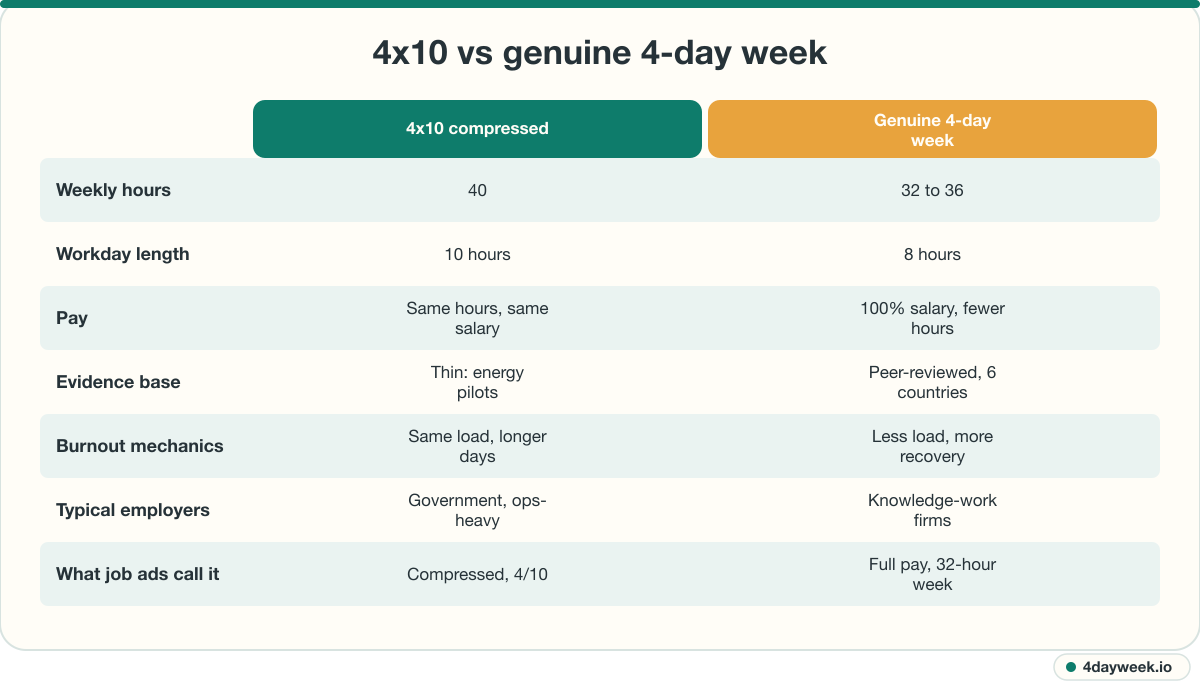 The table below puts the two schedules next to each other on the dimensions that matter when you are weighing a job offer.
| Dimension | 4x10 compressed week | Genuine 4-day week |
|---|---|---|
| Weekly hours | 40 | 32 to 36, usually 32 |
| Length of a workday | 10 hours | 8 hours |
| Pay | Unchanged: same hours, same salary | 100% of salary for reduced hours (full pay) |
| Evidence base | Thin and mixed, mostly government energy pilots | Peer-reviewed trial data across six countries |
| Burnout mechanics | Same load concentrated into longer days; fatigue builds late in the day | Total load drops; recovery time grows |
| Who typically offers it | Government bodies and operations-heavy employers | Output-focused knowledge-work companies |
| What job ads call it | "Compressed workweek", "4/10 schedule", sometimes loosely "4-day week" | "4-day week at full pay", "32-hour week", "100-80-100" |
Two rows deserve a second look. On pay, note that neither schedule touches your salary, but only one changes the underlying deal: holding pay at 100% while cutting hours by 20% makes every working hour worth more, while a 4x10 leaves the exchange rate exactly where it was.
On burnout, the mechanics point in opposite directions. Compressing the week concentrates effort into days long enough that the free day partly becomes recovery. Reducing the week removes effort altogether, which is why the research keeps finding lower fatigue rather than displaced fatigue.
What did the research actually test?
When people cite "the evidence" for the 4-day week, they usually mean one flagship study: Fan, Schor, Kelly and colleagues, published in Nature Human Behaviour (volume 9, pages 2153 to 2168, 2025). It tracked 2,896 employees across 141 organizations in six countries (the US, UK, Canada, Ireland, New Zealand and Australia) through six-month trials of an income-preserving 4-day week: hours reduced, pay maintained.
The headline results were strong. Burnout fell from 2.83 to 2.38 on a 1-to-5 scale. Job satisfaction rose from 7.07 to 7.59 out of 10. The mechanisms the authors identified were improved work ability, reduced fatigue, and fewer sleep problems.
Read that mechanism list again. Every item runs through working less. The trials tested hour reduction, and only hour reduction; the study says nothing about compressed schedules, in either direction. Anyone waving it at a 4x10 proposal is borrowing evidence the schedule has not earned.
Fairness cuts both ways, though. The study is not proof against 4x10s either. The evidence base for compression is simply thinner and more mixed, resting largely on government pilots run to save energy rather than to improve working lives. The clearest of those is worth meeting properly, because 2026 just reran it at national scale.
Why do the 2026 government "4-day weeks" not count?
Start with the Philippines. President Marcos's Memorandum Circular 114, effective March 9, 2026, placed all national government agencies and government-owned corporations on a four day onsite arrangement, delivered either as a compressed workweek or as one designated work-from-home day, targeting cuts of 10 to 20% in electricity and fuel use amid the Middle East conflict, and running "until lifted" (GMA News). The Civil Service Commission's clarifying guidelines, announced on July 16, 2026 by Chairman Marilyn Yap and applied retroactively to March 6, let each agency set its daily hours and its day off "provided employees still complete 40 hours a week"; an employee who takes the fifth day off anyway is docked 1.25 leave credits (Manila Times). That is a 4x10 in all but name: 40 hours, four days, no reduction.
Sri Lanka went further and stopped pretending it was a work schedule at all. In March 2026, President Anura Dissanayake ordered a public-sector 4-day week with Wednesdays declared public holidays, effective immediately, covering government agencies and educational institutions while exempting hospitals, ports and emergency services; officials cited roughly six weeks of fuel reserves remaining (Seoul Economic Daily, March 17, 2026). That is a crisis shutdown with a rebranded name, not a 100-80-100 policy anyone chose for its own sake.
Governments have blurred this line before. In 2008, Utah moved state employees to a Monday-to-Thursday 4x10 under Governor Huntsman's Working 4 Utah initiative, also to save energy (Utah Office of Administrative Rules). A 2010 legislative audit found the projected 3 million dollars in utility savings amounted to just over 500,000, helped along by falling energy prices (KSL.com), and H.B. 328 plus a directive from Governor Herbert returned the state to five 8-hour days in September 2011. Belgium's 2022 Labour Deal, still routinely headlined as a "4-day week law", in fact grants employees only the right to request their existing full-time week, in principle 38 hours, compressed into four days of roughly 9.5 hours, a request employers can refuse with written justification (L&E Global).
The pattern repeats across two decades: when a government announces a 4-day week, the calendar changes and the hours do not. None of these schemes tested, or even attempted, the reduced-hours model the trial evidence supports.
How can you tell which one a job is offering?
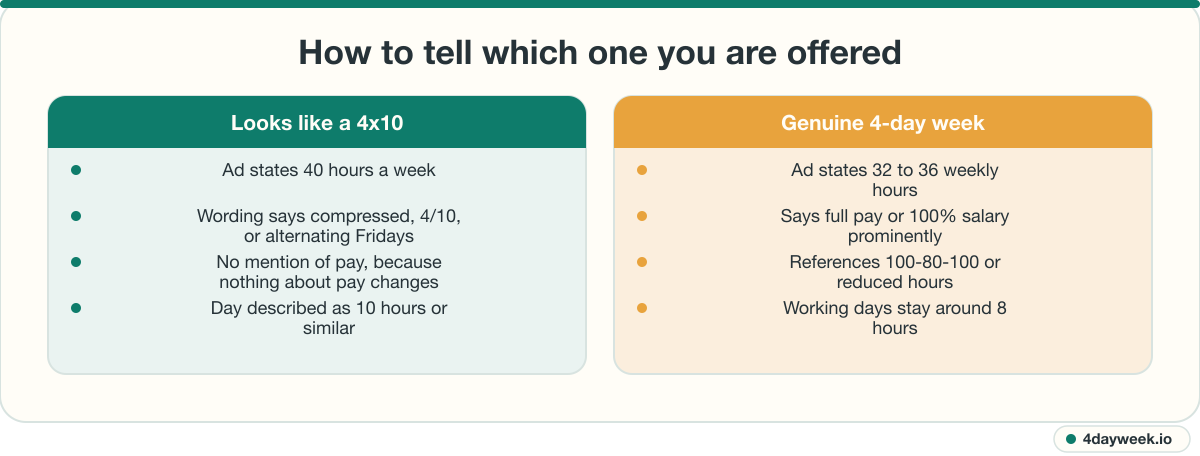 Job ads rarely announce "this is a compressed schedule, your days will be long." You have to read for it. Five checks settle it quickly:
Work-Life Balance Jobs with Genuinely Reduced Hours
Save one to come back to it — it's free.

- Find the total weekly hours. This is the single decisive number. 40 hours across four days is a 4x10. 32 to 36 hours is a genuine reduction. If the ad never states weekly hours, treat that silence as a question for the first interview.
- Read the salary language. Employers offering a real 4-day week tend to say "full pay" or "100% salary" prominently, because it is their strongest selling point. Compressed-schedule ads usually say nothing about pay, because nothing about pay changes.
- Watch the schedule wording. "Compressed", "4/10", "4x10", or "alternating Fridays" all signal redistribution, not reduction.
- Ask one question in the interview. "How many hours does a typical week add up to?" is polite, unambiguous, and impossible to answer with branding.
- Check how the listing is tagged. On 4dayweek.io, every listing carries a schedule-type tag, and compressed weeks are labeled as compressed, never counted as 4-day weeks.
Which one should you choose?
If a 4x10 fits your life, take it without apology. Its advantages are real. There is no pay conversation to win, because your salary is untouched. A standing weekday off is genuinely useful for appointments, childcare handovers, side projects, or simply not being at work. You cut commuting by one round trip a week. And compressed roles are far easier to find, since any employer can offer one without changing its economics.
The costs are equally real, and worth naming. Ten-hour days swallow both ends of the day: an 8am start with a 6:30pm finish is incompatible with most school pickups on every working day, four days out of four. Fatigue concentrates, so the free day is partly spent recovering from the other four. And the wellbeing case is unproven: Utah's audit called the productivity results inconclusive, even though 82% of surveyed employees reported equal or better productivity (KSL.com).
The genuine 4-day week offers the opposite bargain. The hours actually fall, the working days stay a normal length, so daily routines survive, and of the two schedules it is the one backed by the peer-reviewed trial results above. Its main cost is scarcity. 4dayweek.io currently tracks 737 companies with genuine 4-day week policies of 36 hours or less, 666 of them at full pay (4dayweek.io platform data, July 2026). Demand dwarfs that supply: genuine 4-day-week jobs drew 5.1 apply clicks per vacancy over a 60-day window, against 0.42 for 5-day flexibility-perk roles, roughly 12 times as many (n = 1,102 vs 16,773 live jobs). We dig into that gap in our demand vs supply analysis.
So the practical answer: chase the genuine 4-day week if reduced hours are the point, and treat a 4x10 as a legitimate consolation prize, not the destination. Just walk in knowing which deal you signed.
Frequently asked questions
Do you earn less on a 4x10 schedule?
No. A 4x10 keeps you at 40 hours, so your salary is unchanged in both directions: no cut, and no premium. Only the genuine 4-day week changes the underlying deal, holding salary at 100% while removing hours, which is why the phrase "full pay" belongs to that model and not to compressed schedules.
Is the 100-80-100 model the same as a compressed week?
No. 100-80-100, popularized by 4 Day Week Global, the organization that ran the international trials, means 100% pay for 80% of the time in exchange for a commitment to 100% of the output. A compressed week is 100% pay for 100% of the time in longer blocks, so nothing in the deal actually changes.
Are the 2026 Philippine and Sri Lankan schemes permanent 4-day weeks?
No. Both are energy-crisis measures. The Philippine arrangement under Memorandum Circular 114 runs "until lifted" and still requires 40 hours a week (GMA News; Manila Times). Sri Lanka's Wednesday holidays were ordered to conserve fuel during a shortage (Seoul Economic Daily). Neither reduces weekly hours as policy.
Is a 9/80 schedule a 4-day week?
No. A 9/80 spreads 80 hours over nine days across two weeks, buying every other Friday off with longer days: compression again, not reduction. The genuine 9-day fortnight cuts hours instead. Our 9-day fortnight guide covers both formats and the difference between them.
Ready to look for the version where the hours actually drop? Browse live 4-day week jobs, each one tagged by schedule type, so you can see at a glance whether a role is a 32-hour week or a compressed 40.
Four days is the headline; the hours are the deal.




Get 4-day week jobs in your inbox
Create a free account to receive curated opportunities weekly.
Sign up for freeFree forever. No spam, unsubscribe anytime.