
The offer lands in your inbox and your first instinct is to accept it on the spot, out of relief and a quiet fear that asking for more will make the whole thing vanish. That instinct costs people real money. The number in that email is an opening position, and opening positions exist to be tested.
This guide is about negotiating the salary of a new role, the moment you have an offer or are about to get one. If instead you want to raise your pay in the job you already have, that is a separate process, and our guide to asking for a raise is the one you want.
To negotiate a job offer, research your market rate first, let the employer name a number where you can, then counter with a specific, evidence-backed range. Negotiate the whole package, including base, bonus, title and time, and put your ask in writing, warmly and briefly.
Should I even negotiate a job offer?
Almost always, yes. Employers expect it, and many build room into the first number precisely because they assume you will push back. Declining to negotiate does not read as easygoing; it just leaves money on the table that was quietly set aside for you.
The fear that stops people is that a counter will make the offer disappear. In practice, a polite, reasonable counter almost never causes a company to withdraw a genuine offer. They have invested hours choosing you over other candidates, and rescinding over a courteous ask would waste all of that and make them look unstable. If an employer reacts to a respectful negotiation by pulling the offer or turning cold, that is not a salary signal, it is a culture signal, and a useful one to get before you sign.
There is a compounding reason to bother, too. Your next raise, bonus and pension contributions are often calculated from your starting salary, so a few thousand added now quietly lifts everything that follows for years. This is one of the highest-value conversations in your working life, and it usually lasts about ten minutes.
How do I work out my market rate?
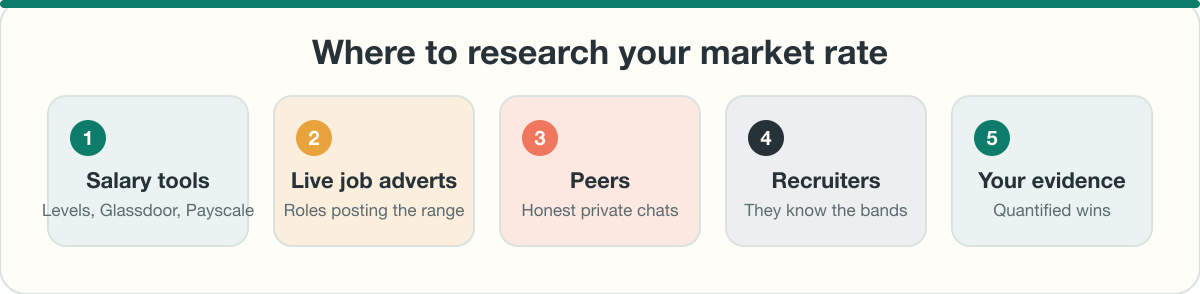 You cannot negotiate well from a feeling. Before you name any number, build a defensible range for your role, level and location from more than one source, so that no single data point can be waved away.
Look across several sources and pay attention to where they agree. Public salary tools give you a broad band. Live job adverts for similar roles sometimes list ranges outright. People in your network, especially recent movers, know the real numbers behind the published ones. Recruiters who work your niche will often share a range for free. In a field with its own pay dynamics, a specialist salary guide beats the generic tools.
| Research step | Where to look | What you get |
|---|---|---|
| Broad benchmarks | Public salary tools and pay reports | A rough band for the role, level and location |
| Live market signal | Current job adverts for similar roles | Real ranges employers are advertising right now |
| Insider numbers | Peers and recent movers in your network | The actual figures behind the published bands |
| Recruiter input | Recruiters who specialise in your field | A candid range and a read on demand |
| Your own value | Your evidence of impact and rarer skills | The case for landing at the top of the band |
Aim to leave this step with three numbers in your head: a floor you would accept, a target you genuinely want, and an ambitious but credible anchor to open with.
When should I talk numbers?
The general rule is to let the employer put a number down first. Whoever names a figure first sets the frame, and going too low caps you before you start. So when the early "what are your salary expectations?" question arrives, it is fine to deflect it politely.
"I would rather understand the full scope of the role before talking figures. What range have you budgeted for this position?"
Often they will simply tell you, and now you are negotiating from their number instead of exposing yours. If they insist that you go first, do not stonewall, because that reads as evasive. Give a researched range with its floor set at your real target, and make clear it depends on the wider package.
"Based on my research for this kind of role, I am looking in the region of [X to Y], depending on the overall package. Does that sit within your band?"
By the time a firm offer is on the table, the dynamic has shifted in your favour. They have decided they want you, which is the exact moment your leverage is highest and a considered counter does its best work.
How do I counter the first offer?
Start by thanking them and showing real enthusiasm, then ask for a little time. You almost never have to answer an offer in the same breath.
"Thank you, I am really pleased. This is an important decision, so I would like a day or two to review the full details. When do you need my answer?"
That pause does two things. It signals that you are considering the role seriously rather than desperately, and it gives you room to prepare. When you come back, anchor with a specific figure or a tight range, tied to evidence rather than need.
"I am genuinely excited about the role. Based on my experience with [specific skill or result] and the market rate for this position, I was hoping we could get the base to [figure]. Is there flexibility to move toward that?"
Then stop talking and let them respond. Silence is uncomfortable and you will want to fill it by softening the ask. Do not. Let the number sit.
If they come back with "that is the most we can do on base," treat it as the start of the wider conversation, not the end. A ceiling on salary is rarely a ceiling on the whole package.
"I understand the base is capped. In that case, could we look at a signing bonus, an earlier salary review, or additional leave to close the gap? I really want to make this work."
The tone throughout is collaborative, not combative: you are both solving the same problem, which is how to get you to yes.
What can I negotiate beyond base salary?
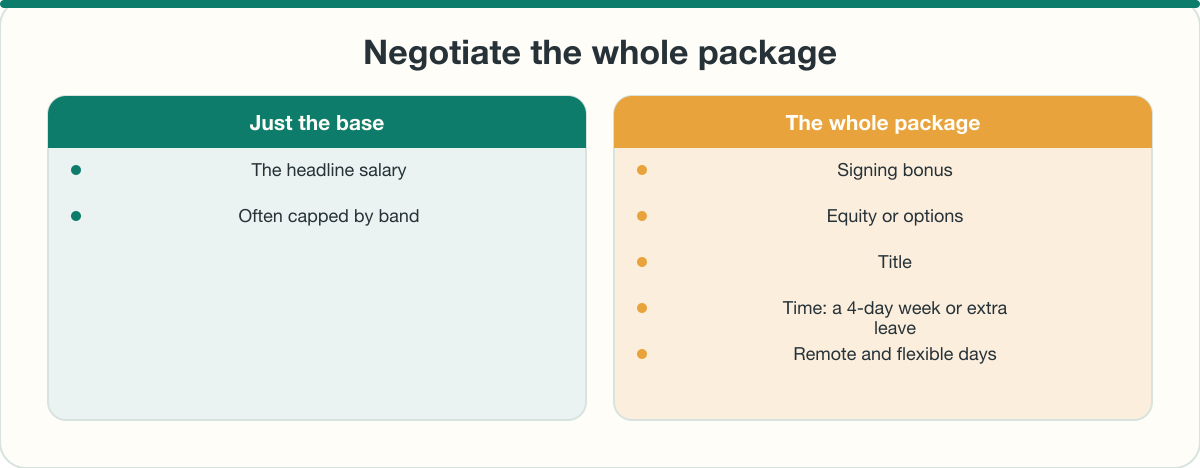 This is where most people stop too early, and where the real gains often hide. Your compensation is a package, and several parts of it are easier to grant than cash, because they come from different budgets or cost the business little.
The lever worth naming loudly is time. Reduced or flexible hours on the same salary are genuine compensation, and they frequently sit outside the tight pay band a hiring manager cannot exceed. A four-day week on full pay is, in plain terms, a pay rise for every hour you work, felt every week rather than once a year on your payslip. A nine-day fortnight, extra annual leave, or a couple of guaranteed remote days do the same job: they cost the employer less than cash and improve your life immediately.
| Lever | What to ask for | Why it can be easier to win than base pay |
|---|---|---|
| Time | A four-day week or nine-day fortnight on the same salary | Often sits outside the salary band and is a per-hour raise you feel weekly |
| Leave | Extra annual leave days beyond the standard allowance | Cheap for the employer, high value to you, easy to sign off |
| Flexibility | Guaranteed remote or genuinely flexible days and hours | Low cost, high daily quality-of-life return |
| Signing bonus | A one-off payment to bridge a base-pay gap | Comes from a different pot than base and does not raise ongoing cost |
| Equity | Shares or options, or a better existing grant | Preserves cash now while giving you a stake in the upside |
| Title | A title that matches the actual work | Costs little today and lifts your value at the next move |
| Review | An agreed salary review at six months | Turns "not now" into a dated, documented "soon" |
Work-Life Balance Jobs with Genuinely Reduced Hours
Save one to come back to it — it's free.



If a shorter or more flexible week is what you are really after, ask for it explicitly and frame it as the serious compensation it is. Our guide to accepting a job offer for a four-day workweek covers how to lock the arrangement down in writing so a friendly "sure" does not evaporate after you start. And if you want employers who already treat a shorter week as standard rather than a favour, our directory of flexible-hours and four-day-week companies is a good place to begin.
How do I put my counter in writing?
Most offers are discussed on a call and confirmed by email, so you will often make or restate your counter in writing. Keep it warm, specific and short. Lead with enthusiasm, state your single most important ask clearly, back it with a line of reasoning, and make it easy to say yes.
"Hi [Name], thank you again, I am excited to join. Having reviewed everything, I would like to propose a base of [figure], which reflects my experience with [specific area] and the market rate for the role. If the base is fixed, I would happily look at a four-day week, a signing bonus or extra leave instead. Everything else looks great and I am keen to get started. Would that work?"
That message is friendly, names one clear priority, offers a fallback so the conversation keeps moving, and closes on a positive. Avoid a long list of demands; pick your top one or two, because a scattergun of asks is easy to refuse wholesale.
What if they won't move on money?
Sometimes the base really is fixed, and that is not the dead end it feels like. Shift to the levers above: time, leave and flexibility are frequently more elastic than salary and, for many knowledge workers, worth more than a few extra percent anyway.
If they will not move on anything at all, you have learned something important. A company that will not flex a penny or a single day at the point of maximum goodwill is showing you how it handles negotiation, and how it may handle you later. Weigh that against everything else the role offers. Sometimes a lower number with an excellent team and a genuine four-day week beats a higher one with neither, exactly the trade our guide to evaluating job offers beyond just the salary helps you weigh.
Whatever you settle on, get the final agreement in writing before you resign from anything. A verbal "yes, that's fine" has a way of blurring once you have started.
Frequently asked questions
Can negotiating cause them to withdraw the offer? It is very unlikely if you are polite and reasonable. A company that has chosen you and invested in the process is not going to torch that over a courteous counter. The rare exception is an aggressive, entitled approach or wildly out-of-band demands. If a respectful negotiation makes an employer pull the offer or go cold, treat it as valuable information about the culture rather than a mistake on your part.
How much higher than the offer should I counter? A common approach is to counter somewhere in the region of five to fifteen percent above the offer, anchored to your market research rather than plucked from the air. The right figure depends on how far the offer sits below your range and how much competing demand you have. Anchor high enough to leave room to settle, but never so high that it dents your credibility.
Should I negotiate salary by email or on a call? Both have a place. A live call is better for the real back-and-forth, because you can read the response and adapt, while email is better for stating your ask precisely and creating a record. A good rhythm is to discuss it warmly on a call, then confirm the agreed numbers in a short follow-up email so nothing is left to memory.
Is asking for a four-day week instead of more money a weak move? Not remotely. Reduced hours on the same salary are a legitimate form of compensation and, per hour worked, a genuine pay rise. Plenty of strong candidates deliberately trade cash for time, and a growing number of employers offer shorter weeks precisely to attract them. Treat it as a serious ask and get it documented like any other term.
Ready to negotiate with an employer that already counts your time as part of the package? Browse thousands of four-day-week and reduced-hours roles at 4dayweek.io/jobs.
The salary is only the headline. Negotiate the whole deal, time included, because the best offer is the one that pays you fairly and hands your week back.




Get 4-day week jobs in your inbox
Create a free account to receive curated opportunities weekly.
Sign up for freeFree forever. No spam, unsubscribe anytime.