
A resignation letter is the easiest document you will write all year, and the one people most often overthink. You do not need to explain yourself, settle old scores, or produce a heartfelt essay. You need a short, clear note that confirms you are leaving and states when.
A resignation letter is a short, formal note telling your employer you are leaving. It states that you are resigning, gives your final working day based on your notice period, and, ideally, thanks them and offers to help with the handover. Keep it professional, warm and brief.
What is a resignation letter actually for?
It is a formal record, not a performance. Three quiet jobs sit behind it.
First, it puts your departure in writing, which protects both you and your employer if there is ever a question about dates or intent. Second, it formally starts your notice period, the clock that runs from the day you give notice to your final day. Third, it sets the tone for everything that follows: your handover, your reference, and the way people remember you once you have gone.
None of that requires drama. The best resignation letters are almost boring, and that is the point.
What should a resignation letter include?
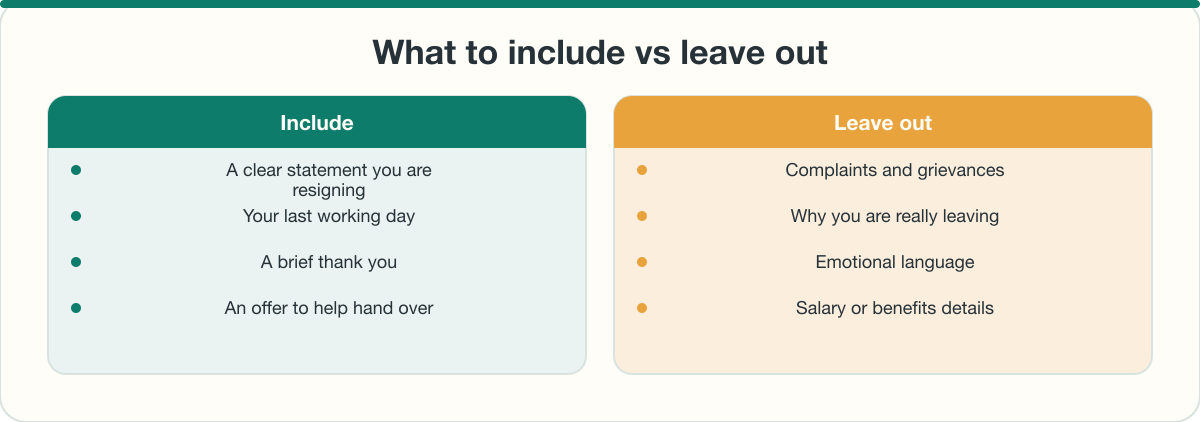 Five things, and no more than five.
- A clear statement that you are resigning. Say the word. "I am writing to formally resign from my position as [job title]." No ambiguity.
- Your final working day. Work it out from your notice period and state the exact date, so there is nothing to calculate or dispute later.
- A brief thank you (optional but wise). One genuine line about something you valued. It costs nothing and it lingers.
- An offer to help with the handover. Signalling that you will leave things tidy is the single kindest thing you can write.
- A professional sign-off and your name. "Yours sincerely" or "Best regards", then your name. A typed name is fine for email.
What you leave out matters just as much as what you put in. Here is the honest split.
| Put it in | Leave it out |
|---|---|
| A plain statement that you are resigning | Your full reasons for leaving |
| Your last working day (an exact date) | Complaints about your manager or team |
| A short, sincere thank you | Salary, bonus or grievance disputes |
| An offer to help hand over | Where you are going and what they pay |
| A calm, professional sign-off | Jokes, sarcasm or passive aggression |
If a sentence is not doing one of the five jobs above, cut it. A grievance belongs in a different conversation, through a different channel, and never in the note that goes on your file.
How much notice should you give?
Your last day depends on your notice period, and that is set by your contract (or, if your contract is silent, by law). Check the contract before you name a date, because guessing here is how people accidentally promise a leaving date they cannot legally hit.
For most people the answer is one month; for senior or specialist roles it is often three. If you are still in probation it is usually far shorter. We cover the rules, the statutory minimums and how to negotiate an earlier release in our full guide to your notice period. Read that first if you are unsure, then put the resulting date in your letter.
How should you hand it over?
Here is the part the letter itself cannot do: tell your manager first, in person or on a call, before the letter lands.
A resignation should never arrive as a surprise email while your manager is mid-meeting. It reads as cold, and it robs you of the goodwill you will want for your reference. The graceful sequence is simple:
- Ask for a short private conversation with your manager.
- Tell them calmly that you have decided to move on, and roughly when.
- Then send the written letter to confirm what you just said, copying HR if that is the norm where you work.
The letter is the paperwork that follows a human conversation, not a replacement for one. If your manager hears it from you first, they are far more likely to become an ally in your exit than an obstacle.
Which resignation letter template do you need?
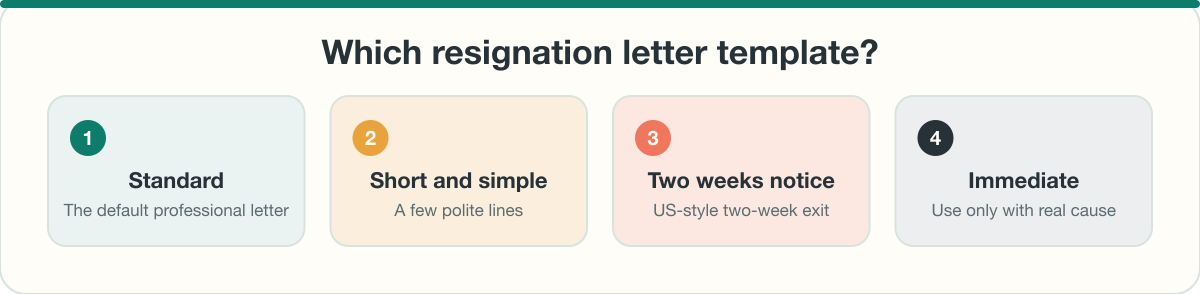 Pick the one that fits your situation, change the bracketed details, and you are done. All four are deliberately short.
1. The standard resignation letter (the safe default for most roles):
Dear [Manager's name],

I am writing to formally resign from my position as [job title] at [company name]. My last working day will be [date], in line with my [notice period] notice period.

Thank you for the opportunities I have had here. I have genuinely valued [something specific, e.g. working with the team on X], and I have learned a great deal.

I want to make this transition as smooth as possible, so please let me know how I can help hand over my work in the coming weeks.

With best regards,
[Your name]
2. The short and simple version (when you want minimal fuss):
Dear [Manager's name],

Please accept this letter as formal notice of my resignation from the position of [job title]. My final working day will be [date].

Thank you for the opportunity. I am happy to help ensure a smooth handover before I leave.

Kind regards,
[Your name]
3. The two weeks' notice version (common where a fortnight is standard or agreed):
Dear [Manager's name],

I am writing to give two weeks' notice of my resignation from [job title] at [company name]. My last day will be [date].

I appreciate the support I have received here and will do everything I can to wrap up and hand over my responsibilities before then.

Best regards,
[Your name]
Work-Life Balance Jobs with Genuinely Reduced Hours
Save one to come back to it — it's free.



4. The immediate resignation version (use with real caution, see the warning below):
Dear [Manager's name],

I am writing to resign from my position as [job title], effective immediately, as of [date]. I understand the implications of leaving without serving my full notice, and I am sorry for the short timescale.

Thank you for the opportunities I have had. I am willing to help remotely with any urgent handover where I can.

Sincerely,
[Your name]
A word on that last one. Resigning with immediate effect means walking away without serving your notice, which can breach your contract. It may affect your final pay and your reference, and reasonable employers remember an abrupt exit for a long time. Reserve it for genuinely serious situations (a safety issue, a toxic environment, or a personal emergency), and where you can, negotiate an early release instead of simply leaving. A calm exit protects your money and your name.
What should the email subject line be?
Most resignations now go by email, so the subject line does a small but real job: it should be clear, calm and easy to find again later. Keep it factual rather than dramatic. Any of these work:
Resignation: [Your name]
Notice of resignation: [Your name], [job title]
Resignation and notice, last day [date]
Attach the letter as a PDF or paste it into the body of the email; either is fine. Address it to your line manager by name, copy HR if that is standard where you work, and send it from your work account during working hours rather than at midnight. None of this is fussy etiquette for its own sake. Small signals of composure are exactly what a future reference remembers.
What tone should you strike?
Professional and warm, even if you are leaving through gritted teeth.
The person reading this letter may be a reference in two years, a contact at a future employer, or someone who sits on a hiring panel you never see coming. Industries are smaller than they feel. Whatever the provocation, do not use the letter to vent. Keep it gracious, keep it short, and save any honest feedback for a calm exit interview if you choose to give one.
If your role is technical and you want a version tuned to a developer's handover (code ownership, on-call, documentation), we have a dedicated guide on how to resign from a software engineering job. The letter is the same shape; the handover detail is where it differs.
Should you say why you are leaving?
You are not obliged to, and often the classiest letters do not. A simple "I have decided to move on" is complete. If you want to give a reason, keep it forward-looking and neutral: a new opportunity, a change of direction, a role that fits your life better.
Be ready for one twist. A strong resignation sometimes triggers a counteroffer, a sudden raise or promotion designed to keep you. That can be flattering and genuinely worth weighing, but it deserves clear eyes rather than a snap yes. We walk through when to accept one and when to decline in our guide to the counteroffer.
And if the real reason you are leaving is the hours, the pace, or an always-on culture that stopped serving you, point your next move somewhere better. A growing number of employers now advertise four-day weeks and reduced-hours roles at full pay, and plenty more offer genuine flexibility over when and where you work. It is worth browsing companies that offer flexible hours before you sign anywhere new, so the job you resign to is a real upgrade on the one you are leaving.
Write the letter, hand it over well, and leave the door open. That is the whole craft.
Frequently asked questions
How do I write a simple resignation letter? State that you are resigning, give your job title and your final working day, add one line of thanks, and offer to help with the handover. Sign off professionally. Four or five sentences is plenty; use the short template above and change the bracketed details.
Do I have to give a reason for leaving in my resignation letter? No. You can simply say you have decided to move on. If you do give a reason, keep it brief, positive and forward-looking. Never use the letter to air complaints, since it goes on your permanent file.
Should I email my resignation letter or hand it over in person? Tell your manager in person or on a call first, then send the written letter to confirm it. A resignation that arrives as a surprise email reads as cold and can cost you goodwill you will want for your reference.
Can I resign with immediate effect? You can, but leaving without serving your notice can breach your contract and may affect your final pay and reference. Reserve immediate resignation for serious situations, and where possible negotiate an early release by agreement instead.
Leaving to win back your evenings and weekends? Browse four-day-week and reduced-hours jobs on 4dayweek.io




Get 4-day week jobs in your inbox
Create a free account to receive curated opportunities weekly.
Sign up for freeFree forever. No spam, unsubscribe anytime.