
Getting a job offer feels like crossing a finish line. It's really a starting line. A job offer is the gateway to one of the biggest financial and lifestyle decisions you will make, and saying "yes" on the strength of the base salary alone is a classic mistake.
A genuinely great opportunity does more than pay the bills. It has to fit your financial goals, your personal life, your long-term ambitions, and your day-to-day happiness.
To make a smart choice, you need a system. Break the decision into four core pillars.
The Four Pillars of a Great Offer
Think of these as the four legs of a table. If one is wobbly, the whole thing tips over.
- Total compensation: The full financial picture — base salary, but also bonuses, equity, retirement contributions (like a 401(k) match), and the real-dollar value of your health insurance.
- Work-life balance: Your time and autonomy. This covers your schedule (including formats like a four-day week), paid time off, remote-work policies, and the unspoken rules around after-hours availability.
- Career growth: A job should be a stepping stone, not a dead end. Here you weigh mentorship, clear promotion tracks, and whether there's a budget for professional development.
- Company culture: The human element — your manager's leadership style, team dynamics, and the overall feel of the workplace. A toxic culture curdles even the sweetest financial package.
Weighing each of these pillars gives you a complete, holistic view of the opportunity. An offer that looks only okay on base pay can suddenly look excellent once you factor in a four-day week or a generous learning stipend.
Getting honest about which benefits employees value most is the foundation of this whole process. It forces you to name what you actually need — more time with family, better health coverage, or an aggressive path to promotion.
This guide walks you through how to dissect each pillar so you can compare offers objectively and choose the role that fits your life.
Deconstructing Total Compensation Beyond Base Salary
The base salary is the headline number. It's the first thing friends and family ask about, and it's easy to fixate on. But judging an offer by base salary alone tells you almost nothing about what's actually inside.
To gauge an offer's real financial weight, look at the entire package — performance bonuses, stock options, and the often-underestimated savings of a strong health plan. An offer with a lower base salary can put more money in your pocket over time.
This infographic breaks down the four pillars to weigh when comparing offers, showing where compensation fits into the bigger picture.

Compensation is a huge piece of the puzzle, but it sits alongside work-life balance, career growth, and company culture.
Calculating Your True Earnings
Total compensation is your base salary plus every other financial reward the company offers. These extras can dramatically lift the value of an offer, so add them all up. A simple spreadsheet is the easiest way to map it out.
The most common components to look for:
- Performance bonuses: Are they guaranteed, or tied to hitting targets? Ask for historical data — what percentage of the team typically earns their full bonus.
- Equity (stock options or RSUs): Equity can be a long-term wealth-builder, so understand the vesting schedule. The overwhelmingly common structure for venture-backed companies is a four-year vest with a one-year cliff, meaning you get nothing if you leave before your first anniversary.
- Retirement matching: A 401(k) match is essentially free money. Among Vanguard-administered plans, the average employer match is 4.6% of pay — a meaningful number to leave on the table if you don't contribute enough to capture it.
- Sign-on bonus: A one-time cash payment to get you in the door. It's often highly negotiable and can offset bonuses you're forfeiting at your old job.
Key takeaway: Always ask for the total compensation breakdown in writing. It forces clarity and gives you a concrete document to analyse — the best defence against misunderstandings over verbal promises.
The Hidden Value of Benefits and Perks
This is where the true quality of an offer reveals itself. A small-looking difference in health-insurance premiums can add up to thousands of dollars out of your pocket over a year.
It also adds up in your favour. For private-industry workers, the U.S. Bureau of Labor Statistics finds benefits average about 30% of total compensation — wages and salaries make up roughly 70%, and benefits the rest. In other words, the package is often noticeably larger than the salary line implies.
To compare benefits properly, ask for the Summary of Benefits and Coverage (SBC) for each health plan. It lays out deductibles, copays, and out-of-pocket maximums, so you can do a true apples-to-apples comparison.
The Financial Impact of a Four-Day Workweek
Now the modern twist: the four-day workweek. An offer of full pay for 32 hours of work changes the math entirely. Even if the annual salary matches a competing offer, your effective hourly rate is far higher.
Consider two illustrative offers:
- Offer A: $100,000 salary for a standard 40-hour week.
- Offer B: $100,000 salary for a 32-hour, four-day week.
With Offer B, your hourly rate is 25% higher. You're paid the same for working a full day less each week — time worth a great deal, personally and financially. You reclaim a day every week for side projects, family, or simply recharging, with no pay cut. Working through the full case for a four-day workweek — the benefits and the trade-offs alike — helps you quantify what is genuinely a game-changing perk.
Offer A vs. Offer B (Total Compensation Breakdown)
Here's a side-by-side comparison. It's easy to be swayed by a higher base salary, but a detailed breakdown shows which offer truly comes out ahead. Every figure below is an illustrative example, not a reported statistic — plug in your own numbers when you run this exercise.
| Compensation Component | Offer A (Standard Tech Co) | Offer B (4-Day Week Co) | Notes & Calculation |
|---|---|---|---|
| Base Salary | $125,000 | $120,000 | Offer A looks better on the surface. |
| Performance Bonus (Target) | $12,500 (10%) | $12,000 (10%) | Based on company and individual performance. |
| Sign-On Bonus | $5,000 | $7,500 | One-time payment, higher in Offer B. |
| 401(k) Match | $5,000 (4% match) | $7,200 (6% match) | Offer B provides $2,200 more per year. |
| Health Insurance Premium (Annual Employee Cost) | -$4,800 | -$2,400 | Based on a $400/mo vs. $200/mo employee contribution. |
| Value of Extra Day Off (52 days/yr) | $0 | +$24,000 | A conservative estimate valuing the extra weekly day off. |
| Year 1 Total Value | $142,700 | $168,300 | Sum of all financial components, including the value of time. |
| Effective Hourly Rate | $59.90 | $72.11 | (Salary + Bonus) ÷ (Hours worked per year). |
In this example, once you account for better benefits and the value of a four-day week, Offer B is worth over $25,000 more in the first year — a reminder to always look beyond the base salary and run your own numbers.
Digging Into Work-Life Balance and Flexibility
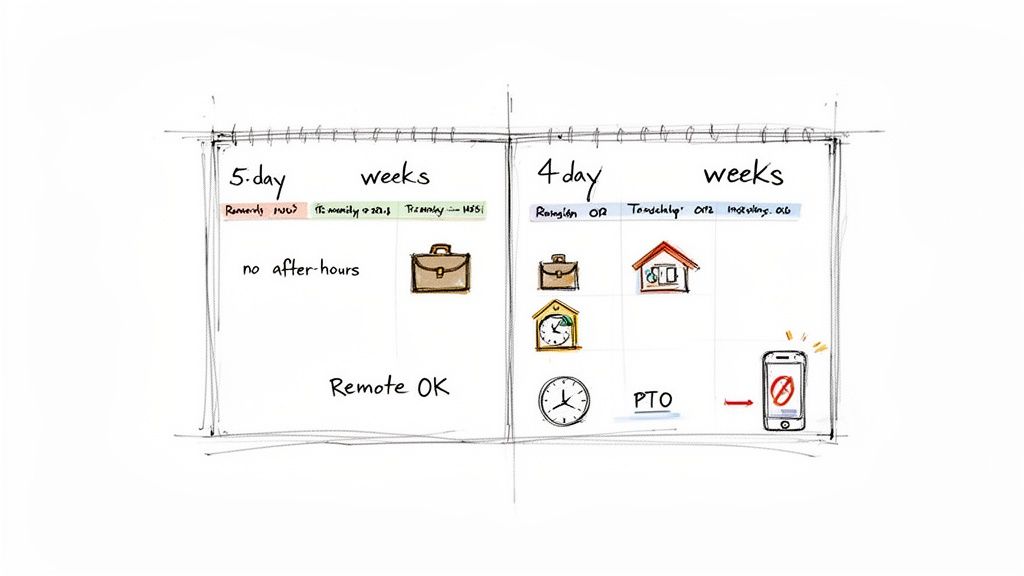
A strong compensation package loses its shine fast when you're stuck in 60-hour weeks fielding emails at midnight. Money matters, but the quality of your actual life — your time, energy, and sanity — matters just as much. This is where work-life balance moves from the "nice-to-have" column to the "must-have" list.
These aren't fluffy perks. They're the bedrock of staying happy and sustainable in a role. A company's real philosophy on work and life shapes your day-to-day reality, so look past the official handbook policies.
The New Shape of the Workweek
The 9-to-5, 40-hour week isn't the only option anymore. Companies are getting creative with scheduling, and the four-day workweek is leading the charge. The UK's 2022 four-day-week pilot — the largest trial of its kind, covering 61 organisations — found 71% of employees reported reduced burnout and company revenue held broadly steady.
Once an offer is on the table, get granular about the schedule.
- Standard vs. compressed: Is it a traditional 40-hour, five-day week, or a compressed setup like a 4x10 (four 10-hour days)?
- Reduced hours: Is a true 32-hour, four-day week at 100% pay on the table? This model dramatically raises your effective hourly rate and quality of life.
- Flexibility: How much real say do you have over start and end times? Can you shift things for a doctor's appointment without burning PTO?
Pinning down these details is key to understanding the importance of work-life balance and whether a role genuinely fits your life.
Uncovering the Truth About Remote and Hybrid Policies
"Hybrid" and "flexible" mean wildly different things from one company to the next. Get concrete answers to avoid a bait-and-switch where a "flexible" job is anything but. Ask direct questions that expose how policies work in practice.
For instance: "Could you walk me through what a typical week looks like for the team, in terms of in-office and remote days?"
That one question reveals whether the policy is a guideline or a rigid mandate — whether "hybrid" means you choose your days, or you're chained to a desk Tuesday through Thursday, no exceptions.
A strong follow-up: "How does the company make sure remote employees get the same opportunities for collaboration and advancement as in-office staff?" Their answer tells you whether they've intentionally built an equitable culture for everyone, regardless of location.
Decoding the Unwritten Rules
The most important parts of a company's work-life culture often aren't written down anywhere. They live in the team's habits and unspoken expectations. Your job is to bring them into the light.
A few prompts to start digging:
- After-hours communication: "What's the team's general norm on communication after hours or on weekends — is it normal to see emails or Slack messages late at night?"
- Vacation culture: "When people take PTO, are they actually able to unplug, or is there a quiet expectation to keep an eye on email?"
- Meeting cadence: "Can you give me a sense of the meeting culture — are calendars usually back-to-back, or is there a real effort to protect time for deep work?"
The answers are revealing. A hiring manager who fumbles the question or gives a vague non-answer may be signalling a culture of overwork. A confident response that champions boundaries is a green flag. For more questions worth asking, see our list of the best work-life balance questions to ask.
Thinking About Your Career Growth and Future Development
A job offer isn't just a snapshot of the next 12 months — it's a potential launchpad for your whole career. A good salary and a flexible schedule feel great right now, but that feeling fades fast if you find yourself in a dead-end role two years later. When you weigh an offer, you're making a bet on your future self.
A role that feeds your ambition and teaches you new skills can be far more valuable long-term than one with a slightly higher starting salary and no path forward. The stakes are real: a Georgetown study found that the highest-paying college majors out-earn the lowest-paying ones by about $3.4 million over a lifetime. The trajectory you choose compounds for decades.
What's the Real Career Path Here?
Before you say yes, dig into the actual opportunities for advancement. Vague promises of "growth opportunities" are noise. You need the concrete steps and timelines for moving up.
Ask direct questions about where the role leads. This isn't aggressive — it's smart.
- Internal mobility: Ask whether the company prioritises promoting from within. A strong internal-mobility track record shows they invest in their own people.
- Succession planning: Ask about the typical path for someone in this position. Where have previous holders of this role gone next? Are they still with the company?
- Performance and promotions: Get the details on how performance is measured and how that connects to promotions and raises. A transparent process is a healthy one.
If you're unsure how to frame these conversations, our guide on how to prepare your case and ask for a promotion has frameworks you can adapt. Understanding the promotion culture now sets you up for later.
How Much Will They Invest in You?
A company's willingness to invest in your skills is a direct measure of how much it values you long-term. This goes well beyond on-the-job training. Look for formal programs and dedicated resources.
A key indicator: a Learning and Development (L&D) budget. Ask whether one exists and how you'd access it.
A great question: "What does success in this role look like at 6 months, 12 months, and 24 months?" The answer reveals their expectations and gives you a roadmap — and it's a natural opening to discuss the support they'll provide to help you hit those milestones.
Look for specific programs that match your ambitions:
- Mentorship programs: Does the company formally connect junior employees with senior leaders? That guidance is invaluable in a new organisation.
- Tuition reimbursement: Some companies help cover certifications, workshops, or even advanced degrees.
- Conference attendance: Is there a budget for industry conferences? A good way to learn, network, and stay current.
Will Your Manager Be Your Champion?
Your direct manager is the single biggest factor in your day-to-day happiness and career growth. A great manager acts as a coach and an advocate. Remember: during interviews, you're not just being evaluated — you're evaluating them.
Get a feel for their style with questions like:
- "How do you support your team's professional development goals?"
- "Can you share an example of how you've helped someone on your team advance their career?"
Pay close attention to the answers. A manager who genuinely cares about their team's growth will have specific, enthusiastic examples ready. A generic, canned response suggests development isn't a real priority for them.
Reading the Signs on Culture and Manager Fit
No amount of money makes up for a toxic boss or a soul-crushing environment. Salary and benefits are easy to measure; it's the human side — culture and your direct manager — that defines your day-to-day happiness and growth.
Figuring this out can feel like guesswork, but it doesn't have to be. The entire hiring process is your first real look behind the curtain. You just need to know what clues to watch for.
Your Interview Experience Is Data
How a company treats you as a candidate speaks volumes. A hiring process that is respectful, organised, and communicative is a strong signal of a healthy internal culture.
If they ghost you for weeks, reschedule at the last minute, or just feel chaotic? That's not a good sign — and a fair preview of what daily work might feel like.
Work-Life Balance Jobs with Genuinely Reduced Hours
Save one to come back to it — it's free.

This isn't just a gut feeling; it shapes whether people take the job at all. In CareerPlug's candidate-experience research, 66% of candidates said a positive experience influenced their decision to accept an offer, and 26% of job seekers declined an offer because of poor communication or unclear expectations. When the money is similar, a smooth process can be the deciding factor.
Assessing the Company Culture
Get past the polished mission statement on the website and uncover the unwritten rules of the workplace. The goal is to understand the real-life dynamics of the team.
Ask potential teammates or the hiring manager some targeted questions:
- Recognition and feedback: "How does the team celebrate wins, big and small? Can you share an example of how constructive feedback is given?"
- Conflict resolution: "When disagreements or different approaches come up on a project, how are they typically resolved?"
- Work-life boundaries: "What are the team's norms around taking time off? When someone is on vacation, are they actually expected to check in?"
Pay as much attention to how they answer as to what they say. Genuine enthusiasm and specific examples are a green flag. Vague, corporate-sounding answers might mean the official culture doesn't match reality.
Evaluating Your Future Manager
Your direct manager can make or break the job. They're your main source of support, your advocate for growth, and the person you'll interact with most. During interviews, size them up just as much as they size you up.
A great manager should feel more like a coach than a micromanager. To get a sense of their style, ask questions that reveal how they actually support their people.
- Onboarding and support: "What does the onboarding process look like for this role? How will I be set up for success in the first 30, 60, and 90 days?"
- Development and growth: "Could you share an example of how you've helped someone on your team grow their skills or advance their career?"
- Leadership style: "How do you prefer to communicate and delegate? Do you lean toward hands-on guidance or giving your team autonomy?"
Their answers tell you everything about their priorities. A manager who actively invests in their team's development is a powerful ally. You may also notice that trust and autonomy tend to be baked in at certain employers — like the ones on our list of tech companies with 4-day work weeks.
Creating Your Personal Decision Matrix
You've done the hard work — analysed compensation, debated work-life balance, sized up the culture. Now you're sitting on a mountain of information: a mix of hard numbers and gut feelings.
It's time to pull it all into one simple, objective tool. This is where you move from instinct to a data-backed decision by building a job offer decision matrix.
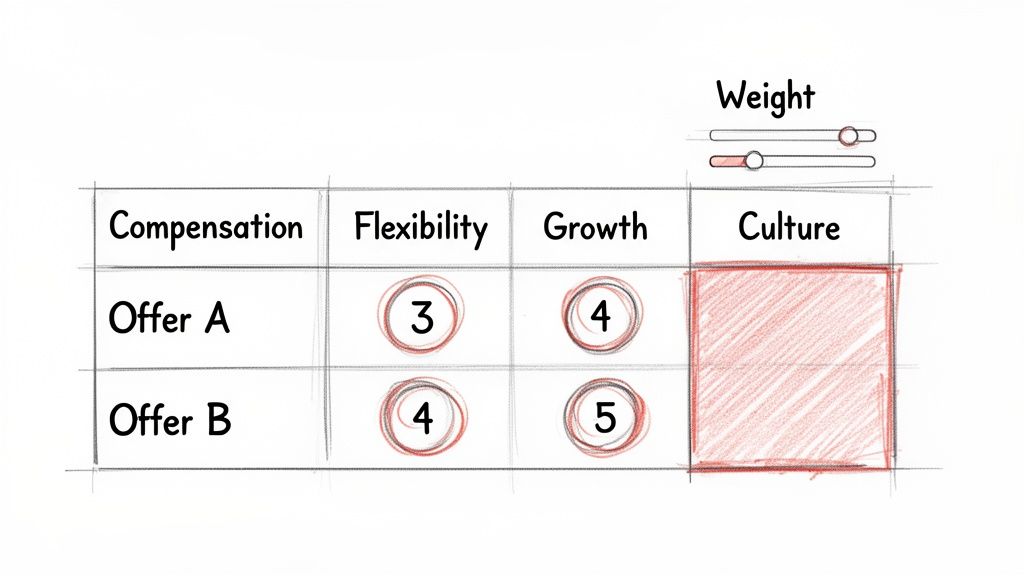
A structured approach strips emotion out of the process and forces you to score each offer on what truly matters to you. You may be surprised that the offer with the highest salary isn't the best fit once everything is laid out.
Setting Up Your Matrix
Open a spreadsheet. In the first column, list the criteria that matter to you. They'll likely mirror the topics above, but get as granular as you need:
- Total annual compensation (salary + bonus + 401(k) match)
- Work-life balance (hours, PTO, remote policy)
- Career growth potential (mentorship, L&D budget)
- Manager fit and leadership style
- Company culture and team vibe
Next, add a "Weight" column. Assign each criterion a number — say, from 1 (nice-to-have) to 5 (deal-breaker). This step personalises the matrix so the final score reflects your real priorities.
Scoring and Comparing Your Offers
With your criteria weighted, add a column for each offer. Score each offer 1 to 10 on every criterion. Be brutally honest, drawing on all your research and conversations.
For each line's "Weighted Score," multiply the weight by the score. If you weight "Career Growth" a 5 and score Offer A a 7, its weighted score is 35.
Tally the weighted scores for each offer and you have a clear numerical winner. The process forces you to look at the whole picture instead of being dazzled by one shiny number.
One often-overlooked factor: the potential "exit cost" of taking a role. Think about how long it would take to find a similar job if this one doesn't pan out. That timeframe matters when you're weighing equity vesting cliffs or restrictive non-compete clauses — and it's worth being honest about before you sign.
Here's a template you can copy and adapt. The scores below are illustrative placeholders — replace them with your own ratings.
Personal Job Offer Decision Matrix (Template)
| Evaluation Criteria | Weight (1-5) | Offer A Score (1-10) | Offer B Score (1-10) | Weighted Score |
|---|---|---|---|---|
| Total Compensation | 4 | 9 | 7 | A: 36, B: 28 |
| Health & Benefits | 3 | 8 | 8 | A: 24, B: 24 |
| Remote Flexibility | 5 | 6 | 9 | A: 30, B: 45 |
| Career Growth | 5 | 7 | 8 | A: 35, B: 40 |
| Manager & Team Fit | 4 | 9 | 7 | A: 36, B: 28 |
| Company Culture | 3 | 8 | 9 | A: 24, B: 27 |
| TOTAL SCORE | A: 185, B: 192 |
This simple tool turns a complex, emotional decision into a straightforward comparison — and gives you the confidence that you're making a strategic choice for your career and life, not just your bank account.
Common Job Offer Scenarios
Even with a solid framework, the final stages of an offer get tricky. You're juggling deadlines, comparing numbers, and trying to make the right call. Here's how to handle a few common situations.
How Do I Handle an Exploding Offer?
You know the one — an offer with a ridiculously short deadline, designed to rush you. Its goal is to create pressure; yours is to stay cool.
First, acknowledge the offer with genuine gratitude. Then politely but firmly ask for more time. It's a reasonable request.
You might say: "Thank you so much for this offer — I'm really excited about the opportunity. This is a big decision, and to give it the consideration it deserves, would it be possible to have until [date]?"
Any reasonable employer will grant a few more days. If they won't budge on an aggressive deadline, that itself is a red flag about company culture and how they treat people under pressure.
Is It Okay to Ask for More Time to Decide?
Yes, absolutely — especially if you're in the final stages with another company.
The trick is to be transparent without oversharing. You don't need to give a play-by-play of your other interviews.
Frame it as wanting to commit fully: this is a major decision for both of you, and you want to be sure you can give a wholehearted yes. Always suggest a specific new date — it shows you're organised and respect their time.
What if I Have a Competing Offer?
Congratulations — multiple offers put you in the driver's seat. Before doing anything, pull out your decision matrix and figure out which job you actually want more.
Once you have a clear favourite, you can use the other offer as leverage — professionally. Reach out to your top-choice company, reiterate how excited you are, and say something like: "As I make my final decision, I've received another competitive offer. I'd love to make this work, so I wanted to ask if there's any flexibility on the compensation package."
Quick tip: Never invent a fake offer to gain leverage. It's a small world, and it can backfire badly. Keep the conversation focused on your genuine enthusiasm for their company.
Can I Re-Negotiate After Accepting an Offer Verbally?
Tread carefully. Going back on your word after a verbal "yes" is risky and generally a bad idea.
A verbal acceptance is treated as a good-faith commitment. Reopening negotiations afterward risks damaging your reputation before you even start — and in some cases, the company may pull the offer entirely.
The time to negotiate is before you accept. Once you've said yes, the remaining job is to review the written contract and confirm it reflects everything you agreed to. A genuine discrepancy is fair to raise — but trying to change terms you've already agreed to is a no-go.
If you want a deeper guide to the negotiation itself, see our software engineer's guide to negotiating benefits during interviews.
The best offer is rarely the one with the biggest base salary — it's the one that fits your finances, your time, and your future, all at once.




Get 4-day week jobs in your inbox
Create a free account to receive curated opportunities weekly.
Sign up for freeFree forever. No spam, unsubscribe anytime.