
That moment a job offer finally lands in your inbox is a real win — all those applications, interviews, and late-night prep sessions have paid off. But before you fire back an immediate "yes," take a breath. Your response in the first day or two matters more than you might think. It sets the tone for everything that follows, from negotiation to your first week on the job.
Reply too fast and you risk overlooking details that matter — especially with a four-day-week role, where the exact schedule is the whole point. Take too long and you can send the wrong signal. The sweet spot: reply promptly, thank them sincerely, and express genuine excitement, while making clear you'd like a short window to review the full offer before committing.
You Got the Offer — Now What?
First, get everything in writing. A verbal offer is a great start, but the written document is where the real details live. It's your single source of truth for salary, benefits, start date, and — most importantly — the exact structure of your four-day schedule.

Your Immediate Action Plan
Before you sign anything, do a thorough review. Does the offer match what you discussed in the interviews? Are there any surprises? It's easy to get swept up in the excitement, but this is the point to slow down and read every line carefully.
The simple sequence — receive, review, respond — keeps you honest. That middle step is where you head off future headaches. Not sure how the different four-day models actually differ? Our guide to the 4-day work week breaks down the 32-hour reduced week, the compressed 4x10, the 9-day fortnight, and more.
Initial Offer Review Checklist
Use this checklist to break the offer down systematically. It helps you weigh what they're offering against what you actually need.
| Component | What to check | Your requirement |
|---|---|---|
| Salary & compensation | Is the base salary what you discussed? Are bonuses or stock options included and clearly explained? | e.g. $90,000 base, 10% annual bonus target |
| Work schedule | Is the four-day model spelled out (e.g. 4x8 hours)? Is your day off specified and guaranteed? | e.g. 32 hours total, Fridays off |
| Benefits package | Does it cover health, dental, and vision? What are the retirement plan and employer-match details? | e.g. PPO health plan, 4% 401(k) match |
| Paid time off | How many vacation days, sick days, and company holidays are included? | e.g. 20 days PTO + 10 paid holidays |
Working through these points gives you a clear picture of the total package before you make your final call.
Take your time. A good employer will respect your need to review the offer thoroughly. Rushing this step is one of the most common — and most avoidable — mistakes candidates make.
Negotiate Before You Accept
That offer feels like the finish line. It isn't — it's the moment your leverage peaks. Accepting is more than saying "yes"; it's where you make sure every detail lines up with your career and your life.
Negotiating isn't about being difficult. It's about starting a new working relationship with total clarity and mutual respect.

This step matters most for a non-traditional role. You need to be certain the four-day week you talked about is the one you're actually getting. Any ambiguity now becomes friction later.
Pin Down Your Priorities
What are your non-negotiables? Salary is often the headline, but a smart negotiation covers the whole package. Rank your must-haves against your nice-to-haves. Securing a true 32-hour week at full pay might be a non-negotiable; a specific laptop model probably isn't.
Knowing your priorities keeps the conversation focused — and keeps you from trading away something that matters for something that doesn't.
A well-prepared negotiation signals professionalism. It's your chance to advocate for your value before you even start.
Candidates are right to be selective. In CareerPlug's 2025 candidate-experience research, 26% of job seekers said they declined an offer because of a poor hiring experience — things like patchy communication or unclear expectations. The way an offer is handled is itself a signal worth weighing.
The Four-Day Week Negotiation Checklist
For a reduced-hours role, the details are the job. A small misunderstanding now can become a real problem later. Use this checklist to guide the conversation.
| Negotiation point | Question to ask | Desired outcome |
|---|---|---|
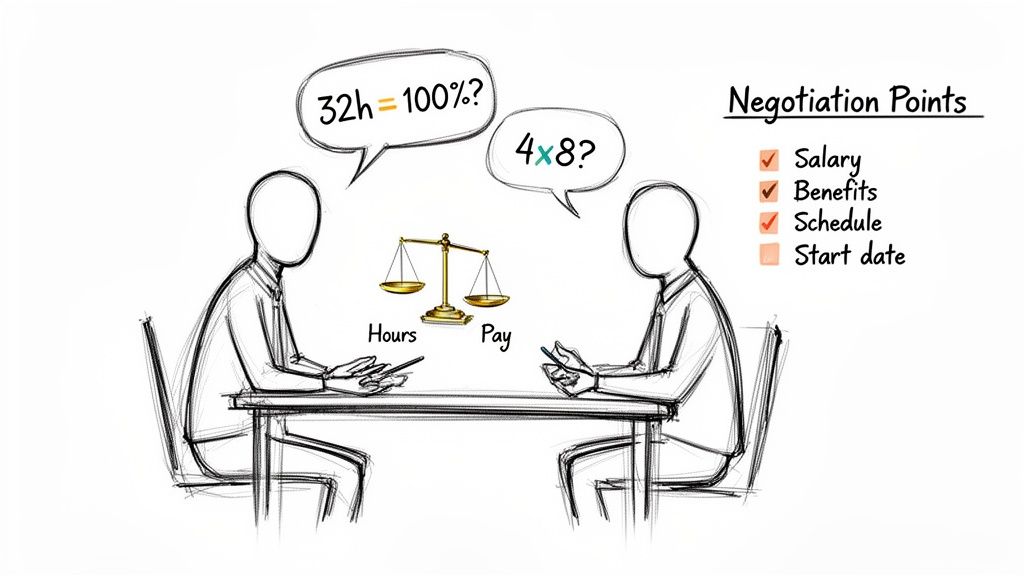
| Schedule model | "Just to confirm we're aligned — is this a 4x8 model, meaning 32 hours per week?" | Confirmation of a genuine reduced-hours week, not a compressed 40-hour schedule. |
| Day off | "I'd prefer Fridays as my day off — is that workable for the team?" | Agreement on a specific day that suits both you and the company. |
| Full salary | "I want to confirm the salary of [amount] is for the 32-hour week, as we discussed." | Written confirmation that your full salary applies to reduced hours. |
| Notice period | "Could you clarify the notice period required from my side, should I ever move on?" | A clear understanding of the standard notice period, with no surprises. |
Getting these specifics confirmed — and written into your final offer — is the part you can't skip. The single most important line to nail down: that full pay applies to the reduced hours. A "four-day week" that's really a compressed 40 hours is a different job. If you want strategies for the wider conversation, our guide on how to ask your boss for a 4-day work week is a good starting point.
Getting Your Acceptance Email Right
Once the negotiation is done, make it official. How you formally accept is the final touch on the professional impression you've built — and it's the document that locks in your agreement.
A phone call is a warm, personal way to accept. A follow-up email is non-negotiable. It puts every detail in writing — salary, start date, and your specific four-day schedule — leaving no room for mix-ups later.
What to Include
Keep it concise, professional, and genuinely warm. Think of it as a confirmation letter that recaps the most important terms. Skip the casual slang, but don't be so formal your personality vanishes.
The must-haves:
- A clear subject line. Don't make the hiring manager guess — "Job Offer Acceptance — [Your Name]" does the job.
- An unambiguous "yes." Open by clearly stating you're accepting the position.
- Confirmation of the terms. This is the critical part. List the key terms you've agreed so everyone is on the same page.
A Sample You Can Adapt
Here's a template built specifically to confirm a four-day-week role, where that extra bit of clarity earns its keep.
Subject: Job Offer Acceptance — Jane Doe
Dear [Hiring Manager's Name],
I'm delighted to formally accept the offer for the Senior Product Designer position. I'm excited to join the team at [Company Name] and start contributing to your upcoming projects.
As discussed, I'm accepting this offer on the following terms:
- Position: Senior Product Designer
- Start date: Monday, 12 January 2026
- Annual salary: $115,000
- Work schedule: A 32-hour, four-day workweek (4x8-hour days), with my designated day off on Fridays.
I look forward to receiving the formal contract and any new-hire paperwork. Please let me know if you need anything from me before then.
Thank you again for this opportunity.
Best regards, Jane Doe
The bulleted list makes the key terms easy to scan and verify at a glance — and gives both sides a clean record to check the contract against.
If you want help structuring the arrangement itself, our flexible working hours template is a useful reference.
Your Post-Acceptance Checklist
Sending that email feels great — but the work isn't quite done. A smooth, professional transition sets up your new role well. Now's the time to exit your current job gracefully and get ready for what's next.
The gap between accepting and your first day fills up with admin. Your new employer will kick off background and reference checks, and send over the formal contract and new-hire paperwork.
Work-Life Balance Jobs with Genuinely Reduced Hours
Save one to come back to it — it's free.

How to Resign Professionally
Once you have the signed offer from your new company, resign. The standard is to do it in person or over a video call with your direct manager, then follow up with a formal resignation letter. Keep the conversation positive, brief, and professional.
A template you can adapt:
Subject: Resignation — [Your Name]
Dear [Manager's Name],
Please accept this email as formal notice that I am resigning from my position as [Job Title] at [Current Company]. My last day will be [Date], two weeks from today.
I've genuinely valued my time here and am grateful for the opportunities you've given me. I'm committed to a smooth handover over my final two weeks, and I wish you and the team all the best.
Sincerely, [Your Name]
This protects your reputation and the relationship. It's a small world — you never know when your paths might cross again.
Preparing for Your New Role
While the admin gears turn, start getting ready for day one. It's also a good moment to think about how you'll make the most of your new schedule — our guide on how to implement a 4-day week has practical ideas for protecting deep-focus time and front-loading the week.
Your pre-onboarding checklist:
- Gather documents. Have your identification and bank details ready for payroll and employment-verification paperwork.
- Review the contract. Read the formal contract carefully. Confirm every term you agreed — salary, and especially your four-day schedule — is accurately reflected.
- Note your questions. Jot down any final questions for HR or your new manager before you start.
Counteroffers and Other Curveballs
Just when you think you've crossed the line, a curveball arrives — a tempting counteroffer from your current boss, or another opportunity you were also pursuing. Handling these with grace protects your reputation and starts your new role on solid ground.
What to Do With a Counteroffer
The moment you hand in your notice, your current employer may suddenly find the budget for that raise you'd been asking for. It's flattering — and it deserves a healthy dose of caution.
Ask yourself why you started job hunting in the first place. Was it only the money, or were there deeper issues: the culture, the workload, a dead-end path? A bigger paycheck rarely fixes the underlying problem. Recruiters have long observed that a large share of people who accept a counteroffer are back on the job market within a year — usually because the original frustrations never went away — and worker-satisfaction surveys consistently find few are happy with the decision long-term.
If your employer truly valued you this much, why did it take a resignation to show it? A counteroffer often just delays the inevitable.
If you took the new job for a tangible, life-changing benefit — a genuine four-day week — that's something a cash counteroffer simply can't match. Stick to the reasons that led you to say yes. If you want to sanity-check the numbers, it's worth comparing a pro-rata four-day-week salary against a traditional five-day role.
Declining Other Offers Gracefully
If you were interviewing with several companies, you'll likely need to decline another offer. Be prompt, polite, and brief — no need to write an essay.
Subject: Job Offer — [Your Name]
Dear [Hiring Manager's Name],
Thank you so much for offering me the [Job Title] position. I was genuinely impressed by your team, but I've decided to accept another opportunity that aligns more closely with my goals right now. I appreciate your time and wish you the best in finding the right candidate.
Best regards, [Your Name]
This keeps the door open for future connections.
Staying in Touch Before You Start
After you've formally accepted, there's often a quiet stretch before day one. About a week out, send a brief, friendly note to your new manager — not asking for work, just showing enthusiasm and asking whether there's anything useful to review beforehand. Small gestures like this reinforce their decision to hire you.
Common Questions After You've Said Yes
Even after you've negotiated and sent the acceptance email, a few last-minute questions tend to surface. Here's how to handle them.
Can a company rescind an offer after I've accepted? It can happen, but it's rare — and almost always for reasons outside your control, like a sudden hiring freeze, a budget cut, or a background-check issue. Your safety net is simple: always get the offer in writing before you resign from your current job. A formal written offer, ideally in the form of an employment contract, is a far stronger foundation than a verbal agreement.
What if the written offer doesn't quite match what we discussed? First, don't panic — it's almost always an admin error, not a bait-and-switch. Address it quickly and politely. A short email to your HR contact pointing out the specific discrepancy usually fixes it: "Thanks again for sending the written offer — I'm excited to get started. I did notice the start date is listed as 5 January, but we'd discussed 12 January. Could you confirm whether that can be updated?"
Can I ask for more time to decide? Yes. If you're waiting to hear from another company, or need to talk logistics through with family, it's entirely reasonable to ask for a few extra days. Be specific — most employers are fine giving two or three business days: "Thank you for the offer — I'm really excited about this. Would it be possible to have until Friday to give you my final decision?" A vague request for "more time" reads as lukewarm; a specific date reads as organised.
Getting the schedule and benefits exactly right matters because the stakes are real. Healthcare costs are a growing source of financial anxiety — in West Health and Gallup's 2025 polling, 47% of US adults said they were worried about being able to afford care in the year ahead, the highest level since tracking began in 2021. The benefits line of an offer deserves as much scrutiny as the salary.
Handle these final questions with clear, calm communication and you can finalise your acceptance with real confidence — knowing the offer in front of you is exactly the opportunity you set out to find, with the four-day week locked in writing.




Get 4-day week jobs in your inbox
Create a free account to receive curated opportunities weekly.
Sign up for freeFree forever. No spam, unsubscribe anytime.