
There's a small box on almost every job application: Notice period.
Most people either guess, leave it blank, or panic that a long one will cost them the job.
It won't, if you understand it. This guide explains what a notice period actually is, how long yours is likely to be, what the law says, and exactly what to write in that box.
What is a notice period?
A notice period is the amount of time between telling your employer you're leaving (or being told you're leaving) and your employment actually ending.
It's the buffer that lets your employer plan a handover and lets you wrap things up properly. It runs from the day notice is given to your final day.
Two things set its length:
- Your contract, which usually states a specific notice period.
- The law, a statutory minimum that applies if your contract is silent or offers less.
If your contract says more than the legal minimum (it usually does), the longer contractual period wins.
How long is a notice period? (UK statutory minimums)
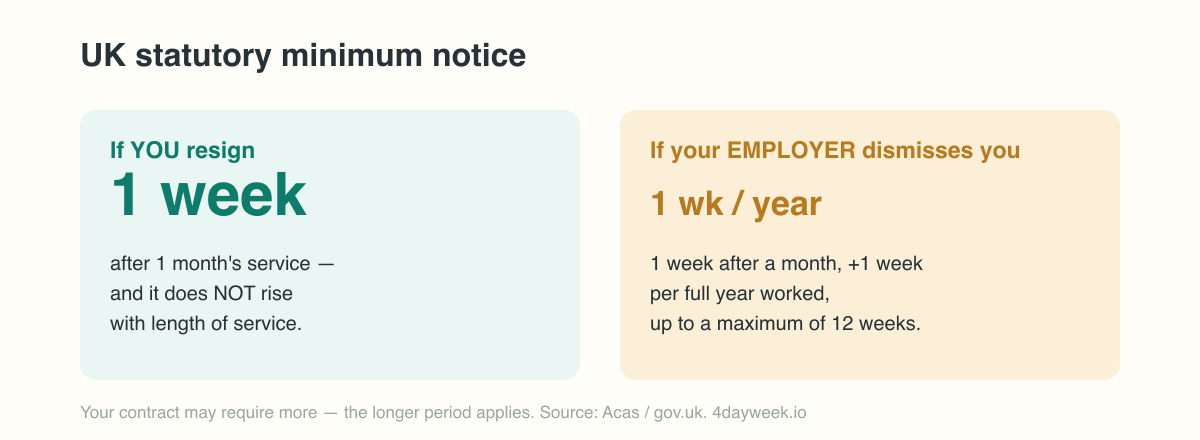
Here's the part people get wrong, so let's be precise. The rules differ depending on which way the notice is going.
If you resign (employee gives notice), the statutory minimum in the UK is:
- One week's notice once you've worked there at least one month, and, importantly, this does not increase with length of service. Whether you've been there two months or twenty years, the statutory minimum you must give is one week.
If your employer dismisses you, the statutory minimum they must give you scales with service:
- One week after a month, rising by one week for each full year you've worked, up to a maximum of 12 weeks.
| Time served | Minimum notice YOU give (resigning) | Minimum notice EMPLOYER gives you |
|---|---|---|
| 1 month – 2 years | 1 week | 1 week |
| 5 years | 1 week | 5 weeks |
| 12+ years | 1 week | 12 weeks (max) |
But, and this matters, most contracts require more than the statutory minimum. A month's notice is common; three months is typical for senior or specialist roles. Your contract is the first place to look.
What to put on a job application
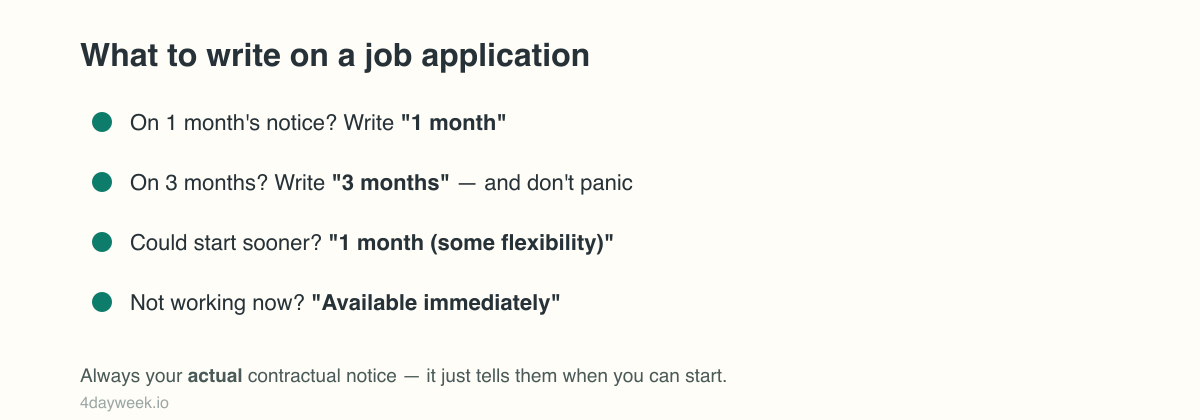
Keep it simple and honest: write your actual notice period as stated in your contract.
- If your contract says one month, write "1 month".
- If you're on three months, write "3 months" (and don't panic, see below).
- If you could start sooner, you can add a note: "1 month (some flexibility)".
- If you're not currently working, write "Immediate" or "Available immediately".
Why it matters: the employer is simply working out when you could realistically start. It's a logistics question, not a test. Being accurate saves everyone an awkward conversation later.
Don't understate it to look more available, if you're offered the job, you still have to serve the notice you're actually on, and starting a new role by breaching your old contract is a bad first impression.
Can you leave before your notice period ends?
Sometimes, through one of these routes:
- By agreement. Your employer may simply let you go early. Ask; many will, especially if you've offered a clean handover.
- Using holiday. Accrued holiday can sometimes be used to shorten the time you physically work.
- Pay in lieu of notice (PILON). Your employer pays you for the notice period instead of you working it, and you leave straight away.
- Garden leave. You're sent home on full pay for the notice period (still employed until it ends). See our garden leave guide.
Leaving without agreement, before your notice is served, can be a breach of contract, which may affect your final pay or reference. It's rarely worth it.
How to negotiate a shorter notice period
Stuck on three months but your new employer wants you sooner? You have more room than you think.
- Ask early and ask nicely. Most managers will flex if you give a clean handover and part on good terms. Frame it around making your exit painless, not just your convenience.
- Offer a solid handover plan. The real fear is the gap you leave behind. Solve it, document your work, train a colleague, tie off projects, and the objection often melts.
- Use accrued holiday. Unused annual leave can effectively shorten the time you physically work.
- Suggest PILON. If they'd rather you gone cleanly, pay in lieu of notice suits both sides.
- Get any agreement in writing. A verbal "sure, leave early" should become an email before you commit to a start date elsewhere.
A word of realism: your employer isn't obliged to release you early. But most reasonable ones will, because a disengaged employee counting down the clock helps no one.
What happens if you just don't work your notice?
Walking out without serving your notice is legal in the sense that no one can physically force you to work, but it can still cost you:
- Breach of contract. Leaving early without agreement breaches your contract, and in principle an employer could pursue losses (rare in practice, but possible for senior or high-impact roles).
- Pay. You may lose pay for the notice you didn't serve, and sometimes accrued holiday.
- References. Burning the bridge on your way out can follow you, references and reputations are small worlds.
Work-Life Balance Jobs with Genuinely Reduced Hours
Save one to come back to it — it's free.



The pragmatic move is almost always to negotiate an early release rather than to simply vanish.
Notice periods during probation
While you're still in a probation period, notice is usually much shorter, often a week, or even less, on both sides, as set out in your contract. That's the trade-off of probation: less security, but an easier exit if the role isn't right. Always check what your specific contract says, as probation terms vary.
What if your employer gives you notice?
Notice runs both ways, and the rules differ when the employer ends things. If you're dismissed or made redundant, the statutory minimum notice your employer must give increases with your length of service, one week after a month, then one week for each full year worked, up to a maximum of 12 weeks. Your contract may promise more.
During that notice you're generally entitled to your normal pay, and in a redundancy you may also be entitled to redundancy pay and time off to look for work. Your employer can also choose to pay you in lieu of notice or place you on garden leave instead of having you work it.
The short version: you owe a fairly small statutory minimum when you resign; your employer owes more, scaling with your service, when they let you go.
Notice, final pay and references
Two practical things people forget in the rush to leave:
- Your final pay should include any untaken holiday you've accrued, plus your normal pay for the notice period. Check your final payslip against what you expect.
- Your reference often rests on how you leave. Serving your notice properly and handing over well is a small investment that pays off for years, a grudge held by a former manager has a long memory.
Leaving well isn't just courtesy. It protects your money and your future.
How to resign well
Your notice period is your last impression. Make it a good one.
- Check your contract first so you know exactly how much notice you owe.
- Resign in writing, clearly, with your intended last day.
- Offer a proper handover, documentation, introductions, tying off loose ends.
- Stay professional to the end. References and reputations outlast any single job.
- Line up the next thing so your start date and your leave date line up cleanly.
And if the reason you're leaving is that the hours, the pace or the always-on culture stopped working for you, aim your next move somewhere better. A growing number of employers now offer four-day weeks and reduced-hours roles, so the job you give notice to can be a real upgrade on the one you're giving notice from.
Frequently asked questions
What is a notice period on a job application? It's the amount of notice you're required to give your current employer before leaving, so a prospective employer knows the earliest you could realistically start. Write your actual contractual notice (e.g. "1 month").
How much notice do I legally have to give when I resign in the UK? The statutory minimum is one week once you've worked there at least a month, and it doesn't increase with service. But your contract usually requires more, often a month, or three for senior roles, and the longer contractual period applies.
Does a long notice period hurt my chances of getting a job? Rarely with good employers, they plan for it. Be upfront and professional; that matters far more than the number. If timing is tight, mention any flexibility you have.
Can I be forced to work my notice period? You're contractually obliged to serve it unless your employer agrees otherwise, offers pay in lieu of notice, or places you on garden leave. Leaving early without agreement can breach your contract.
What should I put if I'm not working right now? Write "Immediate" or "Available immediately", there's no notice to serve.
Giving notice on a job that burned you out? Find four-day-week and reduced-hours roles on 4dayweek.io →




Get 4-day week jobs in your inbox
Create a free account to receive curated opportunities weekly.
Sign up for freeFree forever. No spam, unsubscribe anytime.