
Across 2023, 2024 and 2025, a wave of large employers told staff to come back to the office. Three days a week, sometimes four, sometimes the full five. Many of those same staff had spent the previous years proving they could do the job perfectly well from a spare room or a kitchen table.
That tension is the whole story of the return-to-office debate. Employers have real reasons for wanting people together. Workers have equally real reasons for guarding the flexibility they gained. Both sides tend to argue in absolutes. The honest picture is more mixed, and knowing it puts you in a far stronger position if a mandate ever lands on your desk.
A return-to-office (RTO) mandate is an employer policy requiring staff to work from a company location for a set number of days each week, reversing the remote and hybrid arrangements that became normal after 2020. Some ask for three days, others five.
What does RTO mean?
RTO stands for return to office. It is the policy of requiring employees to work from a company location for a set number of days each week, in place of the remote or hybrid arrangements many people moved to after 2020.
Several variations of the term come up constantly, and they do not mean the same thing.
- RTO days are the specific days you are required to be on site. Some employers name them, Tuesday to Thursday for instance, and call them anchor days. Others set a number and let each team choose.
- Full RTO means five days a week on site with no remote element. It is the strictest version and the least common.
- Hybrid RTO is a split week, most often three days in the office and two at home.
- An RTO exception is a formally approved departure from the policy, usually for a disability, a caring responsibility, or a remote arrangement that was agreed before the mandate existed.
An RTO mandate is any formal requirement to be physically present at a workplace for a defined amount of time, replacing the fully remote or flexible hybrid setups that spread during the pandemic. The strictness varies enormously. A light mandate might be one or two anchor days a week. A hard one is five days, badge-tracked, with attendance folded into performance reviews.
The word "mandate" matters. Plenty of companies encourage office time without forcing it, and that rarely causes friction. What has caused friction across recent years is the shift from encouragement to requirement, often announced top-down, sometimes to people who were originally hired as remote. When the terms of the deal change after the fact, resentment follows, and that resentment is a big part of why RTO has been such a fraught topic.
Why do companies push return to office?
The stated reasons are mostly reasonable on their face. It is worth taking them seriously before picking them apart.
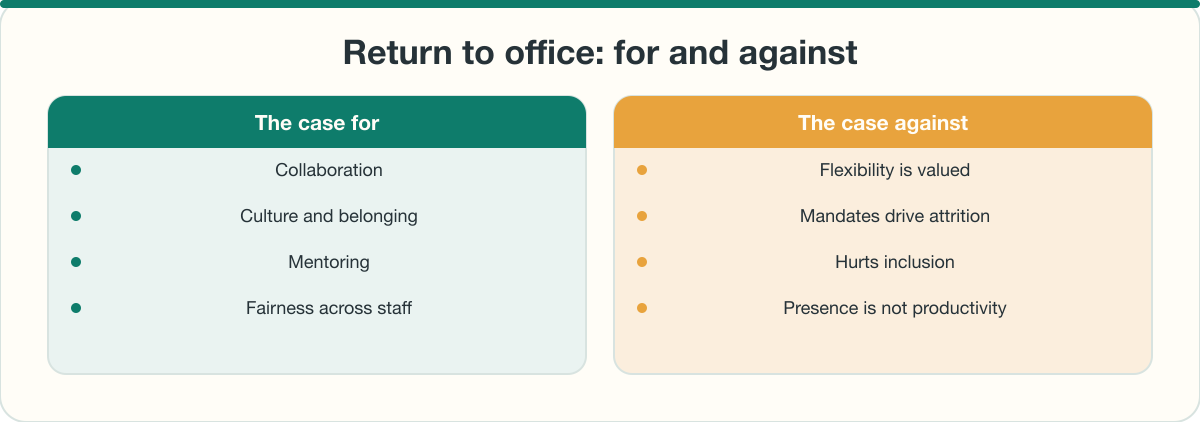
- Collaboration. Leaders point to the spontaneous conversation, the quick desk-side question, the whiteboard session that would never have been scheduled. Some work genuinely does benefit from being in the same room.
- Culture and belonging. The argument that a shared physical space builds the trust, relationships and sense of common purpose that hold a team together.
- Mentoring. A real concern that junior staff learn by osmosis, by overhearing and watching more experienced colleagues, and that fully remote work leaves them adrift.
- Fairness. If some people are in and some are out, managers worry about a two-tier workforce and uneven visibility. A blanket rule feels, to them, like it levels the field.
Then there are the reasons companies say less loudly. Many are locked into long, expensive office leases and would rather fill them than admit the space is a stranded cost. And some mandates are, plainly, about control: a preference for seeing people at desks, and a lingering belief that visible presence equals effort.
What does the evidence actually say?
This is where the debate gets more honest, because the evidence does not tidily back the mandate.
Start with how much flexibility is worth to people. Survey after survey of workers finds that the ability to choose where and when they work ranks among the most valued parts of a job, sometimes rivalling pay. Take it away and you are effectively cutting compensation without cutting the salary, and people respond accordingly.
They respond, often, by leaving. Research and workforce surveys have repeatedly linked strict RTO mandates to higher attrition, with a nasty twist for employers: the people most able to walk are frequently the most senior and skilled, the ones with the leverage and the offers. A widely cited study of large US firms by researchers at the University of Pittsburgh found that return-to-office mandates were not associated with better financial performance, and were associated with lower employee satisfaction. Presence, in other words, did not buy the results leaders assumed it would.
Rigid mandates also tend to fall unevenly. Flexibility is least optional for people with caring responsibilities, for many women who still shoulder the bulk of that work, and for anyone with a long or costly commute or a disability that makes daily travel draining. A one-size-fits-all rule quietly pushes those groups towards the door, which undercuts the "fairness" argument and the inclusion goals most companies claim to hold.
Underneath all of it sits the core flaw: presence is not productivity. A person at a desk can be stalled, distracted or quietly disengaged, and a person at home can be doing the best work of their career. Judging people on where they sit rather than what they produce is a measurement error. It is close cousin to presenteeism, the old habit of treating hours-at-desk as a proxy for value, and it is exactly the thinking a results-only work environment is designed to kill: judge the output, not the attendance.
None of this means the office is worthless. The counter-evidence does not prove that everyone should be remote forever. It proves something narrower and more useful: that a blanket mandate is a blunt tool aimed at a problem that usually needs a scalpel.
The case for and against RTO
 Laid out plainly, the strongest version of each side looks like this.
| The case for RTO | The honest counter |
|---|---|
| Spontaneous collaboration and faster problem-solving | Much collaboration is scheduled anyway, and chat and video handle most of the rest |
| Culture, belonging and mentoring for junior staff | Culture comes from how people are treated, not from desks, and mentoring can be structured deliberately |
| Fairness, with everyone held to one standard | Blanket rules ignore that roles and lives differ, and often feel like control rather than fairness |
| Justifies the cost of expensive office space | A property lease is a weak reason to override how people do their best work |
| Easier oversight and visibility for managers | Presence is not productivity, and visible busyness is not the same as output |
The pattern is clear. Almost every argument for the office is really an argument for some time together for some kinds of work, not for a rigid, universal, five-day rule.
Is hybrid the honest middle ground?
For most knowledge work, the sensible answer sits between the two poles, and it is where a lot of companies have quietly landed: a hybrid model with a couple of intentional in-office days for the things that genuinely benefit from being together, and the rest of the week left flexible.
Work-Life Balance Jobs with Genuinely Reduced Hours
Save one to come back to it — it's free.



Hybrid is not automatically the best of both worlds, though. Done badly it becomes the worst of both: you commute in only to sit on video calls with people in other locations, or you get the coordination problems of remote plus the rigidity of the office. Done well, it means choosing office days for a reason, protecting deep focus for the days at home, and being deliberate rather than defaulting to habit. We weigh this up properly in our guide to the pros and cons of hybrid work, and in the wider comparison of remote versus office work.
The office days you do keep are also more useful when you spend them on collaboration and reserve solo, focused work for quieter settings. An open-plan floor is often the worst place to do genuine deep work, so using precious office time for the meetings and the whiteboarding, not the head-down concentration, gets the most from both.
How should you respond to an RTO mandate?
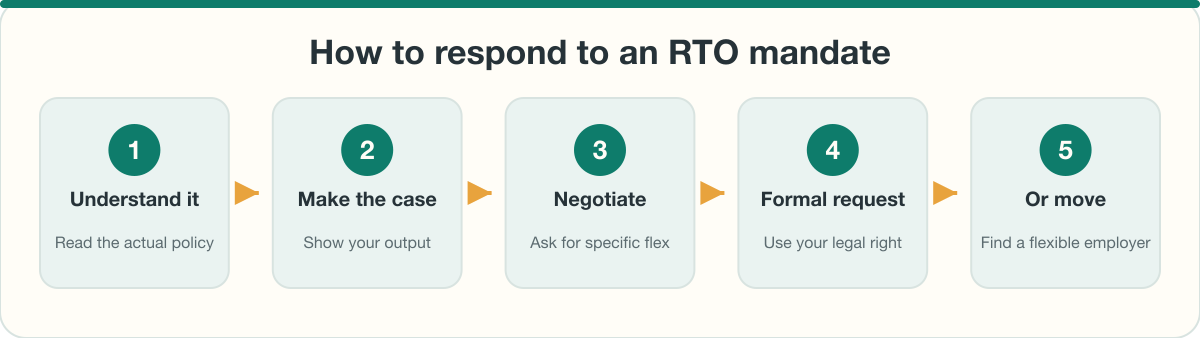 If a mandate lands on you, panic and outrage are understandable and unhelpful. A calm, structured response gives you the best odds of protecting what matters.
-
Understand the actual policy. Read it properly. How many days, which days, are there exceptions, how is attendance measured, and is there any discretion for individual circumstances? You cannot negotiate what you have not read.
-
Make the value case, with evidence. Managers respond to output, not complaints. Come with a record of what you have delivered remotely, ideally showing that your results held up or improved. Frame the conversation around how you do your best work, not around what you would prefer.
-
Negotiate specific flexibility. Vague requests get vague refusals. Ask for something concrete: two office days instead of four, a fixed remote day, flexible core hours to dodge the worst of the commute. A precise, reasonable ask is much harder to reject than "can I stay home". If you already have an agreed arrangement and your employer is trying to take it back, that is a different question with a different answer: see can my employer withdraw flexible working.
-
Use a formal flexible-working request where you have the right. Depending on where you work, you may have a legal route. In the UK, for example, employees have had the right to request flexible working from their first day since April 2024, and employers must handle the request properly. A formal request carries more weight than a chat by the coffee machine.
-
If it will not budge, vote with your feet. Some employers simply will not move, and no amount of reasoning changes that. At that point the strongest move is not to quietly comply and resent it. It is to find an employer that treats flexibility as normal rather than a concession you have to keep re-earning.
One response worth naming and avoiding is coffee badging: swiping in briefly to satisfy an attendance tracker, then leaving. It is a rational reaction to a rule people find pointless, but it is a symptom, not a fix. It signals a broken policy without solving anything, and it can put a target on your back. Better to change the policy, negotiate a real arrangement, or change the employer.
Which brings it back to the honest bottom line. You can argue the case, and you should. But if your company has decided that where you sit matters more than what you produce, the most powerful thing you can do is choose one that has decided otherwise. There is a growing pool of companies that treat flexibility as the default, and you can browse flexible-hours and reduced-hours employers on 4dayweek.io to find them.
Frequently asked questions
What is a return-to-office mandate? It is an employer policy requiring staff to work from a company site for a set number of days each week, reversing the remote or hybrid arrangements that became common after 2020. Mandates range from one or two light anchor days to a strict five days with attendance tracked.
Why are companies bringing people back to the office? The stated reasons are collaboration, culture, mentoring for junior staff and fairness. The quieter ones are expensive office leases that firms want to justify and a management preference for visibility and control. The strength of each reason varies a lot by company and role.
Do return-to-office mandates actually improve productivity? The evidence is weak. A widely cited University of Pittsburgh study of large US firms found RTO mandates were not linked to better financial performance but were linked to lower employee satisfaction, and other research ties strict mandates to higher attrition. Presence is not the same as productivity.
How should I respond to an RTO mandate I disagree with? Read the policy in full, make an evidence-based case built on your output, and negotiate a specific, reasonable arrangement rather than a vague one. Use a formal flexible-working request if you have that right where you work, and if the employer will not move, look for one that treats flexibility as normal.
Tired of being judged on where you sit instead of what you produce? Browse four-day-week and flexible-hours roles on 4dayweek.io.




Get 4-day week jobs in your inbox
Create a free account to receive curated opportunities weekly.
Sign up for freeFree forever. No spam, unsubscribe anytime.