
The US Bureau of Labor Statistics (BLS) puts average paid vacation in private industry at 11 days after one year of service and 20 days after 20 years, in its March 2026 chart, which we read as an average among workers who have it. BLS also reports that paid vacation leave was available to 80 percent of private industry workers in its Employee Benefits in the United States release for March 2026.
(General information, not legal or tax advice. United States, private-sector employers unless a sentence says otherwise.)
How much PTO is normal in the US?
These are the BLS averages for private industry from the chart titled "Paid leave benefits: Average number of sick and vacation days by length of service requirement, March 2026". We use only the paid vacation line:
- After 1 year of service: 11 days, which is 2.2 weeks of five-day weeks
- After 5 years: 16 days, or 3.2 weeks
- After 10 years: 18 days, or 3.6 weeks
- After 20 years: 20 days, or 4 weeks
The chart page has no definitions or footnotes. BLS's Handbook of Methods says of its benefit provision averages: "In all cases, the averages include only those workers with the provision in question." We read that as covering only workers who have paid vacation, though the Handbook does not mention vacation days by name.
None of this is required by the Fair Labor Standards Act (FLSA). The Department of Labor says the FLSA "does not require payment for time not worked, such as vacations, sick leave or federal or other holidays." BLS reports paid sick leave, paid vacation and paid holidays as separate benefits (Table 6), so we say "vacation days" for BLS figures and "PTO" where an employer's page does.
Who gets paid vacation at all?
This is BLS Table 6, private industry, March 2026, showing the share of workers with access to paid vacation:
| Worker group | Access to paid vacation |
|---|---|
| All workers | 80% |
| Full time | 93% |
| Part time | 38% |
| Management, professional, and related occupations | 91% |
| Sales and office occupations | 79% |
| Service occupations | 57% |
That is a gap of 55 percentage points between full-time and part-time workers. For the Great Britain rules for part-timers, see our page on part-time holiday entitlement.
Wage level and establishment size show gaps too. In the same table, access was 55 percent in the lowest 25 percent of occupations by average wage and 94 percent in the highest, and 71 percent in establishments with 1 to 49 workers against 91 percent in those with 500 or more.
How do vacation days grow with service?
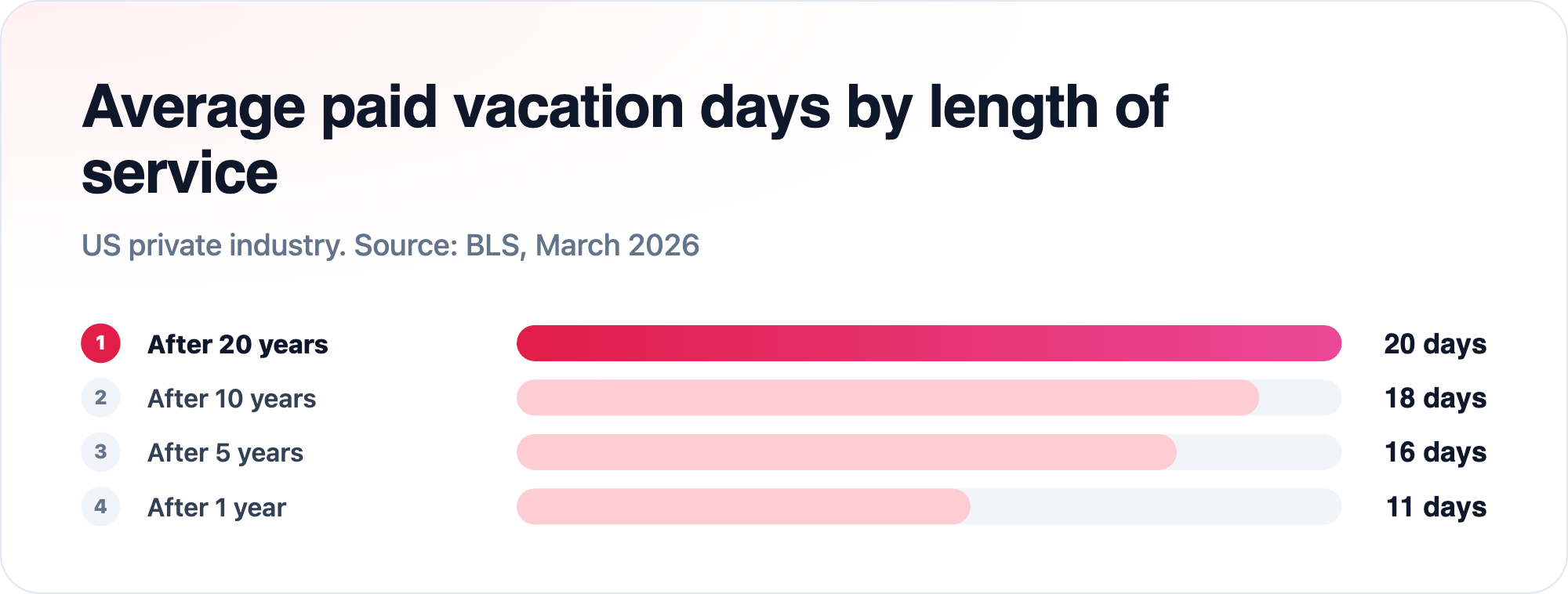 They rise with service, by 9 days in all from the first year to the twentieth, in the chart above.
BLS also describes how workers are spread. Its "Who receives paid vacations?" factsheet says: "In 2026, thirty-two percent of private industry workers received 10 to 14 days of paid vacation after one year of service." It also says: "After 10 years of service, 30 percent of private industry workers received between 15 and 19 days of paid vacation."
Does federal law require PTO or holidays?
The Department of Labor says the FLSA "does not require payment for time not worked, such as vacations, sick leave or federal or other holidays." Its page on vacation leave adds: "These benefits are matters of agreement between an employer and an employee (or the employee's representative)."
The same page adds two rules for government contracts. Under the Service Contract Act (contracts above $2,500), "holiday and/or vacation fringe benefit requirements are stated in the SCA wage determinations". Under Davis-Bacon, "holiday pay and/or vacation pay is required for specific classifications of workers only if" the covered contract's wage determination specifies it.
Some states do require paid sick leave: the Department of Labor's Women's Bureau counted 18 states and the District of Columbia as of December 2024.
So read what your own offer or policy says. See also our PTO advice page.
How does the US compare with Great Britain and EU minimums?
Great Britain and the EU set legal floors. The BLS figures above describe benefits in private industry, not a floor.
In Great Britain, GOV.UK says: "Almost all people classed as workers are legally entitled to 5.6 weeks' paid holiday a year". For a five-day week it says: "Most workers who work a 5-day week must receive at least 28 days' paid annual leave a year." It also says an employer "can choose to include bank holidays as part of a worker's statutory annual leave."
In the EU, Article 7(1) of the Working Time Directive (Directive 2003/88/EC on EUR-Lex) says: "every worker is entitled to paid annual leave of at least four weeks".
Four weeks is 20 days on a five-day week, the BLS average after 20 years of service. The GOV.UK figure of 28 days is more.
The two do not always count the same days: GOV.UK says an employer can include bank holidays in statutory annual leave, while BLS reports paid vacation and paid holidays separately.
What do employers on our site publish?
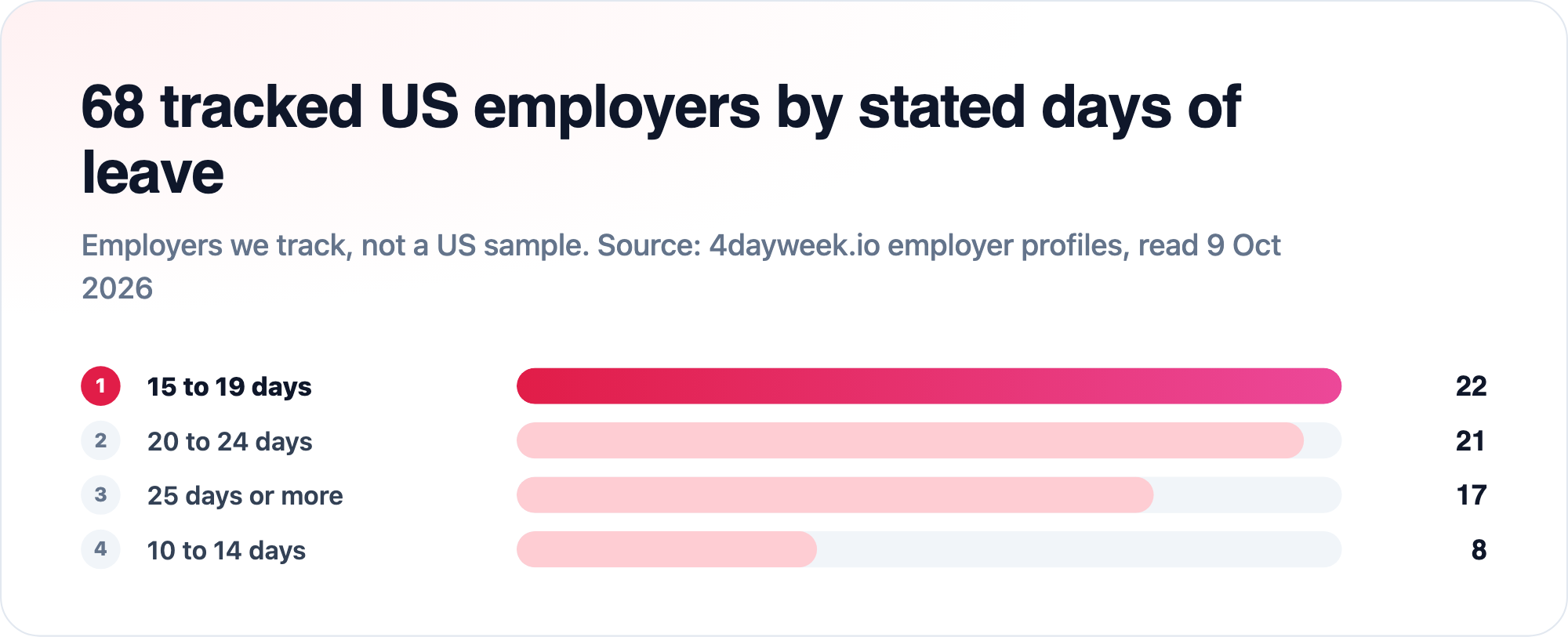 4dayweek.io is a four-day-week job board, so the employers we track are not a sample of US employers.
On 9 October 2026 we had 185 US employer profiles. Of those, 75 (41%) state an explicit full-time number of paid days, 24 say unlimited PTO and 86 state no usable number.
Of the 75 with a number, 43 state holidays as on top, 7 state them as included and 25 do not say either way. The figures below pool the 43 and the 25: 68 employers whose number is given without holidays or whose basis is not stated.
For those 68 employers:
- The median stated figure is 20 days, or 4 weeks.
- The middle half (25th to 75th percentile) runs from 15 to 22.75 days.
- The range is 10 to 34 days.
- The values recorded most often are 15 days (18 employers), 20 days (16) and 25 days (8).
By band: 15 to 19 days, 22 employers; 20 to 24 days, 21; 25 days or more, 17; 10 to 14 days, 8; none under 10 days.
Generous PTO Jobs
Save one to come back to it — it's free.



Of the 68, 47 are tagged four-day-week on this site (44 four-day-week and 3 pro-rata four-day-week), 11 are tagged generous PTO and 10 have other schedule types. We do not call the median a US average or a typical figure.
Nine of the 68 say their number rises with tenure, for example CareMessage: 15 days from day one, 20 after 24 months. Shifting a random 10% of the 68 values by 5 days up or down, over 2,000 simulations, moved the median between 16.5 and 20 days.
How we counted
We read each employer's stated leave by hand and counted the standard full-time number of paid days, ignoring sick, wellness, volunteer and sabbatical days. Weeks were converted at five days, including for 13 employers tagged four-day-week on this site; counting a week as four days for those 13 would move the median to about 18 and the upper quartile to 21. Hours figures were converted at eight hours a day, and "up to" or approximate figures were excluded. The numbers were tracked from public pages and not verified with employers.
We also checked our reading against employers' own pages. We tried 58 employers drawn at random from UK, US and other-country profiles (not US only). 36 had a usable number on their own page. With weeks converted at five days throughout, our reading matched in 32 of them (89%). Four differed, two of them four-day-week employers whose weeks we had counted as four days, and 22 had no usable number on their own page. Eight of the 36 came from closed ads, old hiring posts or archived copies. That check confirms how we read the text, not that any policy is current.
Company profiles on this site also carry a separate "vacation days" field. It is a different measure: it can include public holidays or personal days, so it will not always match the numbers here.
Five employers, in their own words
We read each page on 9 October 2026. The career pages are undated, and the If/When/How job description is marked "Prepared: August 2026". Check the current policy before you rely on any line.
- Discord. "Stay refreshed with four weeks of PTO, 16 paid holidays each year including a week off for the winter holidays". The page adds: "Benefits listed apply to US-based, full time employees." In the lines we read, it does not say whether the four weeks rise with tenure.
- CareMessage. "15 vacation days per year on day one for everyone, 20 days per year after 24 months" and "18 paid holidays, including a 5-day mid-year break and a 5-day end-of-year break". In the lines we read, it gives no figure above 20 days.
- Cooptimize. "5 Weeks + 2 Hours PTO", "1 Week of Accrued PTO on your first day" and "4-Day, 32 Hour Work Weeks". In the lines we read, it does not say whether public holidays sit inside the five weeks.
- Search Engine Journal. "2 weeks PTO", then "U.S.-based employees get 10 holidays observed, plus 3 floating holidays." A separate line offers "2 weeks a year to take care of yourself or a family member", which we read as paid sick leave. In the lines we read, it does not say whether the PTO rises with tenure.
- If/When/How. "sick leave, vacation (starting at 15 days a year, upfront), and holidays; plus, a one-week office closure in December." and "including a 4-day work week". In the lines we read, it does not say what the vacation number rises to.
How should you read the PTO line in a job ad?
- Are holidays on top or inside the number? Discord, CareMessage and Search Engine Journal each list holidays apart from PTO or vacation days. Among our 75 US profiles with a number, 43 state holidays as on top, 7 as included and 25 do not say. Ask if an ad is silent.
- Does the number rise with tenure? CareMessage moves from 15 days to 20 after 24 months, and If/When/How says "starting at 15 days a year".
- Does PTO cover sick days? Search Engine Journal and If/When/How list sick leave separately, and BLS counts sick leave and vacation separately.
- Is it for full-time staff only? Discord's page says its listed benefits apply to "US-based, full time employees".
- Is it a number at all? Of our 185 US profiles, 24 say unlimited PTO and 86 state no usable number. See our pages on unlimited PTO and unlimited PTO companies. Ask for a number, and ask whether a week means five days or four.
Where to look for generous PTO
Our editorial rule for tagging an employer "generous PTO" on 4dayweek.io is that it publishes an explicit number of days off per year, counted as the total including public holidays and company shutdowns, that clears a regional bar. For a United States or Canada employer, the bar is 30 or more total days. That is our rule, not a law.
For roles at employers tagged that way, start with Generous PTO Jobs, and read each employer's own page for its current policy.
Frequently asked questions
Is two weeks of vacation normal in the US?
BLS lists an average of 11 paid vacation days after one year of service, which is 2.2 weeks of five-day weeks (private industry, March 2026; on our reading of BLS's method note, among workers who have paid vacation).
Do US employers have to give paid holidays?
The Department of Labor says the FLSA "does not require payment for time not worked, such as vacations, sick leave or federal or other holidays", and notes exceptions on some federal government contracts. BLS found 81 percent of private industry workers with access to paid holidays in March 2026.
Do part-time workers get paid vacation?
Far fewer have access. In March 2026, 38 percent of part-time private industry workers had access to paid vacation, against 93 percent of full-time workers (BLS).
How does four weeks of PTO compare with the data?
Four weeks is 20 days on a five-day week, the BLS average after 20 years of service (March 2026) and the EU minimum under Article 7(1) of the Working Time Directive. Of our 68 tracked employers, 16 are recorded at 20 days, but they are not a sample of US employers.




Get 4-day week jobs in your inbox
Create a free account to receive curated opportunities weekly.
Sign up for freeFree forever. No spam, unsubscribe anytime.