
For most of the last century the deal was simple. Work hard for forty years, then retire and finally do the things you always meant to. A growing number of people have looked at that bargain and decided the timing is backwards. Why save all your freedom for the decade when your knees have given out?
A micro-retirement (also called a mini-retirement) is an intentional, self-elected, extended break from full-time work, typically six months to two years, taken during your career rather than saved for the end of it. It is retirement in instalments: real time off now, spread through your working life, instead of one long stretch at 65.
What is a micro-retirement?
The core idea is a deliberate pause. You stop full-time work for a meaningful stretch, use the time for whatever matters (travel, family, a project, recovery, a rethink), and then return to work afterwards.
The concept is not new. It traces back to Tim Ferriss and the "mini-retirements" he described in The 4-Hour Workweek in 2007, where he argued for distributing your leisure throughout life rather than deferring all of it to old age. What changed is who is doing it. In 2025 the idea surged as a Gen Z and younger-millennial trend, rebranded as the micro-retirement and shared widely on social media.
Two features define it and separate it from a simple holiday. First, length: a micro-retirement is measured in months, not days, long enough to genuinely reset. Second, self-direction: nobody grants you a micro-retirement. You choose it, you fund it, and you carry the risk. It is usually unpaid and self-funded, with no guaranteed job to return to.
That last point is the whole reason to take it seriously. A micro-retirement is not a perk your employer hands you. It is a bet you place on yourself.
Why is the micro-retirement trend growing?
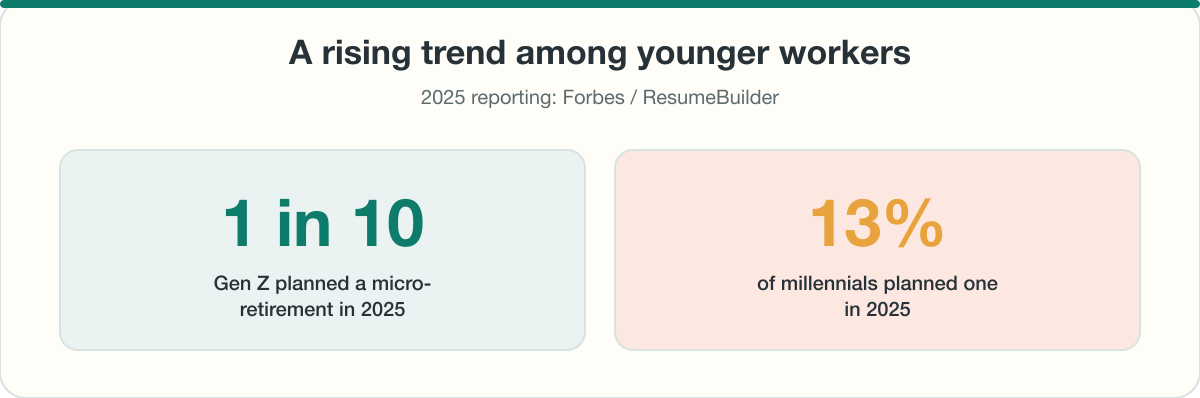 The surge is not really about wanderlust. It is about a generation looking at burnout, stalled progression and low engagement, and deciding the old sequence no longer adds up.
Reporting in 2025 (Forbes, citing ResumeBuilder-type surveys) found that roughly one in ten Gen Z workers and around 13% of millennials planned a micro-retirement in 2025. That is a striking share of the workforce planning to voluntarily step out, and it points to a few forces pushing in the same direction.
- Burnout that a fortnight cannot fix. After years at full tilt, a two-week holiday resets almost nothing. People want a break long enough to actually change how they feel.
- Different values. Younger workers are more willing to trade income and linear progression for time, autonomy and experience now, rather than banking it all for a retirement that feels abstract and distant.
- Low engagement. When work feels disposable and loyalty is rarely rewarded, the cost of stepping away for a while feels lower than it did to previous generations.
- Visible proof. Social media is full of people who took a micro-retirement and came back fine, which makes the leap feel less reckless and more like a known path.
None of this means it is easy or free. It means a lot of people have decided the trade is worth it.
How does a micro-retirement work in practice?
The romance is in the idea. The success is in the admin. Three things decide how it goes.
Funding it. This is the hard part, because a micro-retirement is almost always self-funded. You need to cover your living costs for the whole break, plus a cushion for the job hunt at the end. Most people save aggressively for a year or two beforehand, treating it like a specific savings target with a date attached. Some keep a trickle of freelance or part-time income running to stretch the runway. The single biggest cause of a micro-retirement going wrong is money running out before you are ready to go back, so this is the number you solve first, not last.
Choosing the length. Six months and two years are very different bets. A shorter break is cheaper, easier to explain and lower-risk, but may not be long enough to truly disconnect. A longer one delivers a deeper reset but costs more and widens the gap on your CV. Pick a length you can genuinely afford, then add a re-entry runway on top so you are not job-hunting in a panic.
Managing the CV gap and re-entry. Unlike a sabbatical, no job is held for you, so returning means applying cold into whatever the market looks like when you come back. That is the real risk. You reduce it by keeping one skill lightly warm, staying loosely connected to your network, and preparing a clear, confident story about the break rather than apologising for it. Career gaps are far less stigmatised than they were, and a well-spent, deliberate break can read as maturity. It only becomes a problem if you treat it like one. A career break handled well is an asset you can talk about, not a hole to hide.
If the funding and re-entry risk feel like too much, there is a lighter version. A workation lets you travel and change your surroundings while keeping your paid job, which is not a rest in the same way, but it carries none of the same financial risk.
Micro-retirement vs sabbatical vs career break vs phased retirement
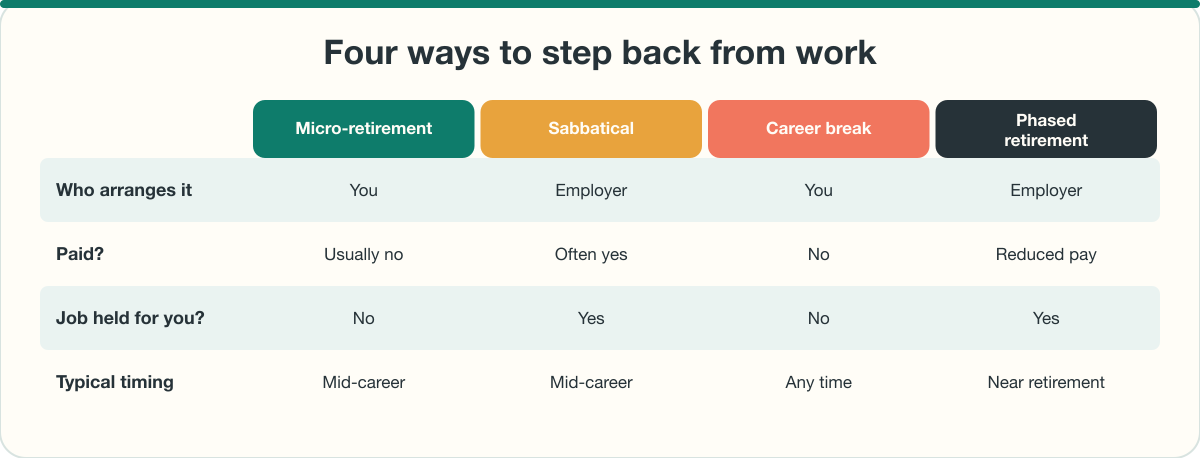 These four get lumped together, and they should not be, because the risk you carry is completely different in each.
A micro-retirement is self-elected, self-funded and usually leaves you without a job to return to. A sabbatical is granted by your employer, who holds your role open, so it is far lower-risk (and sometimes paid). A career break is the broad umbrella term for any extended, intentional time out, of which a micro-retirement is really a branded, deliberately restorative version. Phased retirement is different in kind: it is gradually reducing your hours as you approach actual retirement, not a mid-career pause you return from at full speed.
| Who arranges it | Paid? | Job held for you? | Typical timing | |
|---|---|---|---|---|
| Micro-retirement | You | Usually no, self-funded | No | Anytime mid-career, roughly 6 months to 2 years |
| Sabbatical | Your employer | Sometimes paid or part-paid | Yes | After qualifying service, usually 1 to 3 months |
| Career break | You | No | No | Anytime, months to a couple of years |
| Phased retirement | You and employer | Yes, reduced pay for reduced hours | Yes, ongoing | The years just before full retirement |
The practical takeaway: if your employer offers a sabbatical, ask about that first, because it buys you time without giving up the job. A micro-retirement is what you reach for when you want longer, a clean break, or freedom your employer will not grant, and you are willing to fund and plan for it yourself. If you are near the end of your career, phased retirement is a gentler way to ease down than stopping altogether.
Is a micro-retirement right for you?
Work-Life Balance Jobs with Genuinely Reduced Hours
Save one to come back to it — it's free.



It suits some situations far better than others. Be honest about which one you are in.
It works well if you have savings or a way to fund the break, few fixed commitments that make going without income dangerous, skills that will still be in demand when you return, and a genuine reason to stop rather than a vague restlessness. People who plan the money and the return tend to come back clearer, not derailed.
It works badly if the break would drain your safety net, if you have dependents relying on a steady income, if your field moves so fast that six months out leaves you behind, or if you are hoping the time off will fix a problem that is really about the kind of work you do. A micro-retirement is a reset, not a cure. If you return to the exact conditions that exhausted you, you will need another one soon enough.
The honest test is this: are you running towards something, or just away from your current job? If it is the latter, the break may feel wonderful and then land you right back where you started.
The alternative: building rest into working life
Here is the uncomfortable question underneath the whole trend. If so many people feel they have to quit and disappear for a year to feel human again, what does that say about the way we work the rest of the time?
A micro-retirement is a dramatic fix for a chronic problem. It is powerful, but it is also expensive, risky and available mainly to people who can afford to stop earning. Not everyone can. For most people, the more durable answer is to build the rest into working life so the pressure never accumulates to breaking point.
That is the case for reduced hours. A four-day week, a nine-day fortnight or genuinely flexible hours give you recovery time every single week, not once a decade. You get the space to see family, pursue a project or simply breathe, without draining your savings or gambling your career on a cold re-entry. When your normal week already has slack in it, the urge to escape work entirely tends to fade, because you are not being pushed to empty in the first place.
Put simply: a micro-retirement helps you recover from a working life that takes too much. Reduced hours help you build a working life that does not. If you would rather not have to escape your job to enjoy your life, browse four-day-week, flexible and reduced-hours roles on 4dayweek.io.
Frequently asked questions
How long is a micro-retirement? Typically six months to two years, long enough to properly disconnect and reset, but bounded so it does not become an open-ended exit from work. The right length is whatever you can fund comfortably, plus an extra cushion of savings for the job hunt when you return.
Is a micro-retirement paid? Almost never. Unlike a sabbatical, which your employer grants and sometimes pays, a micro-retirement is self-elected and self-funded. You cover your own living costs for the whole break, which is why saving a runway in advance is the most important part of the plan.
What is the difference between a micro-retirement and a sabbatical? A sabbatical is arranged with your employer, who holds your job open while you are away, so it is lower-risk. A micro-retirement is something you choose and fund yourself, usually with no guaranteed role to return to. If your employer offers a sabbatical, it is worth asking about that first.
Will a micro-retirement hurt my career? Usually not, if you can explain it clearly and re-enter with a plan. Career gaps are far more accepted than they once were, and a deliberate, well-spent break can signal maturity and initiative. The risk is practical rather than reputational: no job is held for you, so you need savings and a return strategy ready.
Would you rather not have to escape work to enjoy your life? Browse four-day-week, flexible and reduced-hours roles on 4dayweek.io.




Get 4-day week jobs in your inbox
Create a free account to receive curated opportunities weekly.
Sign up for freeFree forever. No spam, unsubscribe anytime.