
When something happens, a death, a serious diagnosis, a family emergency, work is the last thing that should be pulling at you.
And yet the first anxious question is often the most practical one: am I even allowed time off for this?
The honest answer, in the UK, is more complicated than most people assume, and it's about to change. This guide sets out what compassionate leave actually is, what you're entitled to right now, whether it's paid, and how to ask.
What is compassionate leave?
Compassionate leave is time off work to deal with a bereavement, a serious illness in the family, or a personal or family emergency.
Some employers call it bereavement leave, family leave, or special leave. The everyday meaning is the same: space to grieve, care for someone, or handle a crisis without having to pretend everything's normal at your desk.
Here's the part that surprises people: in the UK, there is currently no general legal right to compassionate leave. Whether you get it, and whether it's paid, depends mostly on your employer's policy. But there are specific legal rights that sit alongside it, and a bigger one on the way.
Your compassionate leave rights in the UK
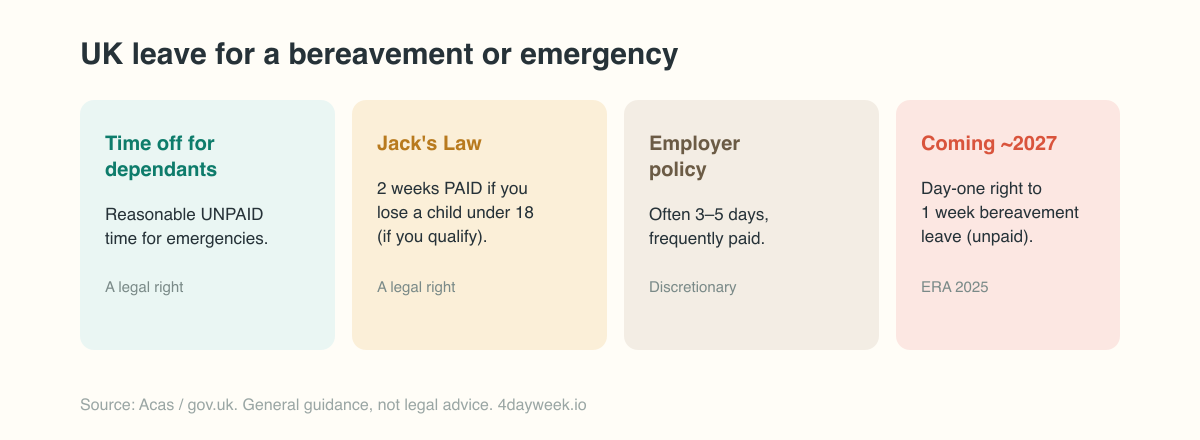
Let's separate what the law guarantees from what your employer chooses to offer.
1. Time off for dependants (a legal right). Every employee has the right to take a reasonable amount of unpaid time off to deal with an emergency involving a dependant, a partner, child, parent, or someone who relies on you. That covers a dependant falling seriously ill, being injured, or dying. It's designed for the immediate crisis and arranging what needs arranging, not extended leave.
2. Parental Bereavement Leave, "Jack's Law" (a legal right). If you lose a child under 18 (or suffer a stillbirth after 24 weeks), you're entitled to two weeks' leave, and it's paid if you meet the qualifying conditions. This is the one clear, paid statutory bereavement right in place today.
3. Employer compassionate leave (discretionary). Beyond those, most decent employers offer their own compassionate leave, commonly 3–5 days for the death of a close relative, and often paid, with less for more distant relationships. This is policy, not law, so it varies. Check your staff handbook or contract.
Is compassionate leave paid?
It depends which of the above applies:
| Type | Paid? |
|---|---|
| Time off for dependants (emergencies) | Unpaid (by law) |
| Parental Bereavement Leave ("Jack's Law") | Paid (if you qualify) |
| Employer compassionate leave | Depends on the policy, often paid, but check |
So there's no single answer, which is exactly why it's worth knowing your employer's policy before you ever need it.
The new bereavement leave law (coming ~2027)
Here's the change worth knowing about, because it fills the biggest gap.
Under the Employment Rights Act 2025, the UK is introducing a broader statutory right to bereavement leave for all employees, not just parents. As currently set out, it will provide at least one week of leave following a bereavement, as a day-one right (no qualifying service needed). It's expected to be unpaid for most (parents losing a child keep their paid entitlement), and is anticipated to come into force around 2027, with the detail, including who counts as a close relationship and how pregnancy loss is covered, set out in secondary legislation.
A related change lands sooner: from 6 April 2026, a new Bereaved Partner's Paternity Leave gives partners up to 52 weeks of leave if they lose their partner before their child's first birthday.
The direction of travel is clear: the UK is moving from "hope your employer is kind" toward a baseline everyone can rely on. (Check gov.uk or Acas for the current position when you need it, the details are still being finalised.)
How to ask for compassionate leave
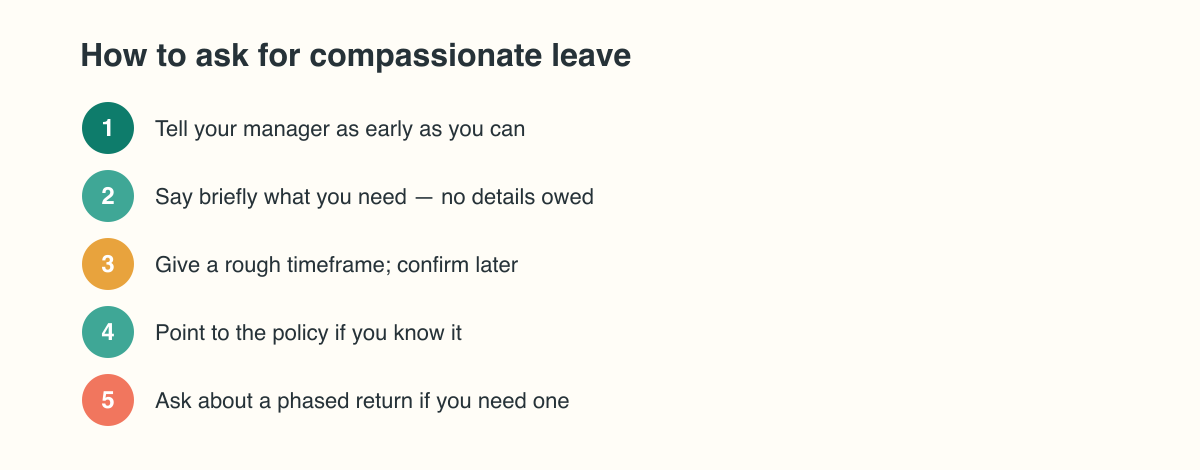
When you're in the middle of it, you shouldn't have to craft the perfect message. Keep it simple.
- Tell your manager as early as you can, a call, a text, or a short email is fine.
- Say what you need, briefly. "My father has died and I need to take some time off from [date]." You do not owe anyone the details.
- Give a rough timeframe if you can, and say you'll confirm as things become clearer.
- Point to the policy if you know it, but don't feel you have to negotiate while grieving.
- Ask about a phased return if you need one. Coming back at full speed on day one is rarely realistic.
A good employer will not make you justify your grief. If yours does, that tells you something.
How much time should you take?
There's no correct amount, grief doesn't run to a schedule, and neither should you feel you have to. But some rough guidance helps:
- For the immediate aftermath of a close bereavement, the death of a partner, parent or child, most people need at least a few days to a week or two just to handle the practicalities (arrangements, family, the funeral) before they can think about work at all.
- For a more distant loss, a day or two to attend a funeral and grieve may be enough.
- For a serious family illness or emergency, it depends entirely on the situation and who's relying on you.
The mistake people most often make is taking too little and returning before they're ready, then struggling for months. It's usually better to take what you need up front, and to ask about a phased return rather than snapping straight back to full capacity.
Work-Life Balance Jobs with Genuinely Reduced Hours
Save one to come back to it — it's free.


Returning to work after a bereavement
Coming back is often harder than being off. Grief doesn't end when compassionate leave does.
- A phased return, reduced hours or days for a while, can make the difference between coping and crumbling. Ask if it's possible.
- Tell your manager what you need on your return: whether you want people to acknowledge it or leave it be, and what you can and can't take on for now.
- Expect bad days. Grief comes in waves; a good employer will understand that productivity won't be linear for a while.
- Know your limits. If you're not coping, say so. Occupational health, an employee assistance programme, or your GP are all there for exactly this.
What if your employer refuses, or has no policy?
If there's no compassionate leave policy, or your request is refused, you still have options:
- Fall back on your legal rights. You can use the right to unpaid "time off for dependants" for the immediate emergency, and Parental Bereavement Leave if it applies.
- Use annual leave to cover the time if you need paid days and nothing else is offered.
- Ask about unpaid leave as a last resort to get the time you need.
- Raise it. A blanket refusal to give any time off for a close bereavement is a red flag worth escalating, and, frankly, a sign of a workplace that doesn't see you as a person.
How an employer treats you at your lowest tells you almost everything about the culture.
When work makes hard times harder
A bereavement or a family crisis has a way of clarifying things. A lot of people come back from one asking why they were giving so much of their life to a job in the first place.
If that's you, it's worth knowing the world of work is changing. More employers now build in genuine flexibility and reduced hours, four-day weeks, compressed schedules and flexible roles that leave room for the parts of life that actually matter. Sometimes the healthiest response to a hard year is finding work that fits around your life, not the other way round.
Frequently asked questions
How many days is compassionate leave in the UK? There's no set legal number for general compassionate leave, it's set by your employer, commonly 3–5 days for a close bereavement. The legal rights that do exist are unpaid "time off for dependants" for emergencies and two weeks' paid Parental Bereavement Leave if you lose a child under 18.
Is compassionate leave paid? Sometimes. Statutory "time off for dependants" is unpaid; Parental Bereavement Leave is paid if you qualify; employer compassionate leave is often paid but depends on the policy.
Do I have a legal right to time off when a relative dies? You have a right to reasonable unpaid time off to deal with the immediate emergency involving a dependant, and paid Parental Bereavement Leave if it's your child under 18. A broader statutory bereavement-leave right for all employees is expected around 2027.
How do I ask for compassionate leave? Tell your manager as soon as you can, state briefly what's happened and roughly how long you need, and confirm details when you're able. You don't have to explain or justify your grief.
What is Jack's Law? It's the common name for Parental Bereavement Leave, the right to two weeks' leave (paid if you qualify) for parents who lose a child under 18 or have a stillbirth after 24 weeks.
If a hard year has you rethinking work, explore four-day-week and reduced-hours roles on 4dayweek.io →




Get 4-day week jobs in your inbox
Create a free account to receive curated opportunities weekly.
Sign up for freeFree forever. No spam, unsubscribe anytime.