
The pitch is seductive. Answer your emails from a terrace in Lisbon, close the laptop at five, and go find dinner by the water. Thousands of remote workers now do exactly this, and call it a workation. The catch is that the version in the brochure and the version most people actually live are not the same thing, so it pays to get the setup right before you book the flight.
A workation (work plus vacation) is an intentional, usually employer-supported arrangement where you do your normal paid job remotely from a leisure or travel destination for a set period. You are on the clock and being paid the whole time. You are not on formal leave.
What is a workation, really?
Strip away the sunset photos and a workation is a location change, nothing more. Your job, your hours, your deadlines and your salary all stay the same. What moves is the desk. Instead of your spare room, you are working from an apartment in Barcelona, a cabin two hours from home, or a co-working space in Bali.
That distinction matters because it sets expectations. On a workation you are expected to deliver your normal output. Meetings still happen. Slack still pings. The difference is that when you shut the laptop, your evenings and weekends land somewhere more interesting than your usual commute.
This is remote flexibility taken to its logical end. If a company already trusts you to work from anywhere, the physical distance between your keyboard and the office is irrelevant. A workation just uses that freedom to put a view outside the window and a trip on either side of the working day.
The word itself has stretched to cover a lot. A weekend where you work Friday then stay through Sunday is a light workation. A month split between a beach town and your job is a serious one. What they share is the core deal: you are travelling, but you have not stopped earning, and you have not spent your holiday allowance to do it.
Why do people take workations?
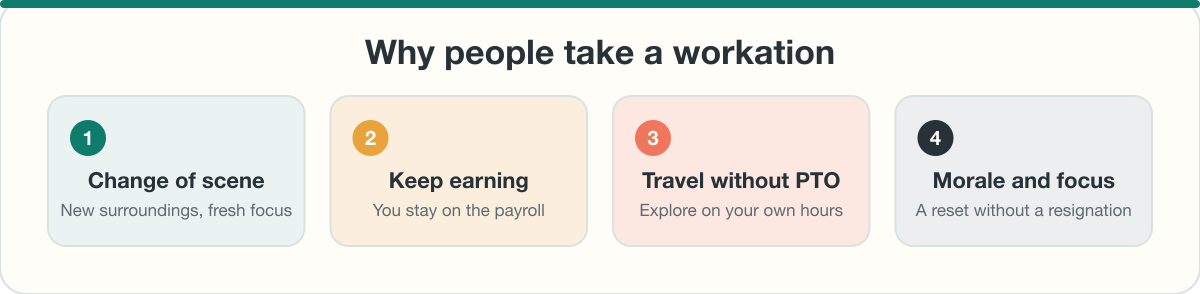 The appeal is easy to understand once you have felt the particular flatness of working from the same four walls for a year.
- A change of scene. New surroundings can lift focus and mood in a way a rearranged desk never will. For a lot of remote workers, the workation is a cure for the quiet monotony of the home office.
- It does not burn your annual leave. This is the big one. You get to be somewhere new without spending precious holiday days to be there. The trip effectively runs on your normal working time.
- Travel while employed. You do not have to save a career break or wait for retirement to see somewhere new. A workation lets you extend a trip, follow a partner's relocation, or spend a fortnight near family without going unpaid.
- Morale and retention. Employers are increasingly relaxed about workations because a happier, better-rested team tends to stay. Offering the option costs a company almost nothing and buys real goodwill.
Notice what all of these have in common. The upside comes from the travel, the change and the freedom, not from resting. A workation is a good tool. It is just the wrong tool if what you actually need is to stop.
Workation vs leaveism vs a real holiday: what is the difference?
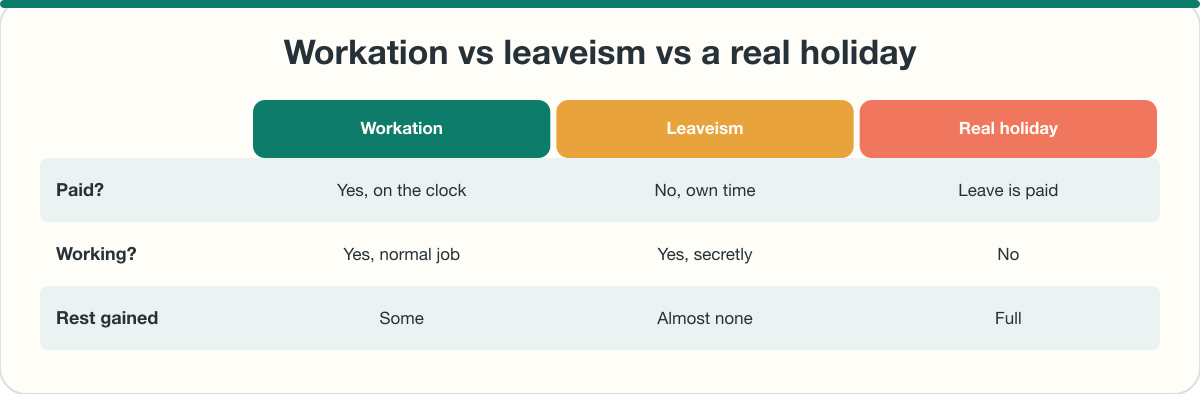 Here is where a lot of people quietly go wrong. They call something a workation when it is really its unhealthy cousin: leaveism.
Leaveism is a term coined in 2013 by Dr Ian Hesketh at the University of Manchester. It describes using annual leave or rest days to catch up on work, or working through a genuine holiday because the pile never shrinks. It is the opposite of what leave is for. And it is common. The CIPD's 2023 Health and Wellbeing at Work survey found that around two thirds, roughly 67%, of organisations had observed some form of leaveism.
The line between a workation and leaveism is intent and honesty. On a workation, you are openly working your normal paid hours, everyone knows it, and your rest is protected around those hours. Leaveism is working on time you were supposed to have off, often in secret, often unpaid, because you cannot switch off. A workation done badly slides straight into leaveism: you meant to log off at five and explore, but you are still on your laptop at nine because the holiday brain never kicked in.
A real holiday is different again. You are on formal leave, you are not expected to deliver anything, and the entire point is recovery.
| Workation | Leaveism | A real holiday | |
|---|---|---|---|
| Are you paid? | Yes, normal salary | No, it is your own time | Yes, it is paid leave |
| Are you working? | Yes, your usual hours | Yes, but you should not be | No |
| Is it agreed and open? | Yes, with your employer | No, usually hidden | Yes, booked as leave |
| Does it burn annual leave? | No | It wastes it | Yes, by design |
| Rest gained | Some, around work | None | The whole point |
Read that table and the honest conclusion follows. A workation gives you a change of scene, not a rest. Leaveism gives you neither. Only a genuine holiday, fully switched off, actually refills the tank. Blur the first into the second and you have taken a trip that left you more tired than when you started, which is the trap that catches people who never really learned to close the laptop. If that describes you, the right to disconnect is worth reading before you book anything.
How do you plan a workation that actually works?
A good workation is boring in its logistics and generous in its experience. Sort the dull parts first and the rest takes care of itself.
Agree it with your employer before you book. This is not optional. Get written sign-off on the dates, the working hours you will keep, and how reachable you need to be. Guessing that your manager will be fine with it is how workations turn into awkward conversations.
Sort timezones honestly. A three-hour gap is manageable. An eight-hour gap means either your mornings or your evenings belong to the office, which quietly eats the trip. Before you commit, map your core meetings against local time and decide whether the overlap is livable. If your team runs on a results-focused rhythm rather than fixed hours, a bigger gap is far easier to absorb.
Check tax, legal and right-to-work rules. Working from another country, even for a couple of weeks, can trigger tax questions, visa issues and right-to-work complications for both you and your employer. Short trips are usually low-risk, but longer stays are not. Confirm the position rather than assuming, and never treat a tourist visa as a work permit without checking.
Sort insurance and connectivity. Travel insurance that covers your kit, reliable internet you have verified in advance (not a hotel promise), and a backup connection for the day the wifi dies. A workation lives or dies on whether you can actually join the 10am call.
Ring-fence your working hours, then leave them alone. Decide when you start and stop, and hold that line in both directions. Work the hours you agreed, then genuinely close the laptop. The whole benefit of a workation evaporates if you are half-working all day and never fully present for either the job or the place.
Remote Jobs with a Great Work-Life Balance
Save one to come back to it — it's free.



Separate work time from exploring time. Do not try to sightsee during a meeting or answer emails on a day trip. Batch your work into clean blocks so the rest of the day is truly yours. The people who love their workations are strict about this. The people who resent them are the ones who let the two bleed into each other.
Who are workations right for, and who should skip them?
Workations are not universal, and pretending they suit everyone is how people end up disappointed.
They work best for self-directed people in genuinely remote, output-focused roles, where the company measures what you deliver rather than when you are at your desk. If your work is asynchronous, your team is used to flexibility, and you are disciplined about switching off, a workation can be one of the best perks of remote life.
They work badly for roles that need constant real-time collaboration across a wide timezone gap, jobs that depend on physical presence, and anyone who genuinely struggles to stop working. If you already answer emails on holiday, a workation will not fix that. It will simply give your inability to disconnect a nicer backdrop, which is presenteeism with a suntan.
There is also the honest question of what you actually need. If you are running on empty, a workation is the wrong prescription, because you will still be working. What you need then is real rest, or something bigger, like a micro-retirement, a proper extended break from work rather than a change of desk.
Where reduced hours come in
The best workations happen inside cultures that already respect boundaries. A company that trusts you to work from another country is usually the same company that trusts you to manage your own time, and those tend to be the ones offering four-day weeks, flexible hours and genuinely remote roles.
That is the deeper point. A workation is a patch on a working life that does not give you enough room. When your normal week already has slack in it, a four-day schedule, flexible hours, real switch-off time, you do not need to fly somewhere to feel a bit of freedom. You have it at home, every week.
If that sounds better than chasing a change of scene, browse four-day-week, flexible and remote roles on 4dayweek.io. You can also filter specifically for remote jobs that make a workation realistic in the first place.
Frequently asked questions
Is a workation the same as a holiday? No. On a workation you are working your normal paid hours from a different location, and you are expected to deliver as usual. A holiday is formal leave where you do no work at all. The difference is that a holiday gives you rest, while a workation mainly gives you a change of scene.
Do I get paid during a workation? Yes. You are doing your regular job remotely, so you are paid your normal salary throughout. That is exactly what separates a workation from annual leave, and what separates it from leaveism, where people work through time off for no pay and no recognition.
Can my employer stop me taking a workation? Yes, if the arrangement is not agreed. Working from another location, especially another country, can raise tax, insurance and right-to-work issues for the business, so most employers require sign-off first. Always get the dates, hours and expectations confirmed in writing before you book.
How long should a workation be? There is no fixed rule, but shorter trips carry fewer tax and legal complications, so a few days to a couple of weeks is the common sweet spot. Longer stays need more careful checks on visas, tax residency and insurance. Whatever the length, keep at least some genuinely work-free holiday in your year as well.
Want a job that makes workations, and switching off, genuinely possible? Browse four-day-week, flexible and remote roles on 4dayweek.io.




Get 4-day week jobs in your inbox
Create a free account to receive curated opportunities weekly.
Sign up for freeFree forever. No spam, unsubscribe anytime.