
Zoom did not invent the tiring meeting. But somewhere around 2020, millions of people discovered a new and specific kind of exhaustion: the flat, wrung-out feeling that follows a day spent staring into a grid of faces. It was strange enough, and common enough, to earn its own name.
Zoom fatigue is the particular tiredness that builds up after prolonged video calls. The term is not tied to one app; it covers Teams, Meet, Webex and the rest. It describes the mental drain of hours spent on camera, reading faces through a screen while a small version of your own face stares back.
What is Zoom fatigue?
Zoom fatigue is not ordinary meeting boredom, and it is not simply the tiredness of a long day. It is a distinct load that video calls place on the brain, one that in-person conversation and even a plain phone call largely avoid. People report it as heavy eyes, a foggy head and a reluctance to get on the next call that has nothing to do with the topic.
There is also a compounding quality to it. One 30-minute call rarely does much harm. Six of them back to back, with no gap to stand up or look away, produce a specific end-of-day flatness: you have barely moved, barely spoken to anyone in the room, and yet feel as though you have worked a double shift. That mismatch, high tiredness from low physical effort, is the signature of Zoom fatigue.
For a while the effect was folklore, something everyone felt but nobody had pinned down. Then the research caught up.
Why do video calls tire us more than meeting in person?
In February 2021, Jeremy Bailenson, a communication professor at Stanford and founding director of its Virtual Human Interaction Lab, published a paper that gave the phenomenon a proper explanation. It appeared in the journal Technology, Mind, and Behavior under the title "Nonverbal Overload: A Theoretical Argument for the Causes of Zoom Fatigue".
Bailenson's argument is that video calls are not a neutral window onto a conversation. They distort the normal signals of human interaction in ways the brain finds effortful. In person, you read a room without thinking. On a call, the same act becomes work, and the interface piles on pressures that a face-to-face meeting never would. He set out four distinct causes.
What are the four causes of Zoom fatigue?
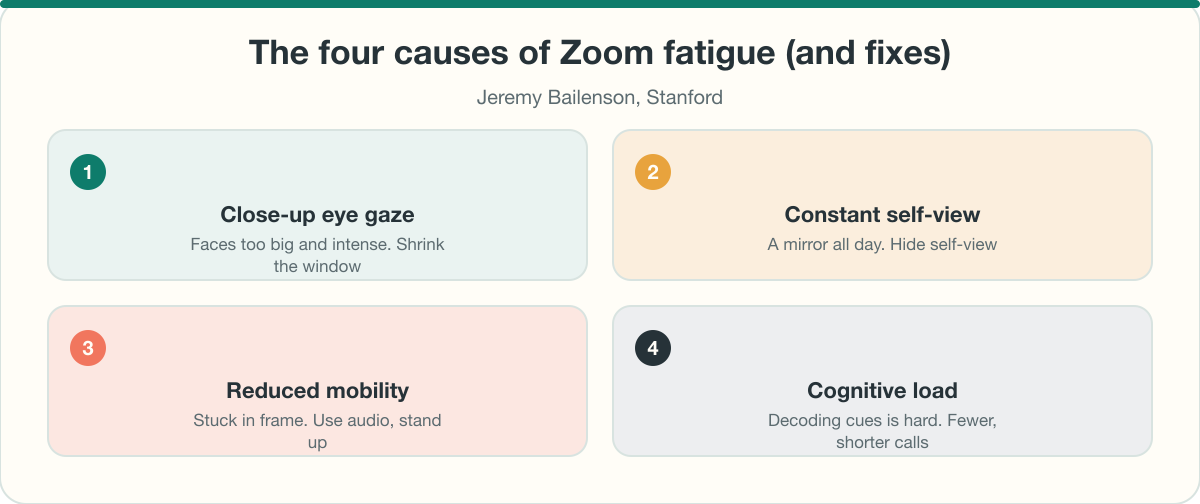 Bailenson breaks the drain into four mechanisms. Usefully, each one points straight at a fix, most of which take seconds to apply.
| Cause (Bailenson, Stanford) | Why it tires you | Practical fix |
|---|---|---|
| Excessive close-up eye contact | A grid of faces stares at you at close range, which the brain reads as intense, the way a stranger standing too close would | Take the window out of full screen, shrink it, and sit further back from the camera |
| Constantly seeing yourself | A live mirror follows you all day, raising self-evaluation and self-consciousness | Hide self-view once you have checked your framing |
| Reduced physical mobility | You must stay boxed in the camera's frame, when phone and in-person talk let you move | Use audio-only or a phone call so you can stand and walk |
| Higher cognitive load | You work harder to send and read nonverbal cues through a screen, so signalling that is normally effortless becomes deliberate | Default suitable meetings to async, and build in real breaks |
Take each in turn.
Excessive eye contact. On a video call, everyone appears to look at you at once, and the faces are often large and close. Bailenson points out that the brain experiences this the way it would a crowd of people standing uncomfortably near, all staring. In a physical meeting, only the current speaker holds the room's gaze, and you can glance down at your notes. On screen, the whole gallery seems to watch. Shrinking the window and moving back turns down the intensity.
Seeing yourself. Most platforms show your own face in real time, all day. Bailenson likens it to being followed by a mirror through every conversation, which no one would tolerate in an office. It quietly raises self-evaluation, and constant self-monitoring is tiring. The fix is trivial: hide self-view once your camera is framed. The other person still sees you; you simply stop policing your own expression.
Reduced mobility. In person or on the phone, people move. They pace, gesture, shift in a chair. Movement helps thinking. A video call pins you inside a rectangle, because stepping out of frame reads as rude or distracting. Bailenson notes that this enforced stillness works against natural cognition. For calls that do not need a screen, going audio-only frees you to stand and walk.
Cognitive load. In a normal conversation, nonverbal cues flow without effort. On video, that machinery jams. You have to work to project that you are listening (exaggerated nods, a fixed gaze at the lens) and work to read cues that arrive flattened and slightly delayed. Bailenson describes this as sending and receiving signals under strain. Multiply it across a day of calls and the mental bill is steep.
What makes the four causes so potent is that they stack. On a single call you can be over-exposed to close-up eyes, watching yourself in the corner, pinned still in frame, and straining to read a flattened room, all at once. None of those pressures exists in a corridor chat or a walk-and-talk phone call. The video window bundles them together and then repeats the bundle, meeting after meeting, until the tank is empty.
Can you measure how much video calls drain you?
The Stanford team went a step further than description. They built a way to measure the effect, the Zoom Exhaustion and Fatigue scale, or ZEF, a questionnaire that gauges how tired a person feels after video calls across several dimensions. It matters because it moves Zoom fatigue from a shared complaint to something an organisation can actually track, and therefore manage. If you cannot measure a problem, it is easy to wave it away as people being soft. A validated scale makes that harder.
It also gives individuals a vocabulary. Instead of vaguely dreading the afternoon block of calls, you can name what is happening and point at the cause. That is the first step to changing anything, at your own desk or across a whole team. Some organisations have begun surveying their people on exactly these dimensions to decide which recurring meetings to keep and which to retire.
Why cutting meetings matters more than tweaking your setup
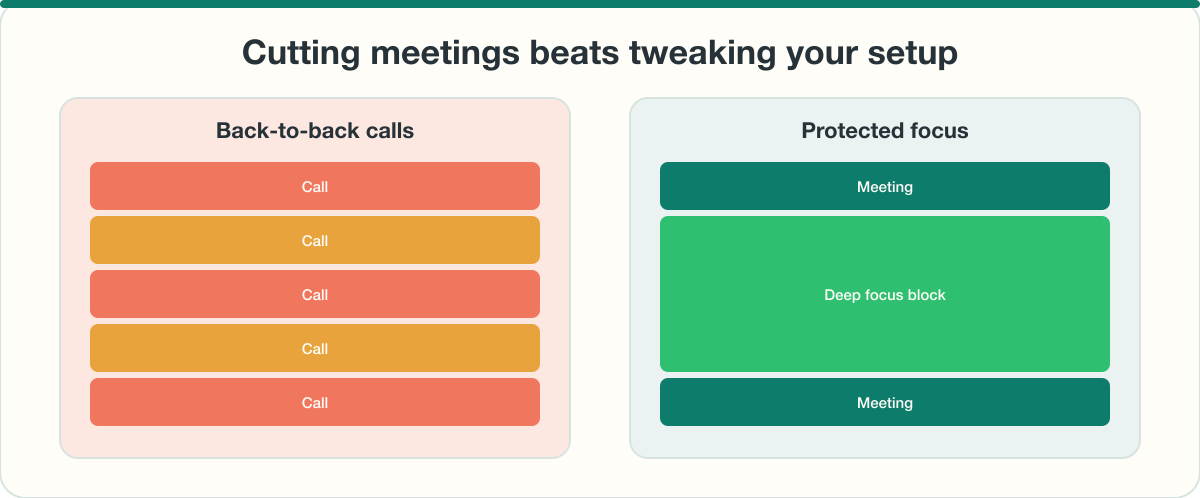 Hiding self-view and sitting back genuinely help. But the honest answer to Zoom fatigue is that most people simply have too many calls. Every fix above shaves the cost of a meeting. None of them questions whether the meeting needed to happen at all.
Remote Jobs with a Great Work-Life Balance
Save one to come back to it — it's free.



Meeting overload has its own logic. A packed calendar can look like importance, the same way constant availability can. Yet a large share of recurring calls could be a short written update, a comment thread or nothing at all. This is the same instinct behind coffee badging, where people show their face in the office briefly to prove presence: the appearance of engagement standing in for the real thing. On video, the equivalent is attending the call to be seen attending, camera on, mind elsewhere.
The cost of that theatre is not spread evenly. The more junior or anxious a person is, the more they feel obliged to keep the camera on, nod along and never drop off, which is exactly the behaviour Bailenson's four causes punish hardest. A meeting culture that treats presence as proof of commitment quietly taxes the people least able to push back.
The way out is cultural, not technical. Teams that default to asynchronous updates reserve real-time calls for the conversations that genuinely need them: a hard decision, a sensitive chat, a proper brainstorm. Everything else becomes a document people read when they surface from focused work. That shift sits at the heart of a results-only work environment, where what you produce counts for more than how many squares you appeared in. It also depends on a healthy right to disconnect, so that cutting meetings does not simply push the work into someone's evening.
There is a deeper link to how the day is structured. A calendar shredded by calls leaves no room for deep work, and the constant hopping between them is its own drain, closely related to the cost of context switching. Protect the blocks between meetings and both problems ease at once.
None of this means video calls are bad. Seeing a colleague's face still carries a warmth that a chat thread cannot, and for a first meeting, a difficult conversation or a genuine group discussion, the richness is worth the cost. The mistake is spending that budget on updates that could have been read in two minutes. Save the camera for the moments that earn it, and the fatigue largely takes care of itself.
This is where reduced-hours work makes the maths concrete. A four-day week strips out a fifth of the available time, so a team cannot carry a calendar wall to wall with low-value calls. The companies that run shorter weeks almost always overhaul meetings first: fewer of them, shorter, and many replaced with writing. Fewer calls is not a nice-to-have in that model. It is the precondition that makes the whole thing work, and it happens to be one of the surest cures for Zoom fatigue.
Frequently asked questions
Is Zoom fatigue a real medical condition? It is not a formal diagnosis, but it is a well-described and researched effect. Stanford's Jeremy Bailenson laid out its causes in a 2021 paper, and his team built the Zoom Exhaustion and Fatigue scale to measure it. The tiredness is real, consistent across people and traceable to specific features of video calls.
Why is a phone call less tiring than a video call? A phone call removes three of Bailenson's four causes at a stroke. There is no close-up gallery of eyes, no live image of your own face, and you are free to move around while you talk. You also stop straining to perform and decode visual cues. For many one-to-one conversations, audio only is the calmer and more efficient choice.
Does turning my camera off help? It can, because it removes the self-view mirror and eases the pressure to perform attention. If your workplace expects cameras on, hiding just your own self-view is a good middle ground: others still see you, but you stop monitoring yourself. Reserving cameras for meetings that truly benefit from them is better still.
How many video meetings is too many? There is no single number, but a useful test is whether you still have unbroken time to do focused work. If calls have carved your day into fragments with no deep block left, you have too many, regardless of the count. The goal is not zero meetings; it is protecting the space between them.
Want a job that trusts you to do great work without living on camera? Explore reduced-hours and four-day-week roles, including plenty of remote positions built around focus rather than face time.
Fewer, better meetings, and a working week with room to breathe.




Get 4-day week jobs in your inbox
Create a free account to receive curated opportunities weekly.
Sign up for freeFree forever. No spam, unsubscribe anytime.