
Plenty of experienced leaders no longer want a single full-time job, and plenty of small companies cannot justify a full-time salary for a senior specialist. Fractional work sits neatly between the two, and it has quietly become one of the most interesting flexible-career models around.
Fractional work means an experienced professional works part-time, on an ongoing basis, for one or several companies, usually in a senior or leadership role such as a fractional CFO, CMO or CTO. It is an embedded part-time job, not a one-off project.
What is fractional work?
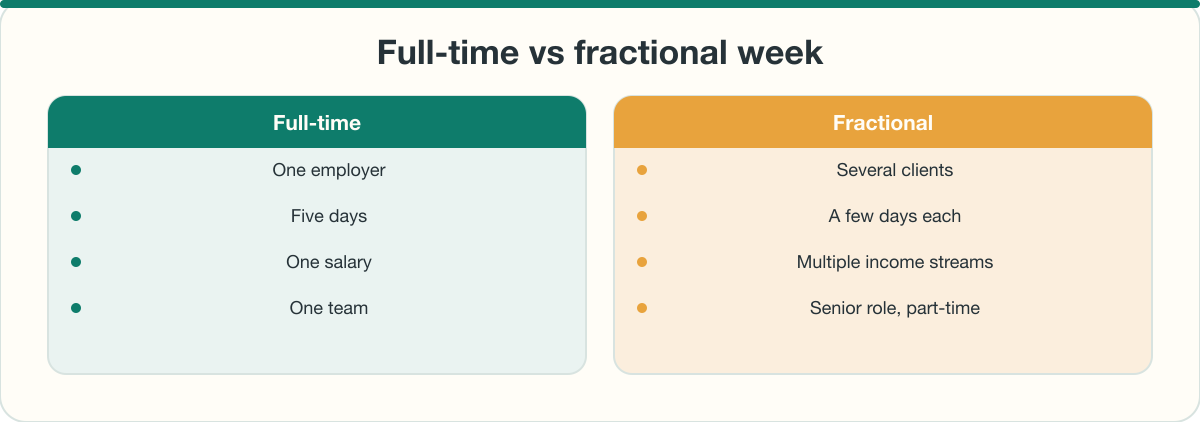
The word "fractional" refers to the fraction of a full-time role you take on. Instead of one person doing a job five days a week, a fractional hire might do it two days a week, indefinitely, while the same person does something similar for another company on the other days.
The roles that go fractional tend to be senior. A growing business often needs the judgement of a finance chief, a marketing lead or a head of people long before it can fill, or afford, a full-time seat. A fractional CFO builds the financial model, sets up reporting and sits in on board meetings. A fractional CMO owns the marketing strategy and hires the junior team. A fractional CTO makes the architecture calls and mentors the engineers. In each case the person is genuinely part of the company. They join the leadership meetings, they carry a company email address, they own outcomes. They simply do it in fewer hours than a full-time equivalent.
That "part of the team" quality is what separates fractional work from a favour or a quick piece of advice. A fractional leader is accountable for results over months and years, not for a single deliverable.
The arrangement usually settles into a rhythm. A fractional CFO might block Mondays and Tuesdays for one client and Wednesdays for another, with a standing slot in each company's leadership meeting so nothing drifts. The days are fewer, but the responsibility is real, and colleagues quickly stop thinking of a good fractional leader as an outsider.
How is fractional work different from consulting and full-time employment?
People use "fractional", "consultant", "contractor" and "freelancer" loosely, and the lines do blur. The useful distinction is about ongoing embeddedness and scope.
A consultant is usually brought in to solve a defined problem or deliver a specific project, then leave. A contractor fills a role for a fixed period, often full-time, then moves on. A fractional leader stays, part-time and ongoing, and owns a function rather than a task. A full-time employee does all of that at full hours with a salary and benefits.
Here is how the models compare.
| Feature | Fractional leader | Consultant / contractor | Full-time employee |
|---|---|---|---|
| Time commitment | Part-time, ongoing | Project or fixed term | Full-time |
| Relationship | Embedded team member | External adviser | Employed staff |
| Scope | Owns a function | Solves a defined problem | Owns a function |
| Pay model | Day rate or monthly retainer | Project fee or day rate | Salary |
| Benefits | Self-arranged | Self-arranged | Employer-provided |
| Typical seniority | Senior / leadership | Varies | Any level |
| Works for | One or several firms | Several clients | One employer |
The row that matters most is "relationship". A fractional leader shows up on the org chart, has a direct report or two, and is treated as staff who happen to work fewer days. That ongoing, inside-the-tent position is the whole point.
Why is fractional work growing?
 Two shifts made fractional work far more common than it was a decade ago.
The first is remote work. Once senior roles could be done well from anywhere, a finance leader in Manchester could serve a startup in London and another in Bristol without moving house or spending half the week on trains. Splitting your week across two or three companies only works when you are not tied to one office, so the normalisation of remote and hybrid work removed the main practical barrier.
The second is the rise of startups and small firms that need senior thinking on a small budget. A company with twenty staff often has real strategic problems, a fundraising round to prepare, a brand to build, a platform to scale, but nowhere near enough work or money to justify a full-time director on a six-figure salary. Fractional hiring lets that company buy a slice of exactly the seniority it needs.
Put those together and you get a market that suits both sides. Companies get senior expertise affordably and can scale the arrangement up or down. Professionals get flexibility, variety and, because the work is senior and specialised, often strong day rates. The model rewards people who care more about interesting problems and control over their week than about a single big title.
What are the pros and cons of fractional work?
 Fractional work is genuinely appealing, but it is self-employment, and that comes with trade-offs worth naming plainly.
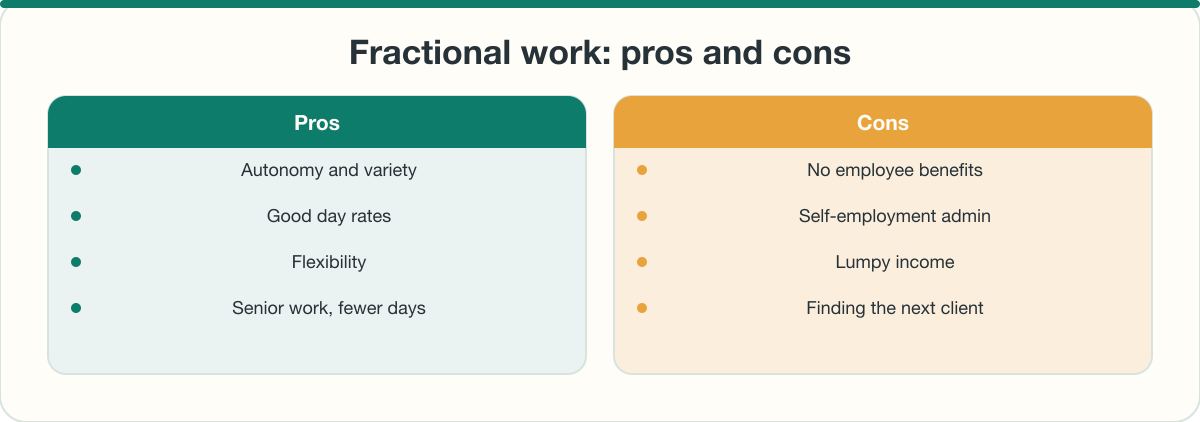
On the upside, you get autonomy. You choose your clients, shape your week and usually work remotely. You get variety, because two or three companies in different sectors keep the work fresh and make you better at your craft. The income can be strong, since senior day rates add up and you are not capped by one salary band. And you spread your risk. If one client ends the arrangement, you still have the others, which can feel more secure than having all your income tied to a single employer.
On the downside, you carry the load of running a business. There is no employer handling your pension, paid holiday, sick pay or health cover, so you fund those yourself and price them into your rates. There is admin: invoicing, tax, contracts and chasing late payments. Income can be lumpy, especially early on before you have a stable roster of clients. Juggling several companies takes real discipline and clear boundaries, or the "part-time" days quietly expand. And you can feel less deeply rooted in any one company than a full-time colleague would.
None of this is a reason to avoid fractional work. It is a reason to go in with your eyes open, charge properly and treat it as a business rather than a series of favours.
Who does fractional work suit?
Fractional work rewards experience. It suits people who have already done the senior job at full-time scale and can now walk into a company and add value quickly, without a long ramp-up. That usually means specialists and leaders with a strong track record: finance directors, marketing leaders, technologists, operations and people chiefs, and senior functional experts of many kinds.
Remote Jobs with a Great Work-Life Balance
Save one to come back to it — it's free.



It suits people who want flexibility and control over their time, perhaps parents, perhaps those easing toward the end of a long career, perhaps anyone who simply does not want one job to swallow every week. Many fractional professionals combine several fractional roles into a broader portfolio career, where the mix of clients and projects is the whole design rather than a stopgap.
It suits self-starters. The people who thrive are comfortable selling their services, managing their own time and being judged on outcomes rather than hours logged. That last point is why fractional work fits so naturally into a results-only work environment, where what you deliver matters more than when or where you sit.
If you need a lot of structure, prefer a single clear boss and value the security of an employment contract, a fractional model may feel exposed. If you value autonomy and can create your own structure, it can be the best work of your career.
How do you get into fractional work?
Most people move into fractional work from a full-time senior role rather than starting cold. A sensible path looks like this.
Start by defining your offer. Be specific about the function you own and the kind of company you serve best, for example "fractional finance lead for seed-stage software companies". A sharp niche is easier to sell than a vague "I can help with anything".
Line up a first client before you leap, if you can. Often that is a former employer, a company in your network or a founder who already trusts your judgement. One anchor client covering a meaningful chunk of your income makes the transition far less frightening.
Price for the reality of self-employment. Your day rate has to cover the holiday, pension, downtime and admin that an employer used to fund, so it should sit well above the daily equivalent of your old salary. Getting comfortable with those conversations matters, and it is worth reading up on how to negotiate your rate before you quote.
Then add strands carefully. Once your first arrangement is stable, take on a second company, then perhaps a third, until your week is full at a level you enjoy. Protect your boundaries as you go, because the biggest risk is letting three "two-day" roles quietly become a stressful six-day week.
Finally, keep marketing gently even when you are busy. Fractional work runs on relationships and referrals, so staying visible in your field is what keeps the pipeline healthy between clients.
Frequently asked questions
Is fractional work the same as part-time work? It is a form of part-time work, but a specific one. Fractional roles are senior, ongoing and usually self-employed, and one person often holds several at once. A standard part-time job is typically a single employed role at reduced hours. The hours are similar; the structure and seniority are not.
How many clients does a fractional professional usually have? It varies. Some people serve one company two or three days a week and keep the rest of their time free. Others build a roster of three or four clients at a day or two each. The right number depends on how full you want your week and how much variety you enjoy.
Do fractional workers get employee benefits? Usually not. Because fractional professionals are self-employed, they arrange and fund their own pension, holiday and insurance, and they price that into their day rates. That independence is part of the trade-off for the flexibility and higher rates the model can offer.
Can fractional work be done remotely? Very often, yes. Remote and hybrid working is a big reason the model took off, because it lets one person serve companies in different cities without commuting to each. Many fractional roles are advertised as remote or flexible from the outset.
Fractional work is, at heart, reduced-hours work for experienced people who would rather own their week than hand it to one employer. If that sounds like the way you want to work, browse flexible and reduced-hours roles on 4dayweek.io and start building a working life that fits around your life.
Ready to work on your own terms? Explore flexible, remote and reduced-hours jobs and find your next role.




Get 4-day week jobs in your inbox
Create a free account to receive curated opportunities weekly.
Sign up for freeFree forever. No spam, unsubscribe anytime.